Recognition: unknown
Operational criterion for Wigner function negativity
Pith reviewed 2026-05-10 00:38 UTC · model grok-4.3
The pith
A quantum state has a positive Wigner function if it contains no coherent superpositions in the coherent-state basis.
A machine-rendered reading of the paper's core claim, the machinery that carries it, and where it could break.
Core claim
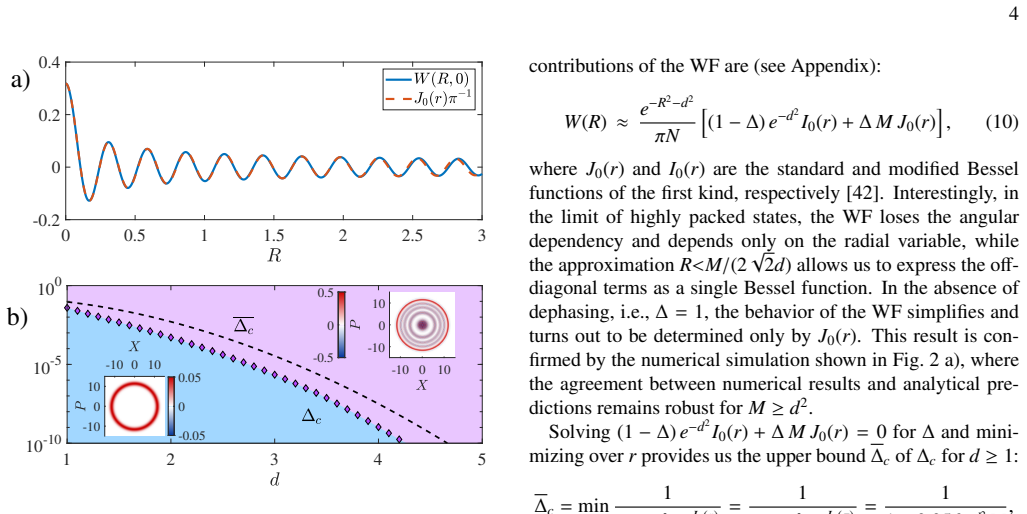
The absence of coherent superpositions in the coherent-state basis constitutes a sufficient condition for the positivity of the Wigner function for an arbitrary quantum state. This condition is both necessary and sufficient for Schrödinger-cat states in full generality, and it is necessary for the positivity of the Wigner function of higher-order cat states on a circle when the number of coherent states becomes large and they are densely packed.
What carries the argument
The operational criterion realized by quantum non-demolition measurements in the coherent-state basis, which directly detects the presence or absence of coherent superpositions and thereby determines the sign of the Wigner function.
If this is right
- Any quantum state lacking coherent superpositions in the coherent-state basis must have a non-negative Wigner function.
- For Schrödinger-cat states the Wigner function is positive if and only if the state contains no coherent superpositions.
- For higher-order cat states on a circle the Wigner function becomes positive in the limit of densely packed coherent states when superpositions are absent.
- The sign of the Wigner function becomes accessible through direct, experimentally realizable non-demolition measurements without requiring full tomography.
Where Pith is reading between the lines
- The criterion suggests that experiments can test for Wigner negativity by checking only for the presence of superpositions rather than reconstructing the full quasiprobability distribution.
- The coherent-state basis acquires a distinguished role for determining Wigner-function properties that may extend to related phase-space distributions.
- States engineered to avoid superpositions in this basis are expected to behave classically in the sense of positive Wigner functions.
Load-bearing premise
Quantum non-demolition measurements in the coherent-state basis can be performed to access the sign of the Wigner function for arbitrary states without state-dependent post-selection or additional assumptions that would limit the criterion.
What would settle it
An experimental preparation of an arbitrary quantum state with no coherent superpositions in the coherent basis whose Wigner function is nevertheless measured to take negative values in some region of phase space.
Figures

read the original abstract
We introduce an operational criterion to identify Wigner function (WF) negativity for an arbitrary quantum state within the framework of quantum non-demolition measurements. This criterion corresponds to experimentally accessible schemes that enable a direct measurement of the WF, and establishes the coherent-state basis as a privileged basis for determining when the WF exhibits negative regions. We show that the absence (presence) of coherent superpositions in the coherent-state basis provides direct information about the positivity (negativity) of the WF. In particular, the absence of such superpositions constitutes a sufficient condition for WF positivity. Although a general proof of necessity remains elusive, we demonstrate that this condition is also necessary in two relevant cases: Schr\"{o}dinger-cat states and higher-order cat states on a circle. More precisely, for Schr\"{o}dinger-cat states we establish a necessary and sufficient condition for the positivity of the WF in full generality, whereas for high-order cat states on a circle we derive an analogous condition in the limit of a large number of densely packed coherent states.
Editorial analysis
A structured set of objections, weighed in public.
Referee Report
Summary. The paper proposes an operational criterion for detecting Wigner function (WF) negativity in arbitrary quantum states using quantum non-demolition (QND) measurements in the coherent-state basis. It establishes that the absence of coherent superpositions in this basis is a sufficient condition for WF positivity in general. Necessity is proven for Schrödinger-cat states (necessary and sufficient) and for higher-order cat states on a circle in the large-N limit, but a general necessity proof is stated to be elusive. The criterion is framed as directly linking the presence/absence of such superpositions to WF negativity/positivity via experimentally accessible QND schemes.
Significance. If the sufficient condition and the specific-case necessity results hold, the work provides a concrete link between coherent-state superpositions and WF negativity that could enable direct experimental probes of nonclassicality without full state tomography. The proofs for cat states and the large-N circle states are technically useful for those families. However, the absence of a general necessity result limits the operational utility for certifying negativity in arbitrary states, reducing the overall impact relative to a bidirectional criterion.
major comments (2)
- [Abstract] Abstract: The claim of an 'operational criterion to identify Wigner function negativity' for arbitrary states is not fully supported, because the paper explicitly notes that a general proof of necessity (presence of coherent superpositions implying WF negativity) remains elusive and is only demonstrated for Schrödinger-cat states and higher-order cat states on a circle. This makes the criterion sufficient for positivity but only partially operational for detecting negativity in full generality.
- [Abstract] Abstract and introduction (implied QND scheme): The operational claim assumes that QND measurements in the coherent-state basis can be implemented to access WF sign directly for arbitrary states without state-dependent post-selection or additional assumptions that would invalidate the measurement for general cases. This assumption is load-bearing for the 'direct measurement' aspect but is not shown to hold universally.
minor comments (2)
- [Abstract] Abstract: The phrasing 'establishes the coherent-state basis as a privileged basis' could be clarified to specify in what sense it is privileged (e.g., for this particular criterion) to avoid overstatement.
- [Abstract] Abstract: Typographical rendering of 'Schrödinger' with escaped quotes should be standardized in the final version.
Simulated Author's Rebuttal
We thank the referee for their careful reading and constructive comments, which help clarify the scope of our results. We agree that the abstract requires revision to avoid overstating the generality of the necessity direction. Our responses to the major comments are provided below, along with planned changes to the manuscript.
read point-by-point responses
-
Referee: [Abstract] Abstract: The claim of an 'operational criterion to identify Wigner function negativity' for arbitrary states is not fully supported, because the paper explicitly notes that a general proof of necessity (presence of coherent superpositions implying WF negativity) remains elusive and is only demonstrated for Schrödinger-cat states and higher-order cat states on a circle. This makes the criterion sufficient for positivity but only partially operational for detecting negativity in full generality.
Authors: We acknowledge that the current abstract phrasing may suggest a fully bidirectional operational criterion for arbitrary states, whereas the manuscript already states that necessity holds only for the specified families. The sufficient condition (absence of coherent superpositions implies WF positivity) is general and directly operational via QND measurements. For detecting negativity, the criterion is operational precisely in the cases where necessity is proven. We will revise the abstract to state explicitly that the criterion is sufficient for positivity in general and necessary and sufficient for Schrödinger-cat states (and in the large-N limit for higher-order cat states on a circle). This change aligns the abstract with the body of the paper without altering the technical claims. revision: yes
-
Referee: [Abstract] Abstract and introduction (implied QND scheme): The operational claim assumes that QND measurements in the coherent-state basis can be implemented to access WF sign directly for arbitrary states without state-dependent post-selection or additional assumptions that would invalidate the measurement for general cases. This assumption is load-bearing for the 'direct measurement' aspect but is not shown to hold universally.
Authors: The QND framework is invoked to render the criterion experimentally accessible by connecting the presence or absence of coherent-state superpositions to measurable outcomes, without requiring full tomography. While a universal, state-independent experimental protocol is not derived in the manuscript (as the focus is on the theoretical link), existing QND techniques for coherent-state projections are referenced as the basis for feasibility. We will add a clarifying paragraph in the introduction that discusses the assumptions, notes that implementations may require state-specific adaptations, and cites relevant experimental literature on QND measurements in the coherent-state basis. This addresses the concern without claiming universality of the experimental scheme. revision: partial
Circularity Check
No circularity: sufficient condition derived from standard QND framework; necessity acknowledged as partial and non-general.
full rationale
The paper's core derivation establishes that absence of coherent superpositions in the coherent-state basis is a sufficient condition for WF positivity via operational QND measurements, with explicit proofs supplied for Schrödinger-cat states (necessary and sufficient) and high-order cat states on a circle (large-N limit). It openly states that a general necessity proof remains elusive, avoiding any claim of full equivalence. No self-definitional loops, fitted parameters renamed as predictions, load-bearing self-citations, or ansatz smuggling appear in the provided derivation chain; the criterion rests on standard quantum measurement theory applied to specific state classes without reducing to its own inputs by construction.
Axiom & Free-Parameter Ledger
axioms (1)
- standard math Standard quantum mechanics including definition of Wigner function and quantum non-demolition measurements
Reference graph
Works this paper leans on
-
[1]
M. Arndt, O. Nairz, J. V os-Andreae, C. Keller, G. van der Zouw, and A. Zeilinger, Nature401, 680 (1999), URLhttps://doi.org/ 10.1038/44348
-
[2]
S. Gerlich, S. Eibenberger, M. Tomandl, S. Nimmrichter, K. Hornberger, P. J. Fagan, J. T ¨uxen, M. Mayor, and M. Arndt, Nature Com- munications2, 263 (2011), URLhttps://doi.org/10.1038/ncomms1263
-
[3]
M. Aspelmeyer,When Zeh Meets Feynman: How to Avoid the Appearance of a Classical World in Gravity Experiments(Springer Inter- national Publishing, Cham, 2022), pp. 85–95, ISBN 978-3-030-88781-0, URLhttps://doi.org/10.1007/978-3-030-88781-0_5
-
[4]
T. M. Fuchs, D. G. Uitenbroek, J. Plugge, N. van Halteren, J.-P. van Soest, A. Vinante, H. Ulbricht, and T. H. Oosterkamp, Science Advances10, 1 (2024), URLhttps://doi.org/10.1126/sciadv.adk2949
-
[5]
S. Pedalino, B. E. Ram ´ırez-Galindo, R. Ferstl, K. Hornberger, M. Arndt, and S. Gerlich, Nature649, 866 (2026), URLhttps://doi. org/10.1038/s41586-025-09917-9
-
[6]
M. A. Nielsen and I. L. Chuang,Quantum computation and quantum information(Cambridge University Press, Cambridge, UK, 2010)
2010
-
[7]
J. S. Bell, Physics Physique Fizika1, 195 (1964), URLhttps://link.aps.org/doi/10.1103/PhysicsPhysiqueFizika.1.195
-
[8]
A. J. Leggett and A. Garg, Phys. Rev. Lett.54, 857 (1985), URLhttps://link.aps.org/doi/10.1103/PhysRevLett.54.857
-
[9]
Emary, N
C. Emary, N. Lambert, and F. Nori, Reports on Progress in Physics77, 016001 (2013), URLhttps://dx.doi.org/10.1088/ 0034-4885/77/1/016001
2013
-
[10]
On the quantum correction for thermodynamic equ ilibrium,
E. Wigner, Phys. Rev.40, 749 (1932), URLhttps://link.aps.org/doi/10.1103/PhysRev.40.749
-
[11]
M. Hillery, R. O’Connell, M. Scully, and E. Wigner, Physics Reports106, 121 (1984), ISSN 0370-1573, URLhttps://www. sciencedirect.com/science/article/pii/0370157384901601
-
[12]
S. Gherardini and G. De Chiara, PRX Quantum5, 030201 (2024), URLhttps://link.aps.org/doi/10.1103/PRXQuantum.5. 030201
-
[13]
R. Hudson, Reports on Mathematical Physics6, 249 (1974), ISSN 0034-4877, URLhttps://www.sciencedirect.com/science/ article/pii/003448777490007X
-
[14]
R. J. Glauber, Phys. Rev.131, 2766 (1963), URLhttps://link.aps.org/doi/10.1103/PhysRev.131.2766
-
[15]
E. C. G. Sudarshan, Phys. Rev. Lett.10, 277 (1963), URLhttps://link.aps.org/doi/10.1103/PhysRevLett.10.277
-
[16]
J. Klauder and B. Skagerstam,Coherent States(World Scientific, 1985), https://www.worldscientific.com/doi/pdf/10.1142/0096, URL https://www.worldscientific.com/doi/abs/10.1142/0096. 8
-
[18]
K. S. Thorne, R. W. P. Drever, C. M. Caves, M. Zimmermann, and V . D. Sandberg, Phys. Rev. Lett.40, 667 (1978), URLhttps: //link.aps.org/doi/10.1103/PhysRevLett.40.667
-
[19]
V . B. Braginsky, Y . I. V orontsov, and K. S. Thorne, Science209, 547 (1980), https://www.science.org/doi/pdf/10.1126/science.209.4456.547, URLhttps://www.science.org/doi/abs/10.1126/science.209.4456.547
-
[20]
V . B. Braginski, F. Y . Khalili, and K. S. Thorne,Quantum measurement(Cambridge University Press, Cambridge [England], 1992), ISBN 052141928X
1992
-
[21]
C. M. Caves, Phys. Rev. Lett.45, 75 (1980), URLhttps://link.aps.org/doi/10.1103/PhysRevLett.45.75
-
[22]
C. M. Caves, K. S. Thorne, R. W. P. Drever, V . D. Sandberg, and M. Zimmermann, Rev. Mod. Phys.52, 341 (1980), URLhttps: //link.aps.org/doi/10.1103/RevModPhys.52.341
-
[23]
Guerlin, J
C. Guerlin, J. Bernu, S. Del ´eglise, C. Sayrin, S. Gleyzes, S. Kuhr, M. Brune, J.-M. Raimond, and S. Haroche, Nature448, 889 (2007), URLhttps://www.nature.com/articles/nature06057
2007
-
[24]
Reconstruction of non -classical cavity field states with snapshots of their decoherence,
S. Del ´eglise, I. Dotsenko, C. Sayrin, J. Bernu, M. Brune, J.-M. Raimond, and S. Haroche, Nature455, 510 (2008), URLhttps: //doi.org/10.1038/nature07288
-
[25]
P. Solinas and S. Gasparinetti, Phys. Rev. E92, 042150 (2015), URLhttp://link.aps.org/doi/10.1103/PhysRevE.92.042150
-
[27]
Fowler, Matteo Mariantoni, John M
P. Solinas, M. Amico, and N. Zangh `ı, Phys. Rev. A105, 032606 (2022), URLhttps://link.aps.org/doi/10.1103/PhysRevA. 105.032606
-
[28]
P. Solinas and S. Gherardini, Phys. Rev. A111, 052217 (2025), URLhttps://link.aps.org/doi/10.1103/PhysRevA.111. 052217
-
[29]
P. Solinas and S. Gherardini, Advances in Physics: X11, 2637832 (2026), URLhttps://www.tandfonline.com/doi/full/10. 1080/23746149.2026.2637832
-
[30]
L. Di ´osi and C. Kiefer, Phys. Rev. Lett.85, 3552 (2000), URLhttps://link.aps.org/doi/10.1103/PhysRevLett.85.3552
-
[31]
Di ´osi and C
L. Di ´osi and C. Kiefer, Journal of Physics A: Mathematical and General35, 2675 (2002), URLhttps://doi.org/10.1088/ 0305-4470/35/11/312
2002
-
[32]
D. C. Brody, E.-M. Graefe, and R. Melanathuru, Phys. Rev. Lett.134, 120201 (2025), URLhttps://link.aps.org/doi/10.1103/ PhysRevLett.134.120201
2025
-
[33]
D. D. Sedov, V . K. Kozin, and I. V . Iorsh, Phys. Rev. Lett.125, 263606 (2020), URLhttps://link.aps.org/doi/10.1103/ PhysRevLett.125.263606
2020
-
[34]
A. Serafini, S. D. Siena, F. Illuminati, and M. G. A. Paris, Journal of Optics B: Quantum and Semiclassical Optics6, S591 (2004), URL https://doi.org/10.1088/1464-4266/6/6/019
-
[35]
Vlastakis, G
B. Vlastakis, G. Kirchmair, Z. Leghtas, S. E. Nigg, L. Frunzio, S. M. Girvin, M. Mirrahimi, M. H. Devoret, and R. J. Schoelkopf, Science342, 607 (2013), http://www.sciencemag.org/content/342/6158/607.full.pdf, URLhttp://www.sciencemag.org/content/ 342/6158/607.abstract
2013
-
[36]
V . F. Maisi, D. Kambly, C. Flindt, and J. P. Pekola, Phys. Rev. Lett.112, 036801 (2014), URLhttps://link.aps.org/doi/10.1103/ PhysRevLett.112.036801
2014
-
[37]
A. V . Lebedev, G. B. Lesovik, and G. Blatter, Phys. Rev. B93, 115140 (2016), URLhttps://link.aps.org/doi/10.1103/ PhysRevB.93.115140
2016
-
[38]
A. S. Holevo,Probabilistic and Statistical Aspects of Quantum Theory(North-Holland Publishing Company, Amsterdam/New York, 1982), ISBN 0444863338
1982
-
[39]
Kraus,States, Effects, and Operations: Fundamental Notions of Quantum Theory, vol
K. Kraus,States, Effects, and Operations: Fundamental Notions of Quantum Theory, vol. 190 ofLecture Notes in Physics(Springer- Verlag, Berlin/Heidelberg, 1983), ISBN 978-3-540-12732-1
1983
-
[40]
Quantum equilibrium and the origin of absolute uncertainty
D. D ¨urr, S. Goldstein, and N. Zangh `ı, Journal of Statistical Physics67, 843 (1992), URLhttps://link.springer.com/article/ 10.1007/BF01049004
-
[41]
Peres,Quantum Theory: Concepts and Methods(Kluwer Academic Publishers, Dordrecht, The Netherlands, 1993), ISBN 0792325494
A. Peres,Quantum Theory: Concepts and Methods(Kluwer Academic Publishers, Dordrecht, The Netherlands, 1993), ISBN 0792325494
1993
-
[42]
Abramowitz and I
M. Abramowitz and I. A. Stegun,Handbook of Mathematical Functions with Formulas, Graphs, and Mathematical Tables(Dover, New York, 1964), ninth dover printing, tenth gpo printing ed
1964
-
[43]
J. Geremia, J. K. Stockton, A. C. Doherty, and H. Mabuchi, Phys. Rev. Lett.91, 250801 (2003), URLhttps://link.aps.org/doi/ 10.1103/PhysRevLett.91.250801
-
[44]
Niemietz, P
D. Niemietz, P. Farrera, S. Langenfeld, and G. Rempe, Nature591, 570 (2021), URLhttps://www.nature.com/articles/ s41586-021-03290-z
2021
-
[45]
R. Yanagimoto, R. Nehra, R. Hamerly, E. Ng, A. Marandi, and H. Mabuchi, PRX Quantum4, 010333 (2023), URLhttps://link. aps.org/doi/10.1103/PRXQuantum.4.010333
-
[46]
Y . Mu, J. Seberry, and Y . Zheng, Optics Communications123, 344 (1996)
1996
-
[47]
S. L. Braunstein and P. van Loock, Rev. Mod. Phys.77, 513 (2005), URLhttps://link.aps.org/doi/10.1103/RevModPhys.77. 513
-
[48]
Weedbrooket al., Gaussian quantum in- formation, Rev
C. Weedbrook, S. Pirandola, R. Garc´ıa-Patr´on, N. J. Cerf, T. C. Ralph, J. H. Shapiro, and S. Lloyd, Rev. Mod. Phys.84, 621 (2012), URL https://link.aps.org/doi/10.1103/RevModPhys.84.621
-
[49]
Adesso, S
G. Adesso, S. Ragy, and A. R. Lee, Open Systems & Information Dynamics21, 1440001 (2014)
2014
-
[50]
P. Solinas and S. Gasparinetti, Phys. Rev. A94, 052103 (2016), URLhttps://link.aps.org/doi/10.1103/PhysRevA.94.052103
discussion (0)
Sign in with ORCID, Apple, or X to comment. Anyone can read and Pith papers without signing in.