Recognition: unknown
A Rocq Formalization of Simplicial Lagrange Finite Elements
Pith reviewed 2026-05-09 23:27 UTC · model grok-4.3
The pith
The paper defines a finite element as a Rocq record and instantiates it with simplicial Lagrange elements of any dimension and degree, proving unisolvence.
A machine-rendered reading of the paper's core claim, the machinery that carries it, and where it could break.
Core claim
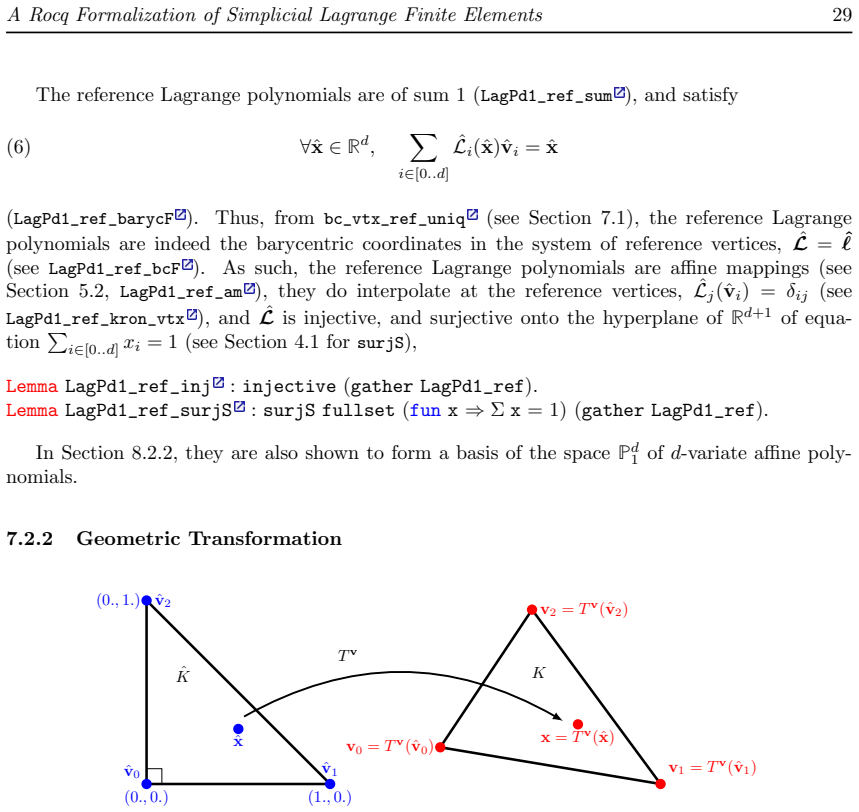
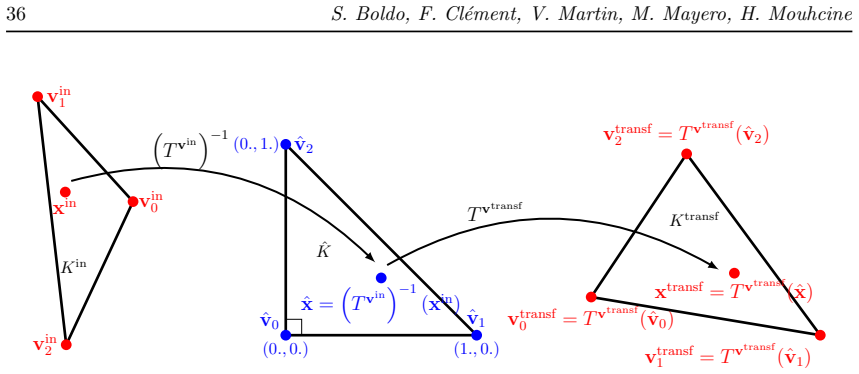
A finite element is defined in Rocq as a record that includes the cell geometry, the polynomial approximation space, and a set of linear forms, together with proofs that the space has the correct dimension and that the forms are unisolvent. The record is instantiated with simplicial Lagrange finite elements for any dimension and degree, with the unisolvence proof included.
What carries the argument
The Rocq record for a finite element, which packages the cell vertices, the polynomial space, the degrees of freedom, and the validity proofs including unisolvence.
If this is right
- The formal definition ensures that the Lagrange elements satisfy all mathematical requirements for any dimension and degree.
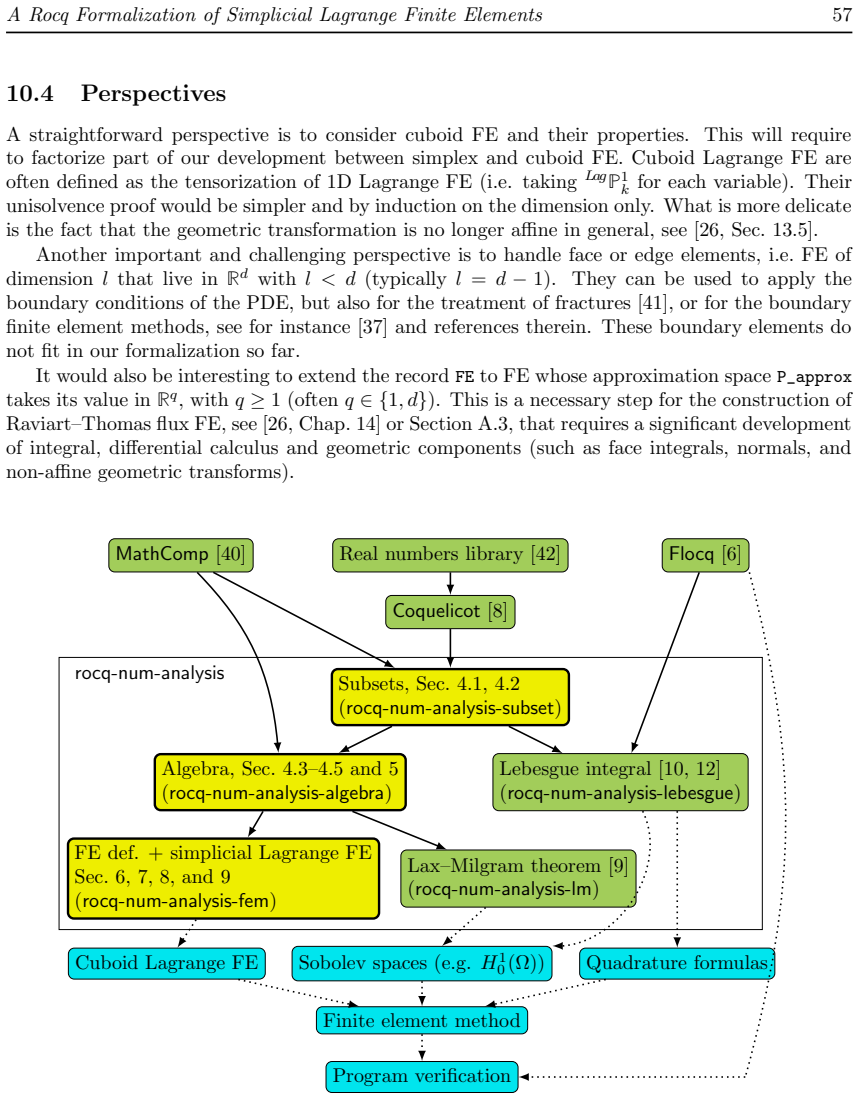
- Supporting results on polynomials in finite and infinite-dimensional spaces are available as reusable Rocq components.
- The unisolvence property is established even for the general case, which is noted as difficult.
- This provides a basis for proving properties of finite element methods in a proof assistant.
Where Pith is reading between the lines
- This formalization advances the goal of proving correctness of scientific computing programs using the finite element method.
- The lemmas developed can support formal proofs of other aspects of numerical analysis.
- Generalization to non-simplicial elements or different node distributions would build directly on the record structure.
- Once local cells are formalized, global mesh assembly and solution procedures become amenable to formal verification.
Load-bearing premise
The Rocq record definitions and supporting lemmas about polynomials and affine spaces accurately capture the intended mathematical concepts of finite elements.
What would settle it
For a specific simplex in dimension 2 with polynomial degree 1, the formalized linear forms would fail to be unisolvent if the proof does not establish that any polynomial vanishing on all nodes is the zero polynomial.
Figures






read the original abstract
Formalization of mathematics is a major topic, that includes in particular numerical analysis, towards proofs of scientific computing programs. The present study is about the finite element method, a popular method to numerically solve partial differential equations. In the long-term goal of proving its correctness, we focus here on the formal definition of what is a finite element. Mathematically, a finite element describes what happens in a cell of a mesh. It notably includes the geometry of the cell, the polynomial approximation space, and a finite set of linear forms that computationally characterizes the polynomials. Formally, we design a finite element as a record in the Rocq proof assistant with both values (such as the vertices of the cell) and proofs of validity (such as the dimension of the approximation space). The decisive validity proof is unisolvence, that makes the previous characterization unique. We then instantiate this record with the most popular and useful, the simplicial Lagrange finite elements for evenly distributed nodes, for any dimension and any polynomial degree, including the difficult unisolvence proof. These proofs require many results (definitions, lemmas, canonical structures) about finite families, affine spaces, multivariate polynomials, in the context of finite or infinite-dimensional spaces.
Editorial analysis
A structured set of objections, weighed in public.
Referee Report
Summary. The paper presents a formalization in the Rocq proof assistant of finite elements as records containing geometric data, polynomial approximation spaces, and degrees of freedom with associated validity proofs, including the crucial unisolvence property. It specializes this to simplicial Lagrange finite elements with evenly distributed nodes, providing the construction and unisolvence proof for arbitrary dimensions and polynomial degrees, along with supporting mathematical libraries for finite families, affine spaces, and multivariate polynomials.
Significance. If the formalization is correct, this work is significant as it provides a machine-checked foundation for the finite element method, which is essential for proving the correctness of numerical solvers for PDEs. The generality to any dimension and degree, with the difficult unisolvence proof, is a notable achievement that can serve as a basis for further formal developments in scientific computing. The explicit machine-checked proofs and reusable library on polynomials and affine spaces are particular strengths.
major comments (1)
- The central claim is the instantiation of the finite-element record with a complete unisolvence proof for simplicial Lagrange elements of arbitrary dimension and degree. However, the manuscript describes the record structure and supporting lemmas at a high level without exhibiting the Rocq definition of the record type, the statement of the unisolvence lemma, or key intermediate results on the polynomial space dimension, leaving the load-bearing formalization unverifiable from the text.
minor comments (2)
- The abstract and introduction mention 'many results (definitions, lemmas, canonical structures)' on finite families and multivariate polynomials; a dedicated section or appendix listing the most important ones with their Rocq names would improve readability and reusability.
- Notation for affine spaces and evenly distributed nodes is introduced without a small concrete example (e.g., the 2D degree-1 or degree-2 case) that would help readers map the general construction to familiar finite-element tables.
Simulated Author's Rebuttal
We thank the referee for their positive evaluation of the significance of our Rocq formalization and for the constructive feedback. We address the single major comment below.
read point-by-point responses
-
Referee: The central claim is the instantiation of the finite-element record with a complete unisolvence proof for simplicial Lagrange elements of arbitrary dimension and degree. However, the manuscript describes the record structure and supporting lemmas at a high level without exhibiting the Rocq definition of the record type, the statement of the unisolvence lemma, or key intermediate results on the polynomial space dimension, leaving the load-bearing formalization unverifiable from the text.
Authors: We agree that the manuscript presents the finite-element record and unisolvence proof at a high level. To improve direct verifiability of the central claim, the revised version will include the Rocq definition of the finite element record type, the precise statement of the unisolvence lemma, and key intermediate results establishing the dimension of the polynomial approximation space (including the cardinality of the chosen basis). These will be placed in a dedicated section or appendix, while preserving readability of the main text. The complete development with all proofs is already available in the public Rocq repository linked from the paper. revision: yes
Circularity Check
No significant circularity identified.
full rationale
The paper presents a direct Rocq formalization of the standard mathematical definition of a finite element (as a record containing cell geometry, polynomial space, and degrees of freedom together with validity proofs including unisolvence). It instantiates this record for simplicial Lagrange elements of arbitrary dimension and degree using supporting libraries for affine spaces, multivariate polynomials, and finite families. No step reduces a claimed result to its own inputs by definition, no fitted parameters are renamed as predictions, and no load-bearing premise relies on a self-citation chain whose content is unverified outside the present work. The derivation is therefore self-contained as a faithful encoding of externally established mathematics.
Axiom & Free-Parameter Ledger
axioms (1)
- standard math Properties of finite families, affine spaces, and multivariate polynomials
Reference graph
Works this paper leans on
-
[1]
Classical analysis with Coq
Reynald Affeldt, Cyril Cohen, Assia Mahboubi, Damien Rouhling, and Pierre-Yves Strub. Classical analysis with Coq. The 9th Coq Workshop, 2018. URL https://easychair.org/ smart-slide/slide/n3pK
2018
-
[2]
Competing inheritance paths in dependent type theory: A case study in functional analysis
Reynald Affeldt, Cyril Cohen, Marie Kerjean, Assia Mahboubi, Damien Rouhling, and Kazuhiko Sakaguchi. Competing inheritance paths in dependent type theory: A case study in functional analysis. In Nicolas Peltier and Viorica Sofronie-Stokkermans, editors, Proc. of the 10th Internat. Joint Conf. on Automated Reasoning (IJCAR 2020) , volume 12167 of LNCS, pa...
-
[3]
12 Black-hole perturbation theory,
Ivo Babuˇ ska and Theofanis Strouboulis. The finite element method and its reliability . Nu- merical Mathematics and Scientific Computation. The Clarendon Press, Oxford University Press, New York, 2001. URL https://doi.org/10.1093/oso/9780198502760.001.0001
-
[4]
Ivo Babuˇ ska and J. Osborn. Eigenvalue problems. In Finite Element Methods (Part 1) , volume 2 of Handbook of Numerical Analysis , pages 641–787. Elsevier Science Publishers B.V., North-Holland, 1991. URL https://doi.org/10.1016/S1570-8659(05)80042-0
-
[5]
Formal verification of a geometry algorithm: A quest for abstract views and symmetry in Coq proofs
Yves Bertot. Formal verification of a geometry algorithm: A quest for abstract views and symmetry in Coq proofs. In Bernd Fischer and Tarmo Uustalu, editors, Proc. of the 15th Internat. Colloquium on Theoretical Aspects of Computing (ICTAC 2018), pages 3–10, Cham,
2018
-
[6]
URL https://doi.org/10.1007/978-3-030-02508-3 1
Springer. URL https://doi.org/10.1007/978-3-030-02508-3 1
-
[7]
Flocq: A unified library for proving floating-point algorithms in Coq
Sylvie Boldo and Guillaume Melquiond. Flocq: A unified library for proving floating-point algorithms in Coq. In Proc. of the IEEE 20th Symposium on Computer Arithmetic (ARITH 2020), pages 243–252, Los Alamitos, 2011. IEEE. URL https://doi.org/10.1109/ARITH.2011. 40
-
[8]
Wave equation numerical resolution: A comprehensive mech- anized proof of a C program
Sylvie Boldo, Fran¸ cois Cl´ ement, Jean-Christophe Filliˆ atre, Micaela Mayero, Guillaume Melquiond, and Pierre Weis. Wave equation numerical resolution: A comprehensive mech- anized proof of a C program. J. Autom. Reason. , 50(4):423–456, 2013. URL https: //doi.org/10.1007/s10817-012-9255-4
-
[9]
Coquelicot: A user-friendly library of real analysis for Coq
Sylvie Boldo, Catherine Lelay, and Guillaume Melquiond. Coquelicot: A user-friendly library of real analysis for Coq. Math. Comput. Sci. , 9(1):41–62, 2015. URL https://doi.org/10. 1007/s11786-014-0181-1
2015
-
[10]
A Coq formal proof of the Lax–Milgram theorem
Sylvie Boldo, Fran¸ cois Cl´ ement, Florian Faissole, Vincent Martin, and Micaela Mayero. A Coq formal proof of the Lax–Milgram theorem. InProc. of the 6th ACM SIGPLAN Internat. Conf. on Certified Programs and Proofs (CPP 2017), pages 79–89, New York, 2017. Association for Computing Machinery. URL https://doi.org/10.1145/3018610.3018625
-
[11]
A Coq formalization of Lebesgue integration of nonnegative functions
Sylvie Boldo, Fran¸ cois Cl´ ement, Florian Faissole, Vincent Martin, and Micaela Mayero. A Coq formalization of Lebesgue integration of nonnegative functions. J. Autom. Reason. , 66 (2):175–213, 2022. URL https://doi.org/10.1007/s10817-021-09612-0
-
[12]
A Coq formalization of the Bochner in- tegral
Sylvie Boldo, Fran¸ cois Cl´ ement, and Louise Leclerc. A Coq formalization of the Bochner in- tegral. Research Report RR-9456, Inria, 2022. URL https://inria.hal.science/hal-03516749/
2022
-
[13]
A Coq formalization of Lebesgue induction principle and Tonelli’s theorem
Sylvie Boldo, Fran¸ cois Cl´ ement, Vincent Martin, Micaela Mayero, and Houda Mouhcine. A Coq formalization of Lebesgue induction principle and Tonelli’s theorem. In M. Chechik, JP. Katoen, and M. Leucker, editors, Proc. of the 25th Internat. Symp. on Formal Methods (FM 2023), volume 14000 of LNCS, pages 39–55, Cham, 2023. Springer. URL https://doi.org/10...
2023
-
[14]
Teaching divisibility and binomials with Coq
Sylvie Boldo, Fran¸ cois Cl´ ement, David Hamelin, Micaela Mayero, and Pierre Rousselin. Teaching divisibility and binomials with Coq. In Julien Narboux, Walther Neuper, and Pedro Quaresma, editors, Proc. of the 13th Internat. Workshop on Theorem proving compo- nents for Educational software (ThEdu 2024) , volume 419 of EPTCS, pages 124–139, 2024. URL htt...
-
[15]
Suzanne C. Brenner and L. Ridgway Scott. The Mathematical Theory of Finite Element Methods, volume 15 of Texts in Applied Mathematics. Springer, New York, 3rd edition, 2008. URL https://doi.org/10.1007/978-0-387-75934-0
-
[16]
Collection Math´ ematiques Appliqu´ ees pour la Maˆ ıtrise
Ha¨ ım Brezis.Analyse fonctionnelle. Collection Math´ ematiques Appliqu´ ees pour la Maˆ ıtrise. [Collection of Applied Mathematics for the Master’s Degree]. Masson, Paris, 1983. URL https: //www.dunod.com/sciences-techniques/analyse-fonctionnelle-theorie-et-applications-0. In French. Inria A Rocq Formalization of Simplicial Lagrange Finite Elements 63
1983
-
[17]
P. G. Ciarlet and P. A. Raviart. General Lagrange and Hermite interpolation in Rn with applications to finite element methods. Arch. Ration. Mech. Anal. , 46(4):177–199, 1972. URL https://doi.org/10.1007/BF00252458
-
[18]
Philippe G. Ciarlet. Basic error estimates for elliptic problems. In Finite Element Meth- ods (Part 1) , volume 2 of Handbook of Numerical Analysis , pages 17–351. Elsevier Science Publishers B.V., North-Holland, 1991. URL https://doi.org/10.1016/S1570-8659(05)80039-0
-
[19]
Philippe G. Ciarlet. The Finite Element Method for Elliptic Problems, volume 40 ofClassics in Applied Mathematics. Society for Industrial and Applied Mathematics (SIAM), Philadelphia,
-
[20]
The Finite Element Method for Elliptic Problems
URL https://doi.org/10.1137/1.9780898719208. Reprint of the 1978 original [North- Holland, Amsterdam]
-
[21]
Finite element method
Fran¸ cois Cl´ ement and Vincent Martin. Finite element method. Detailed proofs to be for- malized in Coq. Research Report RR-9557, Inria, 2024. URL https://inria.hal.science/ hal-04713897/. Release 1.0 (v1)
2024
-
[22]
Hierarchy Builder: Algebraic hierarchies made easy in Coq with Elpi
Cyril Cohen, Kazuhiko Sakaguchi, and Enrico Tassi. Hierarchy Builder: Algebraic hierarchies made easy in Coq with Elpi. In Zena M. Ariola, editor, Proc. of the 5th Internat. Conf. on Formal Structures for Computation and Deduction (FSCD 2020) , volume 167 of LIPIcs, Dagstuhl, Germany, 2020. Schloss Dagstuhl – Leibniz-Zentrum f¨ ur Informatik. URL https: /...
-
[23]
Cox, John Little, and Donal O’Shea
David A. Cox, John Little, and Donal O’Shea. Ideals, Varieties, and Algorithms . Un- dergraduate Texts in Mathematics. Springer, Cham, 2015. URL https://doi.org/10.1007/ 978-3-319-16721-3
2015
-
[24]
The Lean theorem prover (system description)
Leonardo de Moura, Soonho Kong, Jeremy Avigad, Floris van Doorn, and Jakob von Raumer. The Lean theorem prover (system description). In Amy P. Felty and Aart Middeldorp, editors, Proc. of the 25th Internat. Conf. on Automated Deduction (CADE 2015) , vol- ume 9195 of LNCS, pages 378–388, Cham, 2015. Springer. URL https://doi.org/10.1007/ 978-3-319-21401-6 26
2015
-
[25]
On the formalization of the heat conduction problem in HOL
Elif Deniz, Adnan Rashid, Osman Hasan, and Sofi` ene Tahar. On the formalization of the heat conduction problem in HOL. In Kevin Buzzard and Temur Kutsia, editors, Proc. of the 15th Internat. Conf. on Intelligent Computer Mathematics (CICM 2022) , volume 13467 of LNCS, pages 21–37, Cham, 2022. Springer. URL https://doi.org/10.48550/arXiv.2208.06642
-
[26]
Formal study of plane Delaunay triangulation
Jean-Fran¸ cois Dufourd and Yves Bertot. Formal study of plane Delaunay triangulation. In Matt Kaufmann and Lawrence C. Paulson, editors, Proc. of the 1st Internat. Conf. on Interactive Theorem Proving (ITP 2010), pages 211–226, Berlin - Heidelberg, 2010. Springer. URL https://doi.org/10.1007/978-3-642-14052-5 16
-
[27]
Theory and Practice of Finite Elements , volume 159 of Applied Mathematical Sciences
Alexandre Ern and Jean-Luc Guermond. Theory and Practice of Finite Elements , volume 159 of Applied Mathematical Sciences. Springer, New York, 2004. URL https://doi.org/10. 1007/978-1-4757-4355-5
2004
-
[28]
Finite Elements I
Alexandre Ern and Jean-Luc Guermond. Finite Elements I. Approximation and Interpolation, volume 72 of Texts in Applied Mathematics. Springer, Cham, 2021. URL https://doi.org/10. 1007/978-3-030-56341-7
2021
-
[29]
Alexandre Ern and Jean-Luc Guermond. Finite Elements II. Galerkin Approximation, Elliptic and Mixed PDEs , volume 73 of Texts in Applied Mathematics . Springer, Cham, 2021. URL https://doi.org/10.1007/978-3-030-56923-5
-
[30]
Alexandre Ern and Jean-Luc Guermond. Finite Elements III. First-Order and Time- Dependent PDEs, volume 74 of Texts in Applied Mathematics . Springer, Cham, 2021. URL https://doi.org/10.1007/978-3-030-57348-5. RR n° 9590 64 S. Boldo, F. Cl´ ement, V. Martin, M. Mayero, H. Mouhcine
-
[31]
J.L.M. Fernandes and P.A.F. Martins. All-hexahedral remeshing for the finite element analysis of metal forming processes. Finite. Elem. Anal. Des. , 43(8):666–679, 2007. ISSN 0168-874X. URL https://doi.org/10.1016/j.finel.2007.02.001
-
[32]
Fern´ andez, Jean-Fr´ ed´ eric Gerbeau, and Vincent Martin
Miguel A. Fern´ andez, Jean-Fr´ ed´ eric Gerbeau, and Vincent Martin. Numerical simulation of blood flows through a porous interface. M2AN Math. Model. Numer. Anal. , 42(6):961–990,
-
[33]
URL https://doi.org/10.1051/m2an:2008031
-
[34]
Hiroshi Fujita and Takashi Suzuki. Evolution problems. In Finite Element Methods (Part 1), volume 2 of Handbook of Numerical Analysis , pages 789–928. Elsevier Science Publishers B.V., North-Holland, 1991. URL https://doi.org/10.1016/S1570-8659(05)80043-2
-
[35]
Constructive reals in Coq: Axioms and categoricity
Herman Geuvers and Milad Niqui. Constructive reals in Coq: Axioms and categoricity. In Paul Callaghan, Zhaohui Luo, James McKinna, and Robert Pollack, editors, Proc. of the Internat. Workshop on Types for Proofs and Programs (TYPES 2000) , volume 2277 of LNCS, pages 79–95, Berlin - Heidelberg, 2002. Springer. URL https://doi.org/10.1007/ 3-540-45842-5 6
2000
-
[36]
A small scale reflection extension for the Coq system
Georges Gonthier, Assia Mahboubi, and Enrico Tassi. A small scale reflection extension for the Coq system. Research Report RR-6455, Inria, 2008. URL https://inria.hal.science/ inria-00258384/
2008
-
[37]
Cours de math´ ematiques sp´ eciales - 1
Bernard Gostiaux. Cours de math´ ematiques sp´ eciales - 1. Alg` ebre [Lecture Notes in Special Mathematics - 1. Algebra] . Math´ ematiques. Presses Universitaires de France, Paris, 1993. URL https://www.puf.com/cours-de-mathematiques-speciales-tome-1-algebre. In French
1993
-
[38]
Cours de math´ ematiques sp´ eciales - 4
Bernard Gostiaux. Cours de math´ ematiques sp´ eciales - 4. G´ eom´ etrie affine et m´ etrique [Lecture Notes in Special Mathematics - 4. Affine and metric geometry] . Math´ ematiques. Presses Universitaires de France, Paris, 1995. URL https://www.puf.com/ cours-de-mathematiques-speciales-tome-4-geometrie-affine-et-metrique. In French
1995
-
[39]
Numerical analysis of ordinary differential equations in Isabelle/HOL
Fabian Immler and Johannes H¨ olzl. Numerical analysis of ordinary differential equations in Isabelle/HOL. In Lennart Beringer and Amy P. Felty, editors,Proc. of the 3rd Internat. Conf. on Interactive Theorem Proving (ITP 2012) , volume 7406 of LNCS, pages 377–392, Berlin - Heidelberg, 2012. Springer. URL https://doi.org/10.1007/978-3-642-32347-8 26
-
[40]
Mathematical aspects of variational boundary integral equations for time dependent wave propagation
Patrick Joly and Jer´ onimo Rodr´ ıguez. Mathematical aspects of variational boundary integral equations for time dependent wave propagation. J. Integral Equ. Appl. , 29(1):137–187, 2016. URL https://doi.org/10.1216/JIE-2017-29-1-137
-
[41]
Marie Kerjean, Micaela Mayero, and Pierre Rousselin. Maths with Coq in L1, a pedagogical experiment. In Julien Narboux, Walther Neuper, and Pedro Quaresma, editors, Proc. of the 13th Internat. Workshop on Theorem proving components for Educational software (ThEdu 2024), volume 419 of EPTCS, pages 112–123, 2024. URL https://doi.org/10.48550/arXiv. 2505.05990
work page internal anchor Pith review doi:10.48550/arxiv 2024
-
[42]
doi: 10.1007/978-3-642-39634-2\_14.https://inria.hal.science/hal-00816699
Assia Mahboubi and Enrico Tassi. Canonical structures for the working Coq user. In Sandrine Blazy, Christine Paulin-Mohring, and David Pichardie, editors, Proc. of the 4th Internat. Conf. on Interactive Theorem Proving (ITP 2013), volume 7998 of LNCS, pages 19–34, Berlin - Heidelberg, 2013. Springer. URL https://doi.org/10.1007/978-3-642-39634-2 5
-
[43]
Assia Mahboubi and Enrico Tassi. Mathematical Components. Zenodo, Gen` eve, 2020. URL https://doi.org/10.5281/zenodo.7118596
-
[44]
Vincent Martin, J´ erˆ ome Jaffr´ e, and Jean E. Roberts. Modeling fractures and barriers as interfaces for flow in porous media. SIAM J. Sci. Comput. , 26(5):1667–1691, 2005. URL https://doi.org/10.1137/S1064827503429363. Inria A Rocq Formalization of Simplicial Lagrange Finite Elements 65
-
[45]
Formalisation et automatisation de preuves en analyses r´ eelle et num´ erique [Formalization and Proof Automation in Real and Numerical Analysis]
Micaela Mayero. Formalisation et automatisation de preuves en analyses r´ eelle et num´ erique [Formalization and Proof Automation in Real and Numerical Analysis] . Th` ese de Doc- torat, Universit´ e Paris VI, 2001. URL https://www-lipn.univ-paris13.fr/%7Emayero/publis/ these-mayero.ps.gz. In French
2001
-
[46]
Automation for geometry in Isabelle/HOL
Laura Meikle and Jacques Fleuriot. Automation for geometry in Isabelle/HOL. In Renate A. Schmidt, Stephan Schulz, and Boris Konev, editors, Proc. of the 2nd Workshop on Practical Aspects of Automated Reasoning (PAAR 2010), volume 9 of EPiC Series in Computing, pages 84–94, Bramhall, UK, 2012. EasyChair. URL https://doi.org/10.29007/r5k7
-
[47]
Tobias Nipkow, Lawrence C. Paulson, and Markus Wenzel. Isabelle/HOL—A Proof Assistant for Higher-Order Logic , volume 2283 of LNCS. Springer, Berlin - Heidelberg, 2002. URL https://doi.org/10.1007/3-540-45949-9
-
[48]
Kawamoto, and Hiroshi Yamazaki
Sora Otsuki, Pauline N. Kawamoto, and Hiroshi Yamazaki. A simple example for linear partial differential equations and its solution using the method of separation of variables. Formaliz. Math., 27(1):25–34, 2019. URL https://doi.org/10.2478/forma-2019-0003
-
[49]
D´ efinitions Inductives en Th´ eorie des Types [Inductive Definitions in Type Theory]
Christine Paulin-Mohring. D´ efinitions Inductives en Th´ eorie des Types [Inductive Definitions in Type Theory]. Habilitation ` a diriger les recherches, Universit´ e Claude Bernard Lyon I, 1996. URL https://hal.science/tel-00431817/. In French
1996
-
[50]
Numerical approximation of partial differential equations, volume 23 of Springer Series in Computational Mathematics
Alfio Quarteroni and Alberto Valli. Numerical approximation of partial differential equations, volume 23 of Springer Series in Computational Mathematics . Springer, Berlin - Heidelberg,
-
[51]
URL https://doi.org/10.1007/978-3-540-85268-1
-
[52]
Jean E. Roberts and Jean-Marie Thomas. Mixed and hybrid methods. In Finite Element Methods (Part 1) , volume 2 of Handbook of Numerical Analysis , pages 523–639. Elsevier Science Publishers B.V., North-Holland, 1991. URL https://doi.org/10.1016/S1570-8659(05) 80041-9
-
[53]
Nombres r´ eels dans Coq [Real numbers in Coq]
Vincent Semeria. Nombres r´ eels dans Coq [Real numbers in Coq]. In Zaynah Dargaye and Yann Regis-Gianas, editors, Actes des 31es Journ´ ees Francophones des Langages Applicatifs (JFLA 2020) , pages 104–111. IRIF, 2020. URL https://inria.hal.science/hal-02427360/. In French
2020
-
[54]
A formal proof of the Lax equivalence theorem for finite difference schemes
Mohit Tekriwal, Karthik Duraisamy, and Jean-Baptiste Jeannin. A formal proof of the Lax equivalence theorem for finite difference schemes. In A. Dutle, M.M. Moscato, L. Titolo, C.A. Mu˜ noz, and I. Perez, editors,Proc. of the 13th Internat. Symp. NASA Formal Methods (NFM 2021), volume 12673 of LNCS, Cham, 2021. Springer. URL https://doi.org/10.1007/ 978-3...
2021
-
[55]
Lars B. Wahlbin. Local behavior in finite element methods. In Finite Element Methods (Part 1), volume 2 of Handbook of Numerical Analysis , pages 353–522. Elsevier Science Publishers B.V., North-Holland, 1991. URL https://doi.org/10.1016/S1570-8659(05)80040-7
-
[56]
Une th´ eorie des constructions inductives [A Theory of Inductive Con- structions]
Benjamin Werner. Une th´ eorie des constructions inductives [A Theory of Inductive Con- structions]. Th` ese de Doctorat, Universit´ e Paris VII, 1994. URL https://hal.science/ tel-00196524v2. In French
1994
-
[57]
O. C. Zienkiewicz, R. L. Taylor, and J. Z. Zhu. The Finite Element Method: its Basis and Fundamentals. Elsevier/Butterworth Heinemann, Amsterdam, 7th edition, 2013. URL https://doi.org/10.1016/B978-1-85617-633-0.00001-0. RR n° 9590 RESEARCH CENTRE Centre Inria de Saclay Bâtiment Alan T uring Campus de l’École Polytechnique 1 rue Honoré d’Estienne d’Orves ...
discussion (0)
Sign in with ORCID, Apple, or X to comment. Anyone can read and Pith papers without signing in.