Recognition: unknown
Vortex dipoles in expanding shell-shaped Bose-Einstein condensates
Pith reviewed 2026-05-09 22:58 UTC · model grok-4.3
The pith
A vortex-antivortex dipole in an expanding shell-shaped Bose-Einstein condensate breaks spherical symmetry and produces non-monotonic changes in cloud aspect ratio through the interplay of vortex motion and curvature.
A machine-rendered reading of the paper's core claim, the machinery that carries it, and where it could break.
Core claim
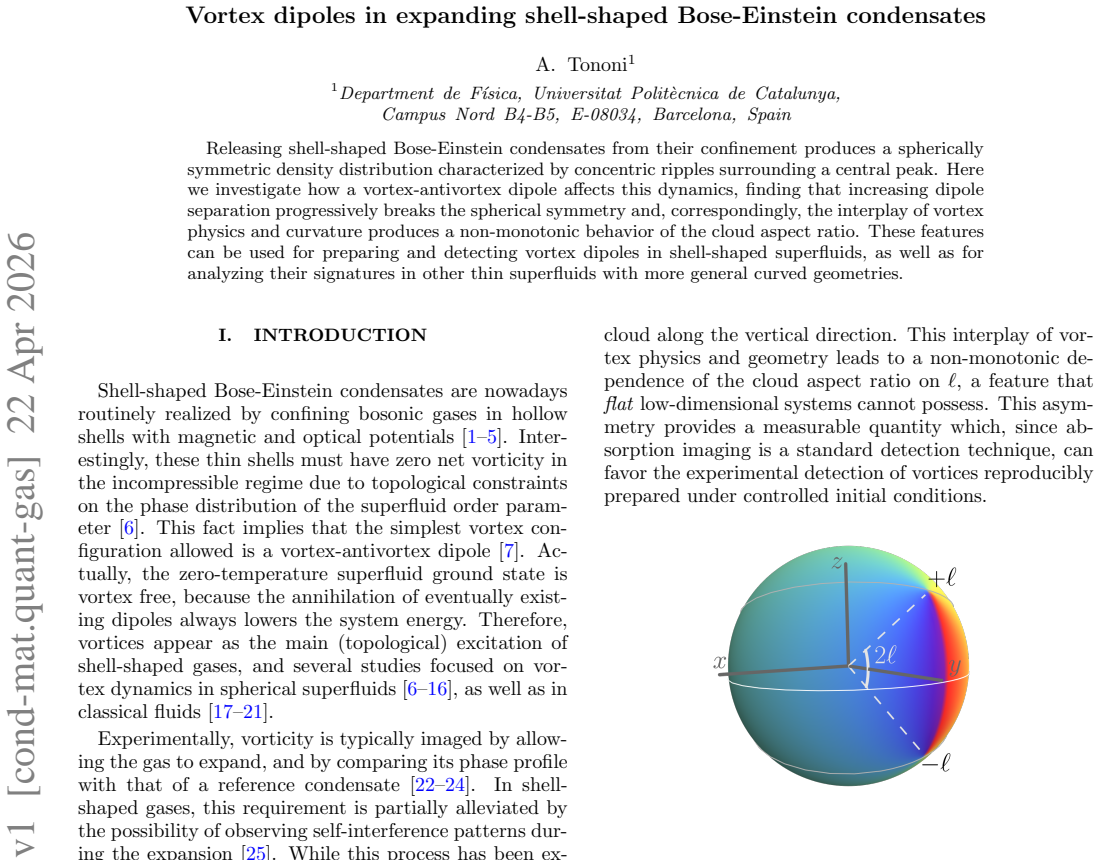
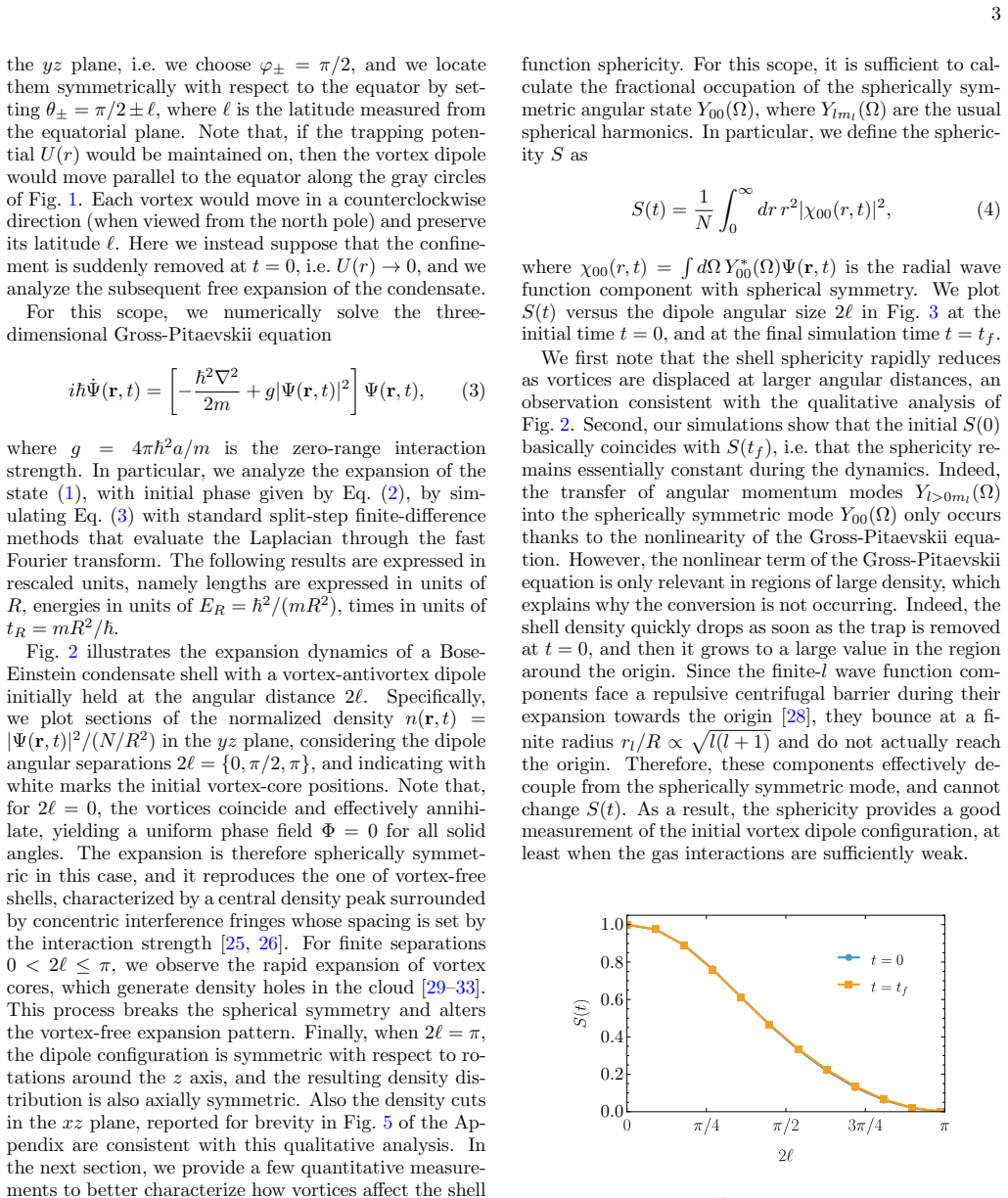
Releasing shell-shaped Bose-Einstein condensates from their confinement produces a spherically symmetric density distribution characterized by concentric ripples surrounding a central peak. Here we investigate how a vortex-antivortex dipole affects this dynamics, finding that increasing dipole separation progressively breaks the spherical symmetry and, correspondingly, the interplay of vortex physics and curvature produces a non-monotonic behavior of the cloud aspect ratio. These features can be used for preparing and detecting vortex dipoles in shell-shaped superfluids, as well as for analyzing their signatures in other thin superfluids with more general curved geometries.
What carries the argument
The vortex-antivortex dipole inside the shell geometry, whose separation acts as the tunable parameter that controls symmetry breaking and modulates the aspect ratio through vortex-curvature coupling.
Load-bearing premise
The vortex dipole stays stable during expansion and its effect on the density can be cleanly isolated from trap imperfections or thermal fluctuations.
What would settle it
Measurements in which the cloud aspect ratio varies monotonically rather than non-monotonically as vortex dipole separation is increased would disprove the claimed non-monotonic behavior arising from vortex-curvature interplay.
Figures


read the original abstract
Releasing shell-shaped Bose-Einstein condensates from their confinement produces a spherically symmetric density distribution characterized by concentric ripples surrounding a central peak. Here we investigate how a vortex-antivortex dipole affects this dynamics, finding that increasing dipole separation progressively breaks the spherical symmetry and, correspondingly, the interplay of vortex physics and curvature produces a non-monotonic behavior of the cloud aspect ratio. These features can be used for preparing and detecting vortex dipoles in shell-shaped superfluids, as well as for analyzing their signatures in other thin superfluids with more general curved geometries.
Editorial analysis
A structured set of objections, weighed in public.
Referee Report
Summary. The paper claims that releasing shell-shaped Bose-Einstein condensates from confinement produces a spherically symmetric density distribution with concentric ripples surrounding a central peak. Introducing a vortex-antivortex dipole progressively breaks this symmetry, and the interplay between vortex physics and shell curvature produces a non-monotonic dependence of the cloud aspect ratio on dipole separation. These features are proposed as tools for preparing and detecting vortex dipoles in shell-shaped superfluids as well as for analyzing their signatures in other thin superfluids with curved geometries.
Significance. If the central claim holds, the work supplies a concrete, falsifiable signature (non-monotonic aspect-ratio evolution) for vortex dipoles in expanding curved superfluids. This could be experimentally useful for detection in shell BECs and extensible to other non-flat geometries, building on standard Gross-Pitaevskii modeling of free expansion.
major comments (1)
- [Abstract] The central claim requires that the vortex-antivortex dipole remains intact and its velocity field interacts with the radial curvature throughout the expansion. The abstract gives no indication that vortex trajectories were tracked or that control runs with artificially pinned vortices were performed to isolate the curvature-vortex contribution from ordinary hydrodynamic expansion. In the Gross-Pitaevskii dynamics of an expanding thin shell, the pair can accelerate, stretch, or annihilate once the local density drops and the healing length grows; without such checks the non-monotonic aspect-ratio result cannot be attributed to the claimed mechanism.
minor comments (1)
- The abstract could usefully specify the numerical method (e.g., 3D or effective 2D GPE), the range of dipole separations examined, and the diagnostic used for the aspect ratio.
Simulated Author's Rebuttal
We thank the referee for their careful reading and for raising this important point about confirming the vortex dipole's integrity and isolating its contribution to the non-monotonic aspect ratio. We address the comment in detail below.
read point-by-point responses
-
Referee: [Abstract] The central claim requires that the vortex-antivortex dipole remains intact and its velocity field interacts with the radial curvature throughout the expansion. The abstract gives no indication that vortex trajectories were tracked or that control runs with artificially pinned vortices were performed to isolate the curvature-vortex contribution from ordinary hydrodynamic expansion. In the Gross-Pitaevskii dynamics of an expanding thin shell, the pair can accelerate, stretch, or annihilate once the local density drops and the healing length grows; without such checks the non-monotonic aspect-ratio result cannot be attributed to the claimed mechanism.
Authors: We agree that explicit confirmation of vortex stability strengthens the central claim. In our Gross-Pitaevskii simulations the vortex cores are located at each time step via the phase singularities (2π windings at density nodes), and the presented density and phase snapshots demonstrate that the dipole remains intact without annihilation or stretching-induced loss for the expansion times and parameters studied. The non-monotonic aspect-ratio evolution appears exclusively when the vortices are free to move and couple to the radial curvature; the vortex-free reference case shows only monotonic expansion. We acknowledge that the abstract does not mention trajectory tracking. In the revision we will update the abstract to state that vortex positions were monitored throughout the dynamics and will add a short paragraph in the results section summarizing the observed vortex trajectories and confirming their persistence. Control runs with artificially pinned vortices were not performed in the original work; we believe the direct comparison to the vortex-free expansion already isolates the dipole contribution, but we are prepared to carry out and include such controls if the referee considers them necessary. revision: partial
Circularity Check
No significant circularity; claims rest on standard superfluid modeling
full rationale
The paper's abstract and described investigation present the non-monotonic aspect-ratio behavior as an emergent outcome from the interplay of vortex dynamics and shell curvature in the Gross-Pitaevskii expansion, without any quoted reduction of results to fitted parameters, self-definitions, or load-bearing self-citations. No steps match the enumerated circularity patterns; the derivation chain is self-contained against external benchmarks of superfluid hydrodynamics.
Axiom & Free-Parameter Ledger
axioms (1)
- domain assumption Dynamics of the expanding shell BEC are described by the Gross-Pitaevskii equation or equivalent hydrodynamic model for superfluids.
Reference graph
Works this paper leans on
-
[1]
Dubessy and H
R. Dubessy and H. Perrin, AVS Quantum Sci.7, 010501 (2025)
2025
-
[2]
R. A. Carollo, D. C. Aveline, B. Rhyno, S. Vishvesh- wara, C. Lannert, J. D. Murphree, E. R. Elliott, J. R. Williams, R. J. Thompson, and N. Lundblad, Nature 606, 281 (2022)
2022
-
[3]
F. Jia, Z. Huang, L. Qiu, R. Zhou, Y. Yan, and D. Wang, Phys. Rev. Lett.129, 243402 (2022)
2022
-
[4]
Huang, K
Z. Huang, K. Y. Lee, C. K. Wong, L. Qiu, B. Yang, Y. Yan, and D. Wang, Phys. Rev. Res.7, 033056 (2025)
2025
-
[5]
Veyron, C
R. Veyron, C. M´ etayer, J. B. Gerent, R. Huang, E. Be- raud, B. M. Garraway, S. Bernon, and B. Battelier, AVS Quantum Sci.8, 013203 (2026)
2026
-
[6]
A. M. Turner, V. Vitelli, and D. R. Nelson, Rev. Mod. Phys.82, 1301 (2010)
2010
-
[7]
Padavi´ c, K
K. Padavi´ c, K. Sun, C. Lannert, and S. Vishveshwara, Phys. Rev. A102, 043305 (2020)
2020
-
[8]
S. J. Bereta, M. A. Caracanhas, and A. L. Fetter, Phys. Rev. A103, 053306 (2021)
2021
-
[9]
Song, Q.-C
C.-H. Song, Q.-C. Gao, X.-Y. Hou, X. Wang, Z. Zhou, Y. He, H. Guo, and C.-C. Chien, Phys. Rev. Res.4, 023005 (2022)
2022
-
[10]
Kanai and W
T. Kanai and W. Guo, Phys. Rev. Lett.127, 095301 (2021)
2021
-
[11]
V. P. Ruban, J. Exp. Theor. Phys.133, 779 (2021)
2021
-
[12]
V. P. Ruban, JETP Letters116, 329 (2022)
2022
-
[13]
Xiong and X
Y. Xiong and X. Yu, Phys. Rev. Res.6, 013133 (2024)
2024
-
[14]
A. C. White, Phys. Rev. A109, 013301 (2024)
2024
-
[15]
He and C.-C
Y. He and C.-C. Chien, Phys. Rev. A108, 053303 (2023)
2023
-
[16]
M. A. Caracanhas, P. Massignan, and A. L. Fetter, Phys. Rev. A105, 023307 (2022)
2022
-
[17]
Bogomolov, Fluid Dynamics12, 863 (1977)
V. Bogomolov, Fluid Dynamics12, 863 (1977)
1977
-
[18]
Kimura and H
Y. Kimura and H. Okamoto, J. Phys. Soc. Jpn.56, 4203 (1987)
1987
-
[19]
Kimura, Proc
Y. Kimura, Proc. R. Soc. Lond. Ser. A455, 245 (1999)
1999
-
[20]
P. K. Newton,The N-Vortex Problem: Analytical Tech- niques(Springer, New York, 2001)
2001
-
[21]
Kim, Proc
S.-C. Kim, Proc. R. Soc. A466, 1749 (2010)
2010
-
[22]
Corman, L
L. Corman, L. Chomaz, T. Bienaim´ e, R. Desbuquois, C. Weitenberg, S. Nascimb` ene, J. Dalibard, and J. Beugnon, Phys. Rev. Lett.113, 135302 (2014)
2014
-
[23]
Del Pace, K
G. Del Pace, K. Xhani, A. Muzi Falconi, M. Fedrizzi, N. Grani, D. Hernandez Rajkov, M. Inguscio, F. Scazza, W. J. Kwon, and G. Roati, Phys. Rev. X12, 041037 (2022)
2022
- [24]
-
[25]
Lannert, T.-C
C. Lannert, T.-C. Wei, and S. Vishveshwara, Phys. Rev. A75, 013611 (2007)
2007
-
[26]
Tononi, F
A. Tononi, F. Cinti, and L. Salasnich, Phys. Rev. Lett. 125, 010402 (2020)
2020
-
[27]
Boegel, A
P. Boegel, A. Wolf, M. Meister, and M. A. Efremov, Quantum Sci. Technol.8, 034001 (2023)
2023
-
[28]
Tononi, M
A. Tononi, M. Lewenstein, and L. Santos, Phys. Rev. A 112, L061305 (2025)
2025
-
[29]
Lundh, C
E. Lundh, C. J. Pethick, and H. Smith, Phys. Rev. A58, 4816 (1998)
1998
-
[30]
Dalfovo and M
F. Dalfovo and M. Modugno, Phys. Rev. A61, 023605 (2000)
2000
-
[31]
K. W. Madison, F. Chevy, W. Wohlleben, and J. Dal- ibard, Phys. Rev. Lett.84, 806 (2000)
2000
-
[32]
Hosten, P
O. Hosten, P. Vignolo, A. Minguzzi, B. Tanatar, and M. P. Tosi, J. Phys. B36, 2455 (2003)
2003
-
[33]
R. P. Teles, F. E. A. dos Santos, M. A. Caracanhas, and V. S. Bagnato, Phys. Rev. A87, 033622 (2013)
2013
-
[34]
Guenther, P
N.-E. Guenther, P. Massignan, and A. L. Fetter, Phys. Rev. A96, 063608 (2017)
2017
-
[35]
Massignan and A
P. Massignan and A. L. Fetter, Phys. Rev. A99, 063602 (2019)
2019
-
[36]
Guenther, P
N.-E. Guenther, P. Massignan, and A. L. Fetter, Phys. Rev. A101, 053606 (2020)
2020
-
[37]
D’Errico, A
C. D’Errico, A. Burchianti, M. Prevedelli, L. Salasnich, F. Ancilotto, M. Modugno, F. Minardi, and C. Fort, Phys. Rev. Res.1, 033155 (2019)
2019
-
[38]
Cavicchioli, C
L. Cavicchioli, C. Fort, F. Ancilotto, M. Modugno, F. Mi- nardi, and A. Burchianti, Phys. Rev. Lett.134, 093401 (2025)
2025
-
[39]
A. Wolf, P. Boegel, M. Meister, A. Balaˇ z, N. Gaaloul, and M. A. Efremov, Phys. Rev. A106, 013309 (2022)
2022
-
[40]
Ma and X
Y. Ma and X. Cui, Phys. Rev. Lett.134, 043402 (2025)
2025
-
[41]
Ancilotto, Phys
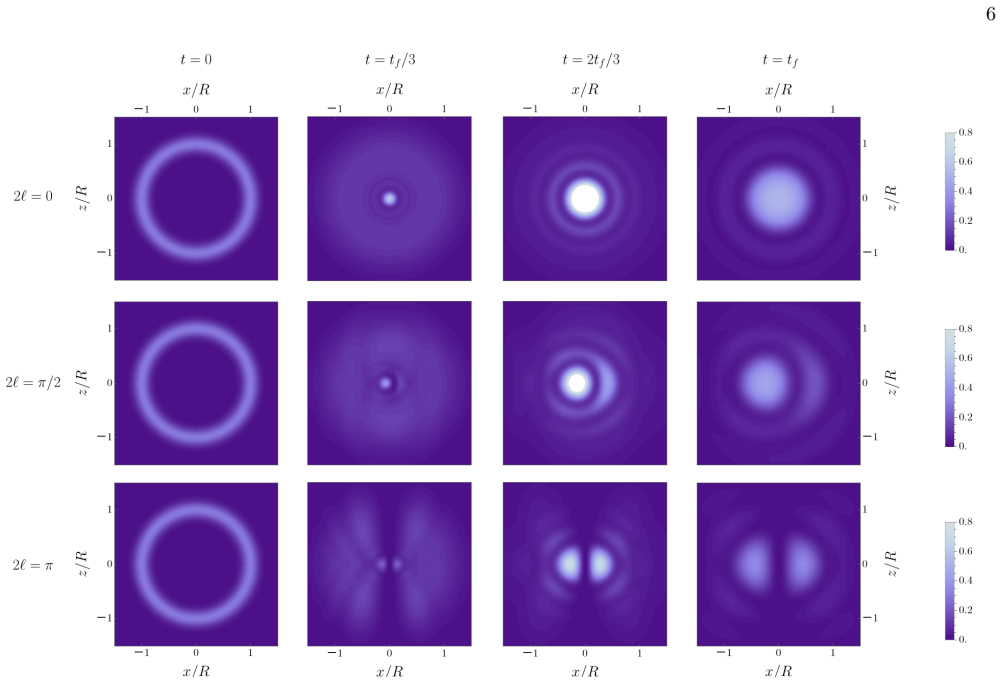
F. Ancilotto, Phys. Rev. Lett.135, 159301 (2025). 6 Figure 5. Density cuts in thexzplane during the free expansion of a Bose-Einstein condensate shell with vortices at angular distance 2ℓ. We use the same parameters as in Fig. 2
2025
-
[42]
Ma and X
Y. Ma and X. Cui, Phys. Rev. Lett.135, 189301 (2025)
2025
discussion (0)
Sign in with ORCID, Apple, or X to comment. Anyone can read and Pith papers without signing in.