Recognition: unknown
Investigation of Nonlinear Collective Dynamics in Relativistic Heavy-Ion Collisions Using A Multi-Phase Transport Model
Pith reviewed 2026-05-09 23:25 UTC · model grok-4.3
The pith
The ratio of χ_{4,22} between U+U and Au+Au collisions remains stable through every stage of the collision evolution.
A machine-rendered reading of the paper's core claim, the machinery that carries it, and where it could break.
Core claim
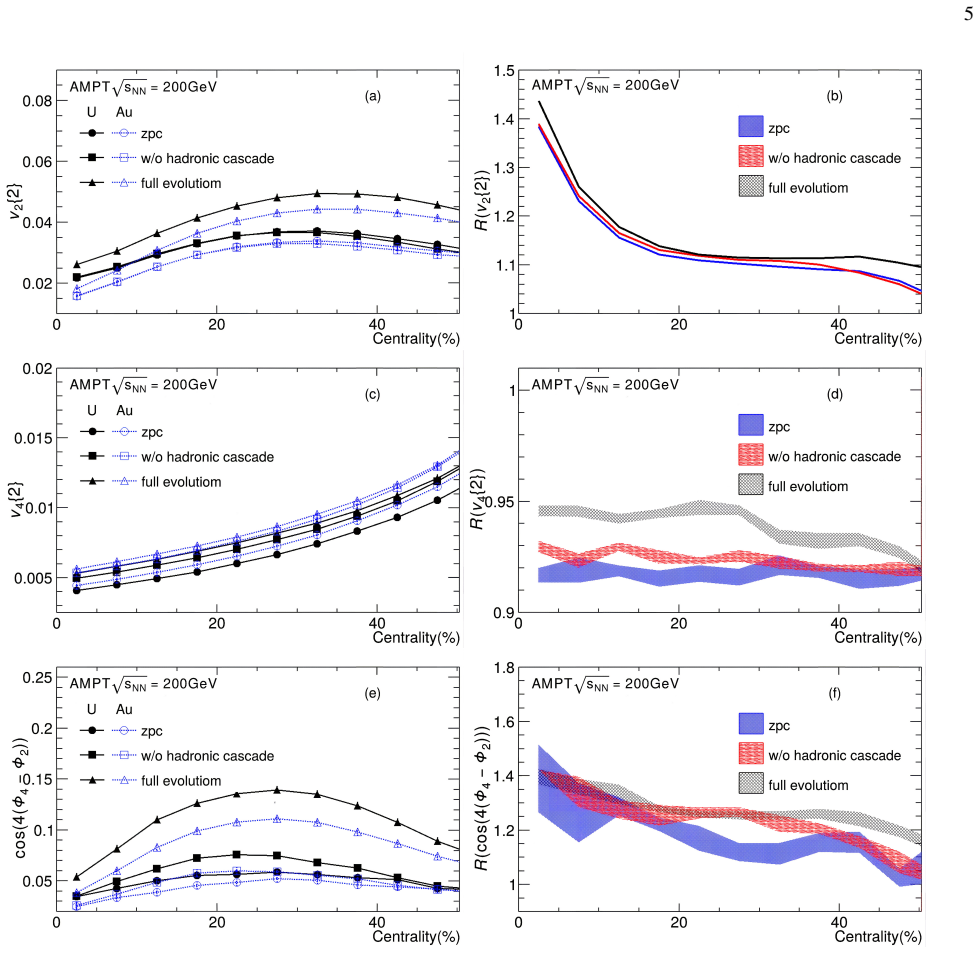
By simulating the full evolution in the AMPT model, the absolute value of the nonlinear response coefficient χ_{4,22} is shown to increase continuously through the partonic cascade, quark coalescence, and hadronic rescattering phases. In contrast, the ratio of χ_{4,22} for ^{238}U+^{238}U versus ^{197}Au+^{197}Au collisions at 200 GeV remains constant within uncertainties at every stage. This stability is interpreted as the ratio canceling the effects of the dynamical evolution and thereby exposing the intrinsic initial-state geometric correlations, such as those from hexadecapole deformation in the uranium nucleus.
What carries the argument
The nonlinear response coefficient χ_{4,22}, which quantifies the coupling between second- and fourth-order flow harmonics, tracked through successive stages of the AMPT model to separate initial geometry from medium response.
If this is right
- The absolute magnitude of χ_{4,22} grows during collective expansion, confirming it as a medium-generated response.
- The ratio between U+U and Au+Au systems cancels evolutionary complexities to highlight initial geometric features.
- This provides theoretical backing for using nonlinear flow observables to extract high-order nuclear structure information in experiments.
Where Pith is reading between the lines
- If the ratio stability is confirmed experimentally, it could allow direct constraints on nuclear hexadecapole deformations without full hydrodynamic modeling.
- Similar ratio analyses could be applied to other pairs of collision systems or to lower-order coefficients to probe different aspects of initial conditions.
- The approach suggests that certain observables can serve as 'initial-state filters' in heavy-ion collisions.
Load-bearing premise
The AMPT model must accurately capture the real evolution of the flow observables through its partonic, coalescence, and hadronic stages without model-specific biases that artificially stabilize the ratio.
What would settle it
An experimental measurement showing that the ratio of χ_{4,22} between U+U and Au+Au changes significantly when comparing different centrality classes or when using data from a different collision energy would falsify the claim of stage-independent stability.
Figures


read the original abstract
The nonlinear response coefficient, $\chi_{4,22}$, is a crucial observable for probing the dynamical properties of the quark-gluon plasma (QGP). While traditionally understood as a signature of medium response, recent studies suggest that $\chi_{4,22}$ also encapsulates critical information regarding the intrinsic initial-state configuration of the colliding nuclei. In this study, we utilize A Multi-Phase Transport (AMPT) model to investigate the microscopic origin and stage-by-stage development of $\chi_{4,22}$ in $^{238}$U+$^{238}$U and $^{197}$Au+$^{197}$Au collisions at $\sqrt{s_{\rm NN}} = 200$ GeV. By tracking the flow observables through the partonic cascade, quark coalescence, and hadronic rescattering phases, we map the translation of initial geometric eccentricities into final-state momentum anisotropies. Our results demonstrate that the absolute magnitude of $\chi_{4,22}$ increases continuously during the collective expansion, confirming its nature as a dynamically generated medium response. However, the comparative ratio of this coefficient between the U+U and Au+Au systems is stable across all evolutionary stages within statistical uncertainties. This indicates that the ratio approximately cancels complex evolutionary dynamics to isolate intrinsic geometric correlations present at the initial state. These findings provide compelling theoretical support and crucial insights for recent experimental efforts aiming to extract high-order nuclear structure, such as hexadecapole deformation, using nonlinear flow observables.
Editorial analysis
A structured set of objections, weighed in public.
Referee Report
Summary. The paper employs the AMPT transport model to track the stage-by-stage evolution of the nonlinear response coefficient χ_{4,22} in 200 GeV U+U and Au+Au collisions. It reports that the absolute magnitude of χ_{4,22} grows continuously through the partonic cascade, quark coalescence, and hadronic rescattering phases, consistent with medium response, while the ratio of χ_{4,22} between the U+U and Au+Au systems remains stable across all stages within statistical uncertainties. The authors interpret this stability as evidence that the ratio cancels evolutionary dynamics and isolates intrinsic initial-state geometric correlations, providing theoretical support for experimental probes of nuclear structure such as hexadecapole deformation.
Significance. If the reported stability of the ratio proves robust, the work would offer a useful microscopic perspective on separating initial-state geometry from QGP response in nonlinear flow observables. The stage-by-stage decomposition in a transport framework is a constructive approach for mapping eccentricities to anisotropies. The absence of model variations or cross-framework comparisons, however, limits the strength of the cancellation claim.
major comments (1)
- [Results section on evolutionary stages and ratio stability] The central claim that the U+U/Au+Au χ_{4,22} ratio is stable across partonic, coalescence, and hadronic stages and thereby cancels complex evolutionary dynamics rests on results from a single AMPT parameter set. No variations of parton cross sections, coalescence probabilities, or hadronic rescattering parameters are performed, nor are comparisons made to hydrodynamic or alternative transport models. This leaves open the possibility that the observed invariance is an artifact of the specific AMPT implementation rather than a general feature (see results on ratio invariance and the discussion of initial-state isolation).
minor comments (2)
- [Abstract and results] The abstract states that the ratio is stable 'within statistical uncertainties,' but the manuscript provides neither the numerical uncertainty values nor details on how they are computed from the simulation ensembles.
- [Discussion and conclusions] Direct comparison of the computed χ_{4,22} values or their ratio to existing experimental measurements is absent, which would help anchor the theoretical findings.
Simulated Author's Rebuttal
We thank the referee for the constructive assessment and for recognizing the potential value of the stage-by-stage decomposition in a transport model. We address the single major comment below.
read point-by-point responses
-
Referee: [Results section on evolutionary stages and ratio stability] The central claim that the U+U/Au+Au χ_{4,22} ratio is stable across partonic, coalescence, and hadronic stages and thereby cancels complex evolutionary dynamics rests on results from a single AMPT parameter set. No variations of parton cross sections, coalescence probabilities, or hadronic rescattering parameters are performed, nor are comparisons made to hydrodynamic or alternative transport models. This leaves open the possibility that the observed invariance is an artifact of the specific AMPT implementation rather than a general feature (see results on ratio invariance and the discussion of initial-state isolation).
Authors: We agree that the analysis employs one standard AMPT parameter set. The observed stability of the U+U to Au+Au ratio is nevertheless obtained by following the same events through three physically distinct stages (partonic scattering, quark coalescence, and hadronic rescattering) whose microscopic implementations differ substantially. The fact that the ratio remains constant within uncertainties across these stages indicates that the cancellation is not driven by any single dynamical ingredient within AMPT. We acknowledge that explicit parameter variations and cross-checks against hydrodynamic or other transport codes would be needed to establish full model independence; such extensions lie outside the present scope. In the revised manuscript we will add a concise paragraph in the discussion section noting this limitation while reiterating that the results demonstrate the cancellation mechanism inside a widely used transport framework. revision: partial
Circularity Check
No circularity: results are direct AMPT simulation outputs
full rationale
The paper reports numerical results obtained by running the AMPT model on U+U and Au+Au collisions and tracking χ_{4,22} through partonic cascade, coalescence, and hadronic stages. No equations, ansatz, or derivation chain are presented that reduce the central claim (stability of the U+U/Au+Au ratio) to a fitted parameter, self-definition, or self-citation. The observed constancy is an empirical feature of the model output, not a constructed equality. Model dependence exists but is external to the paper's internal logic and does not meet any of the enumerated circularity patterns.
Axiom & Free-Parameter Ledger
Reference graph
Works this paper leans on
-
[1]
Partonic Phase The initial spatial configuration is generated by the Heavy Ion Jet Interaction Generator (HIJING) [31], sampling the deformed Woods-Saxon profiles described previously. Soft particle production is governed by the Lund symmetric frag- mentation function,𝑓(𝑧) ∝𝑧 −1 (1−𝑧) 𝑎 exp(−𝑏𝑚 2 ⊥/𝑧), where the fundamental parameters are set to𝑎=0.55 and...
2032
-
[2]
Hadronization Once the partonic medium expands and cools, the quarks and antiquarks are recombined into hadrons via a spatial quark coalescence mechanism. By calculating the flow observ- ables immediately after this coalescence phase, we can inves- tigate how the kinematic recombination of partons into bound hadronic states modifies the previously establi...
-
[3]
This phase accounts for elastic and inelastic hadronic scatterings, reso- nance decays, and baryon-antibaryon annihilations
Full Evolution Including Hadronic Rescattering The final stage of the collision involves the evolution of the newly formed hadronic matter, governed by A Relativis- tic Transport (ART) model [32] using its default, energy- dependent hadronic interaction cross-sections. This phase accounts for elastic and inelastic hadronic scatterings, reso- nance decays,...
-
[4]
J. Adams et al. (STAR Collaboration), Experimental and theo- retical challenges in the search for the quark gluon plasma: The STAR Collaboration’s critical assessment of the evidence from RHIC collisions, Nucl.Phys.A757, 102 (2005), arXiv:nucl- ex/0501009 [nucl-ex]
-
[5]
K. Adcox et al. (PHENIX Collaboration), Formation of dense partonic matter in relativistic nucleus-nucleus collisions at RHIC: Experimental evaluation by the PHENIX collaboration, Nucl.Phys.A757, 184 (2005), arXiv:nucl-ex/0410003 [nucl-ex]. 7
-
[6]
E. V. Shuryak, Quantum Chromodynamics and the Theory of Superdense Matter, Phys. Rept.61, 71 (1980)
1980
- [7]
-
[8]
Collective flow and viscosity in relativistic heavy-ion collisions
U. Heinz and R. Snellings, Collective flow and viscosity in relativistic heavy-ion collisions, Ann. Rev. Nucl. Part. Sci.63, 123 (2013), arXiv:1301.2826 [nucl-th]
work page Pith review arXiv 2013
-
[9]
C. Gale, S. Jeon, and B. Schenke, Hydrodynamic Modeling of Heavy-Ion Collisions, Int. J. Mod. Phys. A28, 1340011 (2013), arXiv:1301.5893 [nucl-th]
work page Pith review arXiv 2013
-
[10]
S. Jeon and U. Heinz, Introduction to Hydrodynamics, Int. J. Mod. Phys. E24, 1530010 (2015), arXiv:1503.03931 [hep-ph]
- [11]
-
[12]
Ollitrault, Anisotropy as a signature of transverse collective flow, Phys
J.-Y. Ollitrault, Anisotropy as a signature of transverse collective flow, Phys. Rev. D46, 229 (1992)
1992
- [13]
- [14]
- [15]
-
[16]
G. Giacalone, J. Jia, and C. Zhang, Impact of Nuclear Defor- mation on Relativistic Heavy-Ion Collisions: Assessing Consis- tency in Nuclear Physics across Energy Scales, Phys. Rev. Lett. 127, 242301 (2021), arXiv:2105.01638 [nucl-th]
- [17]
-
[18]
L. Yan and J.-Y. Ollitrault,𝜈 4, 𝜈5, 𝜈6, 𝜈7: nonlinear hydrody- namic response versus LHC data, Phys. Lett. B744, 82 (2015), arXiv:1502.02502 [nucl-th]
-
[19]
W. Ryssens, G. Giacalone, B. Schenke, and C. Shen, Evidence of Hexadecapole Deformation in Uranium-238 at the Relativis- tic Heavy Ion Collider, Phys. Rev. Lett.130, 212302 (2023), arXiv:2302.13617 [nucl-th]
-
[20]
Zhao (STAR Collaboration), Quark Matter 2025, (2025)
J. Zhao (STAR Collaboration), Quark Matter 2025, (2025)
2025
- [21]
- [22]
- [23]
-
[24]
Zhang, ZPC 1.0.1: A Parton cascade for ultrarelativistic heavy ion collisions, Comput
B. Zhang, ZPC 1.0.1: A Parton cascade for ultrarelativistic heavy ion collisions, Comput. Phys. Commun.109, 193 (1998), arXiv:nucl-th/9709009 [nucl-th]
-
[25]
R. D. Woods and D. S. Saxon, Diffuse Surface Optical Model for Nucleon-Nuclei Scattering, Phys. Rev.95, 577 (1954)
1954
-
[26]
Filip, R
P. Filip, R. Lednicky, H. Masui, and N. Xu, Initial eccentricity in deformed Au-197 + Au-197 and U-238 + U-238 collisions at sNN=200 GeV at the BNL Relativistic Heavy Ion Collider, Phys. Rev. C80, 054903 (2009)
2009
-
[27]
Raman, C
S. Raman, C. W. G. Nestor, Jr, and P. Tikkanen, Transition probability from the ground to the first-excited 2+ state of even- even nuclides, Atom. Data Nucl. Data Tabl.78, 1 (2001)
2001
-
[28]
A. M. Poskanzer and S. A. Voloshin, Methods for analyzing anisotropic flow in relativistic nuclear collisions, Phys. Rev. C 58, 1671 (1998), arXiv:nucl-ex/9805001
work page Pith review arXiv 1998
-
[29]
A. Bilandzic, R. Snellings, and S. Voloshin, Flow analysis with cumulants: Direct calculations, Phys. Rev. C83, 044913 (2011), arXiv:1010.0233 [nucl-ex]
-
[30]
A. Bzdak and G.-L. Ma, Elliptic and triangular flow in𝑝+Pb and peripheral Pb+Pb collisions from parton scatterings, Phys. Rev. Lett.113, 252301 (2014), arXiv:1406.2804 [hep-ph]
-
[31]
Y. He and Z.-W. Lin, Improved Quark Coalescence for a Multi-Phase Transport Model, Phys. Rev. C96, 014910 (2017), arXiv:1703.02673 [nucl-th]
-
[32]
L.-Y. Zhang, J.-H. Chen, Z.-W. Lin, Y.-G. Ma, and S. Zhang, Two-particle angular correlations in𝑝 𝑝and𝑝-Pb collisions at energies available at the CERN Large Hadron Collider from a multiphase transport model, Phys. Rev. C98, 034912 (2018), arXiv:1808.10641 [nucl-th]
- [33]
-
[34]
Wang and M
X.-N. Wang and M. Gyulassy, HIJING: A Monte Carlo model for multiple jet production in p p, p A and A A collisions, Phys. Rev. D44, 3501 (1991)
1991
-
[35]
Formation of superdense hadronic matter in high-energy heavy ion collisions
B.-A. Li and C. M. Ko, Formation of superdense hadronic mat- ter in high-energy heavy ion collisions, Phys. Rev.C52, 2037 (1995), arXiv:nucl-th/9505016 [nucl-th]
- [36]
-
[37]
Nonlinear response of flow harmonics in Gubser flow with participant-reaction planes mismatch
X. Ren, J.-Y. Hu, H.-j. Xu, and S. Pu, Nonlinear response of flow harmonics in Gubser flow with participant-reaction planes mismatch, (2026), arXiv:2604.11058 [nucl-th]
work page internal anchor Pith review Pith/arXiv arXiv 2026
-
[38]
N. Borghini, P. M. Dinh, and J.-Y. Ollitrault, Are flow mea- surements at SPS reliable?, Phys.Rev.C62, 034902 (2000), arXiv:nucl-th/0004026 [nucl-th]
-
[39]
Q. Wang and F. Wang, Non-flow correlations in a cluster model, Phys.Rev.C81, 064905 (2010), arXiv:0812.1176 [nucl-ex]
discussion (0)
Sign in with ORCID, Apple, or X to comment. Anyone can read and Pith papers without signing in.