Recognition: unknown
Using Graph Neural Networks for hadronic clustering and to reduce beam background in the Belle~II electromagnetic calorimeter
Pith reviewed 2026-05-09 22:56 UTC · model grok-4.3
The pith
Graph neural networks identify and remove beam background deposits before clustering in the Belle II electromagnetic calorimeter.
A machine-rendered reading of the paper's core claim, the machinery that carries it, and where it could break.
Core claim
By representing only crystals with energy measurements as nodes in a graph, message-passing layers learn the edges and identify unwanted depositions from beam background and hadronic interactions before clustering. This approach captures the sparsity of the input data and handles the asymmetric sensor layout of the Belle II ECL, allowing the network to remove background contributions and improve both electromagnetic and hadronic reconstruction.
What carries the argument
Graph neural network with energy-depositing crystals as nodes and learned message-passing edges that flag background deposits for removal prior to clustering.
If this is right
- Fewer fake photon clusters are reconstructed from background energy deposits.
- Position resolution for neutral hadrons improves because irregular and disconnected deposits are handled more reliably.
- Overall energy resolution in the calorimeter remains stable or improves as background rates rise with higher SuperKEKB luminosity.
- The same graph representation can be applied to both background cleaning and hadronic clustering in a single step.
Where Pith is reading between the lines
- The sparse-graph representation may transfer to other calorimeters or detectors that face similar background and irregular-shower problems.
- Pre-filtering noise with the network could reduce the computational cost of downstream reconstruction algorithms.
- The method invites direct validation on real data and possible hybrid use with existing clustering routines.
Load-bearing premise
The detector simulation used for training accurately reproduces the background rates, hadronic interaction patterns, and energy deposition details that occur in real Belle II data.
What would settle it
A side-by-side test of the trained network on simulated events versus actual recorded Belle II collision data would show whether background rejection efficiency and clustering accuracy match or degrade substantially.
Figures

read the original abstract
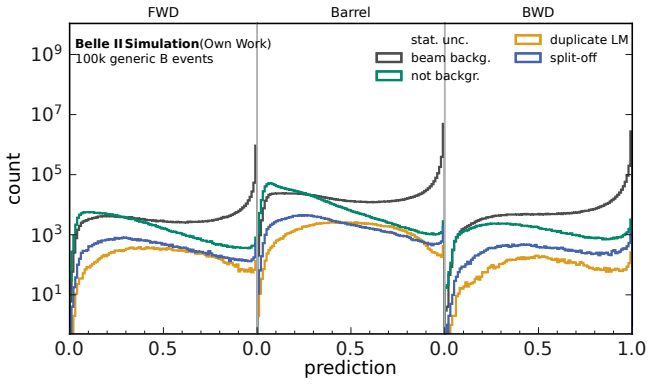
The Belle~II electromagnetic calorimeter consists of 8376 CsI(Tl) scintillation crystals and is not only used for measuring electromagnetic particles but also for identifying and determining the position of hadrons, particularly neutral\textbf{} hadrons. Recent data-taking periods have presented challenges for the current clustering method: Firstly, the record-breaking luminosities achieved by the SuperKEKB accelerator have increased background rates, leading to a higher number of crystals with energy depositions, and an overall increase in the total energy measured in the calorimeter. This resulted in poorer photon energy resolution and the reconstruction of more fake photon clusters. Secondly, challenges arise from the nature of hadronic interactions. In contrast to $\gamma$ and $e^{\pm}$, hadrons interacting in the calorimeter result in irregular, sometimes even disconnected energy depositions. These clusters can be misinterpreted as photon clusters, thereby reducing the position resolution of neutral hadrons or causing a complete misidentification of the hadron. Graph neural networks offer a promising solution to both challenges. By representing only crystals with an energy measurement as nodes, graphs capture the sparsity of the input. Using message-passing layers that learn the graph edges also helps to address the asymmetric sensor layout of Belle~II's ECL. In these proceedings, we will present a novel approach to identify the challenges in the detector simulation. Using this information, we train a Graph Neural Network to identify and remove unwanted depositions abefore clustering.
Editorial analysis
A structured set of objections, weighed in public.
Referee Report
Summary. The manuscript proposes using Graph Neural Networks (GNNs) to address two challenges in the Belle II electromagnetic calorimeter (ECL): increased beam background from high SuperKEKB luminosities, which degrades photon energy resolution and increases fake clusters, and irregular/disconnected energy depositions from hadronic interactions, which impair neutral hadron position resolution and identification. Crystals with energy deposits are represented as graph nodes to exploit sparsity; message-passing layers learn edges to accommodate the asymmetric ECL layout. The work describes identifying challenges in the detector simulation and training a GNN to tag and remove unwanted (background) depositions prior to clustering.
Significance. If the GNN demonstrably improves purity, efficiency, and resolution over the existing algorithm on real data, the result would be significant for Belle II, where background rates are rising and neutral-hadron reconstruction is important for many analyses. The architectural choice to use sparse graphs and learned edges directly targets the stated problems of sparsity and asymmetry and is a clear strength. No machine-checked proofs or parameter-free derivations are present, but the approach is falsifiable once quantitative metrics are supplied.
major comments (2)
- [Abstract] Abstract and main text: the central claim that the trained GNN 'will deliver better purity and position resolution' (or equivalent improvement over the current clustering method) is load-bearing yet unsupported; the manuscript supplies no performance numbers, baseline comparisons, efficiency/purity curves, resolution plots, or error estimates on either simulated or real events.
- [Approach / Simulation section] The statement that the work will 'present a novel approach to identify the challenges in the detector simulation' is load-bearing for the generalization claim, yet no data-MC closure tests, background-enriched sample comparisons, or domain-adaptation steps are described; without them the extrapolation from simulation-trained GNN to real high-luminosity data cannot be assessed.
minor comments (2)
- [Abstract] Typo: 'unwanted depositions abefore clustering' should read 'before clustering'.
- [Abstract] The abstract states the GNN is trained 'to identify and remove unwanted depositions before clustering' but does not specify the loss function, node/edge features, or training objective; adding these details would improve clarity even in a proceedings format.
Simulated Author's Rebuttal
We thank the referee for the careful reading of our manuscript and the constructive feedback. We agree that the current version requires strengthening through the addition of quantitative results and validation details to support the claims. We address the major comments point by point below and will revise the manuscript accordingly.
read point-by-point responses
-
Referee: [Abstract] Abstract and main text: the central claim that the trained GNN 'will deliver better purity and position resolution' (or equivalent improvement over the current clustering method) is load-bearing yet unsupported; the manuscript supplies no performance numbers, baseline comparisons, efficiency/purity curves, resolution plots, or error estimates on either simulated or real events.
Authors: We acknowledge that the submitted manuscript does not contain the requested quantitative metrics or comparisons. These proceedings focus on outlining the GNN architecture tailored to the sparse and asymmetric ECL geometry and on the approach for identifying simulation challenges. In the revised version we will incorporate preliminary performance results from simulation, including purity and efficiency as functions of relevant variables, position resolution plots, and direct comparisons to the baseline clustering algorithm, together with statistical uncertainties. revision: yes
-
Referee: [Approach / Simulation section] The statement that the work will 'present a novel approach to identify the challenges in the detector simulation' is load-bearing for the generalization claim, yet no data-MC closure tests, background-enriched sample comparisons, or domain-adaptation steps are described; without them the extrapolation from simulation-trained GNN to real high-luminosity data cannot be assessed.
Authors: We agree that explicit validation steps are needed to support generalization. The revised manuscript will expand the simulation section to include the data-MC closure tests that were performed, comparisons against background-enriched control samples, and any domain-adaptation measures taken during training. These additions will clarify the path from simulation-trained model to application on real high-luminosity data. revision: yes
Circularity Check
No circularity: GNN training uses external Monte Carlo simulation as input; no self-referential equations or load-bearing self-citations reduce claims to tautology.
full rationale
The manuscript describes a GNN trained on simulated detector events to tag beam background and cluster hadronic deposits. No equations appear that define a quantity in terms of itself or rename a fitted parameter as a prediction. No self-citations are invoked to justify uniqueness theorems or ansatzes. The simulation is treated as an external training source whose fidelity is flagged for future study, but the performance metrics on held-out simulated events are not forced by construction from the same data used for evaluation. This is a standard supervised-learning setup with an independent (if imperfect) data generator.
Axiom & Free-Parameter Ledger
axioms (2)
- domain assumption Detector simulation accurately models beam background rates and hadronic energy depositions in the CsI(Tl) crystals.
- domain assumption Message-passing layers can learn useful edges on the asymmetric Belle II ECL layout.
Reference graph
Works this paper leans on
-
[1]
Abe et al.Belle II Technical Design Report
T. Abe et al.Belle II Technical Design Report. Nov. 1, 2010.doi:10.48550/arXiv.1011
-
[2]
Belle II Technical Design Report
arXiv:1011.0352 [physics].url:http://arxiv.org/abs/1011.0352(visited on 03/09/2026). Pre-published
work page Pith review arXiv 2026
-
[3]
S. Agostinelli et al. “Geant4—a Simulation Toolkit”. In:Nuclear Instruments and Meth- ods in Physics Research Section A: Accelerators, Spectrometers, Detectors and Associated Equipment506.3 (July 2003), pp. 250–303.issn: 01689002.doi:10.1016/S0168-9002(03) 01368-8.url:https://linkinghub.elsevier.com/retrieve/pii/S0168900203013688 (visited on 03/10/2026)
-
[4]
Allison, et al., Geant4 developments and applications, IEEE Trans
J. Allison et al. “Geant4 Developments and Applications”. In:IEEE Trans. Nucl. Sci. 53.1 (Feb. 2006), pp. 270–278.issn: 0018-9499.doi:10.1109/TNS.2006.869826.url: http://ieeexplore.ieee.org/document/1610988/(visited on 03/10/2026)
-
[5]
Allison, et al., Recent developments in Geant4, Nucl
J. Allison et al. “Recent Developments in Geant4”. In:Nuclear Instruments and Methods in Physics Research Section A: Accelerators, Spectrometers, Detectors and Associated Equip- ment835 (Nov. 2016), pp. 186–225.issn: 01689002.doi:10.1016/j.nima.2016.06.125. url:https://linkinghub.elsevier.com/retrieve/pii/S0168900216306957(visited on 03/10/2026)
-
[6]
Francisco Campanario et al. “Standard Model Radiative Corrections in the Pion Form Factor Measurements Do Not Explain the aµAnomaly”. In:Phys. Rev. D100.7 (Oct. 10, 2019), p. 076004.issn: 2470-0010, 2470-0029.doi:10.1103/PhysRevD.100.076004.url: https://link.aps.org/doi/10.1103/PhysRevD.100.076004(visited on 02/12/2026)
-
[7]
The Belle II Collaboration.Belle II Analysis Software Framework (Basf2). Version release- 09-00-00. Zenodo, July 21, 2025.doi:10.5281/ZENODO.5574115.url:https://zenodo. org/doi/10.5281/zenodo.5574115(visited on 03/10/2026)
work page doi:10.5281/zenodo.5574115.url:https://zenodo 2025
-
[8]
Isabel Haide.A Real-Time Graph Neural Network Trigger Algorithm for the Belle II Electromagnetic Calorimeter. 2025.doi:10 . 5445 / IR / 1000184927.url:https : / / publikationen.bibliothek.kit.edu/1000184927(visited on 03/05/2026). Pre-published
-
[9]
Pavel Izmailov et al.Averaging Weights Leads to Wider Optima and Better Generalization. Feb. 25, 2019.doi:10.48550/arXiv.1803.05407. arXiv:1803.05407 [cs].url:http: //arxiv.org/abs/1803.05407(visited on 11/27/2025). Pre-published
-
[10]
Xiangyang Ju et al.Graph Neural Networks for Particle Reconstruction in High Energy Physics Detectors. June 3, 2020.doi:10.48550/arXiv.2003.11603. arXiv:2003.11603 [physics].url:http : / / arxiv . org / abs / 2003 . 11603(visited on 11/26/2025). Pre- published
-
[11]
The EvtGen Particle Decay Simulation Package
David J. Lange. “The EvtGen Particle Decay Simulation Package”. In:Nuclear Instru- ments and Methods in Physics Research Section A: Accelerators, Spectrometers, Detectors and Associated Equipment462.1–2 (Apr. 2001), pp. 152–155.issn: 01689002.doi:10 . 1016/S0168-9002(01)00089-4.url:https://linkinghub.elsevier.com/retrieve/ pii/S0168900201000894(visited on...
2001
-
[12]
S. Longo et al. “CsI(Tl) Pulse Shape Discrimination with the Belle II Electromagnetic Calorimeter as a Novel Method to Improve Particle Identification at Electron–Positron Colliders”. In:Nuclear Instruments and Methods in Physics Research Section A: Accelera- tors, Spectrometers, Detectors and Associated Equipment982 (Dec. 2020), p. 164562.issn: 01689002....
work page doi:10.1016/j.nima.2020.164562.url:https://linkinghub.elsevier 2020
-
[13]
Natochii et al.Beam Background Expectations for Belle II at SuperKEKB
A. Natochii et al.Beam Background Expectations for Belle II at SuperKEKB. Aug. 8, 2022.doi:10 . 48550 / arXiv . 2203 . 05731. arXiv:2203 . 05731 [hep-ex].url:http : //arxiv.org/abs/2203.05731(visited on 11/25/2025). Pre-published
-
[14]
Shah Rukh Qasim et al. “Learning Representations of Irregular Particle-Detector Geom- etry with Distance-Weighted Graph Networks”. In:Eur. Phys. J. C79.7 (July 2019), p. 608.issn: 1434-6044, 1434-6052.doi:10.1140/epjc/s10052-019-7113-9.url:http: //link.springer.com/10.1140/epjc/s10052-019-7113-9(visited on 11/20/2025)
-
[15]
Photon Reconstruction in the Belle II Calorimeter Using Graph Neural Networks
F. Wemmer et al. “Photon Reconstruction in the Belle II Calorimeter Using Graph Neural Networks”. In:Comput Softw Big Sci7.1 (Dec. 2023), p. 13.issn: 2510-2036, 2510-2044. doi:10.1007/s41781- 023- 00105- w.url:https://link.springer.com/10.1007/ s41781-023-00105-w(visited on 11/20/2025)
discussion (0)
Sign in with ORCID, Apple, or X to comment. Anyone can read and Pith papers without signing in.