Recognition: unknown
Astrophysically Realistic Secondary Spins Trigger Chaos in Schwarzschild Spacetime and Discernible Gravitational Wave Signatures
Pith reviewed 2026-05-10 00:03 UTC · model grok-4.3
The pith
Chaos arises in extreme-mass-ratio inspirals around Schwarzschild black holes even with realistic secondary spins, leaving distinct marks on the emitted gravitational waves.
A machine-rendered reading of the paper's core claim, the machinery that carries it, and where it could break.
Core claim
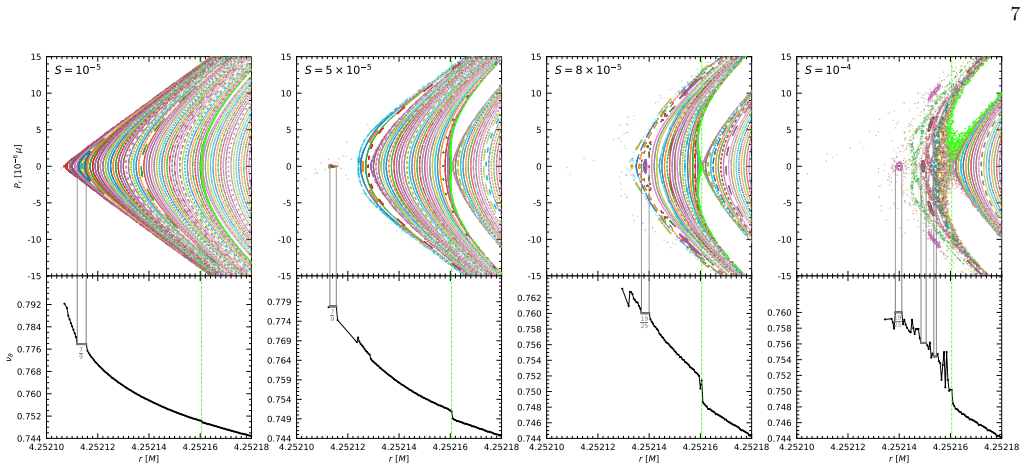
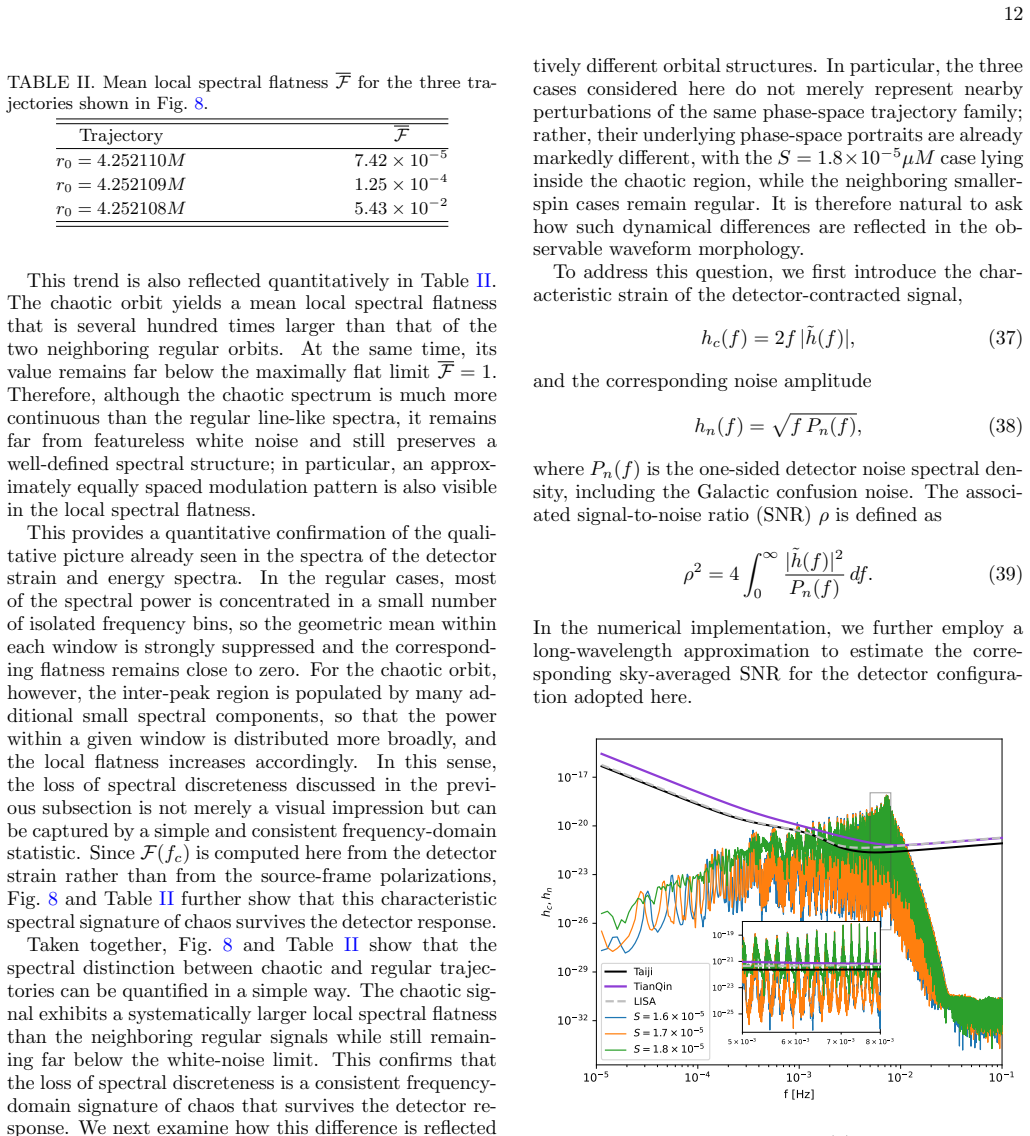
We find that chaos persists across the astrophysically realistic spin range for a spinning secondary orbiting a Schwarzschild black hole. This nonintegrable dynamics leaves clear signatures in the emitted gravitational waves. Nearby regular and chaotic trajectories can remain similar in the time domain and retain broadly aligned dominant spectral peaks, yet chaotic signals develop a much less discrete frequency-domain structure with dense inter-peak power. We introduce a local spectral-flatness measure and find it to be several hundred times larger for the chaotic signal than for the neighboring regular signals. A change in the secondary spin by as little as 1% of its maximal physically 0.25
What carries the argument
Nonintegrable dynamics of a spinning secondary in Schwarzschild spacetime, quantified by a local spectral-flatness measure on the gravitational-wave spectrum.
If this is right
- Chaotic orbits produce gravitational-wave spectra with hundreds of times higher local flatness than nearby regular orbits.
- A one-percent shift in secondary spin can switch an inspiral from regular to chaotic motion and alter the detector signal.
- Chaotic signals retain main frequency peaks but fill the spectrum with dense power between them.
- The transition to chaos remains astrophysically relevant rather than confined to unphysical spin values.
Where Pith is reading between the lines
- Waveform models for space-based detectors may need to incorporate chaotic regimes when secondary spins are known to realistic precision.
- Spectral flatness could serve as a diagnostic to flag chaotic motion in future extreme-mass-ratio inspiral detections.
- Small uncertainties in spin measurement could lead to large differences in predicted waveforms near the chaos boundary.
Load-bearing premise
The numerical model of the inspiral equations accurately captures the true onset of chaos for realistic spins without hidden choices that artificially widen the chaotic regime.
What would settle it
A waveform template computed for a measured secondary spin inside the realistic range that shows no increase in spectral flatness and remains fully discrete in frequency would falsify the claim that chaos occurs and is detectable.
Figures




read the original abstract
Chaos in extreme-mass-ratio inspirals is often thought to require unrealistically large secondary spins, making its astrophysical relevance uncertain. However, we find that chaos persists across the astrophysically realistic spin range for a spinning secondary orbiting a Schwarzschild black hole. This nonintegrable dynamics leaves clear signatures in the emitted gravitational waves. Nearby regular and chaotic trajectories can remain similar in the time domain and retain broadly aligned dominant spectral peaks, yet chaotic signals develop a much less discrete frequency-domain structure with dense inter-peak power. Furthermore, we introduce a local spectral-flatness measure and find it to be several hundred times larger for the chaotic signal than for the neighboring regular signals. Finally, a change in the secondary spin by as little as \(1\%\) of its maximal physically allowed value can drive the system from regular to chaotic motion and produce distinctive detector-level waveforms.
Editorial analysis
A structured set of objections, weighed in public.
Referee Report
Summary. The manuscript claims that chaotic dynamics arise in the motion of a spinning secondary around a Schwarzschild black hole even for astrophysically realistic secondary spins. This nonintegrable behavior produces clear imprints on the emitted gravitational waves, including a transition to less discrete frequency-domain structure with dense inter-peak power. The authors introduce a parameter-free local spectral-flatness measure that is several hundred times larger for chaotic signals than for nearby regular ones, and demonstrate that a 1% shift in secondary spin (relative to its maximum allowed value) can switch the system between regular and chaotic regimes, yielding distinguishable detector-level waveforms.
Significance. If the numerical results hold, the work would substantially increase the astrophysical relevance of chaos in extreme-mass-ratio inspirals by showing that unrealistically large spins are not required. The parameter-free local spectral-flatness diagnostic is a notable strength, offering a reproducible and falsifiable tool to separate regimes without post-hoc tuning. The demonstrated sensitivity to small spin variations further emphasizes the need for precise spin modeling in waveform templates for future detectors such as LISA. Explicit integrator tolerances, conserved-quantity drift checks, and reproducible transitions across nearby initial conditions are additional positive features that support the central claims.
minor comments (1)
- Abstract: A brief statement of the numerical integration scheme, tolerance settings, and the precise definition of the local spectral-flatness measure would help readers evaluate the robustness of the reported findings without immediately consulting the methods section.
Simulated Author's Rebuttal
We thank the referee for the positive assessment of our manuscript, which accurately summarizes our central claims regarding chaos in EMRIs with astrophysically realistic secondary spins, the imprints on gravitational waveforms, and the utility of the parameter-free local spectral-flatness measure. We appreciate the recognition of the numerical robustness checks and the implications for LISA waveform modeling. No specific major comments requiring clarification or revision were raised in the report.
Circularity Check
No significant circularity in numerical derivation of chaos onset
full rationale
The paper's central claims rest on direct numerical integration of the spinning-particle equations of motion in Schwarzschild spacetime (with radiation-reaction terms) and subsequent application of a parameter-free local spectral-flatness diagnostic to the resulting waveforms. No quantities are defined in terms of each other, no fitted parameters are relabeled as predictions, and no load-bearing uniqueness theorems or ansatze are imported via self-citation. The reported 1% spin threshold separating regular and chaotic regimes is obtained from explicit time-domain integrations whose conserved-quantity drift is monitored; the spectral measure is computed independently on the output signals. The derivation chain therefore remains self-contained against external benchmarks and does not reduce to its inputs by construction.
Axiom & Free-Parameter Ledger
Reference graph
Works this paper leans on
-
[1]
Laser Interferometer Space Antenna
P. Amaro-Seoane, H. Audley, S. Babak, J. Baker, E. Ba- rausse, P. Bender, E. Berti, P. Binetruy, M. Born, D. Bor- toluzzi, J. Camp, C. Caprini, V. Cardoso, M. Colpi, J. Conklin, N. Cornish, C. Cutler, K. Danzmann, R. Dolesi, L. Ferraioli, V. Ferroni, E. Fitzsimons, J. Gair, L. G. Bote, D. Giardini, F. Gibert, C. Grimani, H. Hal- loin, G. Heinzel, T. Herto...
work page internal anchor Pith review Pith/arXiv arXiv 2017
-
[2]
Ruan, Z.-K
W.-H. Ruan, Z.-K. Guo, R.-G. Cai, and Y.-Z. Zhang, International Journal of Modern Physics A35, 2050075 (2020)
2020
-
[3]
TianQin: a space-borne gravitational wave detector
J. Luo, L.-S. Chen, H.-Z. Duan, Y.-G. Gong, S. Hu, J. Ji, Q. Liu, J. Mei, V. Milyukov, M. Sazhin, C.-G. Shao, V. T. Toth, H.-B. Tu, Y. Wang, Y. Wang, H.- C. Yeh, M.-S. Zhan, Y. Zhang, V. Zharov, and Z.-B. Zhou, Classical and Quantum Gravity33, 035010 (2016), arXiv:1512.02076 [astro-ph]
work page Pith review arXiv 2016
-
[4]
Science with the space-based interferometer LISA. V: Extreme mass-ratio inspirals
S. Babak, J. Gair, A. Sesana, E. Barausse, C. F. Sop- uerta, C. P. L. Berry, E. Berti, P. Amaro-Seoane, A. Pe- titeau, and A. Klein, Physical Review D95, 103012 (2017), arXiv:1703.09722 [gr-qc]
work page Pith review arXiv 2017
- [5]
-
[6]
L. Barack, Classical and Quantum Gravity26, 213001 (2009), arXiv:0908.1664 [gr-qc]
-
[7]
Barack and A
L. Barack and A. Pound, Reports on Progress in Physics 82, 016904 (2019)
2019
-
[8]
C´ ardenas-Avenda˜ no and C
A. C´ ardenas-Avenda˜ no and C. F. Sopuerta, inRecent Progress on Gravity Tests, edited by C. Bambi and A. C´ ardenas-Avenda˜ no (Springer Nature Singapore, Sin- gapore, 2024) pp. 275–359
2024
- [9]
-
[10]
Kocsis, N
B. Kocsis, N. Yunes, and A. Loeb, Physical Review D 84, 024032 (2011)
2011
- [11]
-
[12]
Speri, A
L. Speri, A. Antonelli, L. Sberna, S. Babak, E. Barausse, J. R. Gair, and M. L. Katz, Physical Review X13, 021035 (2023)
2023
-
[13]
Chatterjee, S
S. Chatterjee, S. Mondal, and P. Basu, Monthly Notices of the Royal Astronomical Society526, 5612 (2023)
2023
-
[14]
Duque, S
F. Duque, S. Kejriwal, L. Sberna, L. Speri, and J. Gair, Physical Review D111, 084006 (2025)
2025
-
[15]
Y.-P. Li, H. Yang, and Z. Pan, Physical Review D111, 063074 (2025)
2025
-
[16]
J. Zhang and H. Yang, Physical Review D99, 064018 (2019), arXiv:1808.02905 [gr-qc]
-
[17]
J. Zhang and H. Yang, Physical Review D101, 043020 (2020), arXiv:1907.13582 [gr-qc]
-
[18]
R. Brito and S. Shah, Physical Review D108, 084019 (2023), arXiv:2307.16093 [gr-qc]
-
[19]
G. A. Piovano, C. Pantelidou, J. Mac Uilliam, and V. Witzany, Physical Review D111, 044009 (2025)
2025
-
[20]
Skoup´ y, G
V. Skoup´ y, G. Lukes-Gerakopoulos, L. V. Drummond, and S. A. Hughes, Physical Review D108, 044041 (2023)
2023
-
[21]
Af- shordi, S
LISA Consortium Waveform Working Group, N. Af- shordi, S. Ak¸ cay, P. A. Seoane, A. Antonelli, J. C. Aurrekoetxea, L. Barack, E. Barausse, R. Benkel, L. Bernard, S. Bernuzzi, E. Berti, M. Bonetti, B. Bonga, G. Bozzola, R. Brito, A. Buonanno, A. C´ ardenas- Avenda˜ no, M. Casals, D. F. Chernoff, A. J. K. Chua, K. Clough, M. Colleoni, G. Comp` ere, M. Dhesi...
2025
-
[22]
Papapetrou, Proceedings of the Royal Society of Lon- don
A. Papapetrou, Proceedings of the Royal Society of Lon- don. Series A. Mathematical and Physical Sciences209, 248 (1951)
1951
-
[23]
W. G. Dixon, Il Nuovo Cimento34, 317 (1964)
1964
-
[24]
Mathisson, General Relativity and Gravitation42, 1011 (2010)
M. Mathisson, General Relativity and Gravitation42, 1011 (2010)
2010
-
[25]
Secondary spins of extreme mass-ratio inspirals: A probe to the formation channels,
Q. Cui, W.-B. Han, and Z. Pan, Physical Review D111, 103044 (2025), arXiv:2502.00856 [astro-ph]
-
[26]
V. Skoup´ y, A new approach to the calculation of extreme- mass-ratio inspirals with a spinning secondary (2026), arXiv:2603.13482 [gr-qc]
- [27]
- [28]
-
[29]
Q. Tan, W. Deng, S. Long, and J. Jing, Journal of Cos- mology and Astroparticle Physics2025(05), 044
-
[30]
Witzany, J
V. Witzany, J. Steinhoff, and G. Lukes-Gerakopoulos, Classical and Quantum Gravity36, 075003 (2019)
2019
-
[31]
Witzany,Hamilton-Jacobi equation for spinning particles near black holes,Phys
V. Witzany, Physical Review D100, 104030 (2019), arXiv:1903.03651 [gr-qc]
-
[32]
Skoup´ y and V
V. Skoup´ y and V. Witzany, Physical Review Letters134, 171401 (2025)
2025
-
[33]
S. Suzuki and K.-i. Maeda, Physical Review D55, 4848 (1997), arXiv:gr-qc/9604020
- [34]
-
[35]
M. D. Hartl, Physical Review D67, 024005 (2003)
2003
-
[36]
M. D. Hartl, Physical Review D67, 104023 (2003)
2003
-
[37]
O. Zelenka, G. Lukes-Gerakopoulos, V. Witzany, and O. Kop´ aˇ cek, Physical Review D101, 024037 (2020), arXiv:1911.00414 [gr-qc]
-
[38]
Lukes-Gerakopoulos and V
G. Lukes-Gerakopoulos and V. Witzany, inHandbook of Gravitational Wave Astronomy, edited by C. Bambi, S. Katsanevas, and K. D. Kokkotas (Springer Singapore, Singapore, 2021) pp. 1–44
2021
- [39]
-
[40]
G. Lukes-Gerakopoulos, T. A. Apostolatos, and G. Con- topoulos, Physical Review D81, 124005 (2010), arXiv:1003.3120 [gr-qc]
-
[41]
Destounis and K
K. Destounis and K. D. Kokkotas, Physical Review D 104, 064023 (2021)
2021
-
[42]
Destounis and P
K. Destounis and P. G. S. Fernandes, Physical Review D 113, 044040 (2026)
2026
- [43]
-
[44]
Hua, Z.-T
Z. Hua, Z.-T. He, J.-Q. Lai, J. Jiao, and Y. Tian, Physics Letters B876, 140402 (2026)
2026
-
[45]
Tulczyjew, Acta Phys
W. Tulczyjew, Acta Phys. Pol.18, 393 (1959)
1959
-
[46]
W. G. Dixon, Proceedings of the Royal Society of Lon- don. A. Mathematical and Physical Sciences314, 499 (1970)
1970
-
[47]
Wald, Physical Review D6, 406 (1972)
R. Wald, Physical Review D6, 406 (1972)
1972
-
[48]
Semerak, Monthly Notices of the Royal Astronomical Society308, 863 (1999)
O. Semerak, Monthly Notices of the Royal Astronomical Society308, 863 (1999)
1999
-
[49]
Ehlers and E
J. Ehlers and E. Rudolph, General Relativity and Grav- itation8, 197 (1977)
1977
-
[50]
Tanaka, Y
T. Tanaka, Y. Mino, M. Sasaki, and M. Shibata, Physical Review D54, 3762 (1996)
1996
-
[51]
J. Levin and G. Perez-Giz, Physical Review D79, 124013 (2009), arXiv:0811.3814 [gr-qc]
-
[52]
M¨ oser, Nachr
J. M¨ oser, Nachr. Akad. Wiss. G¨ ottingen, II , 1 (1962)
1962
-
[53]
A. B. Givental, B. A. Khesin, J. E. Marsden, A. N. Varchenko, V. A. Vassiliev, O. Y. Viro, and V. M. Za- kalyukin, eds., Proof of a theorem of A. N. Kolmogorov on the invariance of quasi-periodic motions under small perturbations of the Hamiltonian, inCollected Works (Springer Berlin Heidelberg, Berlin, Heidelberg, 2009) pp. 267–294
2009
-
[54]
Chierchia, Regular and Chaotic Dynamics13, 130 (2008)
L. Chierchia, Regular and Chaotic Dynamics13, 130 (2008)
2008
-
[55]
Poincar´ e, Rendiconti del Circolo Matematico di Palermo33, 375 (1912)
H. Poincar´ e, Rendiconti del Circolo Matematico di Palermo33, 375 (1912)
1912
-
[56]
G. D. Birkhoff, Transactions of the American Mathemat- ical Society14, 14 (1913)
1913
-
[57]
Guckenheimer and P
J. Guckenheimer and P. Holmes,Nonlinear Oscillations, Dynamical Systems, and Bifurcations of Vector Fields, Applied Mathematical Sciences, Vol. 42 (Springer New York, New York, NY, 1983)
1983
-
[58]
Efthymiopoulos, N
C. Efthymiopoulos, N. Voglis, and G. Contopoulos, in The Dynamics of Small Bodies in the Solar System, edited by B. A. Steves and A. E. Roy (Springer Nether- lands, Dordrecht, 1999) pp. 455–462
1999
-
[59]
Contopoulos,Order and Chaos in Dynamical As- tronomy, Astronomy and Astrophysics Library (Springer Berlin Heidelberg, Berlin, Heidelberg, 2002)
G. Contopoulos,Order and Chaos in Dynamical As- tronomy, Astronomy and Astrophysics Library (Springer Berlin Heidelberg, Berlin, Heidelberg, 2002)
2002
-
[60]
Destounis, A
K. Destounis, A. G. Suvorov, and K. D. Kokkotas, Phys- ical Review D102, 064041 (2020)
2020
-
[61]
G. B. Cook, S. L. Shapiro, and S. A. Teukolsky, The Astrophysical Journal424, 823 (1994)
1994
-
[62]
Seyrich and G
J. Seyrich and G. Lukes-Gerakopoulos, Physical Review D86, 124013 (2012)
2012
-
[63]
X. Wu and T.-y. Huang, Physics Letters A313, 77 (2003), arXiv:gr-qc/0302118
- [64]
-
[65]
Han, General Relativity and Gravitation40, 1831 (2008), arXiv:1006.2229 [gr-qc]
W.-B. Han, General Relativity and Gravitation40, 1831 (2008), arXiv:1006.2229 [gr-qc]
- [66]
-
[67]
Suzuki and K.-i
S. Suzuki and K.-i. Maeda, Physical Review D61, 024005 (1999)
1999
-
[68]
A. J. Lichtenberg and M. A. Lieberman,Regular and Chaotic Dynamics, edited by F. John, J. E. Marsden, and L. Sirovich, Applied Mathematical Sciences, Vol. 38 (Springer New York, New York, NY, 1992)
1992
- [69]
- [70]
-
[71]
T. Zhao, Y. Zhou, R. Shi, Z. Cao, and Z. Ren, Physical Review D109, 084054 (2024)
2024
- [72]
-
[73]
SciML contributors, IRKGaussLegendre.jl: Implicit runge–kutta gauss–legendre 16th order (julia) (2026), gitHub repository, version v0.2.13, accessed 2026-04-10
2026
-
[74]
Seyrich, Physical Review D87, 084064 (2013), arXiv:1302.4580 [physics]
J. Seyrich, Physical Review D87, 084064 (2013), arXiv:1302.4580 [physics]
discussion (0)
Sign in with ORCID, Apple, or X to comment. Anyone can read and Pith papers without signing in.