Recognition: unknown
Flavon assisted low scale leptogenesis
Pith reviewed 2026-05-10 00:09 UTC · model grok-4.3
The pith
Flavon fields from flavor models can serve as the scalar singlet enabling successful leptogenesis at the TeV scale without right-handed neutrino mass degeneracy.
A machine-rendered reading of the paper's core claim, the machinery that carries it, and where it could break.
Core claim
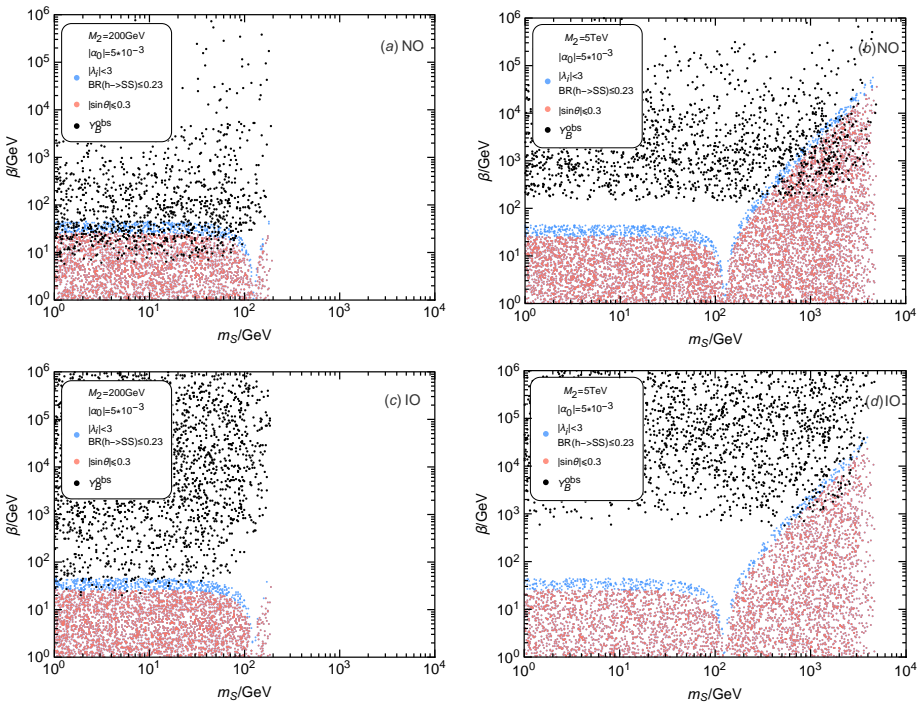
In a flavor-symmetry neutrino mass model that realizes the TM1 mixing pattern, a single flavon field playing the role of the scalar singlet S and coupling to only two right-handed neutrinos allows the observed neutrino masses and mixing angles to be reproduced while the observed baryon asymmetry is generated through leptogenesis at the TeV scale, all within a parameter space compatible with experimental constraints.
What carries the argument
The flavon field acting as the scalar singlet S, coupled via S N_I N_J terms (I not equal J), which opens the decay channels N_I to N_J S that supply additional CP violation for low-scale leptogenesis.
If this is right
- The observed baryon asymmetry is achievable at the TeV scale without requiring near-degenerate right-handed neutrino masses.
- Neutrino masses and the TM1 mixing pattern are reproduced consistently with the same flavon that drives leptogenesis.
- The parameter space remains compatible with existing experimental bounds on new scalars and right-handed neutrinos.
- Only one flavon coupling to two right-handed neutrinos suffices for both tasks.
Where Pith is reading between the lines
- The mechanism could be embedded in other flavor-symmetry models to connect neutrino mixing patterns more directly to cosmological observables.
- Collider searches for new scalar singlets or right-handed neutrinos at the TeV scale could test the viability of this leptogenesis route.
- It reduces reliance on high-scale physics for explaining the matter-antimatter asymmetry by leveraging fields already present for flavor reasons.
Load-bearing premise
The single flavon can simultaneously generate the required right-handed neutrino mass spectrum, supply enough CP violation through the new decay channels, and fit all experimental constraints without extra fine-tuning or internal conflicts.
What would settle it
A full parameter scan in which no region simultaneously reproduces the measured neutrino masses and mixing, produces the observed baryon asymmetry, and evades current constraints would falsify the construction.
Figures


read the original abstract
Low-scale leptogenesis scenarios, such as the resonant or ARS leptogenesis, typically require a highly degenerate mass spectrum of right-handed neutrinos (RHNs). This requirement can be circumvented by extending the seesaw framework with a scalar singlet $S$ that couples to RHNs via the $S N^{}_I N^{}_J$ terms (with $I \neq J$), which opens up new decay channels $N^{}_I \to N^{}_J S$ and provides additional sources of CP violation, thereby enabling successful leptogenesis at the TeV scale without the need for mass degeneracy. In this work, we point out that the flavon fields, which are introduced in many flavor-symmetry neutrino mass models to be responsible for the generation of RHN masses through the acquisition of non-zero vacuum expectation values, serve as ideal candidates for the $S$ field. Taking as an example a flavor-symmetry neutrino mass model that naturally realizes the experimentally allowed TM1 mixing pattern and has the attractive features that only one flavon field plays the role of $S$ and that it couples to only two RHNs, we demonstrate that the observed neutrino masses and mixing angles can be consistently reproduced, while the observed baryon asymmetry can be achieved within a parameter space compatible with current experimental constraints.
Editorial analysis
A structured set of objections, weighed in public.
Referee Report
Summary. The paper proposes using flavon fields from flavor-symmetry neutrino mass models as the scalar singlet S in an extended seesaw framework for low-scale leptogenesis. In a specific model realizing the TM1 mixing pattern, a single flavon couples to only two right-handed neutrinos (RHNs), generates their masses via its VEV, and opens new decay channels N_I → N_J S that supply additional CP violation. The authors claim this setup reproduces the observed neutrino masses and mixing angles while achieving the measured baryon asymmetry Y_B at the TeV scale, all within a parameter space compatible with current experimental constraints, without requiring RHN mass degeneracy.
Significance. If the numerical demonstration holds, the work provides a concrete link between flavor symmetry models and viable low-scale leptogenesis, using an economical choice of a single flavon to avoid degeneracy tuning. This could offer new testable signatures at colliders and in flavor-violating processes while connecting neutrino mixing patterns directly to the baryon asymmetry. The approach is attractive for its minimality but its impact depends on the robustness of the joint parameter scan.
major comments (2)
- [Numerical results / parameter scan section] The central claim that a viable joint parameter space exists (reproducing neutrino data, yielding the observed Y_B via flavon-mediated CP violation, and satisfying all bounds) is load-bearing but rests on numerical results whose details are not fully transparent. The scan must explicitly demonstrate that the required RHN mass splitting for open N_I → N_J S decays does not conflict with the flavon VEV scale needed for the seesaw and TM1 mixing, or force additional tuning beyond what is stated.
- [Leptogenesis calculation section] The CP asymmetry generated by interference between tree-level and loop diagrams involving the flavon in the new decay channels must be derived and shown to be sufficient after solving the Boltzmann equations. Without the explicit expression for the asymmetry parameter (analogous to the standard epsilon in resonant leptogenesis) and the resulting Y_B evolution, it is unclear whether the claimed success holds after including all washout effects and constraints.
minor comments (2)
- [Model setup] Notation for the flavon couplings and RHN mass matrix should be clarified early to avoid confusion with standard seesaw parameters.
- [Results] A table summarizing the viable parameter ranges (flavon VEV, RHN masses, Yukawas) and the corresponding chi-squared for neutrino fit plus Y_B would improve readability.
Simulated Author's Rebuttal
We thank the referee for the careful reading of our manuscript and the constructive comments. We appreciate the positive assessment of the potential impact and address the major comments point by point below, outlining the revisions we will implement to improve transparency and completeness.
read point-by-point responses
-
Referee: [Numerical results / parameter scan section] The central claim that a viable joint parameter space exists (reproducing neutrino data, yielding the observed Y_B via flavon-mediated CP violation, and satisfying all bounds) is load-bearing but rests on numerical results whose details are not fully transparent. The scan must explicitly demonstrate that the required RHN mass splitting for open N_I → N_J S decays does not conflict with the flavon VEV scale needed for the seesaw and TM1 mixing, or force additional tuning beyond what is stated.
Authors: We agree that greater detail on the parameter scan is needed for full transparency. In the revised manuscript we will expand the numerical results section to include the explicit parameter ranges scanned, the precise conditions imposed on the RHN mass splitting to ensure the N_I → N_J S channels are kinematically open, and the consistency checks with the flavon VEV required by the seesaw mechanism and TM1 mixing. We will add plots or tabulated examples demonstrating that viable points exist without introducing tuning beyond the model assumptions already stated, while satisfying all experimental bounds and reproducing the observed Y_B. revision: yes
-
Referee: [Leptogenesis calculation section] The CP asymmetry generated by interference between tree-level and loop diagrams involving the flavon in the new decay channels must be derived and shown to be sufficient after solving the Boltzmann equations. Without the explicit expression for the asymmetry parameter (analogous to the standard epsilon in resonant leptogenesis) and the resulting Y_B evolution, it is unclear whether the claimed success holds after including all washout effects and constraints.
Authors: We acknowledge that the explicit derivation of the CP asymmetry and the Boltzmann evolution were not presented in sufficient detail. In the revision we will derive the CP asymmetry parameter ε for the flavon-mediated decays N_I → N_J S, including the relevant interference terms between tree-level and one-loop diagrams. We will also present the Boltzmann equations governing the evolution of the lepton asymmetry and show the resulting Y_B as a function of temperature, explicitly demonstrating that the observed baryon asymmetry is obtained after all washout effects are included. These additions will appear in the leptogenesis section. revision: yes
Circularity Check
Model construction with explicit parameter scan shows viable region for neutrino data plus leptogenesis; derivation self-contained
full rationale
The paper selects a flavor-symmetry model realizing TM1 mixing with a single flavon S coupling to two RHNs, reproduces neutrino masses and angles by fitting the model's parameters to data, then solves the Boltzmann equations for the new decay channels to show that the observed baryon asymmetry lies within the same scanned region that also satisfies experimental bounds. This is standard model-building and numerical demonstration rather than any derivation that reduces to its inputs by construction. No self-definitional equations, no fitted inputs relabeled as predictions, and no load-bearing self-citations that would make the central claim tautological. The result is the existence of a compatible parameter space, which is independently checkable by reproducing the scan and calculations.
Axiom & Free-Parameter Ledger
free parameters (3)
- Flavon vacuum expectation value
- Right-handed neutrino masses and mass splittings
- Yukawa couplings and scalar couplings to RHNs
axioms (3)
- domain assumption Type-I seesaw mechanism generates light neutrino masses
- domain assumption Flavor symmetry is broken by flavon VEVs to produce observed mixing
- standard math Standard Boltzmann equations govern the evolution of lepton asymmetry
Reference graph
Works this paper leans on
-
[1]
Z. Z. Xing, Phys. Rep.854, 1 (2020)
2020
-
[2]
P. A. R. Adeet al.(Planck Collaboration), Astron. Astrophys. A16, 571 (2014)
2014
-
[3]
Minkowski, Phys
P. Minkowski, Phys. Lett. B67, 421 (1977)
1977
-
[4]
Gell-Mann, P
M. Gell-Mann, P. Ramond and R. Slansky, in Supergravity, edited by P. van Nieuwenhuizen and D. Freedman, (North-Holland, 1979), p. 315
1979
-
[5]
Yanagida, in Proceedings of the Workshop on the Unified Theory and the Baryon Number in the Universe, edited by O
T. Yanagida, in Proceedings of the Workshop on the Unified Theory and the Baryon Number in the Universe, edited by O. Sawada and A. Sugamoto (KEK Report No. 79-18, Tsukuba, 1979), p. 95
1979
-
[6]
R. N. Mohapatra and G. Senjanovic, Phys. Rev. Lett.44, 912 (1980)
1980
-
[7]
Schechter and J
J. Schechter and J. W. F. Valle, Phys. Rev. D22, 2227 (1980)
1980
-
[8]
Fukugita and T
M. Fukugita and T. Yanagida, Phys. Lett. B174, 45 (1986)
1986
-
[9]
Buchmuller, R
W. Buchmuller, R. D. Peccei and T. Yanagida, Ann. Rev. Nucl. Part. Sci.55, 311 (2005)
2005
-
[10]
Buchmuller, P
W. Buchmuller, P. Di Bari and M. Plumacher, Annals Phys.315, 305 (2005)
2005
-
[11]
Davidson, E
S. Davidson, E. Nardi and Y. Nir, Phys. Rept.466, 105 (2008)
2008
-
[12]
Bodeker and W
D. Bodeker and W. Buchmuller, Rev. Mod. Phys.93, 035004 (2021)
2021
-
[13]
Davidson and A
S. Davidson and A. Ibarra, Phys. Lett. B535, 25 (2002)
2002
-
[14]
Pilaftsis, Phys
A. Pilaftsis, Phys. Rev. D56, 5431 (1997)
1997
-
[15]
Pilaftsis and T
A. Pilaftsis and T. E. J. Underwood, Nucl. Phys. B692, 303 (2004)
2004
-
[16]
E. K. Akhmedov, V. A. Rubakov and A. Y. Smirnov, Phys. Rev. Lett.81, 1359 (1998)
1998
-
[17]
Asaka and M
T. Asaka and M. Shaposhnikov, Phys. Lett. B620, 17 (2005)
2005
-
[18]
Le Dall and A
M. Le Dall and A. Ritz, Phys. Rev. D90, no.9, 096002 (2014)
2014
-
[19]
Alanne, T
T. Alanne, T. Hugle, M. Platscher and K. Schmitz, JCAP03, 037 (2019)
2019
-
[20]
Silveira and A
V. Silveira and A. Zee, Phys. Lett. B161, 136-140 (1985)
1985
-
[21]
McDonald, Phys
J. McDonald, Phys. Rev. D50, 3637-3649 (1994). 14
1994
-
[22]
C. P. Burgess, M. Pospelov and T. ter Veldhuis, Nucl. Phys. B619, 709-728 (2001)
2001
-
[23]
Athronet al.[GAMBIT], Eur
P. Athronet al.[GAMBIT], Eur. Phys. J. C77, no.8, 568 (2017)
2017
-
[24]
R. N. Lerner and J. McDonald, Phys. Rev. D80, 123507 (2009)
2009
-
[25]
Enqvist, S
K. Enqvist, S. Nurmi, T. Tenkanen and K. Tuominen, JCAP08, 035 (2014)
2014
-
[26]
Kahlhoefer and J
F. Kahlhoefer and J. McDonald, JCAP11, 015 (2015)
2015
-
[27]
Tenkanen, K
T. Tenkanen, K. Tuominen and V. Vaskonen, JCAP09, 037 (2016)
2016
-
[28]
Y. Ema, M. Karciauskas, O. Lebedev, S. Rusak and M. Zatta, Phys. Lett. B789, 373-377 (2019)
2019
-
[29]
Alanne, A
T. Alanne, A. Meroni and K. Tuominen, Phys. Rev. D96, no.9, 095015 (2017)
2017
-
[30]
Altarelli and F
G. Altarelli and F. Feruglio, Rev. Mod. Phys.82, 2701 (2010)
2010
-
[31]
S. F. King and C. Luhn, Rept. Prog. Phys.76, 056201 (2013)
2013
-
[32]
Feruglio and A
F. Feruglio and A. Romanino, Rev. Mod. Phys.93, 015007 (2021)
2021
-
[33]
G. J. Ding and S. F. King, Rept. Prog. Phys.87084201 (2024)
2024
-
[34]
M. C. Chen, S. Ipek and M. Ratz, Phys. Rev. D100, 035011 (2019)
2019
-
[35]
Altarelli and F
G. Altarelli and F. Feruglio, Nucl. Phys. B741, 215 (2006)
2006
-
[36]
P. F. Harrison, D. H. Perkins and W. G. Scott, Phys. Lett. B530, 167 (2002)
2002
-
[37]
Z. Z. Xing, Phys. Lett. B533, 85 (2002)
2002
-
[38]
Z. h. Zhao, JHEP11, 143 (2014)
2014
-
[39]
J. D. Bjorken, P. F. Harrison and W. G. Scott, Phys. Rev. D74, 073012 (2006)
2006
-
[40]
Z. Z. Xing and S. Zhou, Phys. Lett. B653, 278 (2007)
2007
-
[41]
X. G. He and A. Zee, Phys. Lett. B645, 427 (2007)
2007
-
[42]
C. H. Albright and W. Rodejohann, Eur. Phys. J. C62, 599 (2009)
2009
-
[43]
C. H. Albright, A. Dueck and W. Rodejohann, Eur. Phys. J. C70, 1099 (2010)
2010
-
[44]
Esteban, M
I. Esteban, M. C. Gonzalez-Garcia, M. Maltoni, I. Martinez-Soler, J. P. Pinheiro and T. Schwetz, JHEP12, 216 (2024). 15
2024
-
[45]
Capozzi, W
F. Capozzi, W. Giar` e, E. Lisi, A. Marrone, A. Melchiorri and A. Palazzo, Phys. Rev. D111, 093006 (2025)
2025
- [46]
- [47]
-
[48]
X. G. He, Phys. Lett. B874, 140270 (2026)
2026
-
[49]
Zhang, Phys
D. Zhang, Phys. Rev. D113, no.5, 055035 (2026)
2026
- [50]
-
[51]
Updated bounds on the (1,2) neutrino oscillation parameters after first JUNO results,
F. Capozzi, E. Lisi, F. Marcone, A. Marrone and A. Palazzo, [arXiv:2511.21650 [hep-ph]]
- [52]
-
[53]
N. Ardakanian, [arXiv:2603.21264 [hep-ph]]
-
[54]
M. D. Goodsell and F. Staub, Eur. Phys. J. C78, no.8, 649 (2018)
2018
-
[55]
Robens and T
T. Robens and T. Stefaniak, Eur. Phys. J. C75, 104 (2015)
2015
-
[56]
Ilnicka, T
A. Ilnicka, T. Robens and T. Stefaniak, Mod. Phys. Lett. A33, no.10n11, 1830007 (2018)
2018
-
[57]
S. Dittmaieret al.[LHC Higgs Cross Section Working Group], [arXiv:1101.0593 [hep-ph]]
-
[58]
Aadet al.[ATLAS], JHEP11, 206 (2015)
G. Aadet al.[ATLAS], JHEP11, 206 (2015)
2015
-
[59]
Khachatryanet al.[CMS], JHEP02, 135 (2017)
V. Khachatryanet al.[CMS], JHEP02, 135 (2017). 16
2017
discussion (0)
Sign in with ORCID, Apple, or X to comment. Anyone can read and Pith papers without signing in.