Recognition: unknown
Review of experimental studies of charmed meson decays at BESIII
Pith reviewed 2026-05-09 22:31 UTC · model grok-4.3
The pith
A review of BESIII charmed meson decay studies presents the most precise averages for |V_cs|, |V_cd|, D and D_s decay constants, and several hadronic form factors from combined experimental results.
A machine-rendered reading of the paper's core claim, the machinery that carries it, and where it could break.
Core claim
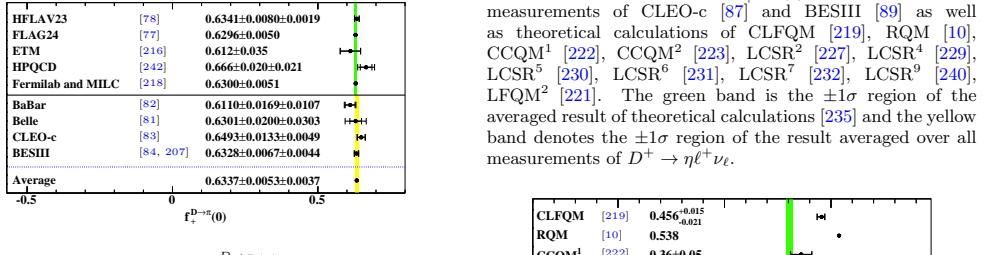
Based on existing results of (semi)leptonic D decays from all experiments, we have presented the most precise averages for the CKM matrix elements |V_cs|=0.9648±0.009±0.0036 and |V_cd|=0.2259±0.0014±0.0013, the decay constants of D+ and D+s f_{D^+}=(213.1±2.0±1.5) MeV and f_{D^+_s}=(253.2±1.2±1.6) MeV, as well as the hadronic form factors f^{D→K}_+(0)=0.7342±0.0007±0.0008, f^{D→π}_+(0)=0.6337±0.0053±0.0037, and others.
Load-bearing premise
The averaging procedure assumes that systematic uncertainties from different experiments are correctly estimated, uncorrelated where not specified, and that the selected measurements form a representative and unbiased sample of the true values.
Figures
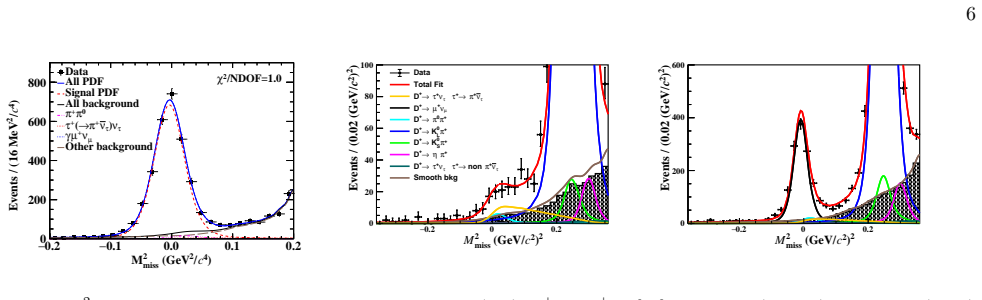


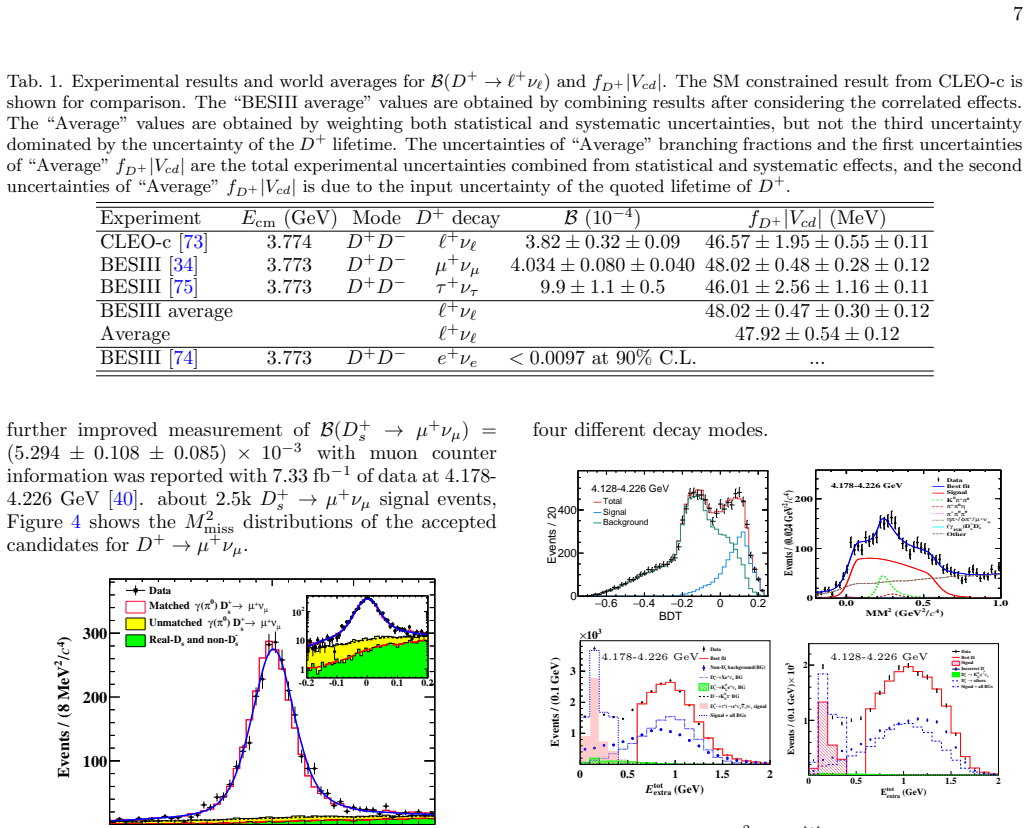


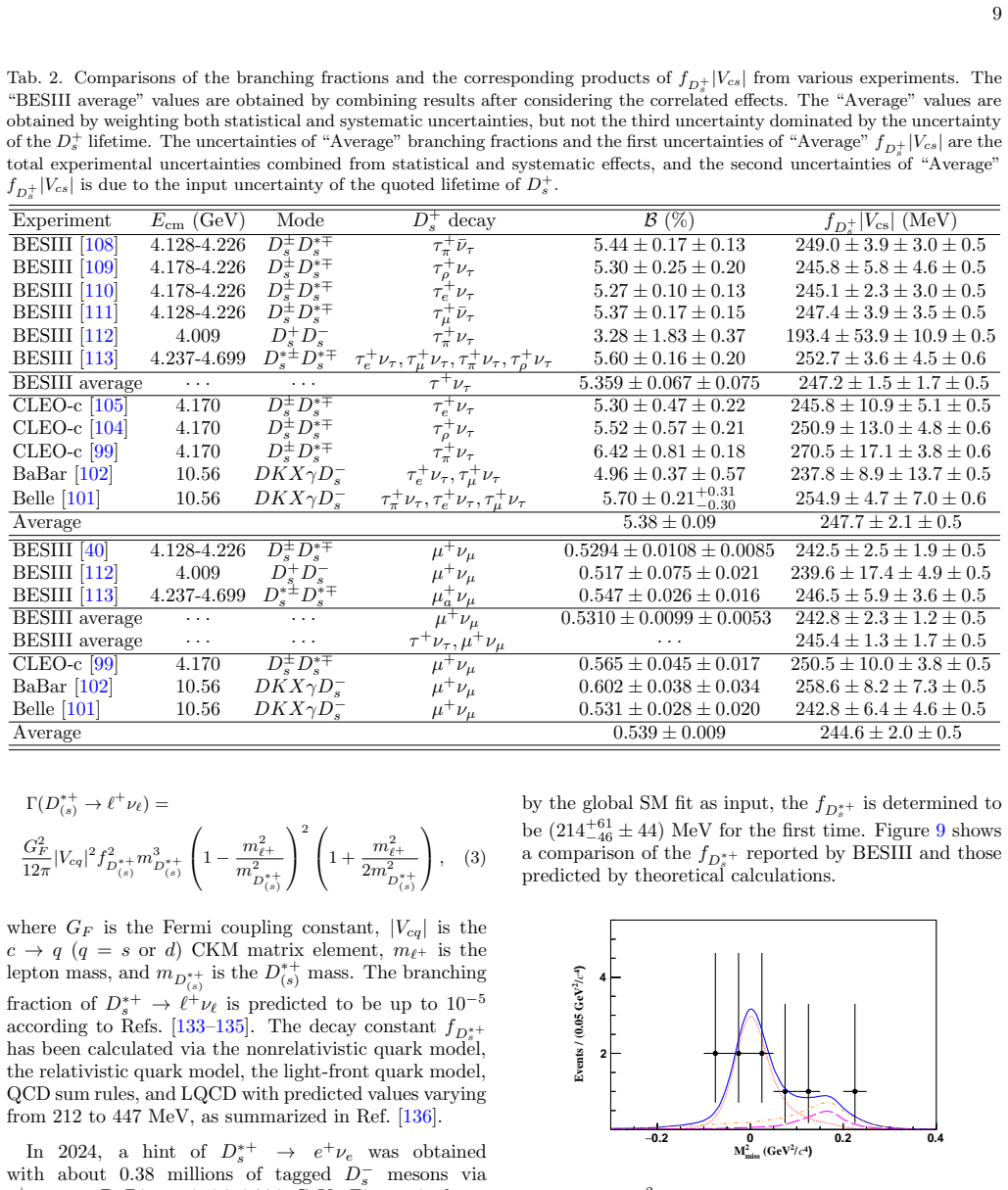
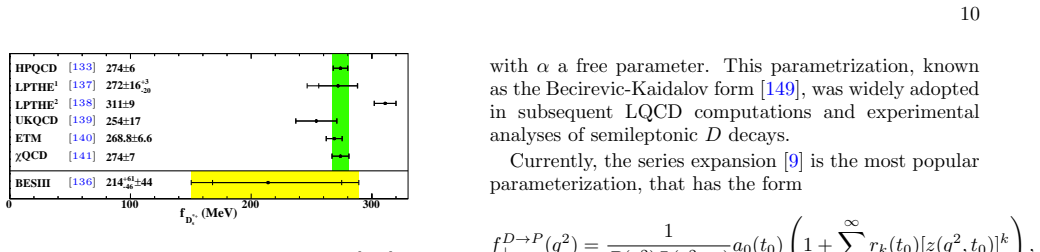










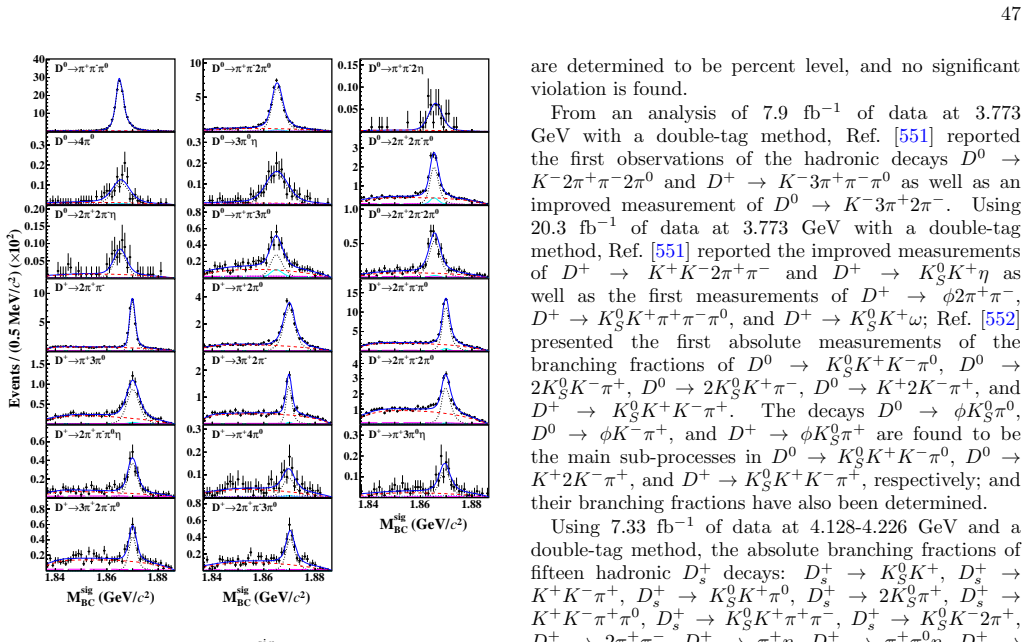
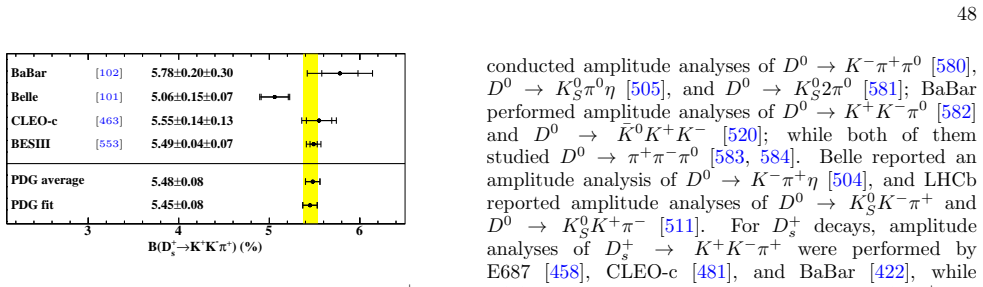


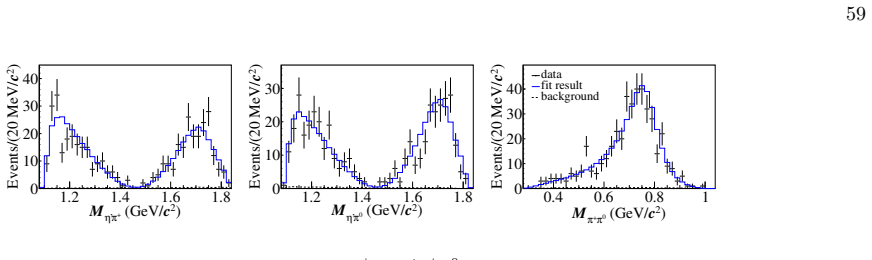
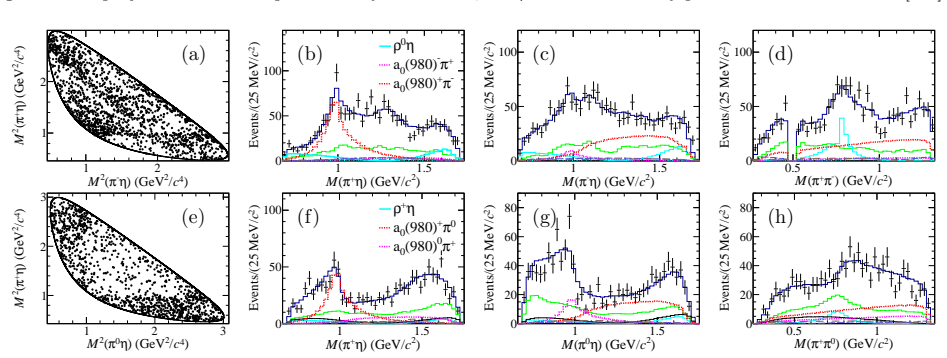


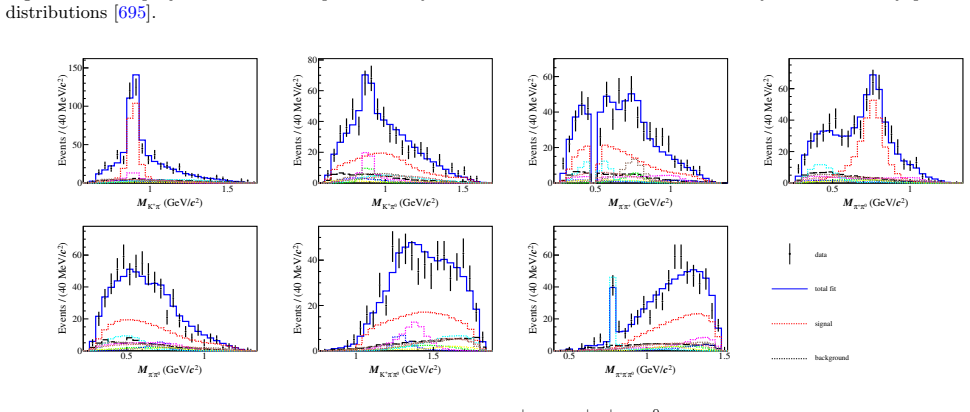


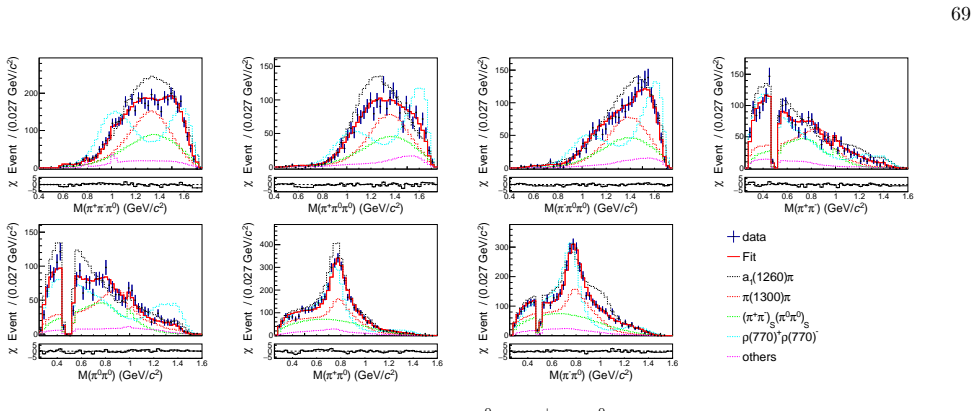


read the original abstract
Experimental measurements of different decays of charmed mesons have been extensively performed at BESIII. Precision measurements of absolute branching fractions of different decays, the decay constants of $D^+$ and $D^+_s$ mesons, hadronic form factors of $D$ transitions to light hadrons ($K$, $\pi$, $\eta$, $\eta^\prime$, $K^*(892)$, $\rho$, $\omega$, $\phi$, $K_1(1270)$, $f_0(980)$), $c\to s(d)$ Cabibbo-Kobayashi-Maskawa (CKM) matrix elements, tests of lepton flavor universality with various (semi)leptonic $D$ decays, precision measurements of strong phase difference between $D^0$ and $\bar D^0$ decays, amplitude analyses of multibody hadronic $D_{(s)}$ decays, search for rare $D$ decays have been reported. The reported results offer important information to test different theoretical calculations, to test the unitarity of the CKM matrix, and to search for new physics effects beyond the standard model (SM). This paper reviews experimental studies of different decays of $D^0$, $D^+$, and $D^+_s$ as well as their excitations at BESIII as of April 15, 2026. Based on existing results of (semi)leptonic $D$ decays from all experiments, we have presented the most precise averages for the CKM matrix elements $|V_{cs}|=0.9648\pm0.009\pm0.0036$ and $|V_{cd}|=0.2259\pm0.0014\pm0.0013$, the decay constants of $D^+$ and $D^+_s$ $f_{D^+}=(213.1\pm2.0\pm1.5)$ MeV and $f_{D^+_s}=(253.2\pm1.2\pm1.6)$ MeV, as well as the hadronic form factors $f^{D\to K}_+(0)=0.7342\pm0.0007\pm0.0008$, $f^{D\to \pi}_+(0)=0.6337\pm0.0053\pm0.0037$, $f^{D\to \eta}_+(0)=0.351\pm0.009\pm0.005$, $f^{D\to \eta^\prime}_+(0)=0.263\pm0.025\pm0.006$, $f^{D_s\to \eta}_+(0)=0.4653\pm0.0058\pm0.0069$, $f^{D_s\to \eta^\prime}_+(0)=0.535\pm0.020\pm0.011$, and $f^{D_s\to K^0}_+(0)=0.627\pm0.036\pm0.009$, where the first and second uncertainties are statistical and systematic, respectively.
Editorial analysis
A structured set of objections, weighed in public.
Referee Report
Summary. This manuscript is a review of experimental studies of charmed meson decays (D^0, D^+, D_s^+ and excitations) at BESIII, summarizing measurements of absolute branching fractions, (semi)leptonic decays, decay constants, hadronic form factors for D transitions to light hadrons, CKM elements |V_cs| and |V_cd|, lepton flavor universality tests, strong phase differences, amplitude analyses of multibody decays, and rare decay searches. It concludes by presenting combined world averages for |V_cs|=0.9648±0.009±0.0036, |V_cd|=0.2259±0.0014±0.0013, f_{D^+}=(213.1±2.0±1.5) MeV, f_{D_s^+}=(253.2±1.2±1.6) MeV, and several f_+(0) values, derived from results across all experiments.
Significance. If the averages are rigorously derived, the review compiles a substantial body of high-precision BESIII data that serves as a key resource for testing lattice QCD calculations, verifying CKM unitarity, and searching for beyond-Standard-Model effects in charm physics. The explicit numerical averages for decay constants and form factors provide concrete benchmarks for phenomenological use.
major comments (1)
- [Abstract] Abstract: The central claim of having 'presented the most precise averages' for |V_cs|, |V_cd|, f_{D^+}, f_{D_s^+}, and the listed f_+(0) values (e.g., f^{D→K}_+(0)=0.7342±0.0007±0.0008) is load-bearing but unsupported by any description of the averaging procedure. No section, table, or appendix specifies the input measurements selected, the list of experiments included, the treatment of correlations among systematic uncertainties from BESIII, CLEO-c, BaBar, Belle, and LHCb, or the combination algorithm (e.g., weighted average, scale factor, or covariance construction). This prevents evaluation of whether the quoted total uncertainties are correctly estimated or whether the 'most precise' assertion holds.
Simulated Author's Rebuttal
We thank the referee for the careful reading and constructive feedback on our manuscript. We appreciate the acknowledgment of its potential value as a resource for lattice QCD tests and CKM unitarity checks. We address the single major comment below.
read point-by-point responses
-
Referee: [Abstract] Abstract: The central claim of having 'presented the most precise averages' for |V_cs|, |V_cd|, f_{D^+}, f_{D_s^+}, and the listed f_+(0) values (e.g., f^{D→K}_+(0)=0.7342±0.0007±0.0008) is load-bearing but unsupported by any description of the averaging procedure. No section, table, or appendix specifies the input measurements selected, the list of experiments included, the treatment of correlations among systematic uncertainties from BESIII, CLEO-c, BaBar, Belle, and LHCb, or the combination algorithm (e.g., weighted average, scale factor, or covariance construction). This prevents evaluation of whether the quoted total uncertainties are correctly estimated or whether the 'most precise' assertion holds.
Authors: We agree that a transparent description of the averaging procedure is required to support the central claims. The quoted values are world averages combining results from BESIII and other experiments (CLEO-c, BaBar, Belle, LHCb), as stated in the abstract. In the revised manuscript we will add a dedicated subsection (or appendix) that explicitly lists: the selected input measurements and experiments, inclusion criteria, treatment of correlations among systematic uncertainties, and the combination algorithm (weighted averages, with scale factors applied where appropriate for consistency). This will enable readers to verify the uncertainties and confirm the 'most precise' status. revision: yes
Circularity Check
Averages of independent experimental results from multiple experiments introduce no circular derivation
full rationale
The paper is a review that summarizes published measurements of charmed meson decays from BESIII and other experiments (CLEO-c, Belle, BaBar, LHCb), then computes simple averages for |V_cs|, |V_cd|, f_D, f_{D_s}, and selected form factors f_+(0). No internal equations, ansatze, or derivations are presented that reduce these averages to quantities defined or fitted within the paper itself. The central claims rest on external literature values whose uncertainties and correlations are taken as given; any self-citations to prior BESIII work are not load-bearing for the quoted averages. This is the standard, non-circular structure of an experimental review.
Axiom & Free-Parameter Ledger
axioms (1)
- domain assumption Standard assumptions in particle physics data averaging, such as Gaussian error distributions and independence of systematic uncertainties where not specified otherwise.
Reference graph
Works this paper leans on
-
[1]
J. E. Augustinet al.(SLAC-SP-017), Phys. Rev. Lett. 33, 1406 (1974)
1974
-
[2]
J. J. Aubertet al.(E598), Phys. Rev. Lett.33, 1404 (1974)
1974
-
[3]
Goldhaberet al., Phys
G. Goldhaberet al., Phys. Rev. Lett.37, 255 (1976)
1976
-
[4]
Peruzziet al., Phys
I. Peruzziet al., Phys. Rev. Lett.37, 569 (1976)
1976
-
[5]
Brandeliket al.(DASP), Phys
R. Brandeliket al.(DASP), Phys. Lett. B70, 132 (1977)
1977
-
[6]
Brandeliket al.(DASP), Phys
R. Brandeliket al.(DASP), Phys. Lett. B80, 412 (1979)
1979
-
[7]
Blaylocket al.(MARK-III), Phys
G. Blaylocket al.(MARK-III), Phys. Rev. Lett.58, 2171 (1987)
1987
-
[8]
Silverman and H
D. Silverman and H. Yao, Phys. Rev. D38, 214 (1988)
1988
-
[9]
T. Becher and R. J. Hill, Phys. Lett. B633, 61 (2006), arXiv:hep-ph/0509090
- [10]
- [11]
- [12]
-
[13]
Y. Amhiset al.(HFLAV), Eur. Phys. J. C77, 895 (2017), arXiv:1612.07233 [hep-ex]
- [15]
- [16]
-
[17]
L. Cappiello, O. Cata, and G. D’Ambrosio, JHEP04, 135 (2013), arXiv:1209.4235 [hep-ph]
-
[18]
Ablikimet al.(BES), Phys
M. Ablikimet al.(BES), Phys. Lett. B668, 263 (2008)
2008
-
[19]
M. Ablikimet al.(BESIII), Chin. Phys. C42, 083001 (2018), arXiv:1803.06293 [hep-ex]
-
[20]
Bernsteinet al., Nucl
D. Bernsteinet al., Nucl. Instrum. Meth. A226, 301 (1984)
1984
-
[21]
J. Z. Baiet al.(BES), Nucl. Instrum. Meth. A344, 319 (1994)
1994
-
[22]
J. Z. Baiet al.(BES), Nucl. Instrum. Meth. A458, 627 (2001)
2001
-
[23]
Petersonet al., Nucl
D. Petersonet al., Nucl. Instrum. Meth. A478, 142 (2002)
2002
-
[24]
Kubotaet al.(CLEO), Nucl
Y. Kubotaet al.(CLEO), Nucl. Instrum. Meth. A320, 66 (1992)
1992
-
[25]
M. Artusoet al., Nucl. Instrum. Meth. A502, 91 (2003), arXiv:hep-ex/0209009
-
[26]
M. Ablikimet al.(BESIII), Nucl. Instrum. Meth. A 614, 345 (2010), arXiv:0911.4960 [physics.ins-det]
-
[27]
M. Ablikim (BESIII), Chin. Phys. C37, 123001 (2013), arXiv:1307.2022 [hep-ex]
-
[28]
M. Ablikimet al.(BESIII), Chin. Phys. C48, 123001 (2024), arXiv:2406.05827 [hep-ex]
-
[29]
Baiet al.(MARK-III), Phys
Z. Baiet al.(MARK-III), Phys. Rev. Lett.66, 1011 (1991)
1991
-
[30]
Ablikimet al.(BESIII Collaborations),arXiv:2601.21185
M. Ablikimet al.(BESIII), (2026), arXiv:2601.21185 [hep-ex]
-
[31]
Ablikimet al.(BESIII Collaborations),arXiv:2601.21196
M. Ablikimet al.(BESIII), (2026), arXiv:2601.21196 [hep-ex]
-
[32]
M. Ablikimet al.(BESIII), Phys. Rev. D89, 051104 (2014), arXiv:1312.0374 [hep-ex]
-
[33]
Ablikimet al.(BESIII), Precision Measurement of the Branching Fraction ofD+→µ+νµ, Phys
M. Ablikimet al.(BESIII), Phys. Rev. Lett.135, 061801 (2025), arXiv:2410.07626 [hep-ex]
- [34]
-
[35]
Cronin-Hennessyet al.(CLEO), Phys
D. Cronin-Hennessyet al.(CLEO), Phys. Rev. D80, 072001 (2009), arXiv:0801.3418 [hep-ex]
-
[36]
M. Ablikimet al.(BESIII), Chin. Phys. C39, 093001 (2015), arXiv:1503.03408 [hep-ex]
-
[37]
M. Ablikimet al.(BESIII), Chin. Phys. C46, 113002 (2022), arXiv:2203.03133 [hep-ex]
-
[38]
Navaset al.(Particle Data Group), Phys
S. Navaset al.(Particle Data Group), Phys. Rev. D 110, 030001 (2024)
2024
-
[39]
Improved measurement of the branching fraction of $D_s^+\to\mu^+\nu_\mu$
M. Ablikimet al.(BESIII), Phys. Rev. D108, 112001 (2023), arXiv:2307.14585 [hep-ex]
work page internal anchor Pith review Pith/arXiv arXiv 2023
-
[40]
Albrechtet al.(ARGUS), Nucl
H. Albrechtet al.(ARGUS), Nucl. Instrum. Meth. A 275, 1 (1989)
1989
-
[41]
B. Aubertet al.(BaBar), Nucl. Instrum. Meth. A479, 1 (2002), arXiv:hep-ex/0105044
-
[42]
Abashianet al.(Belle), Nucl
A. Abashianet al.(Belle), Nucl. Instrum. Meth. A479, 117 (2002)
2002
-
[43]
Anelliet al., Nucl
M. Anelliet al., Nucl. Instrum. Meth. A289, 294 (1990)
1990
-
[44]
Adevaet al.(L3), Nucl
B. Adevaet al.(L3), Nucl. Instrum. Meth. A289, 35 (1990)
1990
-
[45]
Ahmetet al.(OPAL), Nucl
K. Ahmetet al.(OPAL), Nucl. Instrum. Meth. A305, 275 (1991)
1991
-
[46]
J. R. Raabet al.(Tagged Photon Spectrometer), Phys. Rev. D37, 2391 (1988)
1988
-
[47]
P. L. Frabettiet al.(E-687), Nucl. Instrum. Meth. A 320, 519 (1992)
1992
- [48]
-
[49]
Alexopouloset al.(E771), Nucl
T. Alexopouloset al.(E771), Nucl. Instrum. Meth. A 376, 375 (1996)
1996
-
[50]
D. Pripsteinet al.(E789), Phys. Rev. D61, 032005 (2000), arXiv:hep-ex/9906022
-
[51]
Russet al.(SELEX), in29th International Con- ference on High-Energy Physics(1998) pp
J. Russet al.(SELEX), in29th International Con- ference on High-Energy Physics(1998) pp. 1259–1262, arXiv:hep-ex/9812031
work page internal anchor Pith review arXiv 1998
- [52]
-
[53]
Adamovichet al., IEEE Trans
M. Adamovichet al., IEEE Trans. Nucl. Sci.37, 236 (1990). 77
1990
-
[54]
Adinolfiet al., Nucl
M. Adinolfiet al., Nucl. Instrum. Meth. A329, 117 (1993)
1993
-
[55]
Barateet al., Nucl
R. Barateet al., Nucl. Instrum. Meth. A235, 235 (1985)
1985
-
[56]
O. C. Allkoferet al.(European Muon), Nucl. Instrum. Meth.179, 445 (1981)
1981
-
[57]
Biinoet al., Nucl
C. Biinoet al., Nucl. Instrum. Meth. A243, 323 (1986)
1986
-
[58]
Barlaget al.(ACCMOR), Z
S. Barlaget al.(ACCMOR), Z. Phys. C55, 383 (1992)
1992
-
[59]
Eskutet al.(CHORUS), Nucl
E. Eskutet al.(CHORUS), Nucl. Instrum. Meth. A 401, 7 (1997)
1997
-
[60]
J. E. Augustinet al., Phys. Rev. Lett.34, 233 (1975)
1975
-
[61]
Barbaro-Galtieriet al., Phys
A. Barbaro-Galtieriet al., Phys. Rev. Lett.39, 1058 (1977)
1977
-
[62]
I. Abtet al.(HERA-B), Eur. Phys. J. C26, 345 (2003), arXiv:hep-ex/0205106
-
[63]
Blairet al.(CDF), (1996)
R. Blairet al.(CDF), (1996)
1996
-
[64]
A. A. Alves, Jr.et al.(LHCb), JINST3, S08005 (2008)
2008
-
[65]
Aaijet al.,LHCb detector performance, Int
R. Aaijet al.(LHCb), Int. J. Mod. Phys. A30, 1530022 (2015), arXiv:1412.6352 [hep-ex]
-
[66]
Adleret al., Phys
J. Adleret al., Phys. Rev. Lett.60, 1375 (1988), [Erratum: Phys.Rev.Lett. 63, 1658 (1989)]
1988
-
[67]
J. Z. Baiet al.(BES), Phys. Lett. B429, 188 (1998)
1998
-
[68]
M. Ablikimet al.(BES), Phys. Lett. B610, 183 (2005), arXiv:hep-ex/0410050
-
[69]
G. Bonviciniet al.(CLEO), Phys. Rev. D70, 112004 (2004), arXiv:hep-ex/0411050
-
[70]
M. Artusoet al.(CLEO), Phys. Rev. Lett.95, 251801 (2005), arXiv:hep-ex/0508057
- [71]
-
[72]
M. Ablikimet al.(BESIII), Chin. Phys. C.49, 063001 (2025), arXiv:2501.04760 [hep-ex]
-
[73]
Ablikimet al.(BESIII), JHEP01, 089 (2025), arXiv:2410.20063 [hep-ex]
M. Ablikimet al.(BESIII), JHEP01, 089 (2025), arXiv:2410.20063 [hep-ex]
-
[74]
M. Ablikimet al.(BESIII), Phys. Rev. Lett.123, 211802 (2019), arXiv:1908.08877 [hep-ex]
-
[75]
Aokiet al.(Flavour Lattice Averaging Group (FLAG)), FLAG review 2024, Phys
Y. Aokiet al.(Flavour Lattice Averaging Group (FLAG)), Phys. Rev. D113, 014508 (2026), arXiv:2411.04268 [hep-lat]
-
[76]
Banerjeeet al.(Heavy Flavor Averaging Group (HFLAV)), Phys
S. Banerjeeet al.(Heavy Flavor Averaging Group (HFLAV)), Phys. Rev. D113, 012008 (2026), arXiv:2411.18639 [hep-ex]
-
[77]
N. Carrascoet al., Phys. Rev.D91, 054507 (2015), arXiv:1411.7908 [hep-lat]
-
[78]
B- andD-meson leptonic decay con- stants from four-flavor lattice QCD,
A. Bazavovet al., Phys. Rev.D98, 074512 (2018), arXiv:1712.09262 [hep-lat]
-
[79]
Widhalmet al.(Belle Collaboration), Phys
L. Widhalmet al.(Belle Collaboration), Phys. Rev. Lett.97, 061804 (2006)
2006
- [80]
-
[81]
Bessonet al.(CLEO Collaboration), Phys
D. Bessonet al.(CLEO Collaboration), Phys. Rev. D 80, 032005 (2009)
2009
discussion (0)
Sign in with ORCID, Apple, or X to comment. Anyone can read and Pith papers without signing in.