Recognition: unknown
Flow-history-dependent orientational relaxation in dilute polydisperse colloidal rod suspensions
Pith reviewed 2026-05-09 22:50 UTC · model grok-4.3
The pith
In polydisperse colloidal rod suspensions the average orientation relaxation time after flow stops decreases as the preceding shear rate increases.
A machine-rendered reading of the paper's core claim, the machinery that carries it, and where it could break.
Core claim
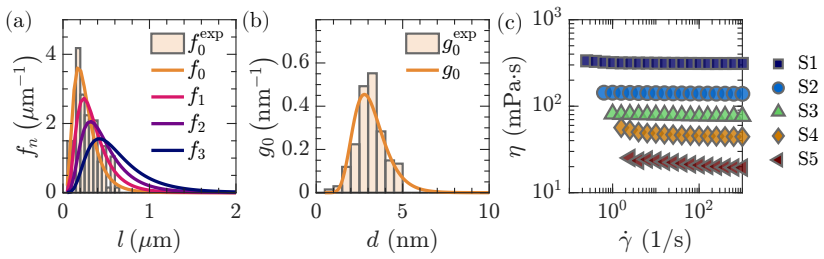
The central claim is that the average orientation relaxation time in dilute polydisperse rod suspensions systematically decreases with increasing pre-shear rate. When the data are plotted against the Péclet number calculated from the rotational diffusion coefficient of the length-weighted average rod, they collapse onto the curve predicted by the polydisperse Fokker-Planck model. The mechanism is a progressive shift in the dominant subpopulation: at low pre-shear longer rods control the relaxation time; at high pre-shear shorter rods do, so that flow history selects which part of the length distribution governs the measured dynamics.
What carries the argument
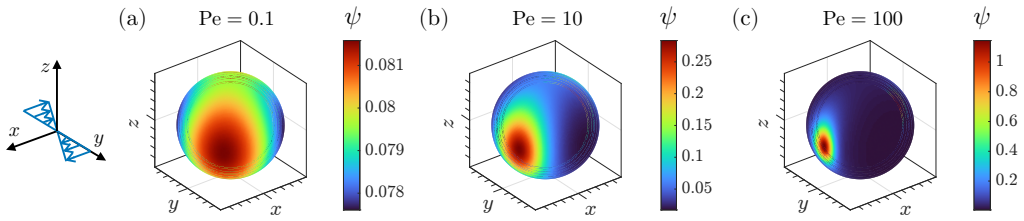
A polydisperse Fokker-Planck model parameterized by the measured rod length distribution, which tracks how each length subpopulation contributes to the birefringence relaxation signal after shear cessation.
If this is right
- In polydisperse rod systems the orientation relaxation time is not a material-specific constant but is set by both flow conditions and the length distribution.
- The rod subpopulation that contributes most to the birefringence signal shifts from longer to shorter rods as pre-shear rate rises.
- Data from different pre-shear rates collapse onto a single curve when scaled by the Péclet number of the length-weighted average rod.
- Quantitative interpretation of rheo-optical measurements in rod suspensions must account for polydispersity and flow history.
Where Pith is reading between the lines
- Processing history could be used to tune the effective relaxation rate in rod-based materials without altering the particle size distribution.
- Analogous subpopulation selection may occur in other polydisperse systems whose components relax at different rates, such as fiber suspensions or certain polymer solutions.
- The model could be extended to predict how the effect changes when rod concentration is raised and hydrodynamic interactions become important.
Load-bearing premise
The birefringence signal measured by polarization imaging directly and quantitatively reflects the average orientation of the rod population without significant contributions from other optical or hydrodynamic effects.
What would settle it
Measure birefringence relaxation times on the same polydisperse suspension after several different pre-shear rates and test whether the observed average times match the subpopulation-shift predictions of the length-weighted Fokker-Planck model; systematic deviation at high rates would falsify the explanation.
Figures


read the original abstract
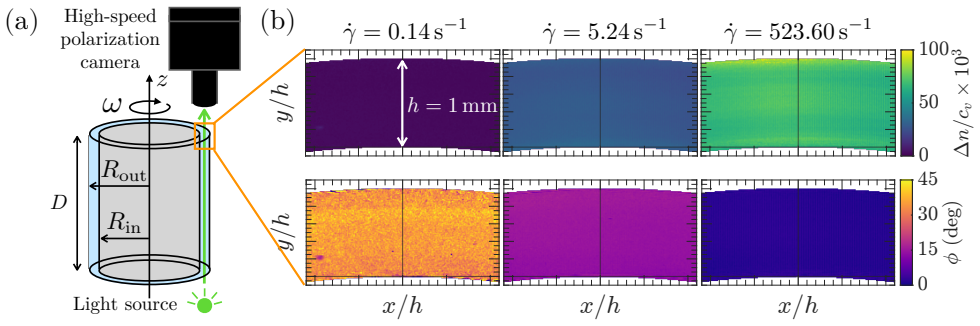
Orientation and relaxation dynamics of rod-like colloids under flow govern the optical and mechanical properties of many emerging soft materials. In polydisperse suspensions, particles of different lengths exhibit distinct rotational diffusion timescales, yet how this polydispersity influences relaxation following flow cessation remains unclear. In particular, it is not well understood how the pre-shear rate determines the subsequent orientation relaxation dynamics. To address this question, we performed simple shear on dilute cellulose nanocrystal (CNC) suspensions in a narrow-gap Taylor-Couette cell and measured birefringence relaxation after flow cessation using high-speed polarization imaging. To interpret the experiments, we formulated a polydisperse Fokker-Planck model parameterized by the measured length distribution. As a result, the average orientation relaxation time systematically decreases with increasing pre-shear rate. Moreover, when organized by the P\'{e}clet number based on the rotational diffusion coefficient of the weighted average rod length, the data agree well with the theory over a wide range of shear rates. This trend arises because the rod sub-population contributing most strongly to the orientation shifts from longer rods to shorter rods as the pre-shear rate increases, showing that the flow history governs the orientation relaxation dynamics. In polydisperse systems, the orientation relaxation time is no longer a material-specific constant but is determined by both the flow conditions and the polydispersity. This study provides a quantitative framework for understanding orientation dynamics in polydisperse rod suspensions and for interpreting rheo-optical measurements.
Editorial analysis
A structured set of objections, weighed in public.
Referee Report
Summary. The manuscript examines flow-history effects on orientational relaxation in dilute polydisperse cellulose nanocrystal (CNC) rod suspensions. Experiments in a narrow-gap Taylor-Couette cell with high-speed polarization imaging show that the average birefringence relaxation time after shear cessation systematically decreases as the pre-shear rate increases. A polydisperse Fokker-Planck model, parameterized directly by the independently measured length distribution, reproduces the experimental trend when the data are organized by a Péclet number constructed from the rotational diffusion coefficient of the weighted-average rod length. The authors attribute the trend to a pre-shear-dependent shift in the rod subpopulation that dominates the measured signal, from longer to shorter rods.
Significance. If the central claim is upheld, the work establishes that relaxation dynamics in polydisperse rod systems are not a fixed material constant but are controlled by flow history through selective orientation of length subpopulations. A clear strength is the parameter-free character of the comparison: the model uses only the measured length distribution as input and achieves data collapse over a wide range of shear rates without adjustable parameters. This supplies a quantitative, falsifiable framework for interpreting rheo-optical measurements in polydisperse colloidal rods and for predicting flow-induced optical and mechanical properties in soft materials.
major comments (2)
- [Model description and comparison with experiment] The mapping from the polydisperse orientation distribution computed by the Fokker-Planck model to the synthetic birefringence signal is not specified. CNC birefringence is typically proportional to a length-dependent polarizability factor (often scaling as L^2 or higher) multiplied by the local order parameter; if the model employs number-averaged or unweighted averaging while the experimental signal is weighted differently, the reported agreement with the single weighted-average Péclet curve could be an artifact. This weighting must be made explicit and shown to be consistent with the experimental conversion to support the subpopulation-shift mechanism.
- [Results and data analysis] The manuscript provides no quantitative error analysis, uncertainty estimates on the extracted relaxation times, or full set of individual relaxation curves. Without these, it is difficult to judge the statistical significance of the systematic decrease in relaxation time or the quality of the data collapse across the reported shear-rate range.
minor comments (2)
- [Abstract and scaling analysis] The precise definition and weighting formula for the 'weighted average rod length' used to construct the Péclet number should be stated explicitly (e.g., whether it is number-, length-, or volume-weighted) rather than left implicit in the abstract and main text.
- [Figures] Figure captions and axis labels would benefit from additional detail on the exact definition of the plotted birefringence quantity and the time window used to extract the relaxation time.
Simulated Author's Rebuttal
We thank the referee for the careful reading of our manuscript and the constructive comments. We appreciate the positive evaluation of the work's significance. We address each major comment below and will revise the manuscript to incorporate the requested clarifications and additional analysis.
read point-by-point responses
-
Referee: [Model description and comparison with experiment] The mapping from the polydisperse orientation distribution computed by the Fokker-Planck model to the synthetic birefringence signal is not specified. CNC birefringence is typically proportional to a length-dependent polarizability factor (often scaling as L^2 or higher) multiplied by the local order parameter; if the model employs number-averaged or unweighted averaging while the experimental signal is weighted differently, the reported agreement with the single weighted-average Péclet curve could be an artifact. This weighting must be made explicit and shown to be consistent with the experimental conversion to support the subpopulation-shift mechanism.
Authors: We agree that the mapping from the computed orientation distributions to the synthetic birefringence signal must be stated explicitly. In the revised manuscript we will add a dedicated paragraph (or subsection) that specifies the exact procedure: the birefringence signal is obtained by integrating the local order parameter for each length subpopulation, weighted by the measured length distribution and by a polarizability factor that scales as L^2 (the standard scaling for CNCs). We will also demonstrate that this weighting is identical to the conversion used to extract the experimental birefringence, thereby confirming that the data collapse onto the weighted-average Péclet curve is not an artifact and directly supports the subpopulation-shift interpretation. revision: yes
-
Referee: [Results and data analysis] The manuscript provides no quantitative error analysis, uncertainty estimates on the extracted relaxation times, or full set of individual relaxation curves. Without these, it is difficult to judge the statistical significance of the systematic decrease in relaxation time or the quality of the data collapse across the reported shear-rate range.
Authors: We acknowledge that the present version lacks quantitative error bars and the complete set of relaxation curves. In the revision we will (i) report uncertainty estimates on the extracted relaxation times obtained from repeated independent measurements, (ii) add error bars to the figures showing relaxation time versus pre-shear rate and versus Péclet number, and (iii) include the full collection of individual relaxation curves in the supplementary information. These additions will allow a direct assessment of the statistical significance of the observed trend and of the quality of the data collapse. revision: yes
Circularity Check
No significant circularity; derivation uses independent inputs
full rationale
The paper parameterizes its polydisperse Fokker-Planck model directly from the experimentally measured length distribution and computes orientation relaxation from the model equations. Data collapse is achieved by nondimensionalizing with a Péclet number constructed from the weighted-average rotational diffusion coefficient, which follows from the model without additional fitting to the relaxation curves. No load-bearing step reduces to a self-definition, a fitted parameter renamed as prediction, or a self-citation chain; the central claim that relaxation time decreases with pre-shear because the dominant subpopulation shifts remains an independent output of the polydisperse dynamics.
Axiom & Free-Parameter Ledger
axioms (1)
- domain assumption Birefringence signal is proportional to the ensemble-averaged orientation of the rods
Reference graph
Works this paper leans on
-
[1]
Butler and Braden Snook
Jason E. Butler and Braden Snook. Microstructural dynamics and rheology of suspensions of rigid fibers. Annual Review of Fluid Mechanics, 50(Volume 50, 2018):299–318, January 2018. ISSN 0066-4189, 1545-
2018
-
[2]
doi: 10.1146/annurev-fluid-122316-045144
-
[3]
Lucia, and Orlando J
Youssef Habibi, Lucian A. Lucia, and Orlando J. Ro- jas. Cellulose nanocrystals: Chemistry, self-assembly, and applications.Chemical Reviews, 110(6):3479– 3500, June 2010. ISSN 0009-2665. doi: 10.1021/ cr900339w
2010
-
[4]
Aref Abbasi Moud and Aliyeh Abbasi Moud. Flow and assembly of cellulose nanocrystals (CNC): A bottom- up perspective - a review.International Journal of Bio- logical Macromolecules, 232:123391, March 2023. ISSN 0141-8130. doi: 10.1016/j.ijbiomac.2023.123391
-
[5]
Pickering, and Lakshmi Priya Muthe
Christian Gauss, Kim L. Pickering, and Lakshmi Priya Muthe. The use of cellulose in bio-derived formulations for 3D/4D printing: A review.Composites Part C: Open Access, 4:100113, March 2021. ISSN 2666-6820. doi: 10.1016/j.jcomc.2021.100113
-
[6]
Jan P. F. Lagerwall, Christina Sch¨ utz, Michaela Sala- jkova, JungHyun Noh, Ji Hyun Park, Giusy Scalia, and Lennart Bergstr¨ om. Cellulose nanocrystal-based materials: From liquid crystal self-assembly and glass formation to multifunctional thin films.NPG Asia Ma- terials, 6(1):e80–e80, January 2014. ISSN 1884-4057. doi: 10.1038/am.2013.69
-
[7]
Ruojun Mu, Xin Hong, Yongsheng Ni, Yuanzhao Li, Jie Pang, Qi Wang, Jianbo Xiao, and Yafeng Zheng. Recent trends and applications of cellulose nanocrys- tals in food industry.Trends in Food Science & Tech- nology, 93:136–144, November 2019. ISSN 0924-2244. doi: 10.1016/j.tifs.2019.09.013
-
[8]
Edwards, and Samuel Frederick Edwards.The Theory of Polymer Dynamics, vol- ume 73
Masao Doi, Sam F. Edwards, and Samuel Frederick Edwards.The Theory of Polymer Dynamics, vol- ume 73. oxford university press, 1988
1988
-
[9]
The motion of ellipsoidal particles immersed in a viscous fluid.Proceedings of the Royal Society of Lon- don
George Barker Jeffery and Louis Napoleon George Filon. The motion of ellipsoidal particles immersed in a viscous fluid.Proceedings of the Royal Society of Lon- don. Series A, Containing Papers of a Mathematical and Physical Character, 102(715):161–179, November
-
[10]
doi: 10.1098/rspa.1922.0078
-
[11]
L. G. Leal and E. J. Hinch. The rheology of a sus- pension of nearly spherical particles subject to brown- ian rotations.Journal of Fluid Mechanics, 55(4):745– 765, October 1972. ISSN 1469-7645, 0022-1120. doi: 10.1017/S0022112072002125
-
[12]
J. Talbot, C. Antoine, P. Claudin, E. Somfai, and T. B¨ orzs¨ onyi. Exploring noisy Jeffery orbits: A com- bined Fokker-Planck and langevin analysis in two and three dimensions.Physical Review E, 110(4):044143, October 2024. doi: 10.1103/PhysRevE.110.044143
-
[13]
Gerald G Fuller.Optical Rheometry of Complex Fluids. Oxford University Press, June 1995. ISBN 978-0-19- 509718-4. doi: 10.1093/oso/9780195097184.001.0001
-
[14]
Paul F. Salipante, Steve Kuei, Ryan P. Murphy, Jeffrey A. Fagan, Christopher M. Sims, Katie M. Weigandt, and Steven D. Hudson. Rheology and microstructural behavior of semidilute suspensions of semiflexible rods across five decades of shear rate. Macromolecules, February 2025. ISSN 0024-9297. doi: 10.1021/acs.macromol.4c02675
-
[15]
Vincenzo Calabrese, Amy Q. Shen, and Simon J. Haward. Naturally derived colloidal rods in microflu- idic flows.Biomicrofluidics, 17(2):021301, March 2023. doi: 10.1063/5.0142867
-
[16]
Roland K´ ad´ ar, Stefan Spirk, and Tiina Nypel¨ o. Cel- lulose nanocrystal liquid crystal phases: Progress and challenges in characterization using rheology coupled to optics, scattering, and spectroscopy.ACS Nano, 15(5):7931–7945, May 2021. ISSN 1936-0851. doi: 10.1021/acsnano.0c09829
-
[17]
Pritchard, Fernando Navarro, Maren Ro- man, and Michael J
Cailean Q. Pritchard, Fernando Navarro, Maren Ro- man, and Michael J. Bortner. Multi-axis alignment of rod-like cellulose nanocrystals in drying droplets. Journal of Colloid and Interface Science, 603:450–458, December 2021. ISSN 0021-9797. doi: 10.1016/j.jcis. 2021.06.069
-
[18]
Lopez, Minne Paul Lettinga, Simon J
Vincenzo Calabrese, Tatiana Porto Santos, Carlos G. Lopez, Minne Paul Lettinga, Simon J. Haward, and Amy Q. Shen. Extensibility governs the flow-induced alignment of polymers and rod-like colloids.Physical Review Research, 6(1):L012042, February 2024. doi: 10.1103/PhysRevResearch.6.L012042
-
[19]
Kento Nakamine, Yuto Yokoyama, William Kai Alexander Worby, Masakazu Muto, and Yoshiyuki Tagawa. Flow birefringence of cellulose nanocrys- tal suspensions in three-dimensional flow fields: Revisiting the stress-optic law.Cellulose, 31(12): 7405–7420, August 2024. ISSN 1572-882X. doi: 10.1007/s10570-024-06045-x. 14
-
[20]
Jongwook Kim, S´ ebastien Michelin, Michiel Hilbers, Lucio Martinelli, Elodie Chaudan, Gabriel Amse- lem, Etienne Fradet, Jean-Pierre Boilot, Albert M. Brouwer, Charles N. Baroud, Jacques Peretti, and Thierry Gacoin. Monitoring the orientation of rare- earth-doped nanorods for flow shear tomography.Na- ture Nanotechnology, 12(9):914–919, September 2017. I...
-
[21]
Charles Rosenblatt, Richard B. Frankel, and Richard P. Blakemore. A birefringence relax- ation determination of rotational diffusion of magnetotactic bacteria.Biophysical Journal, 47 (3):323–325, March 1985. ISSN 0006-3495. doi: 10.1016/S0006-3495(85)83922-9
-
[22]
Bellini, F
T. Bellini, F. Mantegazza, R. Piazza, and V. Degior- gio. Stretched-exponential relaxation of electric bire- fringence in a polydisperse colloidal solution.Euro- physics Letters, 10(5):499, January 1989. ISSN 0295-
1989
-
[23]
doi: 10.1209/0295-5075/10/5/019
-
[24]
Daniel S¨ oderberg, and Fredrik Lundell
Christophe Brouzet, Nitesh Mittal, L. Daniel S¨ oderberg, and Fredrik Lundell. Size-dependent orien- tational dynamics of brownian nanorods.ACS Macro Letters, 7(8):1022–1027, August 2018. doi: 10.1021/ acsmacrolett.8b00487
2018
-
[25]
Roth, Peng Zhang, L
Tomas Ros´ en, Nitesh Mittal, Stephan V. Roth, Peng Zhang, L. Daniel S¨ oderberg, and Fredrik Lundell. Flow fields control nanostructural organization in semi- flexible networks.Soft Matter, 16(23):5439–5449,
-
[26]
doi: 10.1039/ C9SM01975H
ISSN 1744-683X, 1744-6848. doi: 10.1039/ C9SM01975H
-
[27]
Recktenwald, Vincenzo Calabrese, Amy Q
Steffen M. Recktenwald, Vincenzo Calabrese, Amy Q. Shen, Giovanniantonio Natale, and Simon J. Haward. Colloidal rod dynamics under large amplitude oscilla- tory extensional flow.Soft Matter, January 2026. ISSN 1744-6848. doi: 10.1039/D5SM01122A
-
[28]
Shear flow behavior of bidisperse rodlike colloids.Macro- molecules, 53(7):2662–2668, April 2020
Christian Lang and Minne Paul Lettinga. Shear flow behavior of bidisperse rodlike colloids.Macro- molecules, 53(7):2662–2668, April 2020. ISSN 0024-
2020
-
[29]
doi: 10.1021/acs.macromol.9b02239
-
[30]
Matsumoto, H
M. Matsumoto, H. Watanabe, and K. Yoshioka. A method for determining the relaxation spectrum from the decay curve of electric birefringence of macromolec- ular solutions.Kolloid-Zeitschrift und Zeitschrift f¨ ur Polymere, 250(4):298–302, April 1972. ISSN 1435-
1972
-
[31]
doi: 10.1007/BF01513331
-
[32]
Daniel S¨ oderberg
Christophe Brouzet, Nitesh Mittal, Fredrik Lun- dell, and L. Daniel S¨ oderberg. Characterizing the orientational and network dynamics of polydisperse nanofibers on the nanoscale.Macromolecules, 52(6): 2286–2295, March 2019. ISSN 0024-9297. doi: 10. 1021/acs.macromol.8b02714
2019
-
[33]
Paul L. Frattini and Gerald G. Fuller. Rheo-optical studies of the effect of weak brownian rotations in sheared suspensions.Journal of Fluid Mechanics, 168: 119–150, July 1986. ISSN 1469-7645, 0022-1120. doi: 10.1017/S0022112086000319
-
[34]
Paloma Arenas-Guerrero, ´Angel V. Delgado, Kevin J. Donovan, Kenneth Scott, Tommaso Bellini, Francesco Mantegazza, and Mar´ ıa L. Jim´ enez. Determination of the size distribution of non-spherical nanoparticles by electric birefringence-based methods.Scientific Re- ports, 8(1):9502, June 2018. ISSN 2045-2322. doi: 10.1038/s41598-018-27840-0
-
[35]
Rogers, Paul Venema, Leonard M
Salman S. Rogers, Paul Venema, Leonard M. C. Sagis, Erik van der Linden, and Athene M. Donald. Mea- suring the length distribution of a fibril system: a flow birefringence technique applied to amyloid fibrils. Macromolecules, 38(7):2948–2958, April 2005. ISSN 0024-9297. doi: 10.1021/ma0474224
-
[36]
Daisuke Noto, Yuji Tasaka, Jumpei Hitomi, and Yuichi Murai. Applicability evaluation of the stress-optic law in newtonian fluids toward stress field measurements. Physical Review Research, 2(4):043111, October 2020. doi: 10.1103/PhysRevResearch.2.043111
-
[37]
Stress-optical analysis of flu- ids.Rheologica Acta, 1(4):371–375, March 1961
Wladimir Philippoff. Stress-optical analysis of flu- ids.Rheologica Acta, 1(4):371–375, March 1961. ISSN 1435-1528. doi: 10.1007/BF01989069
-
[38]
Connor Lane, Fr´ ed´ eric Baumann, David Rode, and Thomas R¨ osgen. Two-dimensional strain rate imag- ing study using a polarization camera and birefrin- gent aqueous cellulose nanocrystal suspensions.Ex- periments in Fluids, 65(1):8, December 2023. ISSN 1432-1114. doi: 10.1007/s00348-023-03730-8
-
[39]
Daisuke Noto, Kohei Ohie, and Yuji Tasaka. Unsteady flows uncover the limits of the stress-optic law.Na- ture Communications, 16(1):9418, October 2025. ISSN 2041-1723. doi: 10.1038/s41467-025-64461-4
-
[40]
F. P. Bretherton. The motion of rigid particles in a shear flow at low Reynolds number.Journal of Fluid Mechanics, 14(2):284–304, October 1962. ISSN 1469- 7645, 0022-1120. doi: 10.1017/S002211206200124X
-
[41]
Yu-Guo Tao, W. K. den Otter, J. K. G. Dhont, and W. J. Briels. Isotropic-nematic spinodals of rigid long thin rodlike colloids by event-driven brownian dynam- ics simulations.The Journal of Chemical Physics, 124(13):134906, April 2006. ISSN 0021-9606. doi: 10.1063/1.2180251
-
[42]
Doi and S
M. Doi and S. F. Edwards. Dynamics of rod-like macromolecules in concentrated solution. Part 1.Jour- nal of the Chemical Society, Faraday Transactions 2: Molecular and Chemical Physics, 74(0):560–570, January 1978. ISSN 0300-9238. doi: 10.1039/ F29787400560
1978
-
[43]
Masao Doi and Sam F. Edwards. Dynamics of rod- like macromolecules in concentrated solution. Part 2. 15 Journal of the Chemical Society, Faraday Transac- tions 2: Molecular and Chemical Physics, 74(0):918– 932, January 1978. ISSN 0300-9238. doi: 10.1039/ F29787400918
1978
-
[44]
Strand, Sangtae Kim, and Seppo J
Steven R. Strand, Sangtae Kim, and Seppo J. Karrila. Computation of rheological properties of suspensions of rigid rods: Stress growth after inception of steady shear flow.Journal of Non-Newtonian Fluid Mechan- ics, 24(3):311–329, January 1987. ISSN 0377-0257. doi: 10.1016/0377-0257(87)80044-7
-
[45]
A (Galerkin) spectral method for rigid spheroids under flow
Fabian Hillebrand. A (Galerkin) spectral method for rigid spheroids under flow. Zenodo, December 2025
2025
-
[46]
Andrea W. Chow and Gerald G. Fuller. Rheooptical response of rodlike chains subject to transient shear flow. 1. Model calculations on the effects of polydis- persity.Macromolecules, 18(4):786–793, April 1985. ISSN 0024-9297. doi: 10.1021/ma00146a033
-
[47]
Kirstin R. Purdy. Measuring the nematic order of sus- pensions of colloidal fd virus by x-ray diffraction and optical birefringence.Physical Review E, 67(3), 2003. doi: 10.1103/PhysRevE.67.031708
-
[48]
Kojiro Uetani, Hirotaka Koga, and Masaya Nogi. Esti- mation of the intrinsic birefringence of cellulose using bacterial cellulose nanofiber films.ACS Macro Letters, 8(3):250–254, March 2019. doi: 10.1021/acsmacrolett. 9b00024
-
[49]
C. A Hollingsworth and I. Ren´ e Fielding. Effects of particle interaction and polydispersity on flow bire- fringence of suspensions of rigid particles with cylin- drical symmetry.Journal of Colloid and Interface Sci- ence, 36(1):124–129, May 1971. ISSN 0021-9797. doi: 10.1016/0021-9797(71)90248-7
-
[50]
S. S. Rogers, P. Venema, J. P. M. van der Ploeg, L. M. C. Sagis, A. M. Donald, and E. van der Linden. Electric birefringence study of an amyloid fibril system: The short end of the length distribution.The Euro- pean Physical Journal E, 18(2):207–217, October 2005. ISSN 1292-895X. doi: 10.1140/epje/i2005-10038-2
-
[51]
Swift particle size characterization by transient electric birefringence
Denise M Oakley and Barry R Jennings. Swift particle size characterization by transient electric birefringence. Journal of Colloid and Interface Science, 91(1):188– 198, January 1983. ISSN 0021-9797. doi: 10.1016/ 0021-9797(83)90325-9
1983
-
[52]
R. M. J. Watson and B. R. Jennings. Polydisperse size data from single electric birefringence transients. Powder Technology, 72(1):63–69, October 1992. ISSN 0032-5910. doi: 10.1016/S0032-5910(92)85022-N
-
[53]
Jakubek, Maohui Chen, Martin Couillard, Tianyang Leng, Leslie Liu, Shan Zou, Ulrich Baxa, Jeffrey D
Zygmunt J. Jakubek, Maohui Chen, Martin Couillard, Tianyang Leng, Leslie Liu, Shan Zou, Ulrich Baxa, Jeffrey D. Clogston, Wadood Y. Hamad, and Linda J. Johnston. Characterization challenges for a cellulose nanocrystal reference material: Dispersion and particle size distributions.Journal of Nanoparticle Research, 20(4):98, April 2018. ISSN 1572-896X. doi:...
2018
-
[54]
Haward, John Tsamopoulos, and Amy Q
Vincenzo Calabrese, Stylianos Varchanis, Simon J. Haward, John Tsamopoulos, and Amy Q. Shen. Structure-property relationship of a soft colloidal glass in simple and mixed flows.Journal of Colloid and In- terface Science, 601:454–466, November 2021. ISSN 0021-9797. doi: 10.1016/j.jcis.2021.05.103
-
[55]
Ivan Usov and Raffaele Mezzenga. FiberApp: An open-source software for tracking and analyzing poly- mers, filaments, biomacromolecules, and fibrous ob- jects.Macromolecules, 48(5):1269–1280, March 2015. ISSN 0024-9297. doi: 10.1021/ma502264c
-
[56]
Yum Rak Oh and O Ok Park. Transient flow bire- fringence of calf skin collagen solutions.Journal of Chemical Engineering of Japan, 25(3):243–250, 1992. doi: 10.1252/jcej.25.243
-
[57]
Pascal Bertsch, Antoni S´ anchez-Ferrer, Massimo Bag- nani, St´ ephane Isabettini, Joachim Kohlbrecher, Raf- faele Mezzenga, and Peter Fischer. Ion-induced for- mation of nanocrystalline cellulose colloidal glasses containing nematic domains.Langmuir, 35(11):4117– 4124, March 2019. ISSN 0743-7463. doi: 10.1021/acs. langmuir.9b00281
work page doi:10.1021/acs 2019
-
[58]
Vincenzo Calabrese, Stylianos Varchanis, Simon J. Haward, and Amy Q. Shen. Alignment of colloidal rods in crowded environments.Macromolecules, 55 (13):5610–5620, July 2022. ISSN 0024-9297. doi: 10.1021/acs.macromol.2c00769
-
[59]
Tasos Papanastasiou, Georgios Georgiou, and An- dreas N. Alexandrou.Viscous Fluid Flow. CRC Press, Boca Raton, March 2021. ISBN 978-0-367-80242-4. doi: 10.1201/9780367802424
-
[60]
A development of two-dimensional birefringence distribution measure- ment system with a sampling rate of 1.3mhz.Optics Communications, 315:69–73, March 2014
Takashi Onuma and Yukitoshi Otani. A development of two-dimensional birefringence distribution measure- ment system with a sampling rate of 1.3mhz.Optics Communications, 315:69–73, March 2014. ISSN 0030-
2014
-
[61]
doi: 10.1016/j.optcom.2013.10.086
-
[62]
Yuto Yokoyama, Benjamin R. Mitchell, Ali Nassiri, Brad L. Kinsey, Yannis P. Korkolis, and Yoshiyuki Tagawa. Integrated photoelasticity in a soft mate- rial: Phase retardation, azimuthal angle, and stress- optic coefficient.Optics and Lasers in Engineering, 161:107335, February 2023. ISSN 0143-8166. doi: 10.1016/j.optlaseng.2022.107335
-
[63]
Muhammad Noman Khan, Zain ul Abidin, Shamim Khan, Almas, Sonia Mustafa, and Iftikhar Ahmad. Birefringence of cellulose: Review, measurement tech- niques, dispersion models, biomedical applications and future perspectives.Wood Science and Technology, 58(1):5–22, December 2023. ISSN 1432-5225. doi: 10.1007/s00226-023-01512-3. 16
-
[64]
Reddy, Giovanniantonio Natale, Robert K
Naveen K. Reddy, Giovanniantonio Natale, Robert K. Prud’homme, and Jan Vermant. Rheo-optical analysis of functionalized graphene suspensions.Langmuir, 34 (26):7844–7851, July 2018. ISSN 0743-7463. doi: 10. 1021/acs.langmuir.8b01574
2018
-
[65]
The Journal of Phys- ical Chemistry C125(48), 26437–26447 (2021) https://doi.org/10.1021/acs.jpcc
Paloma Arenas-Guerrero, Silvia Ahualli, ´Angel V. Del- gado, and Mar´ ıa L. Jim´ enez. Electric birefringence of gold nanorods: Effect of surfactant coating.The Jour- nal of Physical Chemistry C, 123(43):26623–26632, Oc- tober 2019. ISSN 1932-7447. doi: 10.1021/acs.jpcc. 9b06703
-
[66]
Na Li, Pengxiang Zhao, and Didier Astruc. Anisotropic gold nanoparticles: Synthesis, properties, applications, and toxicity.Angewandte Chemie International Edi- tion, 53(7):1756–1789, 2014. ISSN 1521-3773. doi: 10.1002/anie.201300441
-
[67]
Liz-Marz´ an, and Paul Mulvaney
Jorge P´ erez-Juste, Isabel Pastoriza-Santos, Luis M. Liz-Marz´ an, and Paul Mulvaney. Gold nanorods: Syn- thesis, characterization and applications.Coordina- tion Chemistry Reviews, 249(17):1870–1901, Septem- ber 2005. ISSN 0010-8545. doi: 10.1016/j.ccr.2005.01. 030. 17
discussion (0)
Sign in with ORCID, Apple, or X to comment. Anyone can read and Pith papers without signing in.