Recognition: unknown
Cutoff-independent predictions from nuclear lattice effective field theory
Pith reviewed 2026-05-09 23:01 UTC · model grok-4.3
The pith
A minimal chiral nuclear force fitted only to light nuclei predicts binding energies up to 40Ca with cutoff dependence of just a few MeV.
A machine-rendered reading of the paper's core claim, the machinery that carries it, and where it could break.
Core claim
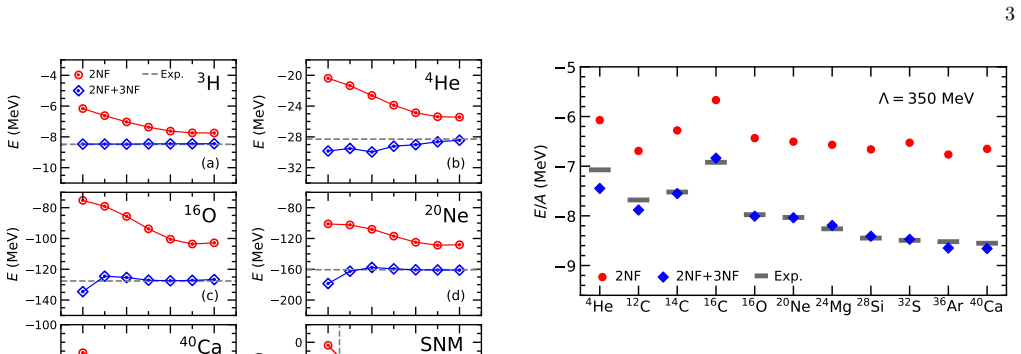
A chiral nuclear interaction consisting of contact terms up to next-to-leading order, a single three-nucleon contact force, and leading-order one-pion exchange, all constrained strictly in the A ≤ 3 sector, accurately reproduces experimental binding energies up to 40Ca with residual cutoff dependencies of only a few MeV by using a lattice-inspired absolute-momentum regulator that suppresses high-momentum modes without complex many-body forces.
What carries the argument
The lattice-inspired absolute-momentum regulator that suppresses high-momentum modes and prevents overbinding.
If this is right
- Binding energies for medium-mass nuclei can be predicted from parameters fixed solely in the A ≤ 3 sector.
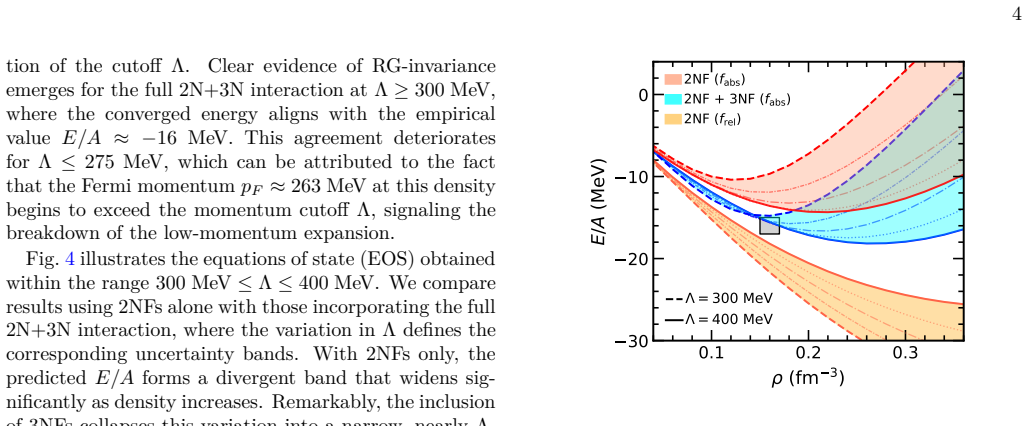
- Cutoff independence holds across nuclei from light to 40Ca and sub-saturated nuclear matter with residuals of a few MeV.
- Complex many-body forces are unnecessary to resolve overbinding in soft chiral forces.
- The same minimal interaction serves as a foundation for both continuum and lattice ab initio calculations.
Where Pith is reading between the lines
- The regulator approach may extend to other observables such as nuclear radii or scattering without additional fitting.
- Testing the interaction on nuclei heavier than 40Ca would show where the minimal form ceases to be accurate.
- Similar absolute-momentum regulators could simplify EFT calculations in related few-body systems.
Load-bearing premise
That parameters fitted strictly to nuclei with three or fewer nucleons remain predictive for heavier nuclei without higher-order interactions or explicit many-body forces.
What would settle it
A calculation of the 40Ca binding energy at varied cutoffs within the paper's range showing deviations much larger than a few MeV.
Figures

read the original abstract
Cutoff independence is an essential requirement for the predictive power of nuclear \textit{ab initio} calculations based on effective field theory (EFT). While it is conventionally assumed that such invariance necessitates high-order interactions and complex many-body forces, we present a minimal chiral nuclear force that exhibits remarkable cutoff independence across a broad range from light to medium-mass nuclei and sub-saturated nuclear matter. Our framework comprises only contact terms up to next-to-leading order, a single three-nucleon contact force, and a leading-order one-pion-exchange potential, all constrained strictly in the $A \leq 3$ sector. Despite its simplicity, this interaction accurately reproduces experimental binding energies up to $^{40}\text{Ca}$ with unexpectedly small residual cutoff dependencies of only a few MeV. We demonstrate that the use of a lattice-inspired \emph{absolute}-momentum regulator efficiently suppresses high-momentum modes, resolving the overbinding problem for soft chiral forces without invoking complex many-body forces. These results establish a robust and economic foundation for EFT-based \textit{ab initio} calculations in both continuum and lattice frameworks.
Editorial analysis
A structured set of objections, weighed in public.
Referee Report
Summary. The manuscript presents a minimal chiral EFT nuclear interaction consisting of LO one-pion exchange, NLO two-nucleon contacts, and a single three-nucleon contact, with all low-energy constants fixed exclusively to A≤3 data. It claims that a lattice-inspired absolute-momentum regulator enables cutoff-independent predictions of binding energies up to 40Ca with only a few MeV residual dependence, without requiring higher-order or additional many-body forces.
Significance. If the reported cutoff independence and predictive accuracy hold under detailed scrutiny, the result would be significant for nuclear ab initio theory: it offers a simple, economical framework that could streamline calculations in both lattice and continuum settings while addressing overbinding issues for soft interactions. The approach challenges the conventional need for complex many-body forces in this mass range and highlights the potential of regulator design to enhance EFT predictivity.
major comments (3)
- Abstract: the central claim that binding energies up to 40Ca are reproduced with 'only a few MeV' residual cutoff dependence is stated without quantitative details on the precise binding-energy values, error bars, fitting procedure, data selection criteria, or numerical methods employed. This leaves the load-bearing assertion of cutoff independence only partially supported.
- Regulator section (implied in formalism and results): the absolute-momentum regulator is presented as efficiently suppressing high-momentum modes without artifacts, yet no explicit comparison is shown with a conventional momentum cutoff applied to the same interaction. Without this test, it remains unclear whether the small residual dependence is a genuine EFT feature or an artifact of the regulator choice effectively renormalizing the low-energy constants in a cutoff-dependent manner when the many-body space enlarges to 40Ca.
- Results on 40Ca: parameters are fitted strictly to A≤3 systems, and the application to 40Ca is offered as a prediction; however, the manuscript does not demonstrate that the single 3N contact plus NLO contacts remain sufficient without cutoff-dependent absorption of higher-order or many-body contributions, contrary to standard chiral EFT experience where three- and four-body forces become essential in this regime.
minor comments (2)
- The explicit functional form of the absolute-momentum regulator should be provided with an equation number in the formalism section to allow reproducibility.
- Clarify the precise definition of 'cutoff independence' (e.g., variation across which specific cutoff values) and include a table summarizing binding energies versus cutoff for key nuclei.
Simulated Author's Rebuttal
We thank the referee for the positive assessment of the significance of our work and for the detailed comments. We address each of the major comments below.
read point-by-point responses
-
Referee: Abstract: the central claim that binding energies up to 40Ca are reproduced with 'only a few MeV' residual cutoff dependence is stated without quantitative details on the precise binding-energy values, error bars, fitting procedure, data selection criteria, or numerical methods employed. This leaves the load-bearing assertion of cutoff independence only partially supported.
Authors: We acknowledge that the abstract could be more informative. In the revised manuscript, we will include quantitative details such as the specific binding energies for nuclei up to 40Ca, the range of residual cutoff dependence (a few MeV), and references to the fitting procedure and numerical methods described in the main text. This will better support the central claim. revision: yes
-
Referee: Regulator section (implied in formalism and results): the absolute-momentum regulator is presented as efficiently suppressing high-momentum modes without artifacts, yet no explicit comparison is shown with a conventional momentum cutoff applied to the same interaction. Without this test, it remains unclear whether the small residual dependence is a genuine EFT feature or an artifact of the regulator choice effectively renormalizing the low-energy constants in a cutoff-dependent manner when the many-body space enlarges to 40Ca.
Authors: The absolute-momentum regulator is specifically chosen in our lattice EFT framework to suppress high-momentum components in a manner consistent with the EFT power counting. We believe the small residual dependence observed is a genuine feature, as evidenced by the consistent predictions across cutoffs. However, to address the referee's concern, we will add a paragraph in the formalism section discussing the properties of this regulator compared to conventional ones and why it avoids the renormalization artifacts mentioned. A full numerical comparison may require additional computations, but we will clarify the distinction. revision: partial
-
Referee: Results on 40Ca: parameters are fitted strictly to A≤3 systems, and the application to 40Ca is offered as a prediction; however, the manuscript does not demonstrate that the single 3N contact plus NLO contacts remain sufficient without cutoff-dependent absorption of higher-order or many-body contributions, contrary to standard chiral EFT experience where three- and four-body forces become essential in this regime.
Authors: Our calculations show that the minimal set of interactions, constrained only in A≤3, provides predictions for 40Ca binding energies with only a few MeV cutoff dependence, which indicates that the single 3N contact is sufficient in this regulator scheme. This does not contradict standard chiral EFT because the absolute-momentum regulator effectively handles the high-momentum contributions differently than soft regulators that lead to overbinding. We will expand the discussion in the results section to explicitly address this point and explain how our approach differs from conventional expectations. revision: no
Circularity Check
No significant circularity; extrapolation and regulator effects are demonstrated rather than constructed
full rationale
The paper constrains all LECs strictly to A≤3 data, then performs explicit many-body calculations to obtain binding energies and cutoff dependence up to 40Ca. This is a standard EFT extrapolation test whose outcomes are not forced by the fitting procedure itself. The lattice-inspired absolute-momentum regulator is introduced as an independent technical choice whose UV suppression is verified numerically by comparing cutoff variations; it is not defined in terms of the target cutoff independence. No quoted equation or claim reduces the reported predictions to the input fits by construction, and no self-citation chain is invoked to justify uniqueness or forbid alternatives. The central results therefore remain independent of the fitted inputs.
Axiom & Free-Parameter Ledger
free parameters (1)
- NLO contact strengths and 3N contact strength
axioms (2)
- domain assumption Chiral EFT power counting remains valid up to NLO for nuclear forces
- ad hoc to paper Absolute-momentum lattice regulator suppresses high-momentum modes without artifacts
Reference graph
Works this paper leans on
-
[1]
Machleidt, What is ab initio?, Few-body Syst
R. Machleidt, What is ab initio?, Few-body Syst. 64, 77 (2023)
2023
-
[2]
Papenbrock, Ab initio computations of atomic nuclei, arXiv:2410.00843 [nucl-th] (2024)
T. Papenbrock, Ab initio computations of atomic nuclei, arXiv:2410.00843 [nucl-th] (2024)
-
[3]
Navrátil, S
P. Navrátil, S. Quaglioni, G. Hupin, C. Romero-Redondo, and A. Calci, Unified ab initio approaches to nuclear structure and reactions, Phys. Scr. 91, 053002 (2016)
2016
-
[4]
Weinberg, Nuclear forces from chiral lagrangians, Phys
S. Weinberg, Nuclear forces from chiral lagrangians, Phys. Lett. B 251, 288 (1990)
1990
-
[5]
Epelbaum, H.-W
E. Epelbaum, H.-W. Hammer, and U.-G. Meißner, Mod- ern theory of nuclear forces, Rev. Mod. Phys. 81, 1773 (2009)
2009
-
[6]
Machleidt and D
R. Machleidt and D. R. Entem, Chiral effective field the- ory and nuclear forces, Phys. Rep. 503, 1 (2023)
2023
-
[7]
Hammer, S
H.-W. Hammer, S. König, and U. van Kolck, Nuclear effective field theory: Status and perspectives, Rev. Mod. Phys. 92, 025004 (2020)
2020
-
[8]
D. R. Entem and R. Machleidt, Accurate charge- dependent nucleon-nucleon potential at fourth order of chiral perturbation theory, Phys. Rev. C 68, 041001 (2003)
2003
-
[9]
Epelbaum, W
E. Epelbaum, W. Glöckle, and U.-G. Meißner, The two- nucleon system at next-to-next-to-next-to-leading order, Nucl. Phys. A 747, 362 (2005)
2005
-
[10]
Ekström, G
A. Ekström, G. Baardsen, C. Forssén, G. Ha- gen, M. Hjorth-Jensen, G. R. Jansen, R. Machleidt, W. Nazarewicz, T. Papenbrock, J. Sarich, and S. M. Wild, Optimized chiral nucleon-nucleon interaction at next-to-next-to-leading order, Phys. Rev. Lett. 110, 192502 (2013)
2013
-
[11]
Epelbaum, H
E. Epelbaum, H. Krebs, and U.-G. Meißner, Impoved chiral nucleon-nucleon potential up to next-to-next-to- next-to-leading order, Eur. Phys. J. A 51, 53 (2015)
2015
-
[12]
Reinert, H
P. Reinert, H. Krebs, and E. Epelbaum, Semilocal momentum-space regularized chiral two-nucleon poten- tials up to fifth order, Eur. Phys. J. A 54, 86 (2018)
2018
-
[13]
Machleidt and F
R. Machleidt and F. Sammarruca, Can chiral EFT give us satisfaction?, Eur. Phys. J. A 56, 95 (2020)
2020
- [14]
-
[15]
R. J. Furnstahl, H.-W. Hammer, and A. Schwenk, Nu- clear structure at the crossroads, Few-Body Syst. 62, 72 (2021)
2021
-
[16]
D. B. Kaplan, M. J. Savage, and M. B. Wise, A new expansion for nucleon-nucleon interactions, Phys. Lett. B 424, 390 (1998)
1998
-
[17]
Nogga, R
A. Nogga, R. G. E. Timmermans, and U. v. Kolck, Renor- malization of one-pion exchange and power counting, Phys. Rev. C 72, 054006 (2005)
2005
-
[18]
Epelbaum, J
E. Epelbaum, J. Gegelia, and U.-G. Meißner, Wilsonian renormalization group versus subtractive renormalization in effective field theories for nucleonnucleon scattering, Nucl. Phys. B 925, 161 (2017)
2017
-
[19]
A. N. Kvinikhidze and B. C. Blankleider, Renormalisa- tion group analysis of electromagnetic couplings in the pionless effective field theorys, Eur. Phys. J. A 54, 216 (2018)
2018
-
[20]
Epelbaum, A
E. Epelbaum, A. M. Gasparyan, J. Gegelia, and U.-G. Meißner, How (not) to renormalize integral equations with singular potentials in effective field theory, Eur. Phys. J. A 54, 186 (2018)
2018
-
[21]
Epelbaum, A
E. Epelbaum, A. M. Gasparyan, J. Gegelia, U.-G. Meißner, and X.-L. Ren, How to renormalize integral equations with singular potentials in effective field the- ory, Eur. Phys. J. A 56, 152 (2020)
2020
-
[22]
Contessi, M
L. Contessi, M. Pavon Valderrama, and U. van Kolck, Limits on an improved action for contact effective field theory in two-body systems, Phys. Lett. B 856, 138903 (2024)
2024
-
[23]
Yang, Further theoretical study on the renormaliza- tion group aspect of perturbative corrections, Phys
C.-J. Yang, Further theoretical study on the renormaliza- tion group aspect of perturbative corrections, Phys. Rev. C 112, 014004 (2025)
2025
-
[24]
P. F. Bedaque, H.-W. Hammer, and U. van Kolck, Renor- malization of the three-body system with short-range in- teractions, Phys. Rev. Lett. 82, 463 (1999)
1999
-
[25]
J. Wang, J. P. D’Incao, B. D. Esry, and C. H. Greene, Origin of the three-body parameter universality in efimov physics, Phys. Rev. Lett. 108, 263001 (2012)
2012
-
[26]
Epelbaum, J
E. Epelbaum, J. Gegelia, U.-G. Meißner, and D.-L. Yao, Renormalization of the three-boson system with short- range interactions revisited, Eur. Phys. J. A 53, 98 (2017)
2017
-
[27]
Y.-H. Song, R. Lazauskas, and U. van Kolck, Triton bind- ing energy and neutron-deuteron scattering up to next- to-leading order in chiral effective field theory, Phys. Rev. C 96, 024002 (2017)
2017
-
[28]
Platter, H.-W
L. Platter, H.-W. Hammer, and U.-G. Meißner, On the correlation between the binding energies of the triton and the -particle, Phys. Lett. B 607, 254 (2005)
2005
-
[29]
Kirscher, Zero-energy neutrontriton and protonhelium-3 scattering with EFT( π /), Phys
J. Kirscher, Zero-energy neutrontriton and protonhelium-3 scattering with EFT( π /), Phys. Lett. B 721, 335 (2013)
2013
-
[30]
Klein, S
N. Klein, S. Elhatisari, T. A. Lähde, D. Lee, and U.-G. Meißner, The Tjon band in nuclear lattice effective field theory, Eur. Phys. J. A 54, 121 (2018)
2018
-
[31]
L. H. A vraham and B. Bazak, Few-nucleon systems within finite-cutoff pionless EFT, Phys. Lett. B 872, 140100 (2026)
2026
-
[32]
Shi, C.-C
J.-A. Shi, C.-C. Wang, and B.-N. Lu, Observation of renormalization group invariance in symmetry-restored nuclear lattice effective field theory, Phys. Lett. B 874, 140303 (2026)
2026
-
[33]
Shirokov, I
A. Shirokov, I. Shin, Y. Kim, M. Sosonkina, M. P., and J. Vary, N3LO NN interaction adjusted to light nuclei in ab exitu approach, Phys. Lett. B 761, 87 (2016)
2016
-
[34]
Logoteta, I
D. Logoteta, I. Bombaci, and A. Kievsky, Nuclear matter saturation with chiral three-nucleon interactions fitted to light nuclei properties, Phys. Lett. B 758, 449 (2016)
2016
-
[35]
Drischler, K
C. Drischler, K. Hebeler, and A. Schwenk, Chiral inter- actions up to next-to-next-to-next-to-leading order and nuclear saturation, Phys. Rev. Lett. 122, 042501 (2019)
2019
-
[36]
Hoppe, C
J. Hoppe, C. Drischler, K. Hebeler, A. Schwenk, and J. Simonis, Probing chiral interactions up to next-to- next-to-next-to-leading order in medium-mass nuclei, Phys. Rev. C 100, 024318 (2019)
2019
-
[37]
V. Somà, P. Navrátil, F. Raimondi, C. Barbieri, and T. Duguet, Novel chiral Hamiltonian and observables in light and medium-mass nuclei, Phys. Rev. C 101, 014318 (2020)
2020
-
[38]
Hüther, K
T. Hüther, K. Vobig, K. Hebeler, R. Machleidt, and R. Roth, Family of chiral two- plus three-nucleon interac- 6 tions for accurate nuclear structure studies, Phys. Lett. B 808, 135651 (2020)
2020
-
[39]
W. G. Jiang, C. Forssén, T. Djärv, and G. Hagen, Nuclear-matter saturation and symmetry energy within ∆-full chiral effective field theory, Phys. Rev. C 109, L061302 (2024)
2024
-
[40]
Schiavilla, L
R. Schiavilla, L. Girlanda, A. Gnech, A. Kievsky, A. Lo- vato, L. E. Marcucci, M. Piarulli, and M. Viviani, Two- and three-nucleon contact interactions and ground-state energies of light- and medium-mass nuclei, Phys. Rev. C 103, 054003 (2021)
2021
-
[41]
C.-J. Yang, A. Ekström, C. Forssén, and G. Hagen, Power counting in chiral effective field theory and nuclear bind- ing, Phys. Rev. C 103, 054304 (2021)
2021
-
[42]
M. S. Sánchez, D. D. Dao, and L. Bonneau, Cutoff effects in hartree-fock calculations at leading order of chiral ef- fective field theory, Phys. Rev. C 107, 064307 (2023)
2023
-
[43]
L. Contessi, M. Schäfer, A. Gnech, A. Lovato, and U. van Kolck, A renormalizable theory for not-so-light nuclei, arXiv:2505.09299 [nucl-th] (2025)
-
[44]
B.-N. Lu, N. Li, S. Elhatisari, Y.-Z. Ma, D. Lee, and U.- G. Meißner, Perturbative quantum monte carlo method for nuclear physics, Phys. Rev. Lett. 128, 242501 (2022)
2022
-
[45]
J. Liu, T. Wang, and B.-N. Lu, Perturbative quantum monte carlo calculation with high-fidelity nuclear forces, Eur. Phys. J. A 61, 85 (2025)
2025
-
[46]
C.-X. Wu, T. Wang, B.-N. Lu, and N. Li, Charge- dependent nucleon-nucleon interaction at N3LO in nu- clear lattice effective field theory, Phys. Rev. C 112, 014009 (2025)
2025
-
[47]
Zhang, X.-Y
Z.-Y. Zhang, X.-Y. Hu, G.-Z. He, J. Liu, J.-A. Shi, B.- N. Lu, and Q. Wang, Binding of the three-hadron dD∗k system from the lattice effective field theory, Phys. Rev. D 111, 036002 (2025)
2025
-
[48]
T. Wang, X. Feng, and B.-N. Lu, Investigating nuclear β decay using a lattice quantum monte carlo approach, Phys. Rev. C 112, 025502 (2025)
2025
-
[49]
D. Lee, B. Borasoy, and T. Schaefer, Nuclear lattice sim- ulations with chiral effective field theory, Phys. Rev. C 70, 014007 (2004)
2004
-
[50]
Lee and T
D. Lee and T. Schäfer, Neutron matter on the lattice with pionless effective field theory, Phys. Rev. C 72, 024006 (2005)
2005
-
[51]
Lee, Lattice simulations for few-and many-body sys- tems, Prog
D. Lee, Lattice simulations for few-and many-body sys- tems, Prog. Part. Nucl. Phys. 63, 117 (2009)
2009
-
[52]
T. A. Lähde and U.-G. Meißner, Nuclear Lattice Effective Field Theory , Vol. 957 (Springer Cham, 2019) p. 1
2019
-
[53]
B. D. Day, Elements of the Brueckner-Goldstone theory of nuclear matter, Rev. Mod. Phys. 39, 719 (1967)
1967
-
[54]
M. I. Haftel and F. Tabakin, Nuclear saturation and the smoothness of nucleon-nucleon potentials, Nucl. Phys. A 158, 1 (1970)
1970
-
[55]
H. Q. Song, M. Baldo, G. Giansiracusa, and U. Lom- bardo, Bethe-Brueckner-Goldstone expansion in nuclear matter, Phys. Rev. Lett. 81, 1584 (1998)
1998
-
[56]
Epelbaum, H
E. Epelbaum, H. Krebs, D. Lee, and U.-G. Meißner, Lat- tice calculations for A = 3 , 4, 6, 12 nuclei using chiral ef- fective field theory, Eur. Phys. J. A 45, 335 (2010)
2010
-
[57]
Supplemental Material
-
[58]
B.-N. Lu, T. A. Lähde, D. Lee, and U.-G. Meißner, Pre- cise determination of lattice phase shifts and mixing an- gles, Phys. Lett. B 760, 309 (2016)
2016
-
[59]
N. Li, S. Elhatisari, E. Epelbaum, D. Lee, B.-N. Lu, and U.-G. Meißner, Neutron-proton scattering with lat- tice chiral effective field theory at next-to-next-to-next- to-leading order, Phys. Rev. C 98, 044002 (2018)
2018
-
[60]
Gezerlis, I
A. Gezerlis, I. Tews, E. Epelbaum, S. Gandolfi, K. Hebeler, A. Nogga, and A. Schwenk, Quantum monte carlo calculations with chiral effective field theory inter- actions, Phys. Rev. Lett. 111, 032501 (2013)
2013
-
[61]
J. E. Lynn, I. Tews, J. Carlson, S. Gandolfi, A. Gez- erlis, K. E. Schmidt, and A. Schwenk, Quantum monte carlo calculations of light nuclei with local chiral two- and three-nucleon interactions, Phys. Rev. C 96, 054007 (2017)
2017
-
[62]
Coester, S
F. Coester, S. Cohen, B. Day, and C. M. Vincent, Varia- tion in nuclear-matter binding energies with phase-shift- equivalent two-body potentials, Phys. Rev. C 1, 769 (1970)
1970
-
[63]
Z. H. Li, U. Lombardo, H.-J. Schulze, W. Zuo, L. W. Chen, and H. R. Ma, Nuclear matter saturation point and symmetry energy with modern nucleon-nucleon po- tentials, Phys. Rev. C 74, 047304 (2006)
2006
-
[64]
Hebeler, S
K. Hebeler, S. K. Bogner, R. J. Furnstahl, A. Nogga, and A. Schwenk, Improved nuclear matter calculations from chiral low-momentum interactions, Phys. Rev. C 83, 031301 (2011)
2011
-
[65]
Z. H. Li and H.-J. Schulze, Nuclear matter with chiral forces in Brueckner-Hartree-Fock approximation, Phys. Rev. C 85, 064002 (2012)
2012
-
[66]
J.-N. Hu, Y. Zhang, E. Epelbaum, U.-G. Meißner, and J. Meng, Nuclear matter properties with nucleon-nucleon forces up to fifth order in the chiral expansion, Phys. Rev. C 96, 034307 (2017)
2017
-
[67]
Symanzik, Continuum limit and improved action in lattice theories:(i)
K. Symanzik, Continuum limit and improved action in lattice theories:(i). principles and φ4 theory, Nucl. Phys. B 226, 187 (1983)
1983
-
[68]
Symanzik, Continuum limit and improved action in lattice theories:(ii)
K. Symanzik, Continuum limit and improved action in lattice theories:(ii). o (n) non-linear sigma model in per- turbation theory, Nucl. Phys. B 226, 205 (1983)
1983
-
[69]
Klein, D
N. Klein, D. Lee, and U.-G. Meißner, Lattice improve- ment in lattice effective field theory, Eur. Phys. J. A 54, 233 (2018)
2018
-
[70]
N. Li, S. Elhatisari, E. Epelbaum, D. Lee, B. Lu, and U.- G. Meißner, Galilean invariance restoration on the lat- tice, Phys. Rev. C 99, 064001 (2019)
2019
-
[71]
Elhatisari, L
S. Elhatisari, L. Bovermann, Y. Ma, E. Epelbaum, D. Frame, F. Hildenbrand, M. Kim, Y. Kim, H. Krebs, T. Lähde, D. Lee, B. Lu, U.-G. Meißner, G. Rupak, S. Shen, Y. Song, and G. Stellin, Wavefunction matching for solving quantum many-body problems, Nat. 630, 59 (2024). S1 Supplemental Material In this appendix we present the methods and numerical details of...
2024
-
[72]
Reinert, H
P. Reinert, H. Krebs and E. Epelbaum, Eur. Phys. J. A 54, 86 (2013)
2013
-
[73]
B.-N. Lu, T. A. Lähde, D. Lee and Ulf-G. Meißner, Phys. Lett. B 760, 309 (2016)
2016
-
[74]
V. G. J. Stoks, R. A. M. Klomp, C. P. F. Terheggen and J. J. de Swart, Phys. Rev. C 49, 2950 (1994)
1994
-
[75]
J. A. Tjon, Phys. Lett. B 56, 217 (1975)
1975
-
[76]
Meißner, G
Ulf-G. Meißner, G. Ríos and A. Rusetsky, Phys. Rev. Lett. 114, 091602 (2015)
2015
-
[77]
B.-N. Lu, N. Li, S. Elhatisari, Y.-Z. Ma, D. Lee, and Ulf-G. Meißner, Phys. Rev. Lett. 128, 242501 (2022)
2022
-
[78]
Wigner, Phys
E. Wigner, Phys. Rev. 51, 106 (1937)
1937
-
[79]
B.-N. Lu, N. Li, S. Elhatisari, D. Lee, E. Epelbaum and Ulf-G. Meißner, Phys. Lett. B 797, 134863 (2019)
2019
-
[80]
Platter, H.-W
L. Platter, H.-W. Hammer and Ulf-G. Meißner, Phys. Lett. B 607, 254 (2005)
2005
discussion (0)
Sign in with ORCID, Apple, or X to comment. Anyone can read and Pith papers without signing in.