Recognition: unknown
Relative Entropy Estimation in Function Space: Theory and Applications to Trajectory Inference
Pith reviewed 2026-05-10 00:30 UTC · model grok-4.3
The pith
A data-driven estimator for Kullback-Leibler divergence on function space allows coherent comparison of trajectory inference methods from snapshot marginals.
A machine-rendered reading of the paper's core claim, the machinery that carries it, and where it could break.
Core claim
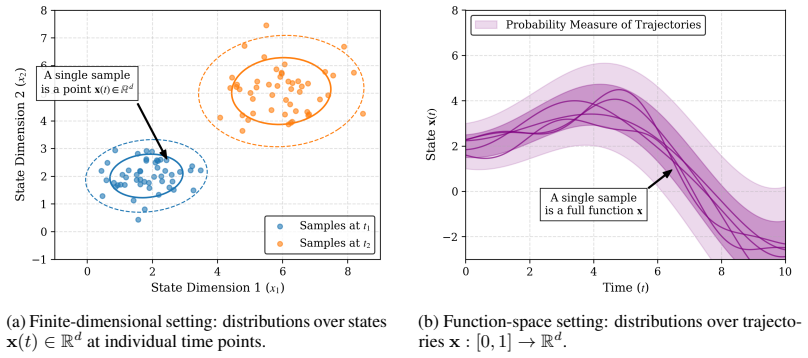
The central claim is that a tractable, data-driven estimator for the relative entropy between measures on function space can be constructed from finite snapshot marginals, and that this estimator recovers analytic values on controlled benchmarks while exposing the limitations of marginal-based evaluation protocols when applied to trajectory inference on synthetic and real scRNA-seq data, particularly in areas of sparse or missing observations.
What carries the argument
The data-driven estimator for functional KL divergence, which approximates path-space relative entropy from independent marginal samples.
If this is right
- Current marginal-based evaluation metrics for trajectory inference can produce inconsistent assessments of method quality.
- Path-space KL supplies a single coherent ranking that aligns better with the underlying dynamics.
- The measure highlights discrepancies in inferred trajectories especially in regions with sparse or missing data.
- Functional KL serves as a principled criterion for comparing methods under partial observability.
Where Pith is reading between the lines
- The estimator could be applied to other partially observed dynamical systems where only cross-sectional samples are available.
- Inference algorithms might be redesigned to minimize this functional divergence directly instead of matching marginals.
- Performance on real data with fewer time points would test how sensitive the recovery remains to reduced marginal information.
Load-bearing premise
The estimator recovers the true path-space divergence accurately enough from finite snapshot marginals even though full path laws are non-identifiable.
What would settle it
On the benchmark suite with known analytic KL values, if the estimator's output deviates substantially from the true value across multiple runs or dataset sizes, the claim of accurate recovery would be falsified.
Figures




read the original abstract
Trajectory Inference (TI) seeks to recover latent dynamical processes from snapshot data, where only independent samples from time-indexed marginals are observed. In applications such as single-cell genomics, destructive measurements make path-space laws non-identifiable from finitely many marginals, leaving held-out marginal prediction as the dominant but limited evaluation protocol. We introduce a general framework for estimating the Kullback-Leibler divergence (KL) divergence between probability measures on function space, yielding a tractable, data-driven estimator that is scalable to realistic snapshot datasets. We validate the accuracy of our estimator on a benchmark suite, where the estimated functional KL closely matches the analytic KL. Applying this framework to synthetic and real scRNA-seq datasets, we show that current evaluation metrics often give inconsistent assessments, whereas path-space KL enables a coherent comparison of trajectory inference methods and exposes discrepancies in inferred dynamics, especially in regions with sparse or missing data. These results support functional KL as a principled criterion for evaluating trajectory inference under partial observability.
Editorial analysis
A structured set of objections, weighed in public.
Referee Report
Summary. The manuscript introduces a general framework for estimating the Kullback-Leibler divergence between probability measures on function space, yielding a tractable data-driven estimator applicable to trajectory inference from snapshot marginal data. It validates the estimator on a benchmark suite where estimated functional KL matches analytic values, then applies the approach to synthetic and real scRNA-seq datasets to demonstrate that path-space KL yields more coherent comparisons of TI methods than existing metrics and reveals discrepancies in inferred dynamics, particularly in sparse or missing data regions.
Significance. If the estimator recovers true path-space divergences reliably from finite marginals, the work would provide a principled evaluation criterion for trajectory inference under partial observability, addressing limitations of held-out marginal prediction. The benchmark matching to analytic KL and the real-data application to expose metric inconsistencies are concrete strengths that support the central claim at a high level.
major comments (3)
- [§3 (Estimator Construction)] §3 (Estimator Construction): The data-driven estimator for functional KL must be shown to produce values invariant to the choice of reference measure, kernel, or optimization regularizer, since path-space laws are non-identifiable from finite marginal snapshots. Without explicit control or invariance proof, reported KL values risk reflecting implicit regularization rather than intrinsic path divergence, directly undermining the claim of coherent TI comparisons in sparse regimes.
- [§4.2 (Benchmark Validation)] §4.2 (Benchmark Validation): The reported close match to analytic KL on benchmarks is encouraging, but the benchmarks should include controlled variations in snapshot density and missing-data patterns to test stability precisely where non-identifiability is most severe; current validation may not cover the regimes highlighted in the real-data claims.
- [§5 (Real Data Application)] §5 (Real Data Application): The assertion that path-space KL exposes discrepancies in inferred dynamics requires explicit description of how the estimator is applied to the output trajectories of each TI method and whether sensitivity analyses were performed with respect to the choice of reference or regularization parameters.
minor comments (2)
- [Notation and Methods] Clarify throughout whether the estimator assumes a specific form for the reference measure on path space and how this is chosen in practice for the scRNA-seq experiments.
- [Figures] Add error bars or variability estimates to the KL comparisons in figures showing real-data results to allow assessment of statistical significance of the reported inconsistencies.
Simulated Author's Rebuttal
We thank the referee for the constructive comments, which help clarify the presentation and strengthen the validation of our functional KL estimator. We address each major comment point by point below, indicating the revisions planned for the next version of the manuscript.
read point-by-point responses
-
Referee: [§3 (Estimator Construction)] The data-driven estimator for functional KL must be shown to produce values invariant to the choice of reference measure, kernel, or optimization regularizer, since path-space laws are non-identifiable from finite marginal snapshots. Without explicit control or invariance proof, reported KL values risk reflecting implicit regularization rather than intrinsic path divergence.
Authors: We agree that invariance properties are critical given the non-identifiability from marginal snapshots. The estimator is constructed via a variational formulation that is independent of the reference measure by design (as the KL is defined relative to any dominating measure), but we acknowledge that explicit verification was not included. In the revised manuscript we will add a new subsection in §3 providing both a short invariance proof under the stated assumptions and empirical sensitivity plots with respect to kernel bandwidth and regularizer strength, confirming that the reported values track intrinsic path divergence rather than regularization artifacts. revision: yes
-
Referee: [§4.2 (Benchmark Validation)] The reported close match to analytic KL on benchmarks is encouraging, but the benchmarks should include controlled variations in snapshot density and missing-data patterns to test stability precisely where non-identifiability is most severe; current validation may not cover the regimes highlighted in the real-data claims.
Authors: We concur that testing stability under reduced snapshot density and missing-data regimes is necessary to support the real-data claims. We will expand §4.2 with additional controlled experiments that systematically vary the number of observed time points and introduce structured missingness patterns, reporting both bias and variance of the estimator relative to the analytic KL in these more challenging settings. revision: yes
-
Referee: [§5 (Real Data Application)] The assertion that path-space KL exposes discrepancies in inferred dynamics requires explicit description of how the estimator is applied to the output trajectories of each TI method and whether sensitivity analyses were performed with respect to the choice of reference or regularization parameters.
Authors: We will revise §5 to include a precise description of the pipeline: each TI method’s output trajectories are treated as samples from the path measure, which are then fed directly into the functional KL estimator using a fixed reference measure and kernel. We will also add a sensitivity analysis subsection that varies the reference measure and regularization parameters across a modest grid and reports that the relative ordering of TI methods remains stable, thereby supporting the claim that observed discrepancies reflect differences in inferred dynamics. revision: yes
Circularity Check
No significant circularity detected
full rationale
The paper introduces a new data-driven estimator for functional KL divergence on path space and validates its accuracy by direct comparison to analytic KL values on a benchmark suite. This external match supplies independent grounding. No load-bearing steps reduce by the paper's own equations to fitted parameters, self-definitions, or self-citation chains; the application to scRNA-seq data uses the validated estimator without re-deriving results from its own outputs. The derivation chain is therefore self-contained against external benchmarks.
Axiom & Free-Parameter Ledger
axioms (1)
- domain assumption A tractable data-driven estimator exists for the KL divergence between probability measures on function space that can be computed from snapshot marginals.
Reference graph
Works this paper leans on
-
[1]
Stochastic Equations in Infinite Dimensions , publisher=
Da Prato, Giuseppe and Zabczyk, Jerzy , year=. Stochastic Equations in Infinite Dimensions , publisher=
-
[2]
2025 , eprint=
Mesh-Informed Neural Operator : A Transformer Generative Approach , author=. 2025 , eprint=
2025
-
[3]
Density of the set of all infinitely differentiable functions with compact support in weighted Sobolev spaces , volume =
Nakai, Eiichi and Tomita, Naohito and Yabuta, Kozo , year =. Density of the set of all infinitely differentiable functions with compact support in weighted Sobolev spaces , volume =
-
[4]
2025 , eprint=
Simulation of infinite-dimensional diffusion bridges , author=. 2025 , eprint=
2025
-
[5]
2025 , eprint=
Improving Rectified Flow with Boundary Conditions , author=. 2025 , eprint=
2025
-
[6]
Chen, Yifan and. Scale-. doi:10.48550/arXiv.2509.02971 , urldate =. arXiv , keywords =:2509.02971 , primaryclass =
-
[7]
Generative diffusion models in infinite dimensions: a survey , volume =
Franzese, Giulio , year =. Generative diffusion models in infinite dimensions: a survey , volume =. Philosophical Transactions A , doi =
-
[8]
Advances in Neural Information Processing Systems 36 (NeurIPS 2023) , year =
Score‐based Generative Modeling through Stochastic Evolution Equations in Hilbert Spaces , author =. Advances in Neural Information Processing Systems 36 (NeurIPS 2023) , year =
2023
-
[9]
and Guibentif, Cristina and et al
Pijuan-Sala, Blanca and Griffiths, Jonathan A. and Guibentif, Cristina and et al. , title =. Nature , volume =. 2019 , doi =
2019
-
[10]
and Oravecz, A
Riba, A. and Oravecz, A. and Durik, M. and et al. , title =. Nature Communications , volume =. 2022 , doi =
2022
-
[11]
Bogachev and Nicolai V
Vladimir I. Bogachev and Nicolai V. Krylov and Michael R. Fokker--Planck--Kolmogorov Equations , volume =. 2022 , publisher =
2022
-
[12]
Bogachev, V. I. and Rockner, M. , year =. Regularity of. Journal of Functional Analysis , volume =. doi:10.1006/jfan.1995.1123 , urldate =
-
[13]
2008 , isbn =
Gradient Flows: In Metric Spaces and in the Space of Probability Measures , author =. 2008 , isbn =
2008
-
[14]
, year = 2024, month = may, number =
Baldassari, Lorenzo and Siahkoohi, Ali and Garnier, Josselin and Solna, Knut and de Hoop, Maarten V. , year = 2024, month = may, number =. Taming. doi:10.48550/arXiv.2405.15676 , urldate =. 2405.15676 , primaryclass =
-
[15]
2025 , eprint=
RFMI: Estimating Mutual Information on Rectified Flow for Text-to-Image Alignment , author=. 2025 , eprint=
2025
-
[16]
Lim, Jae Hyun and Kovachki, Nikola B. and Baptista, Ricardo and Beckham, Christopher and Azizzadenesheli, Kamyar and Kossaifi, Jean and Voleti, Vikram and Song, Jiaming and Kreis, Karsten and Kautz, Jan and Pal, Christopher and Vahdat, Arash and Anandkumar, Anima , year = 2025, journal =. Score-
2025
-
[17]
2007 , isbn =
A Course in Functional Analysis , author =. 2007 , isbn =
2007
-
[18]
2025 , eprint=
Flow Straight and Fast in Hilbert Space: Functional Rectified Flow , author=. 2025 , eprint=
2025
-
[19]
2010 , series =
Stochastic Differential Equations:. 2010 , series =
2010
-
[20]
International conference on machine learning , pages=
Action matching: Learning stochastic dynamics from samples , author=. International conference on machine learning , pages=. 2023 , organization=
2023
-
[21]
Nature Machine Intelligence , volume =
Reconstructing Growth and Dynamic Trajectories from Single-Cell Transcriptomics Data , author =. Nature Machine Intelligence , volume =. doi:10.1038/s42256-023-00763-w , urldate =
-
[22]
Numerische Mathematik , author =
Benamou, Jean-David and Brenier, Yann , year = 2000, month = jan, journal =. A Computational Fluid Mechanics Solution to the. doi:10.1007/s002110050002 , urldate =
-
[23]
2015 , eprint=
An Interpolating Distance between Optimal Transport and Fisher-Rao , author=. 2015 , eprint=
2015
-
[24]
Nature Biotechnology37(5), 547–554 (2019) https://doi.org/10.1038/s41587-019-0071-9
A comparison of single-cell trajectory inference methods , author =. Nature Biotechnology , volume =. 2019 , publisher =. doi:10.1038/s41587-019-0071-9 , url =
-
[25]
Camargo and Allon M
Caleb Weinreb and Alejo Rodriguez-Fraticelli and Fernando D. Camargo and Allon M. Klein , title =. Science , volume =. 2020 , doi =
2020
-
[26]
Huguet, Guillaume and Magruder, D. S. and Tong, Alexander and Fasina, Oluwadamilola and Kuchroo, Manik and Wolf, Guy and Krishnaswamy, Smita , year = 2022, month = nov, number =. Manifold. doi:10.48550/arXiv.2206.14928 , urldate =. arXiv , keywords =:2206.14928 , primaryclass =
-
[27]
2023 , eprint=
Diffusion Schr\"odinger Bridge Matching , author=. 2023 , eprint=
2023
-
[28]
2023 , eprint=
Diffusion Schr\"odinger Bridge with Applications to Score-Based Generative Modeling , author=. 2023 , eprint=
2023
-
[29]
The schr
Bunne, Charlotte and Hsieh, Ya-Ping and Cuturi, Marco and Krause, Andreas , booktitle=. The schr. 2023 , organization=
2023
-
[30]
Geoffrey Schiebinger and Jian Shu and Marcin Tabaka and Brian Cleary and Vidya Subramanian and Aryeh Solomon and Joshua Gould and Siyan Liu and Stacie Lin and Peter Berube and Lia Lee and Jenny Chen and Justin Brumbaugh and Philippe Rigollet and Konrad Hochedlinger and Rudolf Jaenisch and Aviv Regev and Eric S. Lander , keywords =. Optimal-Transport Analy...
-
[31]
Moon, Kevin R. and. Visualizing Structure and Transitions in High-Dimensional Biological Data -. Nature Biotechnology , volume =. doi:10.1038/s41587-019-0336-3 , urldate =
-
[32]
Annals of Mathematical Statistics , volume =
Kullback, Solomon , title =. Annals of Mathematical Statistics , volume =. 1968 , doi =
1968
-
[33]
Likelihood Training of Schr\"odinger Bridge using Forward-Backward
Tianrong Chen and Guan-Horng Liu and Evangelos Theodorou , booktitle=. Likelihood Training of Schr\"odinger Bridge using Forward-Backward. 2022 , url=
2022
-
[34]
Thirty-seventh Conference on Neural Information Processing Systems , year=
Deep Momentum Multi-Marginal Schr\"odinger Bridge , author=. Thirty-seventh Conference on Neural Information Processing Systems , year=
-
[35]
Linear Estimators and Measurable Linear Transformations on a
Mandelbaum, Avi , year = 1984, month = feb, journal =. Linear Estimators and Measurable Linear Transformations on a. doi:10.1007/BF00533743 , urldate =
-
[36]
Absolutely Continuous Solutions for Continuity Equations in
Da Prato, Giuseppe and Flandoli, Franco and Roeckner, Michael , year = 2019, month = jul, number =. Absolutely Continuous Solutions for Continuity Equations in. doi:10.48550/arXiv.1707.07254 , urldate =. arXiv , keywords =:1707.07254 , primaryclass =
-
[37]
2020 , month = mar, url =
Lecomte, Dominique , title =. 2020 , month = mar, url =
2020
-
[38]
Functional flow matching.arXiv preprint arXiv:2305.17209, 2023
Kerrigan, Gavin and Migliorini, Giosue and Smyth, Padhraic , year = 2023, month = dec, number =. Functional. doi:10.48550/arXiv.2305.17209 , urldate =. 2305.17209 , primaryclass =
-
[39]
Functional Analysis: An Introduction to Metric Spaces, Hilbert Spaces, and Banach Algebras , author =. 2023 , edition =. doi:10.1007/978-3-031-27537-1 , url =
-
[40]
2025 , eprint=
Score-based Diffusion Models in Function Space , author=. 2025 , eprint=
2025
-
[41]
2020 , eprint=
Computational Optimal Transport , author=. 2020 , eprint=
2020
-
[42]
Borgwardt and Malte J
Arthur Gretton and Karsten M. Borgwardt and Malte J. Rasch and Bernhard Sch. A Kernel Two-Sample Test , journal =. 2012 , volume =
2012
-
[43]
Multi-marginal Schr
Shen, Yunyi and Berlinghieri, Renato and Broderick, Tamara , booktitle=. Multi-marginal Schr. 2025 , organization=
2025
-
[44]
Advances in neural information processing systems , volume=
Manifold interpolating optimal-transport flows for trajectory inference , author=. Advances in neural information processing systems , volume=
-
[45]
Nature Biotechnology , year=
Visualizing structure and transitions in high-dimensional biological data , author=. Nature Biotechnology , year=
-
[46]
Single-cell RNA-seq reveals novel regulators of human embryonic stem cell differentiation to definitive endoderm , volume =
Chu, Li-Fang and Leng, Ning and Zhang, Jue and Hou, Zhonggang and Mamott, Daniel and Vereide, David and Choi, Jeea and Kendziorski, Christina and Stewart, Ron and Thomson, James , year =. Single-cell RNA-seq reveals novel regulators of human embryonic stem cell differentiation to definitive endoderm , volume =. Genome Biology , doi =
-
[47]
1957 , publisher=
The strategy of the genes , author=. 1957 , publisher=
1957
-
[48]
2025 , eprint=
Multi-Marginal Schr\"odinger Bridge Matching , author=. 2025 , eprint=
2025
-
[49]
Advances in Neural Information Processing Systems , volume=
Trajectory inference via mean-field langevin in path space , author=. Advances in Neural Information Processing Systems , volume=
-
[50]
Diffusion schr
Shi, Yuyang and De Bortoli, Valentin and Campbell, Andrew and Doucet, Arnaud , journal=. Diffusion schr
-
[51]
2021 , publisher=
Topics in optimal transportation , author=. 2021 , publisher=
2021
-
[52]
A survey of the schr " odinger problem and some of its connections with optimal transport , author=. arXiv preprint arXiv:1308.0215 , year=
-
[53]
Nature Methods , volume =
CellRank for directed single-cell fate mapping , author =. Nature Methods , volume =
-
[54]
Nature Methods , volume =
CellRank 2: unified fate mapping in multiview single-cell data , author =. Nature Methods , volume =. 2024 , doi =
2024
-
[55]
Nature Methods , volume =
Diffusion pseudotime robustly reconstructs lineage branching , author =. Nature Methods , volume =. 2016 , doi =
2016
-
[56]
International conference on machine learning , pages=
Trajectorynet: A dynamic optimal transport network for modeling cellular dynamics , author=. International conference on machine learning , pages=. 2020 , organization=
2020
-
[57]
arXiv preprint arXiv:2310.09031 , year=
MINDE: Mutual information neural diffusion estimation , author=. arXiv preprint arXiv:2310.09031 , year=
-
[58]
International conference on machine learning , pages=
Mutual information neural estimation , author=. International conference on machine learning , pages=. 2018 , organization=
2018
-
[59]
Interpretable diffusion via information de- composition.arXiv preprint arXiv:2310.07972, 2023
Interpretable diffusion via information decomposition , author=. arXiv preprint arXiv:2310.07972 , year=
-
[60]
arXiv preprint arXiv:2102.09204 , year=
Towards a mathematical theory of trajectory inference , author=. arXiv preprint arXiv:2102.09204 , year=
-
[61]
50 Nature Biotechnology32(4), 381–386 (2014) https://doi.org/10.1038/nbt.2859
The dynamics and regulators of cell fate decisions are revealed by pseudotemporal ordering of single cells , Author =. 2014 , Journal =. doi:10.1038/nbt.2859 , Number =
-
[62]
Nature vol
RNA velocity of single cells , author=. Nature vol. 560,7719: 494-498 , doi=
-
[63]
International Conference on Artificial Intelligence and Statistics , pages=
Diffusion Generative Models in Infinite Dimensions , author=. International Conference on Artificial Intelligence and Statistics , pages=. 2023 , organization=
2023
-
[64]
Journal of Machine Learning Research , volume=
Score-based diffusion models in function space , author=. Journal of Machine Learning Research , volume=
-
[65]
Continuous-Time Functional Diffusion Processes , volume =
Franzese, Giulio and Corallo, Giulio and Rossi, Simone and Heinonen, Markus and Filippone, Maurizio and Michiardi, Pietro , booktitle =. Continuous-Time Functional Diffusion Processes , volume =
-
[66]
Advances in Neural Information Processing Systems , volume=
Mutual information estimation via normalizing flows , author=. Advances in Neural Information Processing Systems , volume=
-
[67]
2026 , url=
Ivan Butakov and Alexander Semenenko and Valeriia Kirova and Ivan Oseledets and Alexey Frolov , booktitle=. 2026 , url=
2026
-
[68]
Gowri, Gokul and Lun, Xiao-Kang and Klein, Allon M. and Yin, Peng , booktitle =. Approximating mutual information of high-dimensional variables using learned representations , volume =. doi:10.52202/079017-4223 , editor =
-
[69]
Stumpf, Patrick S. and Smith, Rosanna C. G. and Lenz, Michael and Schuppert, Andreas and M. Stem Cell Differentiation as a Non-Markov Stochastic Process , volume =. doi:10.1016/j.cels.2017.08.009 , journal =
-
[70]
Mitchell, Kevin J. , year=. Developmental noise is an overlooked contributor to innate variation in psychological traits , volume=. doi:10.1017/S0140525X21001655 , journal=
-
[71]
, publisher =
Mitchell, Kevin J. , publisher =. Innate: How the Wiring of Our Brains Shapes Who We Are , urldate =
-
[72]
Data Mining and Knowledge Discovery , Year =
Deep learning for time series classification: a review , Author =. Data Mining and Knowledge Discovery , Year =
-
[73]
Nowakowski and Aparna Bhaduri and Alex A
Tomasz J. Nowakowski and Aparna Bhaduri and Alex A. Pollen and Beatriz Alvarado and Mohammed A. Mostajo-Radji and Elizabeth Di Lullo and Maximilian Haeussler and Carmen Sandoval-Espinosa and Siyuan John Liu and Dmitry Velmeshev and Johain Ryad Ounadjela and Joe Shuga and Xiaohui Wang and Daniel A. Lim and Jay A. West and Anne A. Leyrat and W. James Kent a...
2017
-
[74]
2021 , issn =
Chromatin and gene-regulatory dynamics of the developing human cerebral cortex at single-cell resolution , journal =. 2021 , issn =
2021
-
[75]
Tusi and Merav Socolovsky and Allon M
Caleb Weinreb and Samuel Wolock and Betsabeh K. Tusi and Merav Socolovsky and Allon M. Klein , title =. Proceedings of the National Academy of Sciences , volume =
-
[76]
and Pavon, Michele , title =
Chen, Yongxin and Georgiou, Tryphon T. and Pavon, Michele , title =. SIAM Review , year =
-
[77]
arXiv preprint arXiv:2303.04772 , year=
Multilevel diffusion: Infinite dimensional score-based diffusion models for image generation , author=. arXiv preprint arXiv:2303.04772 , year=
-
[78]
Journal of Machine Learning Research , volume=
Infinite-dimensional diffusion models , author=. Journal of Machine Learning Research , volume=
-
[79]
Advances in Neural Information Processing Systems , volume=
Score-based generative modeling through stochastic evolution equations in hilbert spaces , author=. Advances in Neural Information Processing Systems , volume=
-
[80]
arXiv preprint arXiv:2405.18353 , year=
Simulating infinite-dimensional nonlinear diffusion bridges , author=. arXiv preprint arXiv:2405.18353 , year=
discussion (0)
Sign in with ORCID, Apple, or X to comment. Anyone can read and Pith papers without signing in.