Recognition: 2 theorem links
· Lean TheoremPhysics-Conditioned Synthesis of Internal Ice-Layer Thickness for Incomplete Layer Traces
Pith reviewed 2026-05-12 03:36 UTC · model grok-4.3
The pith
A network conditioned on climate-model features synthesizes complete ice-layer thickness stacks from incomplete radar traces, recovering missing segments and improving pretraining for downstream deep-layer prediction.
A machine-rendered reading of the paper's core claim, the machinery that carries it, and where it could break.
Core claim
By conditioning on colocated physical features synchronized from physical climate models, the network combines geometric learning to aggregate within-layer spatial context with a transformer-based temporal module that propagates information across layers to encourage coherent stratigraphy and consistent thickness evolution; optimized with a mask-aware robust regression objective that evaluates errors only at observed thickness values and normalizes by the number of valid entries, the model generates complete thickness stacks that preserve observed values where available, recover fragmented segments and even fully absent layers while remaining consistent with measured traces, and supply pretr
What carries the argument
Physics-conditioned synthesis network that aggregates within-layer geometric context and propagates across-layer information via transformer, trained with mask-aware robust regression on incomplete supervision.
If this is right
- The synthesized stacks recover fragmented segments and fully absent layers while remaining consistent with measured traces.
- Pretraining a deep-layer predictor on the synthesized stacks improves fine-tuned accuracy over training from scratch on the same fully traced data.
- The model preserves observed thickness values exactly and infers only the missing regions.
- The mask-aware objective enables stable training under varying sparsity without imputation.
Where Pith is reading between the lines
- Older radar datasets previously discarded for incompleteness could now be reprocessed into usable accumulation histories for climate studies.
- The same conditioning approach might extend to other sparse geophysical imaging domains where physical simulation outputs are available.
- Validation against independent measurements on a different ice sheet would directly test whether climate-model conditioning avoids systematic bias.
Load-bearing premise
Colocated physical features from climate models are accurate enough that conditioning on them produces completions consistent with radar observations and physically plausible without introducing systematic biases from the climate model.
What would settle it
Compare model-inferred thicknesses in masked regions against held-out complete radar traces or independent ice-core measurements, or test whether pretraining accuracy gains vanish when climate features are replaced by random values.
Figures

read the original abstract
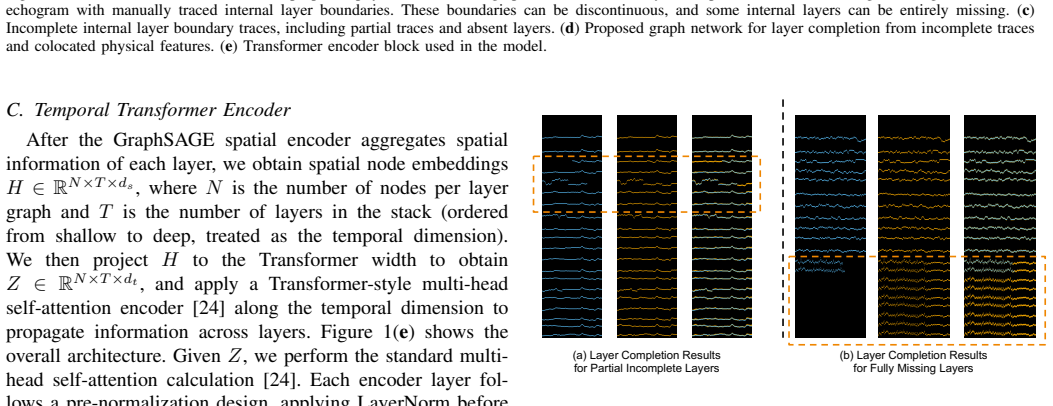
Internal ice layers imaged by radar provide key evidence of snow accumulation and ice dynamics, but radar-derived layer boundary observations are often incomplete, with discontinuous traces and sometimes entirely missing layers, due to limited resolution, sensor noise, and signal loss. Existing graph-based models for ice stratigraphy generally assume sufficiently complete layer profiles and focus on predicting deeper-layer thickness from reliably traced shallow layers. In this work, we address the layer-completion problem itself by synthesizing complete ice-layer thickness annotations from incomplete radar-derived layer traces by conditioning on colocated physical features synchronized from physical climate models. The proposed network combines geometric learning to aggregate within-layer spatial context with a transformer-based temporal module that propagates information across layers to encourage coherent stratigraphy and consistent thickness evolution. To learn from incomplete supervision, we optimize a mask-aware robust regression objective that evaluates errors only at observed thickness values and normalizes by the number of valid entries, enabling stable training under varying sparsity without imputation and steering completions toward physically plausible values. The model preserves observed thickness where available and infers only missing regions, recovering fragmented segments and even fully absent layers while remaining consistent with measured traces. As an additional benefit, the synthesized thickness stacks provide effective pretraining supervision for a downstream deep-layer predictor, improving fine-tuned accuracy over training from scratch on the same fully traced data.
Editorial analysis
A structured set of objections, weighed in public.
Referee Report
Summary. The manuscript proposes a method for synthesizing complete internal ice-layer thickness annotations from incomplete radar-derived traces by conditioning on colocated physical features from climate models. The network integrates geometric learning for within-layer spatial context and a transformer-based module for cross-layer temporal propagation. Training uses a mask-aware robust regression loss that only considers observed thickness values. The synthesized stacks are used as pretraining supervision for a downstream deep-layer predictor, with the claim that this improves fine-tuned accuracy compared to training from scratch on fully traced data.
Significance. This work tackles a relevant challenge in processing incomplete radar data for ice stratigraphy analysis. The physics-conditioned approach and the mask-aware loss are well-motivated design choices. The potential for the synthesized data to serve as pretraining supervision is an interesting contribution that could benefit related machine learning tasks in glaciology, provided the completions are validated to be accurate and free from systematic biases introduced by the conditioning.
major comments (3)
- [Abstract and §3 (Method)] The abstract and method description supply no quantitative results, ablation studies, error metrics, or validation against ground truth, making it impossible to judge whether the synthesized thicknesses remain consistent with observations or support the downstream pretraining improvement claim.
- [§3.2 (Loss function)] The mask-aware regression loss penalizes errors only at observed locations but includes no explicit term or constraint to regularize against potential mismatches between the climate-model conditioning features and the radar traces (e.g., in accumulation rates or spatial alignment). This is load-bearing for the claim that completions are physically plausible and that pretraining gains are genuine rather than illusory.
- [§5 (Experiments)] The headline claim that synthesized stacks improve fine-tuned accuracy over training from scratch requires empirical support via specific metrics, baseline comparisons, and tests on independent data; without these, the pretraining benefit cannot be assessed and the skeptic concern about unquantified biases cannot be ruled out.
minor comments (2)
- [Abstract] The abstract states that the model 'recovers fragmented segments and even fully absent layers while remaining consistent with measured traces' but provides no supporting figures, tables, or numbers.
- [§3.2] Clarify the exact mathematical form of the mask-aware robust regression objective, including how normalization by the number of valid entries is implemented.
Simulated Author's Rebuttal
We thank the referee for the constructive feedback, which identifies key areas where additional quantitative support and clarifications will strengthen the manuscript. We address each major comment below and will revise the paper accordingly.
read point-by-point responses
-
Referee: [Abstract and §3 (Method)] The abstract and method description supply no quantitative results, ablation studies, error metrics, or validation against ground truth, making it impossible to judge whether the synthesized thicknesses remain consistent with observations or support the downstream pretraining improvement claim.
Authors: We agree that the abstract and §3 would benefit from explicit quantitative results to support the claims. In the revised manuscript, we will update the abstract to report key metrics such as mean absolute error on observed thicknesses and downstream accuracy gains. We will also expand §3 with ablation studies on the geometric and transformer modules, plus validation metrics against ground truth from fully traced regions, to demonstrate consistency. revision: yes
-
Referee: [§3.2 (Loss function)] The mask-aware regression loss penalizes errors only at observed locations but includes no explicit term or constraint to regularize against potential mismatches between the climate-model conditioning features and the radar traces (e.g., in accumulation rates or spatial alignment). This is load-bearing for the claim that completions are physically plausible and that pretraining gains are genuine rather than illusory.
Authors: The mask-aware loss is designed to avoid imputation artifacts by evaluating only at observed locations. We acknowledge that an explicit regularization term for alignment with climate features would further strengthen physical plausibility. In revision, we will add such a term to the loss (e.g., penalizing mismatches in derived accumulation rates) along with ablations demonstrating its effect on completion quality and downstream performance. revision: yes
-
Referee: [§5 (Experiments)] The headline claim that synthesized stacks improve fine-tuned accuracy over training from scratch requires empirical support via specific metrics, baseline comparisons, and tests on independent data; without these, the pretraining benefit cannot be assessed and the skeptic concern about unquantified biases cannot be ruled out.
Authors: We will revise §5 to include the requested empirical support. This will comprise specific metrics (e.g., accuracy deltas on fine-tuning), baseline comparisons (training from scratch and alternative completion approaches), and evaluations on independent held-out data to quantify biases. These additions will directly address the pretraining benefit and concerns about unquantified biases. revision: yes
Circularity Check
No significant circularity; derivation is self-contained
full rationale
The paper describes a conditional synthesis network that ingests incomplete radar traces plus colocated climate-model features, applies geometric and transformer layers, and optimizes a mask-aware regression loss that penalizes only observed locations. No equation or claim reduces the output thickness stacks to a fitted parameter renamed as prediction, nor does any load-bearing step rest on a self-citation whose content is itself unverified. The downstream pretraining benefit is stated as an empirical improvement measured on held-out data, not derived by construction from the synthesis objective itself. The method therefore remains externally falsifiable against independent radar observations and does not exhibit any of the enumerated circular patterns.
Axiom & Free-Parameter Ledger
axioms (2)
- domain assumption Physical features synchronized from climate models are accurate enough to guide plausible layer completions
- domain assumption Observed thickness values are reliable ground truth that should be preserved exactly
Lean theorems connected to this paper
-
IndisputableMonolith/Cost/FunctionalEquation.leanwashburn_uniqueness_aczel unclear?
unclearRelation between the paper passage and the cited Recognition theorem.
The proposed network combines geometric learning to aggregate within-layer spatial context with a transformer-based temporal module... mask-aware robust regression objective... conditioning on colocated physical features synchronized from physical climate models.
-
IndisputableMonolith/Foundation/RealityFromDistinction.leanreality_from_one_distinction unclear?
unclearRelation between the paper passage and the cited Recognition theorem.
We use five MAR-derived variables as physical node features: snow mass balance, near-surface temperature, meltwater refreezing, height change due to melting, and snowpack height.
What do these tags mean?
- matches
- The paper's claim is directly supported by a theorem in the formal canon.
- supports
- The theorem supports part of the paper's argument, but the paper may add assumptions or extra steps.
- extends
- The paper goes beyond the formal theorem; the theorem is a base layer rather than the whole result.
- uses
- The paper appears to rely on the theorem as machinery.
- contradicts
- The paper's claim conflicts with a theorem or certificate in the canon.
- unclear
- Pith found a possible connection, but the passage is too broad, indirect, or ambiguous to say the theorem truly supports the claim.
Reference graph
Works this paper leans on
-
[1]
Chapter 12 - glaciers and ice sheets,
S. A. Arcone, “Chapter 12 - glaciers and ice sheets,” inGround Penetrating Radar Theory and Applications, H. M. Jol, Ed. Amsterdam: Elsevier, 2009, pp. 361–
work page 2009
-
[2]
Available: https://www.sciencedirect.com/ science/article/pii/B9780444533487000120
[Online]. Available: https://www.sciencedirect.com/ science/article/pii/B9780444533487000120
-
[4]
Prediction of annual snow accumulation using a recurrent graph convolutional approach,
B. Zalatan and M. Rahnemoonfar, “Prediction of annual snow accumulation using a recurrent graph convolutional approach,” inIGARSS 2023 - 2023 IEEE International Geoscience and Remote Sensing Symposium, 2023, pp. 5344–5347
work page 2023
-
[5]
Prediction of deep ice layer thickness using adaptive recurrent graph neural networks,
——, “Prediction of deep ice layer thickness using adaptive recurrent graph neural networks,” in2023 IEEE International Conference on Image Processing (ICIP), 2023, pp. 2835–2839
work page 2023
-
[6]
——, “Recurrent graph convolutional networks for spa- tiotemporal prediction of snow accumulation using air- borne radar,” in2023 IEEE Radar Conference (Radar- Conf23), 2023, pp. 1–6
work page 2023
-
[7]
Multi-branch spatio- temporal graph neural network for efficient ice layer thickness prediction,
Z. Liu and M. Rahnemoonfar, “Multi-branch spatio- temporal graph neural network for efficient ice layer thickness prediction,” 2024. [Online]. Available: https: //arxiv.org/abs/2411.04055
-
[8]
Grit: Graph transformer for internal ice layer thickness prediction,
——, “Grit: Graph transformer for internal ice layer thickness prediction,” inIGARSS 2025 - 2025 IEEE In- ternational Geoscience and Remote Sensing Symposium, 2025, pp. 1–5
work page 2025
-
[9]
St-grit: Spatio-temporal graph transformer for internal ice layer thickness prediction,
——, “St-grit: Spatio-temporal graph transformer for internal ice layer thickness prediction,” in2025 IEEE International Conference on Image Processing (ICIP), 2025, pp. 1109–1114
work page 2025
-
[10]
Learning spatio-temporal patterns of polar ice layers with physics-informed graph neural network,
——, “Learning spatio-temporal patterns of polar ice layers with physics-informed graph neural network,”
-
[11]
Available: https://arxiv.org/abs/2406
[Online]. Available: https://arxiv.org/abs/2406. 15299
-
[12]
Physics-informed machine learning for deep ice layer tracing in sar im- ages,
M. Rahnemoonfar and B. Zalatan, “Physics-informed machine learning for deep ice layer tracing in sar im- ages,” inIGARSS 2024 - 2024 IEEE International Geo- science and Remote Sensing Symposium, 2024, pp. 6938– 6942
work page 2024
-
[13]
Z. Liu and M. Rahnemoonfar, “Physics-informed spatio- temporal graph neural network for efficient deep ice layer thickness estimation in radar imagery,” in2025 IEEE International Radar Conference (RADAR), 2025, pp. 1– 6
work page 2025
-
[14]
Brief communication: Evaluation of the near-surface climate in era5 over the greenland ice sheet,
A. Delhasse, C. Kittel, C. Amory, S. Hofer, D. van As, R. S. Fausto, and X. Fettweis, “Brief communication: Evaluation of the near-surface climate in era5 over the greenland ice sheet,”The Cryosphere, vol. 14, no. 3, pp. 957–965, 2020. [Online]. Available: https: //tc.copernicus.org/articles/14/957/2020/
work page 2020
-
[15]
X. Fettweis, S. Hofer, R. S ´ef´erian, C. Amory, A. Delhasse, S. Doutreloup, C. Kittel, C. Lang, J. Van Bever, F. Veillon, and P. Irvine, “Brief communication: Reduction in the future greenland ice sheet surface melt with the help of solar geoengineering,” The Cryosphere, vol. 15, no. 6, pp. 3013–3019, 2021. [Online]. Available: https://tc.copernicus.org/...
work page 2021
-
[16]
Ai-ready snow radar echogram dataset (sred) for climate change monitoring,
O. Ibikunle, H. Talasila, D. Varshney, J. Li, J. Paden, and M. Rahnemoonfar, “Ai-ready snow radar echogram dataset (sred) for climate change monitoring,” 2025. [Online]. Available: https://arxiv.org/abs/2505.00786
-
[17]
Ultra-wideband radars for remote sensing of snow and ice,
S. Gogineni, J. B. Yan, D. Gomez, F. Rodriguez-Morales, J. Paden, and C. Leuschen, “Ultra-wideband radars for remote sensing of snow and ice,” inIEEE MTT-S Inter- national Microwave and RF Conference, 2013, pp. 1–4
work page 2013
-
[18]
Icebridge snow radar l1b geolocated radar echo strength profiles,
C. Leuschen, B. Panzer, P. Gogineni, F. Rodriguez, J. Paden, and J. Li, “Icebridge snow radar l1b geolocated radar echo strength profiles,” Boulder, Colorado USA: National Snow and Ice Data Center. Digital media., 2011/2024, accessed on 2024
work page 2011
-
[19]
Cresis airborne radars and platforms for ice and snow sounding,
E. Arnold, C. Leuschen, F. Rodriguez-Morales, J. Li, J. Paden, R. Hale, and S. Keshmiri, “Cresis airborne radars and platforms for ice and snow sounding,”Annals of Glaciology, vol. 61, no. 81, p. 58–67, 2020
work page 2020
-
[20]
X. Fettweis, B. Franco, M. Tedesco, J. Van Angelen, J. T. Lenaerts, M. R. van den Broeke, and H. Gall ´ee, “Estimating the greenland ice sheet surface mass balance contribution to future sea level rise using the regional atmospheric climate model mar,”The Cryosphere, vol. 7, no. 2, pp. 469–489, 2013
work page 2013
-
[21]
Surface mass balance model intercomparison for the greenland ice sheet,
C. L. Vernon, J. Bamber, J. Box, M. Van den Broeke, X. Fettweis, E. Hanna, and P. Huybrechts, “Surface mass balance model intercomparison for the greenland ice sheet,”The Cryosphere, vol. 7, no. 2, pp. 599–614, 2013
work page 2013
-
[22]
Parameterization of melt rate and surface temperature in the greenland ice sheet,
N. Reeh, “Parameterization of melt rate and surface temperature in the greenland ice sheet,”Polarforschung, vol. 59, no. 3, pp. 113–128, 1991
work page 1991
-
[23]
Inductive representation learning on large graphs,
W. L. Hamilton, R. Ying, and J. Leskovec, “Inductive representation learning on large graphs,” 2018
work page 2018
-
[24]
Semi-Supervised Classification with Graph Convolutional Networks
T. N. Kipf and M. Welling, “Semi-supervised classification with graph convolutional networks,” 2017. [Online]. Available: https://arxiv.org/abs/1609.02907
work page internal anchor Pith review Pith/arXiv arXiv 2017
-
[25]
Graph neural networks: A review of methods and applications,
J. Zhou, G. Cui, S. Hu, Z. Zhang, C. Yang, Z. Liu, L. Wang, C. Li, and M. Sun, “Graph neural networks: A review of methods and applications,” AI Open, vol. 1, pp. 57–81, 2020. [Online]. Available: https://www.sciencedirect.com/science/article/ pii/S2666651021000012
work page 2020
-
[26]
A. Vaswani, “Attention is all you need,”Advances in Neural Information Processing Systems, 2017
work page 2017
discussion (0)
Sign in with ORCID, Apple, or X to comment. Anyone can read and Pith papers without signing in.