Recognition: unknown
High-Accuracy Numerical Solutions of Particle Motion in Static Magnetic Fields
Pith reviewed 2026-05-10 15:34 UTC · model grok-4.3
The pith
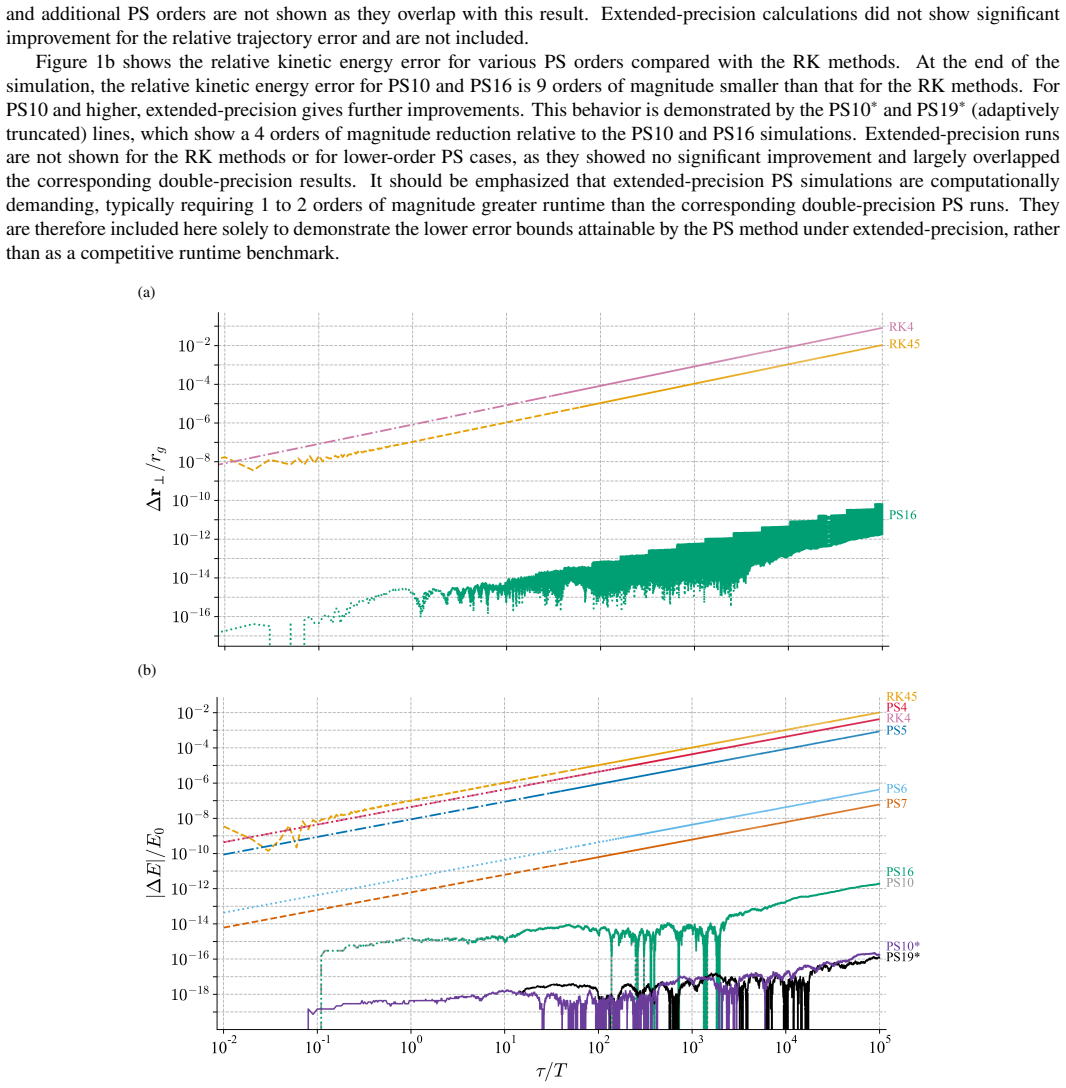
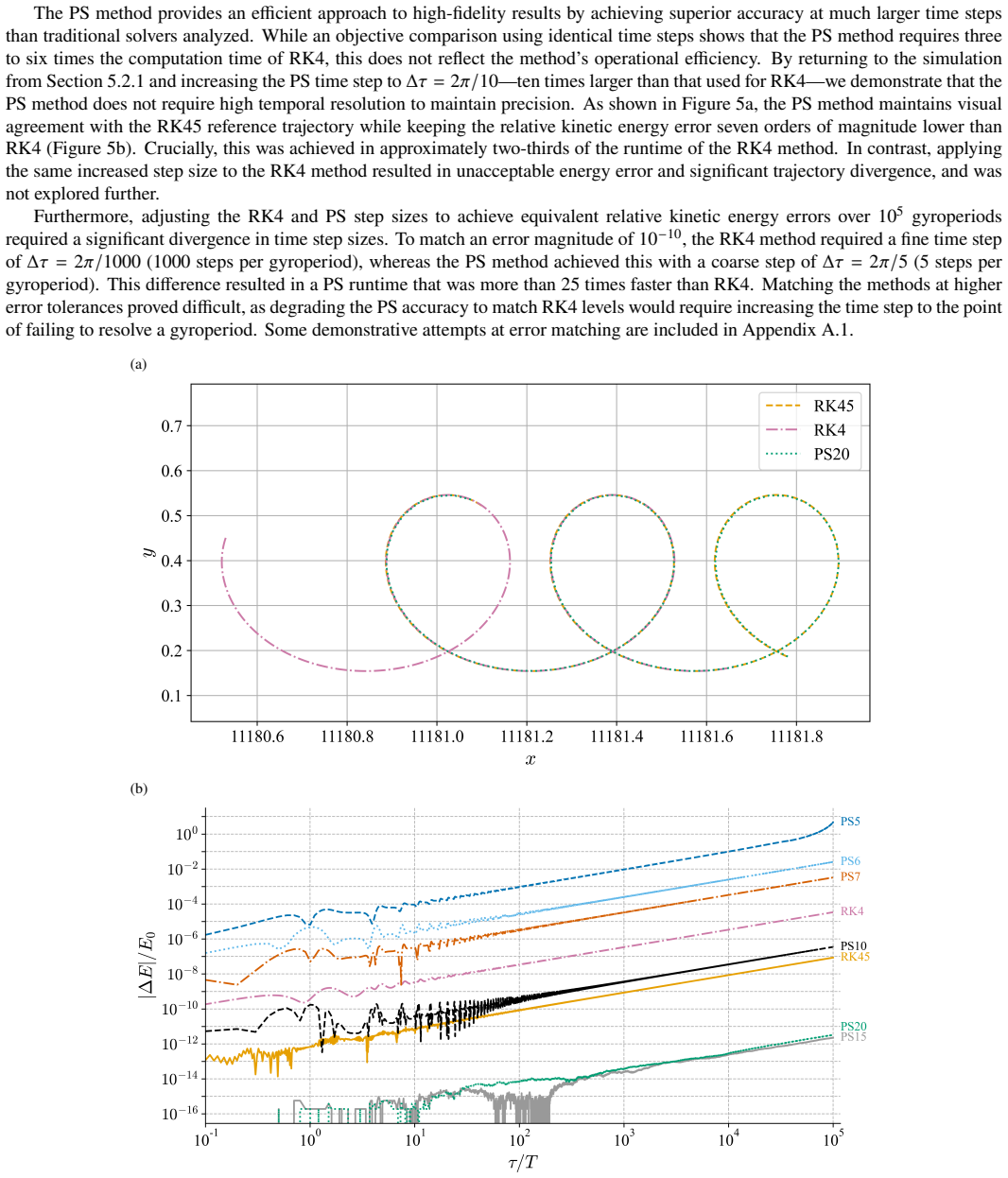
The Parker-Sochacki power series method conserves kinetic energy 4 to 13 orders of magnitude better than Runge-Kutta methods when integrating charged particle motion in static magnetic fields.
A machine-rendered reading of the paper's core claim, the machinery that carries it, and where it could break.
Core claim
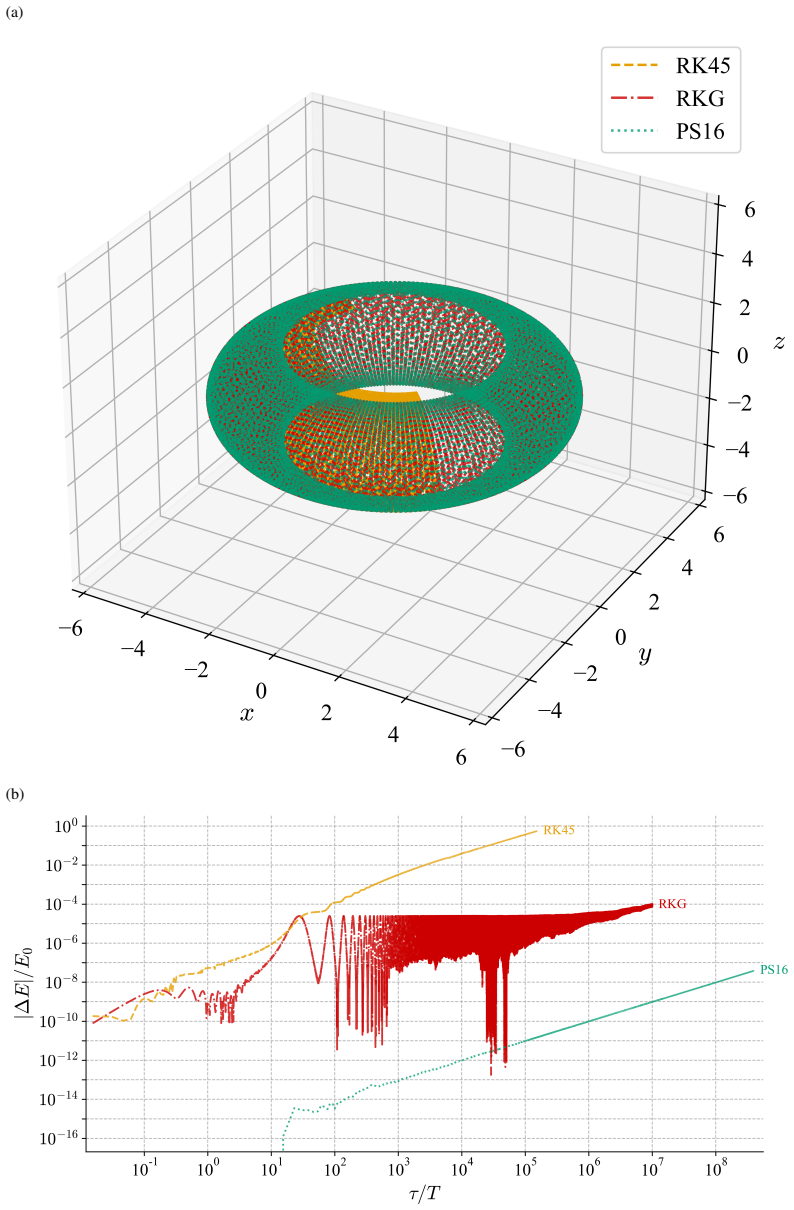
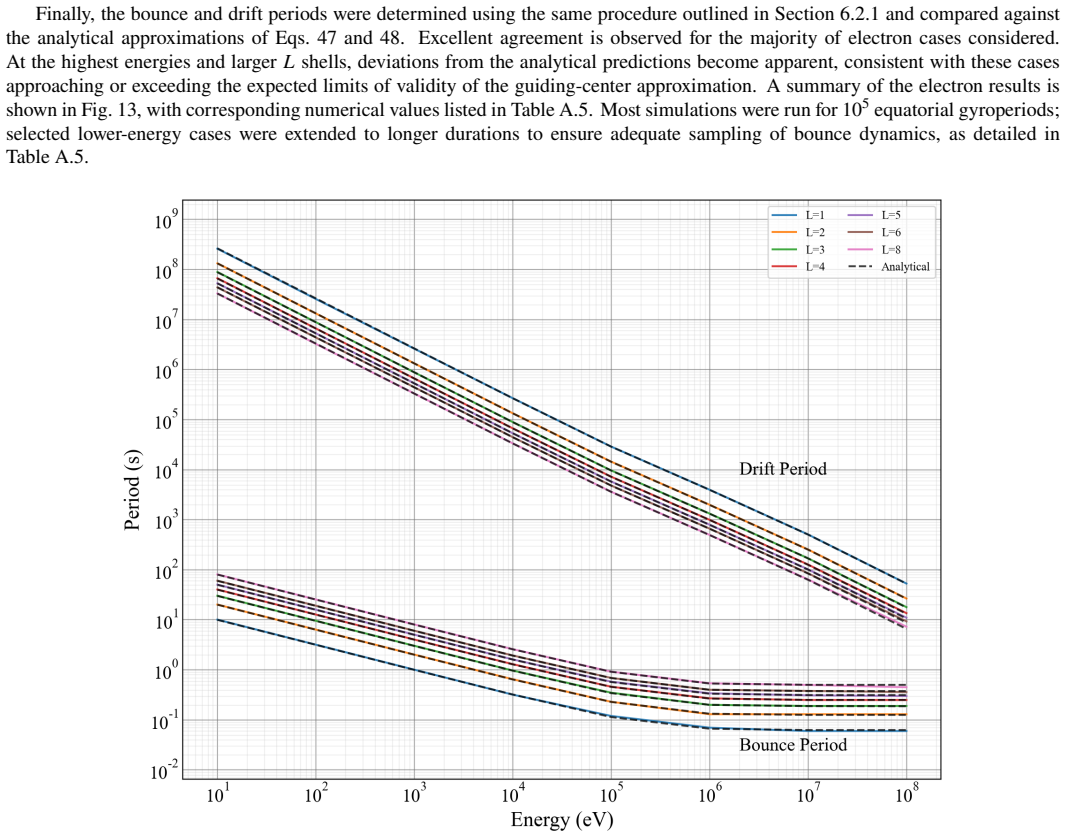
The Parker-Sochacki method constructs a power series solution tailored to the Lorentz force equations and advances the particle state by summing that series at each fixed time step. When applied to protons and electrons in uniform, tanh, and dipole magnetic fields, it produces kinetic energy errors four to thirteen orders of magnitude smaller than those of fourth-order Runge-Kutta or adaptive Dormand-Prince integrators and, for protons in the dipole field, four to five times lower error than the symplectic Gauss-Legendre Runge-Kutta method at identical fixed step size. The same power series integrator is the only method tested that remains stable for electron motion in the dipole field; the
What carries the argument
The Parker-Sochacki power series expansion, which recursively computes time derivatives from the Lorentz equations and sums the resulting series to advance the solution over each time step.
If this is right
- At matched target kinetic energy error the Parker-Sochacki method completes integrations faster than fixed-step fourth-order Runge-Kutta.
- The symplectic Gauss-Legendre Runge-Kutta method can exhibit secular growth in energy error during sufficiently long integrations in inhomogeneous fields.
- Only the Parker-Sochacki method maintains both accuracy and stability for every tested combination of field geometry and particle species.
- Fixed-time-step Parker-Sochacki runs achieve the reported accuracy levels without requiring adaptive step-size control.
Where Pith is reading between the lines
- Because the method depends on rapid series convergence, it may be combined with occasional coefficient recalculation to handle mildly time-varying fields over short static intervals.
- The observed stability advantage for light particles suggests the integrator could reduce the number of time steps needed in large-scale simulations of cosmic-ray or space-plasma trajectories.
- Replacing standard Runge-Kutta codes with Parker-Sochacki in existing particle-tracing packages would lower the computational cost of reaching a target statistical precision in long-duration runs.
Load-bearing premise
The magnetic fields remain perfectly static and the power series converges rapidly enough for the chosen fixed time steps and field geometries tested.
What would settle it
Re-running the electron trajectories in the dipole field with the Parker-Sochacki method at the same fixed time step used for the failed Gauss-Legendre runs; if the energy error grows at a rate comparable to the Runge-Kutta methods or the integration becomes unstable, the reported superiority would be falsified.
Figures





read the original abstract
The Parker-Sochacki (PS) method is investigated as an alternative to Runge-Kutta (RK) methods for solving the Lorentz equations of motion for a charged particle in a static magnetic field. Traditional methods, including fixed-time-step fourth-order RK, adaptive Dormand-Prince RK, and Gauss-Legendre Runge-Kutta (RKG), advance the solution by sampling derivative estimates at selected points to approximate the solution over a time increment. In contrast, the PS method uses a power series expansion in time that is specific to the system of equations, which is a fundamentally different approach. We assess the accuracy and long-term stability of the RK, RKG, and PS methods for three static magnetic fields: uniform, hyperbolic tangent, and dipole, with the RKG method included only for the dipole problem. The PS method results in a 4 to 13 orders-of-magnitude improvement in kinetic energy conservation over the RK methods. When the methods are compared at matched target kinetic energy error, the PS method was substantially faster than RK4, the method with the shortest runtime under identical fixed-time-step conditions. For the dipole field problem, the PS method had the lowest kinetic energy error and had runtimes 4 to 5 times shorter than RKG when using the same fixed time step for proton runs. The PS method was the only method in this study to maintain accuracy and stability for all problems for both protons and electrons; the RKG method failed on all electron runs in the dipole problem. We further show that, over sufficiently long integrations in inhomogeneous magnetic fields, the symplectic RKG may exhibit secular growth in energy error. Overall, these results indicate that the PS method provides a computationally efficient and highly accurate alternative to the symplectic RKG and standard RK methods.
Editorial analysis
A structured set of objections, weighed in public.
Referee Report
Summary. The manuscript presents a comparison of the Parker-Sochacki (PS) power series method with Runge-Kutta (RK4, adaptive Dormand-Prince) and Gauss-Legendre Runge-Kutta (RKG) methods for integrating the Lorentz equations of motion for charged particles in static magnetic fields. Using test cases of uniform, hyperbolic tangent, and dipole magnetic fields, the authors report that the PS method achieves 4 to 13 orders of magnitude better conservation of kinetic energy, is faster at matched error levels, and is the only method that remains stable and accurate for both protons and electrons across all problems, while RKG fails for electrons in the dipole field. It also notes potential secular energy error growth in long RKG integrations.
Significance. If the numerical results hold under scrutiny, the PS method could represent a valuable tool for high-accuracy trajectory integrations in magnetized plasmas, offering better long-term conservation without adaptive stepping. The direct head-to-head comparisons on fixed problems provide useful benchmarks for the field. However, the reliance on fixed time steps in inhomogeneous fields where frequencies vary spatially requires careful validation to ensure the improvements are not due to unequal effective resolution.
major comments (2)
- [Numerical results for dipole field] The claim that PS is the only stable method for electrons rests on fixed Δt comparisons, but the local cyclotron frequency varies by orders of magnitude in the dipole (B ∝ 1/r³); without reporting Δt relative to the minimum gyro-period or local truncation error estimates, the stability advantage may not generalize or may reflect insufficient resolution for RK/RKG rather than inherent superiority of PS.
- [Methods and implementation] Details on the PS series truncation (order selection, remainder bound) and the precise protocol for measuring kinetic energy error (integration duration, sampling, definition of 'error') are missing, making it difficult to assess the reported 4-13 orders-of-magnitude gains or to reproduce the runtime comparisons.
minor comments (1)
- [Abstract] The abstract mentions 'chosen fixed time steps' but could specify the criteria used for selecting those steps across methods and particles.
Simulated Author's Rebuttal
We thank the referee for their careful and constructive review of our manuscript. We address each major comment below and have revised the paper to incorporate the requested details and clarifications.
read point-by-point responses
-
Referee: The claim that PS is the only stable method for electrons rests on fixed Δt comparisons, but the local cyclotron frequency varies by orders of magnitude in the dipole (B ∝ 1/r³); without reporting Δt relative to the minimum gyro-period or local truncation error estimates, the stability advantage may not generalize or may reflect insufficient resolution for RK/RKG rather than inherent superiority of PS.
Authors: We agree that reporting the time step relative to the local and minimum gyro-period is essential for fair assessment in inhomogeneous fields. In our tests, Δt was chosen to resolve the highest cyclotron frequency encountered in each domain (for electrons in the dipole, Δt ≈ T_gyro,min / 100 near the origin). We have added a dedicated subsection in the revised manuscript that tabulates Δt / T_gyro,min for every particle and field, together with a priori local truncation-error estimates for each integrator. These additions confirm that all methods operated at comparable effective resolution, and the observed stability advantage of PS is not an artifact of under-resolution. We have also expanded the discussion of generalization limits. revision: yes
-
Referee: Details on the PS series truncation (order selection, remainder bound) and the precise protocol for measuring kinetic energy error (integration duration, sampling, definition of 'error') are missing, making it difficult to assess the reported 4-13 orders-of-magnitude gains or to reproduce the runtime comparisons.
Authors: We thank the referee for highlighting these omissions. The revised Methods section now specifies: (i) the PS truncation rule, in which the power-series order is increased until the remainder bound (computed from the next term via the Cauchy estimate) drops below 10^{-15}; (ii) the exact kinetic-energy error protocol—integrations of 10^4 gyroperiods, error sampled at every step, and error defined as max_t |K(t) − K(0)| / K(0). These additions enable full reproduction of the accuracy and runtime results. revision: yes
Circularity Check
No circularity: performance claims rest on direct numerical benchmarks
full rationale
The paper reports measured outcomes from fixed-time-step integrations of the Lorentz equations in three static magnetic fields (uniform, tanh, dipole) for both protons and electrons. The 4–13 order-of-magnitude kinetic-energy conservation advantage, runtime comparisons at matched error, and stability statements are presented as empirical results from those runs; no equation, parameter fit, or self-citation is shown to reduce the claimed superiority to a tautology or to the input data by construction. The PS power-series description is a standard, non-circular algorithmic choice for the ODE system and does not feed back into the performance metrics. The derivation chain is therefore self-contained against external test problems.
Axiom & Free-Parameter Ledger
axioms (1)
- domain assumption The magnetic fields are time-independent and the solution remains sufficiently smooth for the chosen integrators.
Reference graph
Works this paper leans on
-
[1]
Boyce and R
W. Boyce and R. DiPrima.Elementary Differential Equations and Boundary Value Problems. 10th. Wiley, 2017
2017
-
[2]
Chapra and R
S. Chapra and R. Canale.Numerical Methods for Engineers. McGraw-Hill, 2015
2015
-
[3]
J. C. Butcher.Numerical Methods for Ordinary Differential Equations. 3rd. Wiley, 2016
2016
-
[4]
A Comparison of Explicit Runge-Kutta Methods
S. Walters, R. Turner, and L. Forbes. “A Comparison of Explicit Runge-Kutta Methods”. In:The ANZIAM Journal64 (2022), pp. 227–249
2022
-
[5]
Iserles.A First Course in the Numerical Analysis of Differential Equations
A. Iserles.A First Course in the Numerical Analysis of Differential Equations. Cambridge University Press, 1996
1996
-
[6]
Implementing the Picard Iteration
G. Parker and S. Sochacki. “Implementing the Picard Iteration”. In:Neural, Parallel, and Scientific Computations4 (1996), pp. 97–112
1996
-
[7]
S. Ansari and M. H. Akrami. “An Effective Approach for Solving Nonlinear Fractional Initial Value Problems: The Fractional Legendre-PicardIterationMethod”.In:JournalofMathematicalExtension18.3(2024),pp.1–29.doi:10.30495/JME.2024. 2941
-
[8]
A comparison of HPM, NDHPM, Picard and Picard–Pade´methods for solving Michaelis–Menten equation
H. Vazquez-Leal et al. “A comparison of HPM, NDHPM, Picard and Picard–Pade´methods for solving Michaelis–Menten equation”. In:Journal of King Saud University27 (2015), pp. 7–14.doi:10.1016/j.jksus.2014.11.001
-
[9]
J. W. Rudmin.Application of the Parker-Sochacki Method to Celestial Mechanics. Tech. rep. Physics Dept., James Madison University, 1998
1998
-
[10]
J.GuentherandM.Wolf.“AnAdaptive,HighlyAccurateandEfficient,Parker-SochackiAlgorithmforNumericalSolutionsto Initial Value Ordinary Differential Equation Systems”. In:SIAM Undergraduate Research Online12 (2019).issn: 2327-7807. doi:10.1137/19s019115
-
[11]
Adiabatic Charged-Particle Motion
T. G. Northrop. “Adiabatic Charged-Particle Motion”. In:Reviews of Geophysics1.3 (1963), pp. 283–304.doi:10.1029/ RG001i003p00283
1963
-
[12]
InsolubilityofTrappedParticleMotioninaMagneticDipoleField
A.DragtandJ.Finn.“InsolubilityofTrappedParticleMotioninaMagneticDipoleField”.In:JournalofGeophysicalResearch 81.13 (1976), pp. 2327–2347.doi:10.1029/JA081i013p02327
-
[13]
On a plasma sheath separating regions of oppositely directed magnetic field
E. G. Harris. “On a plasma sheath separating regions of oppositely directed magnetic field”. In:Il Nuovo Cimento23.1 (Jan. 1962), pp. 115–121.issn: 1827-6121.doi:10.1007/bf02733547
-
[14]
Knuth.The Art of Computer Programming, Vol
D. Knuth.The Art of Computer Programming, Vol. 1: Fundamental Algorithms (3rd ed.)See Chapter 1, Section 1.2.9. Addison-Wesley, 1997
1997
-
[15]
Spiking neural network simulation: numerical integration with the Parker–Sochacki method
R. Stewart and W. Bair. “Spiking neural network simulation: numerical integration with the Parker–Sochacki method”. In: Journal of Computational Neuroscience27.1 (2009), pp. 115–133.doi:10.1007/s10827-008-0121-5
-
[16]
“IEEEStandardforFloating-PointArithmetic”.In:IEEEStd754(2019),pp.1–84.doi:10.1109/IEEESTD.2019.8766229
-
[17]
C.R.Harrisetal.“ArrayprogrammingwithNumPy”.In:Nature585.7825(Sept.2020),pp.357–362.doi:10.1038/s41586- 020-2649-2
-
[18]
S.K.Lam,A.Pitrou,andS.Seibert.“Numba:ALLVM-BasedPythonJITCompiler”.In:ProceedingsoftheSecondWorkshop on the LLVM Compiler Infrastructure in HPC. 2015, pp. 1–6.doi:10.1145/2833157.2833162
-
[19]
J.R. Dormand and P.J. Prince. “A family of embedded Runge-Kutta formulae”. In:Journal of Computational and Applied Mathematics6.1 (Mar. 1980), pp. 19–26.issn: 0377-0427.doi:10.1016/0771-050x(80)90013-3
-
[20]
P. Virtanen et al. “SciPy 1.0: Fundamental Algorithms for Scientific Computing in Python”. In:Nature Methods17 (2020), pp. 261–272.doi:10.1038/s41592-019-0686-2
-
[21]
F. F. Chen.Introduction to Plasma Physics and Controlled Fusion (3rd ed., Vol. 1). Springer, 2016, pp. 19–21
2016
-
[22]
Birdsall and A
C. Birdsall and A. Langdon.Plasma Physics via Computer Simulation. See Chapter 4, Section 4.2. Institute of Physics Publishing, 1991
1991
-
[23]
Kivelson and C
M. Kivelson and C. Russell.Introduction to Space Physics. Cambridge University Press, 1995, pp. 250–252
1995
-
[24]
E. E. Grigorenko et al. “Imprints of Quasi-Adiabatic Ion Dynamics on the Current Sheet Structures Observed in the Martian Magnetotail by MAVEN”. In:Journal of Geophysical Research: Space Physics122.10 (2017), pp. 10, 176–10, 193.doi: 10.1002/2017JA024216
-
[25]
Statistical Survey of Thin Current Sheets in Earth’s Magnetotail: MMS Observations
Z. Zhang et al. “Statistical Survey of Thin Current Sheets in Earth’s Magnetotail: MMS Observations”. In:Journal of Geophysical Research: Space Physics129.5 (2024).doi:10.1029/2024JA032575
-
[26]
L. F. Shampine. “Stiffness and Nonstiff Differential Equation Solvers, II: Detecting Stiffness with Runge–Kutta Methods”. In: ACM Transactions on Mathematical Software3.1 (1977), pp. 44–53.doi:10.1145/355719.355723
-
[27]
Walt.Introduction to Geomagnetically Trapped Radiation
M. Walt.Introduction to Geomagnetically Trapped Radiation. Cambridge University Press, 1994. 34
1994
-
[28]
Symplecticintegration:Anewapproachtotracingchargedparticlemotioninthegeomagneticfield
H.YugoandT.Iyemori.“Symplecticintegration:Anewapproachtotracingchargedparticlemotioninthegeomagneticfield”. In:Journal of Geophysical Research106.A11 (2001), pp. 26, 075–26, 079.doi:10.1029/2000JA000424
-
[29]
Symplectic tracing of high-energy chraged particles in the inner magnetosphere
H. Yugo and T. Iyemori. “Symplectic tracing of high-energy chraged particles in the inner magnetosphere”. In:Journal of Geophysical Research112.A06243 (2007).doi:10.1029/2006JA011601
-
[30]
WORLD SCIENTIFIC, 1986.isbn: 9789814503150.doi: 10.1142/0287.url:http://dx.doi.org/10.1142/0287
S M Omohundro.Geometric Perturbation Theory in Physics. WORLD SCIENTIFIC, 1986.isbn: 9789814503150.doi: 10.1142/0287.url:http://dx.doi.org/10.1142/0287
work page doi:10.1142/0287.url:http://dx.doi.org/10.1142/0287 1986
-
[31]
J. G. Roederer.Dynamics of Geomagnetically Trapped Radiation. Physics and Chemistry in Space. Berlin, Heidelberg: Springer-Verlag, 1970.isbn: 978-3-642-49300-3
1970
-
[32]
Pitchangledistributionofmagnetospherictrappedparticles:Atest-particlesimulation
P.K.Soni,B.Kakad,andA.Kakad.“Pitchangledistributionofmagnetospherictrappedparticles:Atest-particlesimulation”. In:Advances in Space Research68.8 (2021), pp. 3381–3390.issn: 0273-1177.doi:10.1016/j.asr.2021.06.004
-
[33]
On the validity of the guiding-center approximation in a magnetic dipole field
A. J. Brizard and D. G. Markowski. “On the validity of the guiding-center approximation in a magnetic dipole field”. In: arXiv:2111.05353 [physics.plasm-ph](2021).url:https://arxiv.org/abs/2111.05353
-
[34]
ModelingtheEffectsofDriftOrbitBifurcationonRadiationBeltElectrons
J.Huang,W.Tu,andW.W.Eshetu.“ModelingtheEffectsofDriftOrbitBifurcationonRadiationBeltElectrons”.In:Journal of Geophysical Research: Space Physics127.11 (2022).issn: 2169-9402.doi:10.1029/2022ja030827
-
[35]
T. Umeda and T. Ozaki. “Advanced numerical techniques for time integration of relativistic equations of motion for charged particles”. In:Earth, Planets and Space75.1 (2023).issn: 1880-5981.doi:10.1186/s40623-023-01902-8. 35 A Supplemental Tables Table A.1: Comparison of mean and maximum relative kinetic energy error and runtime for particle simulations i...
discussion (0)
Sign in with ORCID, Apple, or X to comment. Anyone can read and Pith papers without signing in.