Recognition: unknown
Structure and Growth of Galileo Sequences
Pith reviewed 2026-05-10 06:08 UTC · model grok-4.3
The pith
Every polynomial Galileo sequence of positive integers must be the first difference a_n = C(n^d - (n-1)^d) for some constant C and degree d.
A machine-rendered reading of the paper's core claim, the machinery that carries it, and where it could break.
Core claim
The central result is that a sequence of positive integers is a polynomial Galileo sequence if and only if it takes the explicit difference form a_n = C(n^d - (n-1)^d) for fixed positive integers C and d. This form automatically satisfies the doubling relation on partial sums with k = 2^d. The same scaling property is used to construct a binary-tree representation for arbitrary positive Galileo sequences and to obtain asymptotic power-law bounds when the sequence is additionally monotone.
What carries the argument
The Galileo doubling condition on partial sums S_{2n} = k S_n, which forces the sequence terms to be generated by a self-similar binary-tree structure or, in the polynomial case, by the exact first-difference formula a_n = C(n^d - (n-1)^d).
If this is right
- The scaling constant must be a power of two: k = 2^d for the polynomial degree d.
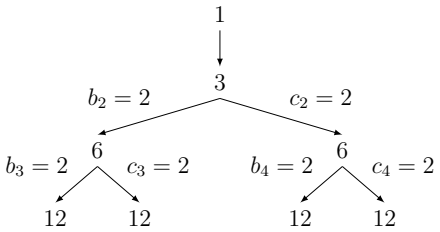
- Every positive Galileo sequence, polynomial or not, can be represented by a binary tree whose nodes encode the terms.
- Monotone positive integer Galileo sequences obey power-law growth bounds on their partial sums.
- The continuous analogs are fully characterized by the same scaling functional equation.
Where Pith is reading between the lines
- The binary-tree representation suggests that any Galileo sequence can be generated recursively by splitting intervals in a self-similar way, which may allow efficient computation or sampling.
- The power-law bounds for monotone cases imply that the growth rate is determined solely by the doubling constant k, independent of other details of the sequence.
- The continuous characterization may serve as a limit object for discrete sequences under suitable rescaling, opening the possibility of studying convergence rates.
Load-bearing premise
The sequence must consist of positive integers whose partial sums satisfy the exact doubling relation S_{2n} = k S_n for a fixed k greater than 1 and every positive integer n.
What would settle it
Exhibit a polynomial sequence of positive integers whose partial sums satisfy S_{2n} = k S_n for some fixed k > 1 but which cannot be written as C(n^d - (n-1)^d) for any constants C and d.
Figures

read the original abstract
A Galileo sequence \((a_n)\) is a sequence of positive integers whose partial sums $S_n$ satisfy $S_{2n}=kS_n$ for some $k>1$. In this paper we prove that every polynomial Galileo sequence is given by first differences of the form \(a_n= C\left(n^d-(n-1)^d\right)\). We then show that every positive Galileo sequence has a binary-tree representation. Finally, for positive monotone integer-valued Galileo sequences, we prove power-law growth bounds, and give a continuous analog together with a characterization of all continuous solutions.
Editorial analysis
A structured set of objections, weighed in public.
Referee Report
Summary. The manuscript defines a Galileo sequence as a sequence of positive integers (a_n) whose partial sums S_n satisfy the scaling relation S_{2n} = k S_n for a fixed k > 1 and all positive integers n. It claims to prove that all such sequences that are polynomial are the first differences a_n = C (n^d - (n-1)^d) for some constant C and degree d. Additionally, it establishes a binary-tree representation for general positive Galileo sequences, proves power-law growth bounds for positive monotone integer-valued Galileo sequences, and characterizes all continuous solutions to the analogous scaling problem.
Significance. Should the proofs be correct, the paper offers a precise characterization of polynomial sequences satisfying the partial-sum scaling condition, showing they must be discrete derivatives of monomials. The binary-tree representation provides a combinatorial structure, and the growth bounds and continuous analog extend the results beyond polynomials. The derivation via substitution into the functional equation S_{2n} - k S_n = 0, forcing lower degree terms to vanish, is a standard and clean approach for such problems.
minor comments (2)
- [Abstract] Abstract: the main polynomial result is stated without noting that k must equal 2^d; adding this relation would make the claim self-contained.
- [Introduction] The definition of the partial sums S_n is used throughout but never written explicitly as S_n = sum_{i=1}^n a_i; a single displayed equation in the introduction would remove any ambiguity.
Simulated Author's Rebuttal
We thank the referee for their careful reading of the manuscript and for the positive assessment of the results on Galileo sequences. The referee recommends minor revision, but the report contains no specific major comments or criticisms to address. We appreciate the concise summary of the paper's contributions and will incorporate any minor editorial improvements in the revised version.
Circularity Check
Derivation is self-contained algebraic consequence of the scaling condition
full rationale
The paper defines a Galileo sequence via the partial-sum condition S_{2n}=k S_n for fixed k>1 and positive integer terms. For the polynomial case, it assumes S_n is a polynomial of degree d and substitutes into the functional equation. Each monomial term n^j scales by the distinct factor 2^j when n is replaced by 2n, so the only way the equation holds identically is if all coefficients except the leading one vanish and k=2^d. The claimed form a_n=C(n^d-(n-1)^d) is then the immediate first difference of the resulting monomial. No parameter is fitted to data, no self-citation supplies the uniqueness, and no ansatz is smuggled in; the result follows directly from the definition and elementary polynomial algebra. The binary-tree representation and growth bounds are likewise presented as consequences of the same scaling without circular reduction.
Axiom & Free-Parameter Ledger
free parameters (2)
- C
- d
axioms (2)
- domain assumption The sequence consists of positive integers and the partial-sum relation S_{2n} = k S_n holds for a fixed k > 1 and all positive integers n.
- domain assumption For the polynomial case, a_n is a polynomial function of n.
Reference graph
Works this paper leans on
-
[1]
¨Omer E˘ gecio˘ glu.A note on iterated Galileo sequences. Discrete Math. Algorithms Appl. 9(2017), Article 1750015. DOI: 10.1142/S179383091750015X
-
[2]
Translated by H
Galileo Galilei.Dialogues Concerning Two New Sciences. Translated by H. Crew and Alfonso de Salvio. Macmillan, New York, 1914. (Original work published 1638 asDiscorsi e Dimostrazioni Matematiche Intorno a Due Nuove Scienze.)
1914
-
[3]
May.Galileo sequences, a good dangling problem
Kenneth O. May.Galileo sequences, a good dangling problem. Amer. Math. Monthly79 (1972), 67–69. DOI: 10.2307/2978135
-
[4]
Hari Pulapaka.On generalized alternating Galileo sequences. Missouri J. Math. Sci. 20(3) (2008), 178–185. DOI: 10.35834/mjms/1316032777
-
[5]
Tattersall.Elementary Number Theory in Nine Chapters, 2nd ed
James J. Tattersall.Elementary Number Theory in Nine Chapters, 2nd ed. Cambridge Univ. Press, Cambridge, 2005
2005
-
[6]
David Zeitlin.A family of Galileo sequences. Amer. Math. Monthly82(1975), 819–822. DOI: 10.2307/2319798
-
[7]
Published elec- tronically athttps://oeis.org
OEIS Foundation Inc.The On-Line Encyclopedia of Integer Sequences. Published elec- tronically athttps://oeis.org. 12
discussion (0)
Sign in with ORCID, Apple, or X to comment. Anyone can read and Pith papers without signing in.