Recognition: unknown
Sharpening New Physics Searches in Neutrino Oscillations with DUNE-PRISM
Pith reviewed 2026-05-09 23:36 UTC · model grok-4.3
The pith
The PRISM technique allows DUNE to recover sensitivity to non-unitarity and sterile neutrinos despite large systematic uncertainties.
A machine-rendered reading of the paper's core claim, the machinery that carries it, and where it could break.
Core claim
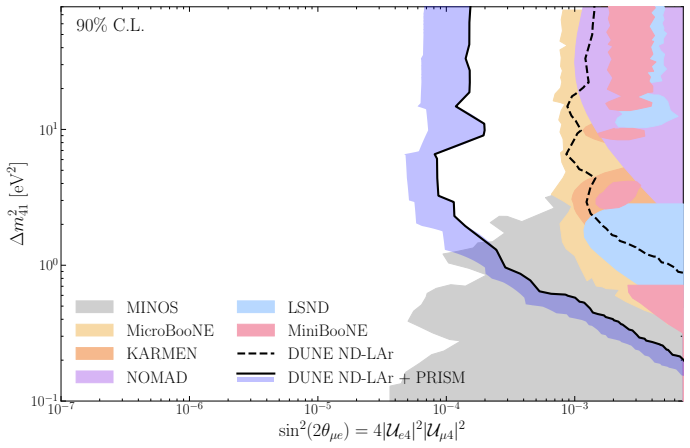
PRISM mitigates the impact of large systematic uncertainties in DUNE by exploiting measurements at multiple off-axis angles, thereby restoring the experiment's sensitivity to non-unitary neutrino mixing and sterile neutrino scenarios in the electron and muon sectors to the level obtained with small spectral uncertainties.
What carries the argument
The PRISM (Precision Reaction Independent Spectrum Measurement) technique, which uses neutrino flux measurements at multiple off-axis angles to derive data-driven constraints on flux and cross-section systematics.
If this is right
- Sensitivity to non-unitarity in the electron and muon sectors is restored to near the level achievable with minimal uncertainties.
- Sterile neutrino searches in the electron and muon sectors regain comparable reach.
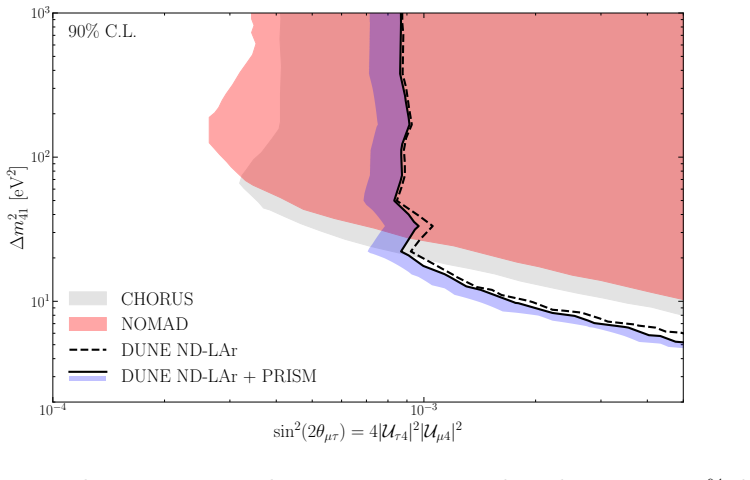
- Improvement remains marginal in the tau sector because off-axis fluxes lie mostly below the tau production threshold.
- Higher-statistics neutrino and antineutrino flux predictions for multiple off-axis angles are now available.
Where Pith is reading between the lines
- The same multi-position strategy could be adapted to other long-baseline experiments facing similar flux and cross-section uncertainties.
- Global fits combining DUNE-PRISM data with other oscillation results may yield tighter limits on sterile neutrino mixing angles.
- If off-axis modeling uncertainties prove controllable, PRISM could be combined with additional near-detector techniques to further extend new-physics reach.
Load-bearing premise
Measurements at different off-axis angles supply a robust data-driven handle on flux and cross-section uncertainties without introducing new uncontrolled errors from off-axis flux modeling or detector response.
What would settle it
An analysis of real or simulated DUNE-PRISM data in which the post-constraint systematic uncertainty remains large or the projected sensitivity to non-unitarity or sterile neutrinos does not improve to the level claimed.
Figures




read the original abstract
Upcoming long-baseline neutrino oscillation experiments such as DUNE aim to achieve unprecedented precision, but their physics reach is ultimately constrained by systematic uncertainties in neutrino flux predictions and neutrino-nucleus cross sections. These limitations are especially critical for new-physics searches in neutrino oscillations at the near detector, including non-unitarity and sterile neutrinos, where the signal manifests as small distortions in the energy spectrum and is therefore highly sensitive to spectral uncertainties. The PRISM (Precision Reaction Independent Spectrum Measurement) technique offers a robust strategy to mitigate these effects by exploiting measurements at multiple off-axis angles, effectively providing a data-driven handle to reduce systematics. In this work, we demonstrate that PRISM can significantly reduce the impact of large systematic uncertainties, restoring sensitivity to non-unitarity and sterile neutrino scenarios in the electron and muon sectors to a level comparable to that obtained with small spectral uncertainties. We also include the results for the $\tau$ sector with PRISM; however, in this case, since the majority of the flux measured at off-axis angles lies below the $\tau$ production threshold, we find the improvement to be marginal. As part of this work, we have obtained neutrino and antineutrino fluxes for different off-axis angles with higher statistics than those provided by the DUNE collaboration. We make available these fluxes as auxiliary material to this manuscript.
Editorial analysis
A structured set of objections, weighed in public.
Referee Report
Summary. The manuscript investigates the use of the PRISM (Precision Reaction Independent Spectrum Measurement) technique at the DUNE near detector to mitigate large systematic uncertainties in neutrino flux and cross-section predictions for new-physics searches in neutrino oscillations. By exploiting data at multiple off-axis angles, the authors claim that PRISM restores sensitivity to non-unitarity and sterile-neutrino scenarios in the electron and muon sectors to levels comparable to those achievable with small spectral uncertainties. Improvement in the tau sector is reported as marginal because most off-axis flux lies below the tau production threshold. The work also computes and releases higher-statistics neutrino and antineutrino fluxes at various off-axis angles as auxiliary material.
Significance. If the central claim holds, the result would meaningfully strengthen DUNE's reach for new-physics searches by providing a practical, data-driven route to control flux and cross-section systematics that currently limit spectral-distortion analyses. The public release of higher-statistics off-axis fluxes is a concrete strength that supports reproducibility and community follow-up studies.
major comments (2)
- [PRISM implementation and flux modeling sections] The load-bearing assumption that multi-angle off-axis measurements supply a purely data-driven constraint on flux and cross-section systematics (without injecting new uncontrolled errors) requires explicit validation. The angle-dependent spectra are still generated from beamline simulations (horn focusing, target geometry, decay pipe); any residual shape or normalization uncertainties in these inputs could correlate with the new-physics spectral distortions being searched for, reducing the effective systematic reduction below the claimed level. This must be demonstrated with dedicated uncertainty propagation or decorrelation studies.
- [Results and sensitivity analysis sections] The abstract states that PRISM restores sensitivity 'to a level comparable to that obtained with small spectral uncertainties' in the electron and muon sectors. A quantitative comparison (e.g., via tabulated sensitivity metrics or overlaid curves) between the PRISM case, the large-systematics baseline, and the small-spectral-uncertainty ideal case is needed to substantiate the 'comparable' claim and to assess how close the restoration actually comes.
minor comments (2)
- The marginal improvement in the tau sector is noted, but a brief discussion of how the combined e/μ/τ sensitivity is affected when the tau channel contributes little would help readers evaluate the overall new-physics reach.
- Clarify the exact factor by which the released off-axis fluxes improve statistics relative to the DUNE collaboration's public fluxes.
Simulated Author's Rebuttal
We thank the referee for their positive assessment of our manuscript and for the constructive comments that help strengthen the presentation of the PRISM method and its impact on new-physics sensitivities. We address each major comment below and have revised the manuscript accordingly.
read point-by-point responses
-
Referee: [PRISM implementation and flux modeling sections] The load-bearing assumption that multi-angle off-axis measurements supply a purely data-driven constraint on flux and cross-section systematics (without injecting new uncontrolled errors) requires explicit validation. The angle-dependent spectra are still generated from beamline simulations (horn focusing, target geometry, decay pipe); any residual shape or normalization uncertainties in these inputs could correlate with the new-physics spectral distortions being searched for, reducing the effective systematic reduction below the claimed level. This must be demonstrated with dedicated uncertainty propagation or decorrelation studies.
Authors: We agree that explicit validation of the residual impact from beamline simulation uncertainties is necessary to substantiate the data-driven nature of the PRISM constraints. Although the nominal off-axis spectra in our studies are generated from beamline simulations, the PRISM technique uses the multi-angle data to fit and constrain flux and cross-section parameters directly. In the revised manuscript we have added a dedicated subsection in the PRISM implementation section that propagates uncertainties in key beamline parameters (horn focusing, target geometry, decay pipe) and demonstrates through decorrelation studies that the multi-angle measurements reduce their correlation with new-physics spectral distortions to a level that preserves the reported sensitivity restoration in the electron and muon sectors. revision: yes
-
Referee: [Results and sensitivity analysis sections] The abstract states that PRISM restores sensitivity 'to a level comparable to that obtained with small spectral uncertainties' in the electron and muon sectors. A quantitative comparison (e.g., via tabulated sensitivity metrics or overlaid curves) between the PRISM case, the large-systematics baseline, and the small-spectral-uncertainty ideal case is needed to substantiate the 'comparable' claim and to assess how close the restoration actually comes.
Authors: We concur that a quantitative comparison is required to support the 'comparable' claim. The revised manuscript now includes a new table in the results section reporting explicit sensitivity metrics (90% CL exclusion limits on non-unitarity parameters and sterile-neutrino mixing angles) for the three cases: large systematics without PRISM, PRISM, and the ideal small-spectral-uncertainty scenario. We have also added overlaid sensitivity curves in the relevant figures for the electron and muon sectors to allow direct visual assessment of how closely the PRISM results approach the small-uncertainty case. revision: yes
Circularity Check
No significant circularity; central claim rests on independent flux simulations
full rationale
The paper demonstrates PRISM's ability to mitigate flux and cross-section systematics for new-physics searches by using measurements at multiple off-axis angles. This relies on newly computed higher-statistics neutrino/antineutrino fluxes (provided as auxiliary material) and standard oscillation physics, not on re-deriving or fitting the target sensitivities from the same data. No load-bearing self-citations, self-definitional steps, or fitted inputs renamed as predictions appear in the derivation chain. The result is self-contained against external simulation benchmarks.
Axiom & Free-Parameter Ledger
axioms (1)
- domain assumption Off-axis angle variations provide independent spectral information sufficient to constrain flux and cross-section systematics without new dominant uncertainties.
Reference graph
Works this paper leans on
-
[1]
Minkowski,µ→eγat a Rate of One Out of10 9 Muon Decays?,Phys
P. Minkowski,µ→eγat a Rate of One Out of10 9 Muon Decays?,Phys. Lett. B67 (1977) 421–428
1977
-
[2]
R. N. Mohapatra and G. Senjanovic,Neutrino Mass and Spontaneous Parity Nonconservation,Phys. Rev. Lett.44(1980) 912
1980
-
[3]
Yanagida,Horizontal gauge symmetry and masses of neutrinos,Conf
T. Yanagida,Horizontal gauge symmetry and masses of neutrinos,Conf. Proc. C 7902131(1979) 95–99
1979
-
[5]
G. C. Branco, W. Grimus, and L. Lavoura,The Seesaw Mechanism in the Presence of a Conserved Lepton Number,Nucl. Phys. B312(1989) 492–508
1989
-
[6]
J. Kersten and A. Y. Smirnov,Right-Handed Neutrinos at CERN LHC and the 22 Mechanism of Neutrino Mass Generation,Phys. Rev. D76(2007) 073005, [arXiv:0705.3221]
- [7]
- [8]
-
[9]
R. N. Mohapatra and J. W. F. Valle,Neutrino Mass and Baryon Number Nonconservation in Superstring Models,Phys. Rev. D34(1986) 1642
1986
-
[10]
M. C. Gonzalez-Garcia and J. W. F. Valle,Fast Decaying Neutrinos and Observable Flavor Violation in a New Class of Majoron Models,Phys. Lett. B216(1989) 360–366
1989
- [11]
-
[12]
Bernabéu, A
J. Bernabéu, A. Santamaria, J. Vidal, A. Mendez, and J. Valle,Lepton flavour non-conservation at high energies in a superstring inspired standard model,Physics Letters B187(1987), no. 3 303–308
1987
-
[13]
R. N. Mohapatra,Mechanism for Understanding Small Neutrino Mass in Superstring Theories,Phys. Rev. Lett.56(1986) 561–563
1986
- [14]
- [15]
-
[16]
M. Malinsky, J. C. Romao, and J. W. F. Valle,Novel supersymmetricSO(10)seesaw mechanism,Phys. Rev. Lett.95(2005) 161801, [hep-ph/0506296]
-
[17]
M. Blennow, E. Fernández-Martínez, J. Hernández-García, J. López-Pavón, X. Marcano, and D. Naredo-Tuero,Bounds on lepton non-unitarity and heavy neutrino mixing,JHEP08(2023) 030, [arXiv:2306.01040]
-
[18]
M. Blennow, P. Coloma, E. Fernandez-Martinez, J. Hernandez-Garcia, and J. Lopez-Pavon,Non-Unitarity, sterile neutrinos, and Non-Standard neutrino Interactions,JHEP04(2017) 153, [arXiv:1609.08637]. [22]LSNDCollaboration, A. Aguilar-Arevalo et al.,Evidence for neutrino oscillations from the observation of¯νe appearance in a¯νµ beam,Phys. Rev. D64(2001) 1120...
-
[19]
S. Antusch, C. Biggio, E. Fernandez-Martinez, M. B. Gavela, and J. Lopez-Pavon, Unitarity of the Leptonic Mixing Matrix,JHEP10(2006) 084, [hep-ph/0607020]
- [20]
-
[21]
P. Coloma, J. López-Pavón, S. Rosauro-Alcaraz, and S. Urrea,New physics from oscillations at the DUNE near detector, and the role of systematic uncertainties,JHEP 08(2021) 065, [arXiv:2105.11466]. [34]nuPRISMCollaboration, S. Bhadra et al.,Letter of Intent to Construct a nuPRISM Detector in the J-PARC Neutrino Beamline,arXiv:1412.3086
-
[22]
Hasnip,DUNE-PRISM - a new method to measure neutrino oscillations
C. Hasnip,DUNE-PRISM - a new method to measure neutrino oscillations. PhD thesis, Oxford University, Oxford U., 2023
2023
-
[23]
J. Gehrlein, J. Kopp, M. MacMahon, and G. A. Parker,A LENS on DUNE-PRISM: Characterizing a Neutrino Beam with Off-Axis Measurements,arXiv:2510.09546. [37]DUNECollaboration, S. Abbaslu et al.,Towards mono-energetic virtualνbeam cross-section measurements: A feasibility study ofν-Ar interaction analysis with DUNE-PRISM,arXiv:2509.07664
-
[24]
Yanagida,Horizontal Symmetry and Mass of the Top Quark,Phys
T. Yanagida,Horizontal Symmetry and Mass of the Top Quark,Phys. Rev. D20(1979) 2986
1979
-
[25]
Complex Spinors and Unified Theories
M. Gell-Mann, P. Ramond, and R. Slansky,Complex Spinors and Unified Theories, Conf. Proc. C790927(1979) 315–321, [arXiv:1306.4669]
work page Pith review arXiv 1979
-
[26]
Bernabeu, A
J. Bernabeu, A. Santamaria, J. Vidal, A. Mendez, and J. W. F. Valle,Lepton Flavor Nonconservation at High-Energies in a Superstring Inspired Standard Model,Phys. Lett. B187(1987) 303–308
1987
- [27]
- [28]
- [29]
-
[30]
The Reactor Antineutrino Anomaly
G. Mention, M. Fechner, T. Lasserre, T. A. Mueller, D. Lhuillier, M. Cribier, and A. Letourneau,The Reactor Antineutrino Anomaly,Phys. Rev. D83(2011) 073006, [arXiv:1101.2755]
work page Pith review arXiv 2011
-
[31]
On the determination of anti-neutrino spectra from nuclear reactors,
P. Huber,On the determination of anti-neutrino spectra from nuclear reactors,Phys. Rev. C84(2011) 024617, [arXiv:1106.0687]. [Erratum: Phys.Rev.C 85, 029901 (2012)]
-
[32]
M. Blennow, P. Coloma, E. Fernández-Martínez, J. Hernández-García, J. López-Pavón, X. Marcano, D. Naredo-Tuero, and S. Urrea,Misconceptions in neutrino oscillations in 24 presence of non-unitary mixing,Nucl. Phys. B1017(2025) 116944, [arXiv:2502.19480]
-
[33]
A. Broncano, M. B. Gavela, and E. E. Jenkins,The Effective Lagrangian for the seesaw model of neutrino mass and leptogenesis,Phys. Lett. B552(2003) 177–184, [hep-ph/0210271]. [Erratum: Phys.Lett.B 636, 332 (2006)]
-
[34]
E. Fernandez-Martinez, M. B. Gavela, J. Lopez-Pavon, and O. Yasuda,CP-violation from non-unitary leptonic mixing,Phys. Lett. B649(2007) 427–435, [hep-ph/0703098]
-
[35]
Langacker and D
P. Langacker and D. London,Mixing Between Ordinary and Exotic Fermions,Phys. Rev. D38(1988) 886
1988
- [36]
-
[37]
D. Tommasini, G. Barenboim, J. Bernabeu, and C. Jarlskog,Nondecoupling of heavy neutrinos and lepton flavor violation,Nucl. Phys. B444(1995) 451–467, [hep-ph/9503228]
- [38]
-
[39]
E. Akhmedov, A. Kartavtsev, M. Lindner, L. Michaels, and J. Smirnov,Improving Electro-Weak Fits with TeV-scale Sterile Neutrinos,JHEP05(2013) 081, [arXiv:1302.1872]
-
[40]
S. Antusch and O. Fischer,Non-unitarity of the leptonic mixing matrix: Present bounds and future sensitivities,JHEP10(2014) 094, [arXiv:1407.6607]
-
[41]
E. Fernandez-Martinez, J. Hernandez-Garcia, J. Lopez-Pavon, and M. Lucente,Loop level constraints on Seesaw neutrino mixing,JHEP10(2015) 130, [arXiv:1508.03051]
-
[42]
E. Fernandez-Martinez, J. Hernandez-Garcia, and J. Lopez-Pavon,Global constraints on heavy neutrino mixing,JHEP08(2016) 033, [arXiv:1605.08774]. [57]MicroBooNECollaboration, P. Abratenko et al.,Search for light sterile neutrinos with two neutrino beams at MicroBooNE,Nature648(2025), no. 8092 64–69, [arXiv:2512.07159]. [58]DUNECollaboration, B. Abi et al.,...
- [43]
-
[44]
Simulation of long-baseline neutrino oscillation experiments with GLoBES
P. Huber, M. Lindner, and W. Winter,Simulation of long-baseline neutrino oscillation experiments with GLoBES (General Long Baseline Experiment Simulator),Comput. Phys. Commun.167(2005) 195, [hep-ph/0407333]
work page Pith review arXiv 2005
-
[45]
New features in the simulation of neutrino oscillation experiments with GLoBES 3.0
P. Huber, J. Kopp, M. Lindner, M. Rolinec, and W. Winter,New features in the simulation of neutrino oscillation experiments with GLoBES 3.0: General Long Baseline Experiment Simulator,Comput. Phys. Commun.177(2007) 432–438, [hep-ph/0701187]. [63]IceCubeCollaboration, M. G. Aartsen et al.,Searches for Sterile Neutrinos with the IceCube Detector,Phys. Rev. ...
work page Pith review arXiv 2007
-
[46]
The GENIE Neutrino Monte Carlo Generator: Physics and User Manual
C. Andreopoulos, C. Barry, S. Dytman, H. Gallagher, T. Golan, R. Hatcher, G. Perdue, and J. Yarba,The GENIE Neutrino Monte Carlo Generator: Physics and User Manual, arXiv:1510.05494. [76]GENIECollaboration, J. Tena-Vidal et al.,Neutrino-Nucleon Cross-Section Model Tuning in GENIE v3,arXiv:2104.09179
-
[47]
A. De Gouvêa, K. J. Kelly, G. V. Stenico, and P. Pasquini,Physics with Beam Tau-Neutrino Appearance at DUNE,Phys. Rev. D100(2019), no. 1 016004, [arXiv:1904.07265]
- [48]
discussion (0)
Sign in with ORCID, Apple, or X to comment. Anyone can read and Pith papers without signing in.