Recognition: unknown
Relativistic effects in k-essence
Pith reviewed 2026-05-09 23:06 UTC · model grok-4.3
The pith
Relativistic corrections distinguish k-essence models in angular galaxy spectra where Fourier measurements show degeneracies.
A machine-rendered reading of the paper's core claim, the machinery that carries it, and where it could break.
Core claim
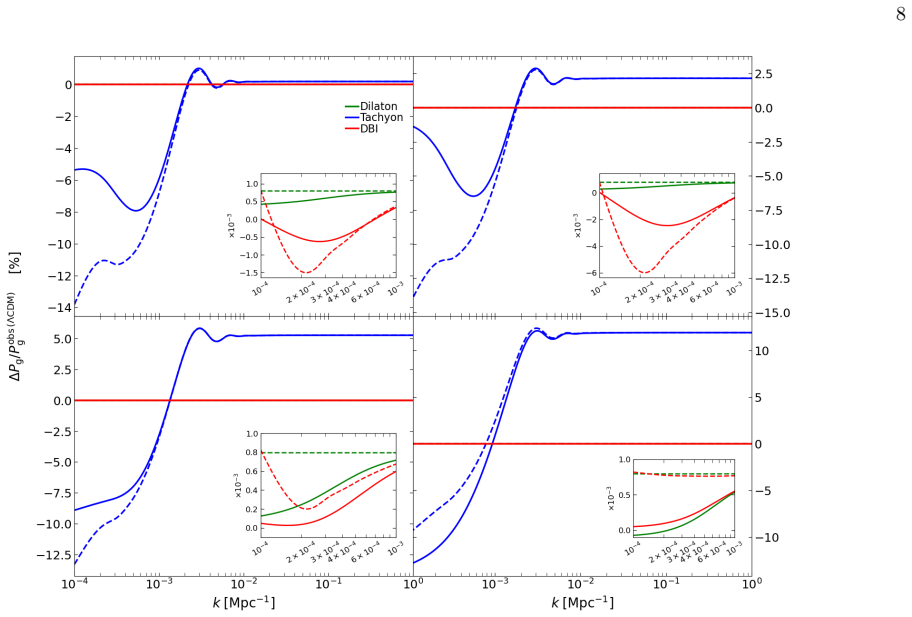
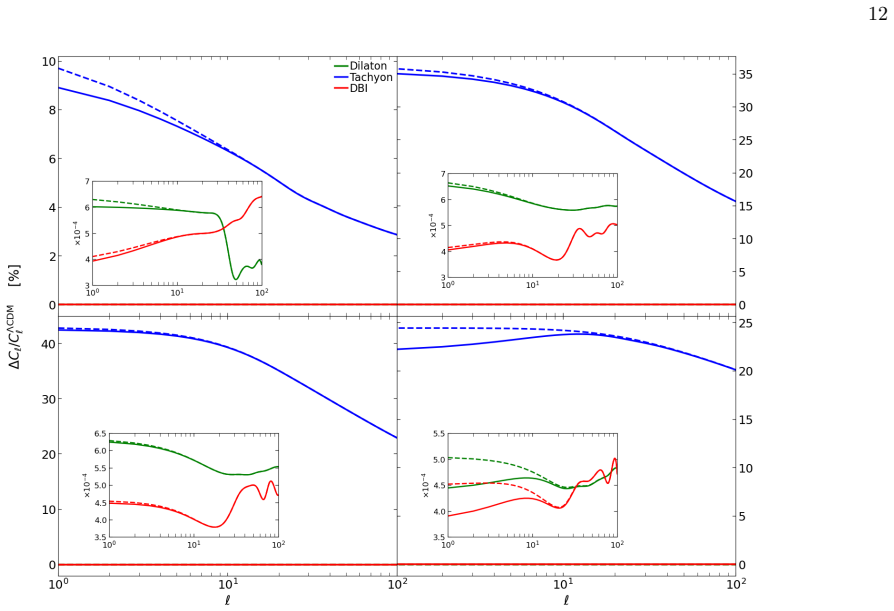
Relativistic corrections dominate the galaxy power spectrum on very large scales and increase with redshift, but remain largely insensitive to k-essence microphysics in Fourier space, leading to strong degeneracies among models. In the angular power spectrum, where line-of-sight integrals are included, the same effects are significantly amplified, yielding better sensitivity to clustering k-essence; the tachyon in particular exhibits clear deviations across multipoles and redshifts in the Doppler and combined velocity-gravitational potential contributions.
What carries the argument
The angular galaxy power spectrum incorporating relativistic corrections, which uses line-of-sight integrals to separate Doppler, gravitational potential, and other terms and thereby exposes model-specific imprints of k-essence.
Load-bearing premise
Enforcing identical present-day cosmological parameters across models fully isolates the imprints of k-essence dynamics and perturbations without residual degeneracies from the background expansion history or perturbation equation choices.
What would settle it
A measurement showing no deviation in the angular power spectrum for the tachyon model relative to the cosmological constant at low multipoles and moderate-to-high redshifts would falsify the claim that angular spectra provide amplified sensitivity.
Figures






read the original abstract
Relativistic effects are sensitive to subtle changes in dark energy. These effects grow on very large scales and at high redshifts, which will be the reach of upcoming surveys. We investigate these effects in both the linear and the angular galaxy power spectra in a late-time universe dominated by cold dark matter and k-essence, focusing on three core models (dilaton, tachyon, and DBI scalar fields) and contrasting their predictions with those of the concordance model. By enforcing identical present-day cosmological parameters, we isolate the imprints of k-essence dynamics and perturbations on very large scales. We found that relativistic corrections dominate on very large scales and grow with redshift, but are largely insensitive to k-essence microphysics in Fourier space, leading to strong degeneracies among the models. However, in the angular power spectrum, where line-of-sight integrals are naturally included, relativistic effects are significantly amplified, yielding better sensitivity to clustering k-essence. In particular, the tachyon exhibits clear deviations across multipoles and redshifts, with distinct imprints in the Doppler and the combined (velocity and gravitational) potentials contributions. Furthermore, our results show that neglecting relativistic corrections can lead to systematic misestimation of deviations of k-essence from the cosmological constant. Our results show the relativistic angular galaxy power spectrum as a more consistent and robust probe of ultra-large-scale physics. These findings underscore the need for full relativistic modelling in next-generation surveys that are targeting horizon-scale modes, where the imprint of non-standard dark energy is most pronounced.
Editorial analysis
A structured set of objections, weighed in public.
Referee Report
Summary. The manuscript investigates relativistic corrections to galaxy clustering in k-essence dark energy models (dilaton, tachyon, DBI) contrasted with ΛCDM. By enforcing identical present-day cosmological parameters, the authors isolate the effects of k-essence dynamics and perturbations on very large scales in both Fourier-space power spectra and angular power spectra. Key findings include that relativistic effects dominate on large scales and grow with redshift, exhibit degeneracies among models in Fourier space, but show amplified sensitivity and distinct imprints (especially for tachyon) in the angular power spectrum due to line-of-sight integrals. Neglecting these corrections can lead to misestimation of deviations from ΛCDM.
Significance. If the separation between background evolution and perturbation microphysics is robust, the result highlights that angular power spectra offer a more sensitive probe of clustering k-essence than Fourier-space spectra for future ultra-large-scale surveys. The explicit comparison across three k-essence models and the demonstration of redshift-dependent growth of relativistic terms provide a concrete basis for advocating full relativistic modeling, which could reduce systematic biases in dark energy constraints.
major comments (2)
- [Background evolution and parameter matching (implicit in abstract and methods)] The central claim that present-day parameter matching fully isolates k-essence microphysics (sound speed, perturbation equations) from background effects is load-bearing. Different k-essence Lagrangians produce distinct w(a) and thus different ρ_DE(z) and H(z) even at fixed Ω_DE(0). Relativistic terms (ISW, Doppler, gravitational potentials) integrate over the growth factor and dΦ/dt, both of which depend on H(z). The paper must explicitly compare H(z) and the linear growth factor D(z) across models (e.g., in a dedicated background-evolution subsection or figure) and demonstrate that reported degeneracies in P(k) and amplifications in C_ℓ arise from perturbation-level differences rather than these background mismatches. Without this, the isolation assumption remains unverified.
- [Results on Fourier vs angular spectra] The abstract states that relativistic corrections are 'largely insensitive to k-essence microphysics in Fourier space' yet 'significantly amplified' in the angular spectrum. This contrast is central, but the line-of-sight integrals for the angular power spectrum (including velocity and potential contributions) must be shown to incorporate the model-specific perturbation equations without additional scale cuts or gauge artifacts. If the Fourier-space insensitivity partly reflects the common background expansion rather than the microphysics, the claimed advantage of angular spectra for distinguishing tachyon deviations would be overstated.
minor comments (2)
- [Perturbation equations] Clarify the precise gauge choice (e.g., Newtonian or synchronous) used for the relativistic corrections and confirm that the same gauge is applied consistently to all models and to ΛCDM.
- [Discussion] The statement that 'neglecting relativistic corrections can lead to systematic misestimation' should be quantified, e.g., by showing the fractional bias in inferred parameters when relativistic terms are omitted.
Simulated Author's Rebuttal
We thank the referee for their careful reading and constructive comments on our manuscript. The points raised regarding background evolution and the Fourier versus angular spectra distinction are important for clarifying our claims. We address each major comment below and will incorporate revisions to strengthen the presentation.
read point-by-point responses
-
Referee: [Background evolution and parameter matching] The central claim that present-day parameter matching fully isolates k-essence microphysics (sound speed, perturbation equations) from background effects is load-bearing. Different k-essence Lagrangians produce distinct w(a) and thus different ρ_DE(z) and H(z) even at fixed Ω_DE(0). Relativistic terms integrate over the growth factor and dΦ/dt, both of which depend on H(z). The paper must explicitly compare H(z) and the linear growth factor D(z) across models and demonstrate that reported degeneracies in P(k) and amplifications in C_ℓ arise from perturbation-level differences rather than these background mismatches. Without this, the isolation assumption remains unverified.
Authors: We agree that explicit verification of the background quantities would strengthen the isolation claim. In our analysis, we fix the present-day parameters (Ω_m0, Ω_DE0, H0, and w0) to be identical for all models, allowing each Lagrangian to determine its subsequent evolution. This is a standard approach for isolating microphysical effects in dark energy comparisons. However, to directly respond to the concern, we will add a dedicated subsection (or figure) in the methods section comparing H(z) and the linear growth factor D(z) for the dilaton, tachyon, DBI, and ΛCDM cases. Our internal checks show that differences in H(z) remain below a few percent for z < 2 (the range of interest), with growth factors similarly close, indicating that the observed degeneracies in Fourier space and distinctions in angular space are driven by perturbation-level differences such as the sound speed. We will quantify any residual impact on the relativistic terms and update the text accordingly. revision: yes
-
Referee: [Results on Fourier vs angular spectra] The abstract states that relativistic corrections are 'largely insensitive to k-essence microphysics in Fourier space' yet 'significantly amplified' in the angular spectrum. This contrast is central, but the line-of-sight integrals for the angular power spectrum (including velocity and potential contributions) must be shown to incorporate the model-specific perturbation equations without additional scale cuts or gauge artifacts. If the Fourier-space insensitivity partly reflects the common background expansion rather than the microphysics, the claimed advantage of angular spectra for distinguishing tachyon deviations would be overstated.
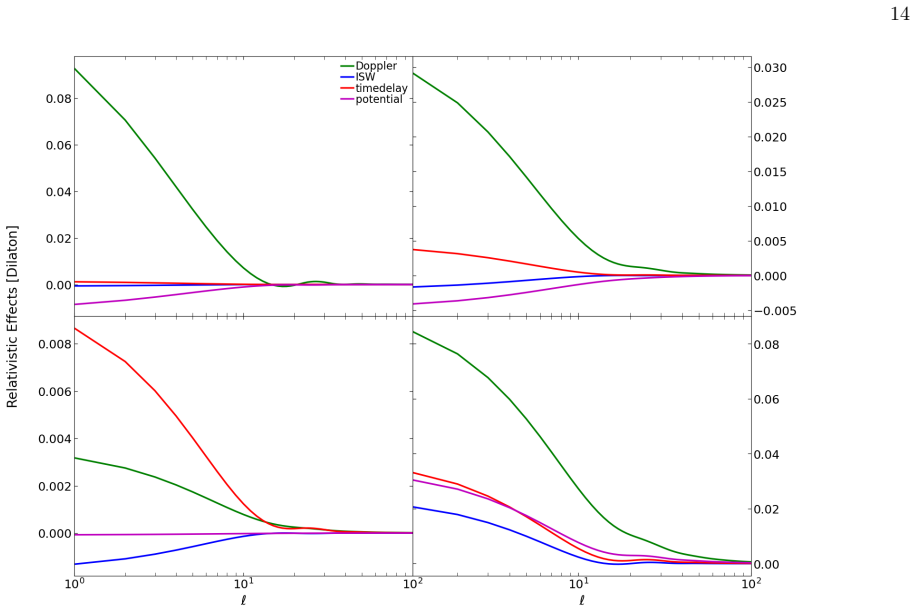
Authors: We thank the referee for highlighting the need to clarify this central contrast. The Fourier-space power spectra are computed at fixed redshift and wavenumber using the complete, model-specific perturbation equations (including the k-essence sound speed and scalar-field fluctuations) in the Newtonian gauge. The observed insensitivity on ultra-large scales reflects the fact that relativistic corrections there are dominated by the common background expansion and matter growth, with microphysical differences contributing less distinctly to P(k). The angular power spectra, by contrast, employ the full line-of-sight integrals of the velocity, density, and gravitational potential terms, where these model-specific perturbations accumulate differently, producing the amplified distinctions (most notably for the tachyon). No additional scale cuts or gauge changes are introduced beyond the linear-regime validity already stated. To address the comment, we will expand the results section with explicit discussion of how the perturbation equations enter the line-of-sight integrals and add supplementary plots of the separate Doppler, ISW, and potential contributions for each model. This will confirm that the advantage of angular spectra is not overstated. revision: partial
Circularity Check
No significant circularity; derivation is self-contained
full rationale
The paper solves the background evolution and linear perturbation equations for each k-essence model (dilaton, tachyon, DBI) with the single constraint of matching present-day cosmological parameters, then computes relativistic corrections to the galaxy power spectrum in Fourier space and via line-of-sight integrals for C_ℓ. This is a standard, non-circular procedure: the distinct w(a) and sound-speed behaviors of each Lagrangian produce different H(z), growth factors, and velocity potentials, which are then projected into the observables. No step reduces a claimed prediction to a fitted parameter by construction, no load-bearing uniqueness theorem is imported from self-citation, and no ansatz is smuggled. The reported insensitivity in Fourier space and amplification in angular spectra follow directly from the differing line-of-sight kernels once the equations are integrated; the method does not presuppose the outcome.
Axiom & Free-Parameter Ledger
axioms (2)
- domain assumption Linear perturbation theory remains valid on horizon scales for the chosen k-essence models
- domain assumption Present-day cosmological parameters can be fixed identically across models without altering the perturbation equations
Reference graph
Works this paper leans on
-
[1]
= 44.856191 and α= 0.5 for the tachyon, and we useκ 2M4/(3H2
-
[2]
freezing
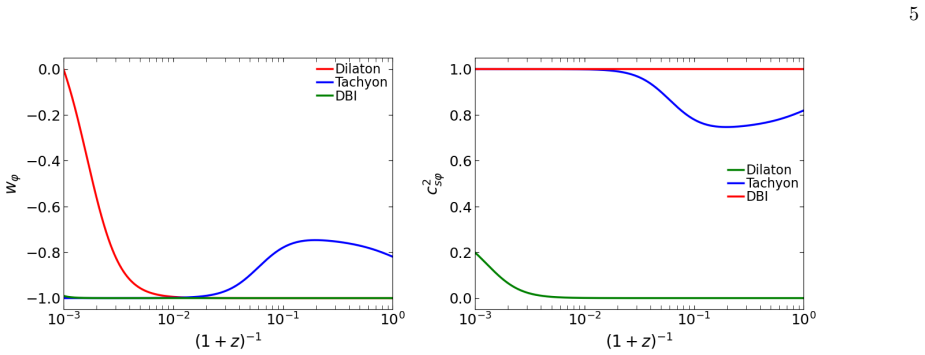
= 109 for the DBI field. In Fig. 1 (left panel) we show the cosmic evolutions of k-essence equation of state parameters (19), (24), and (32) for the dilaton, the tachyon, and the DBI field, re- spectively. We see that the dilaton is in the tracking regime at decoupling, with an equation of state param- eter equal to that of the dominant component (matter)...
-
[3]
Key small-Xexpansions (1 +c 1X)1/2 = 1 + 1 2 c1X− 1 8 c2 1X2, (1 +c 1X) −1/2 = 1− 1 2 c1X+ 3 8 c2 1X2, (1 +c 1X) −3/2 = 1− 3 2 c1X+ 15 8 c2 1X2, where (c 2X)3 =O(X 3) and (c 3X)4 =O(X 4), so we ignore those terms, and go up toX 2
-
[4]
Expandw ϕ The equation of state is the ratiow ϕ =N(X)/D(X). NumeratorN(X): N(X)≡ −2.01 + 2(1 +c 1X)1/2, =−2.01 + 2 1 + 1 2 c1X− 1 8 c2 1X2 , =−1.01 +c 1X− 1 4 c2 1X2, DenominatorD(X): D(X)≡2.01−2(1 +c 1X) −1/2, = 2.01−2 1− 1 2 c1X+ 3 8 c2 1X2 , = 0.01 +c 1X− 3 4 c2 1X2. We use the expansion, (a+bX+cX 2)/(d+eX+f X 2), which leads to wϕ =−1+200c 1X− 20000 +...
-
[5]
Expand∂ X N(X): ∂X N(X) =c 1(1 +c 1X) −1/2, =c 1 1− 1 2 c1X+ 3 8 c2 1X2 , =c 1 − 1 2 c2 1X+ 3 8 c3 1X2
Expandc 2 sϕ: Note that:c 2 sϕ =∂ X N(X)/∂ X D(X). Expand∂ X N(X): ∂X N(X) =c 1(1 +c 1X) −1/2, =c 1 1− 1 2 c1X+ 3 8 c2 1X2 , =c 1 − 1 2 c2 1X+ 3 8 c3 1X2. Expand∂ X D(X): ∂X D(X) =c 1(1 +c 1X) −3/2, =c 1 1− 3 2 c1X+ 15 8 c2 1X2 , =c 1 − 3 2 c2 1X+ 15 8 c3 1X2. From the definition ofc 2 sϕ above, after expansion: c2 sϕ = 1 +c 1X−c 2 1X2 +O(X 3),(A2)
-
[6]
Note that this is perturbative, only valid for|w ϕ+1| ≪1
Expressc 2 sϕ in terms ofw ϕ We use the series we already found: wϕ =−1 + 200c 1X−αc 2 1X2 +O(X 3),(A3) whereα= 20000 + 1 2, and c2 sϕ = 1 +c 1X−c 2 1X2 +O(X 3).(A4) Letδ≡w ϕ + 1 with|δ| ≪1, then we have δ= 200c 1X−αc 2 1X2.(A5) Solve forX(perturbatively): First approximation: X≈ δ 200c1 .(A6) Next-order correction: solving iteratively, using (A6) in (A5)...
2003
- [7]
-
[8]
J. Yoo, General Relativistic Description of the Ob- served Galaxy Power Spectrum: Do We Understand What We Measure?, Phys. Rev. D82, 083508 (2010), arXiv:1009.3021 [astro-ph.CO]
-
[9]
Yoo, Relativistic Effect in Galaxy Clustering, Class
J. Yoo, Relativistic Effect in Galaxy Clustering, Class. Quant. Grav.31, 234001 (2014), arXiv:1409.3223 [astro- ph.CO]
-
[10]
The linear power spectrum of observed source number counts,
A. Challinor and A. Lewis, The linear power spectrum of observed source number counts, Phys. Rev. D84, 043516 (2011), arXiv:1105.5292 [astro-ph.CO]
-
[11]
What galaxy surveys really measure,
C. Bonvin and R. Durrer, What galaxy surveys really measure, Phys. Rev. D84, 063505 (2011), arXiv:1105.5280 [astro-ph.CO]
- [12]
-
[13]
L. Lopez-Honorez, O. Mena, and S. Rigolin, Biases on cosmological parameters by general relativity effects, Phys. Rev. D85, 023511 (2012), arXiv:1109.5117 [astro- ph.CO]
- [14]
-
[15]
Bonvin, Isolating relativistic effects in large-scale structure, Class
C. Bonvin, Isolating relativistic effects in large-scale structure, Class. Quant. Grav.31, 234002 (2014), arXiv:1409.2224 [astro-ph.CO]
-
[16]
Vector perturbations of galaxy number counts
R. Durrer and V. Tansella, Vector perturbations of galaxy number counts, JCAP07, 037, arXiv:1605.05974 [astro-ph.CO]
- [17]
- [18]
-
[19]
D. Duniya, Understanding the relativistic overden- sity of galaxy surveys, arXiv:1606.00712 (2016), arXiv:1606.00712 [astro-ph.CO]
-
[20]
Duniya, Dark energy homogeneity in general relativ- ity: Are we applying it correctly?, Gen
D. Duniya, Dark energy homogeneity in general relativ- ity: Are we applying it correctly?, Gen. Rel. Grav.48, 52 (2016), arXiv:1505.03436 [gr-qc]
- [21]
-
[22]
C. Armendariz-Picon, V. F. Mukhanov, and P. J. Stein- hardt, A Dynamical solution to the problem of a small cosmological constant and late time cosmic accelera- tion, Phys. Rev. Lett.85, 4438 (2000), arXiv:astro- ph/0004134
-
[23]
C. Armendariz-Picon, V. F. Mukhanov, and P. J. Stein- hardt, Essentials of k essence, Phys. Rev. D63, 103510 (2001), arXiv:astro-ph/0006373
-
[24]
F. Piazza and S. Tsujikawa, Dilatonic ghost condensate as dark energy, JCAP07, 004, arXiv:hep-th/0405054
-
[25]
Amendola and S
L. Amendola and S. Tsujikawa,Dark Energy: Theory and Observations(Cambridge University Press, 2010)
2010
- [26]
-
[27]
S. Tsujikawa, Dark energy: investigation and model- ing, arXiv preprint 1004.1493 10.1007/978-90-481-8685- 3 8 (2010), arXiv:1004.1493 [astro-ph.CO]
-
[28]
Modified Gravity and Cosmology
T. Clifton, P. G. Ferreira, A. Padilla, and C. Skordis, Modified Gravity and Cosmology, Phys. Rept.513, 1 (2012), arXiv:1106.2476 [astro-ph.CO]
work page internal anchor Pith review arXiv 2012
-
[29]
M. Ishak, Testing General Relativity in Cosmology, Liv- ing Rev. Rel.22, 1 (2019), arXiv:1806.10122 [astro- ph.CO]
-
[30]
Duniya, Large-scale imprint of relativistic effects in the cosmic magnification, Phys
D. Duniya, Large-scale imprint of relativistic effects in the cosmic magnification, Phys. Rev. D93, 103538 (2016), [Addendum: Phys.Rev.D 93, 129902 (2016)], arXiv:1604.03934 [astro-ph.CO]
- [31]
- [32]
-
[33]
D. Duniya and B. Mongwane, Cosmic magnification in beyond-Horndeski gravity, arXiv:2311.04169 (2023), arXiv:2311.04169 [astro-ph.CO]
-
[34]
C. Armendariz-Picon, T. Damour, and V. F. Mukhanov, k - inflation, Phys. Lett. B458, 209 (1999), arXiv:hep- th/9904075
-
[35]
Kinetically Driven Quintessence
T. Chiba, T. Okabe, and M. Yamaguchi, Kinetically driven quintessence, Phys. Rev. D62, 023511 (2000), arXiv:astro-ph/9912463
work page Pith review arXiv 2000
- [36]
- [37]
-
[38]
S. Tsujikawa, A. De Felice, and J. Alcaniz, Testing for dynamical dark energy models with redshift-space dis- tortions, JCAP01, 030, arXiv:1210.4239 [astro-ph.CO]
-
[39]
A. Mohammadi, T. Golanbari, and K. Saaidi, Beta- function formalism for k-essence constant-roll inflation, Phys. Dark Univ.28, 100505 (2020), arXiv:1912.07006 [gr-qc]
-
[40]
K. Rezazadeh, S. Asadzadeh, K. Fahimi, K. Karami, and A. Mehrabi, The growth of DM and DE perturbations in DBI non-canonical scalar field scenario, Annals Phys. 422, 168299 (2020), arXiv:2001.07920 [gr-qc]
-
[41]
F. A. M. Mulki and H. Wulandari, Analytical treat- ment of small scales matter power spectrum in coupled scalar field (CSF) cosmology, EPJ Web Conf.240, 02003 (2020)
2020
-
[42]
J. M. Bardeen, Gauge Invariant Cosmological Perturba- tions, Phys. Rev. D22, 1882 (1980)
1980
-
[43]
Planck 2018 results. VI. Cosmological parameters
N. Aghanimet al.(Planck), Planck 2018 results. VI. Cosmological parameters, Astron. Astrophys.641, A6 (2020), [Erratum: Astron.Astrophys. 652, C4 (2021)], arXiv:1807.06209 [astro-ph.CO]
work page internal anchor Pith review arXiv 2018
- [44]
-
[45]
E. Gaztanaga, C. Bonvin, and L. Hui, Measurement of the dipole in the cross-correlation function of galaxies, JCAP01, 032, arXiv:1512.03918 [astro-ph.CO]
-
[46]
V. Desjacques, D. Jeong, and F. Schmidt, Large- Scale Galaxy Bias, Phys. Rept.733, 1 (2018), arXiv:1611.09787 [astro-ph.CO]
work page Pith review arXiv 2018
-
[47]
T. Baldauf, U. Seljak, L. Senatore, and M. Zaldarriaga, Galaxy Bias and non-Linear Structure Formation in Gen- eral Relativity, JCAP10, 031, arXiv:1106.5507 [astro- ph.CO]
-
[48]
N. Bartolo, S. Matarrese, and A. Riotto, Relativistic Ef- fects and Primordial Non-Gaussianity in the Galaxy bias, JCAP04, 011, arXiv:1011.4374 [astro-ph.CO]
-
[49]
Blanchardet al.(Euclid), Euclid preparation
A. Blanchardet al.(Euclid), Euclid preparation. VII. Forecast validation for Euclid cosmological probes, As- tron. Astrophys.642, A191 (2020), arXiv:1910.09273 [astro-ph.CO]
- [50]
- [51]
-
[52]
A. Abateet al.(LSST Dark Energy Science), Large Syn- optic Survey Telescope: Dark Energy Science Collabora- tion, arXiv preprint 1211.0310 10.2172/1156445 (2012), arXiv:1211.0310 [astro-ph.CO]
discussion (0)
Sign in with ORCID, Apple, or X to comment. Anyone can read and Pith papers without signing in.