Recognition: unknown
Search for dark matter produced in association with a dark Higgs boson decaying into a bottom quark-antiquark pair in proton-proton collisions at sqrt{s} = 13 TeV
Pith reviewed 2026-05-09 22:15 UTC · model grok-4.3
The pith
No excess found in dark matter search with dark Higgs decaying to bottom quarks, excluding mediator masses up to 4.5 TeV.
A machine-rendered reading of the paper's core claim, the machinery that carries it, and where it could break.
Core claim
In the absence of any observed signal, the search establishes 95% confidence level upper limits on the signal strength for dark Higgs boson mass hypotheses below 160 GeV. For a dark Higgs boson mass of 50 GeV, mediator masses up to 4.5 TeV are excluded at 95% confidence level, while for 150 GeV the exclusion reaches up to 2.5 TeV. These represent the most stringent limits set to date for the dark Higgs boson masses considered.
What carries the argument
The experimental signature of large missing transverse momentum from the dark matter particles combined with a resonant peak in the invariant mass of the bottom quark-antiquark pair from the dark Higgs decay.
Load-bearing premise
Standard model background processes are accurately estimated from data and simulation without large unaccounted systematic effects, and the theoretical model correctly predicts the production and decay kinematics.
What would settle it
A statistically significant excess of events showing both large missing transverse momentum and a peak in the bottom quark pair invariant mass at the hypothesized dark Higgs mass would support the signal and falsify the null result.
Figures


read the original abstract
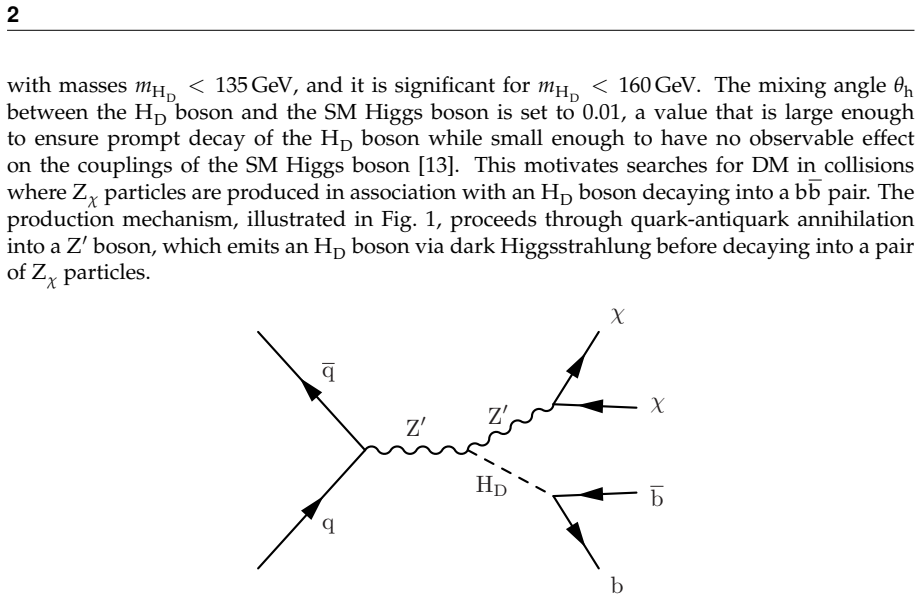
A search for dark matter produced in association with a dark Higgs boson decaying into a bottom quark-antiquark pair has been performed using proton-proton collision data at a center-of-mass energy of 13 TeV. The search uses data collected with the CMS detector at the CERN LHC during the 2016$-$2018 data-taking period, corresponding to an integrated luminosity of 138 fb$^{-1}$. The results are interpreted in terms of a theoretical model of dark matter production that, together with a spin-1 gauge boson mediator, predicts the existence of a Higgs-boson-like particle in the dark sector (i.e., a dark Higgs boson). This search focuses on an experimental signature with large missing transverse momentum from dark matter production and a resonant structure in the invariant mass of the bottom quark-antiquark pair from the dark Higgs boson decay. Upper limits at 95% confidence level on the signal strength for dark Higgs boson mass hypotheses below 160 GeV are set. Values of the mediator mass up to 4.5 (2.5) TeV are excluded at 95% confidence level for a dark Higgs boson mass of 50 (150) GeV. This represents the most stringent limits set to date for the dark Higgs boson masses considered in this study.
Editorial analysis
A structured set of objections, weighed in public.
Referee Report
Summary. The paper reports a search for dark matter produced in association with a dark Higgs boson decaying to a bottom quark-antiquark pair, using 138 fb^{-1} of 13 TeV proton-proton collision data collected by the CMS detector in 2016-2018. Events are selected with large missing transverse momentum and a resonant structure in the bb invariant mass; results are interpreted in a model with a spin-1 mediator, setting 95% CL upper limits on signal strength for dark Higgs masses below 160 GeV and excluding mediator masses up to 4.5 TeV (2.5 TeV) for dark Higgs masses of 50 GeV (150 GeV), stated as the most stringent limits to date.
Significance. If the background modeling and systematic uncertainties hold, this analysis provides competitive constraints on a dark-sector extension with a dark Higgs boson, using the full Run-2 dataset and standard data-driven techniques in the high-MET + resonant bb channel. The profile-likelihood limit-setting procedure and simulation-based signal acceptance are standard strengths that support the quoted exclusions.
minor comments (2)
- [Abstract] Abstract: the statement that these are 'the most stringent limits set to date' requires a brief quantitative comparison to prior results (e.g., from ATLAS or earlier CMS searches) to be substantiated; this should appear in the introduction or results section.
- The description of background estimation and systematic uncertainties (mentioned in the reader's assessment) should include a dedicated table or subsection quantifying the dominant uncertainties and their effect on the final limits.
Simulated Author's Rebuttal
We thank the referee for the careful review of our manuscript and for the positive recommendation of minor revision. The referee's summary accurately reflects the analysis, dataset, and key results, including the 95% CL exclusion limits on the spin-1 mediator mass for the two benchmark dark Higgs masses. No specific major comments were raised in the report.
Circularity Check
No circularity: standard data-driven limit setting
full rationale
The paper performs a search for dark matter + dark Higgs in the high-MET + resonant bb final state using 138 fb^{-1} of 13 TeV CMS data. Upper limits at 95% CL on signal strength and mediator-mass exclusions are obtained via a profile-likelihood ratio test statistic applied to binned distributions of observed data compared against simulated signal and data-driven background estimates. No central result is obtained by fitting a parameter to a subset of the same data and then reinterpreting that fit as an independent prediction; no self-citation chain is invoked to justify a uniqueness theorem or ansatz that would otherwise be unverified; and the kinematic acceptance and background modeling rest on externally validated simulation and control-region techniques rather than on the target exclusion itself. The derivation chain is therefore self-contained against external benchmarks.
Axiom & Free-Parameter Ledger
axioms (2)
- domain assumption Standard model background processes and detector response are correctly modeled in simulation and can be validated with data control regions.
- domain assumption The theoretical model with spin-1 mediator and dark Higgs accurately describes the kinematics and branching ratios of the signal process.
invented entities (2)
-
dark Higgs boson
no independent evidence
-
spin-1 gauge boson mediator
no independent evidence
Reference graph
Works this paper leans on
-
[1]
N. Arkani-Hamed, D. P . Finkbeiner, T. R. Slatyer, and N. Weiner, “A theory of dark matter”,Phys. Rev. D79(2009) 015014,doi:10.1103/PhysRevD.79.015014, arXiv:0810.0713
-
[2]
, year = 1937, month = oct, volume =
F. Zwicky, “On the masses of nebulae and of clusters of nebulae”,Astrophys. J.86(1937) 217,doi:10.1086/143864
-
[3]
G. Bertone, D. Hooper, and J. Silk, “Particle dark matter: Evidence, candidates and constraints”,Phys. Rept.405(2005) 279,doi:10.1016/j.physrep.2004.08.031, arXiv:hep-ph/0404175
-
[4]
Dark matter benchmark models for early LHC Run-2 searches: Report of the ATLAS/CMS dark matter forum
D. Abercrombie et al., “Dark matter benchmark models for early LHC Run-2 searches: Report of the ATLAS/CMS dark matter forum”,Phys. Dark Univ.27(2020) 100371, doi:10.1016/j.dark.2019.100371,arXiv:1507.00966. References 15
-
[5]
CMS Collaboration, “Search for new particles in events with energetic jets and large missing transverse momentum in proton-proton collisions at √s= 13 TeV”,JHEP11 (2021) 153,doi:10.1007/JHEP11(2021)153,arXiv:2107.13021
-
[6]
ATLAS Collaboration, “Search for new phenomena in events with an energetic jet and missing transverse momentum in pp collisions at √s=13 TeV with the ATLAS detector”, Phys. Rev. D103(2021) 112006,doi:10.1103/PhysRevD.103.112006, arXiv:2102.10874
-
[7]
M. Duerr et al., “Hunting the dark Higgs”,JHEP04(2017) 143, doi:10.1007/JHEP04(2017)143,arXiv:1701.08780
-
[8]
Dark forces in the sky: Signals from Z ′ and the dark Higgs
N. F. Bell, Y. Cai, and R. K. Leane, “Dark forces in the sky: Signals from Z ′ and the dark Higgs”,JCAP08(2016) 001,doi:10.1088/1475-7516/2016/08/001, arXiv:1605.09382
-
[9]
Implications of unitarity and gauge invariance for simplified dark matter models
F. Kahlhoefer, K. Schmidt-Hoberg, T. Schwetz, and S. Vogl, “Implications of unitarity and gauge invariance for simplified dark matter models”,JHEP02(2016) 016, doi:10.1007/JHEP02(2016)016,arXiv:1510.02110
-
[10]
Impact of mass generation for spin-1 mediator simplified models
N. F. Bell, Y. Cai, and R. K. Leane, “Impact of mass generation for spin-1 mediator simplified models”,JCAP01(2017) 039,doi:10.1088/1475-7516/2017/01/039, arXiv:1610.03063
-
[11]
Dark Univ.26(2019) 100377,doi:10.1016/j.dark.2019.100377,arXiv:1703.05703
LHC Dark Matter Working Group, “Recommendations of the LHC Dark Matter Working Group: Comparing LHC searches for dark matter mediators in visible and invisible decay channels and calculations of the thermal relic density”,Phys. Dark Univ.26(2019) 100377,doi:10.1016/j.dark.2019.100377,arXiv:1703.05703
-
[12]
LHC and Tevatron bounds on the dark matter direct detection cross-section for vector mediators
M. T. Frandsen et al., “LHC and Tevatron bounds on the dark matter direct detection cross-section for vector mediators”,JHEP07(2012) 123, doi:10.1007/JHEP07(2012)123,arXiv:1204.3839
-
[13]
A portrait of the Higgs boson by the CMS experiment ten years after the discovery
CMS Collaboration, “A portrait of the Higgs boson by the CMS experiment ten years after the discovery”,Nature607(2022) 60,doi:10.1038/s41586-022-04892-x, arXiv:2207.00043. [Corrigendum:doi:10.1038/s41586-023-06164-8]
-
[14]
ATLAS Collaboration, “Search for dark matter produced in association with a dark Higgs boson decaying into W+W− in the one-lepton final state at √s= 13 TeV using 139 fb −1 of pp collisions recorded with the ATLAS detector”,JHEP07(2023) 116, doi:10.1007/JHEP07(2023)116,arXiv:2211.07175
-
[15]
CMS Collaboration, “Search for dark matter particles in W +W− events with transverse momentum imbalance in proton-proton collisions at √s= 13 TeV”,JHEP03(2024) 134, doi:10.1007/JHEP03(2024)134,arXiv:2310.12229
-
[16]
ATLAS Collaboration, “Search for dark matter produced in association with a dark Higgs boson in the bb final state using pp collisions at √s= 13 TeV with the ATLAS detector”, Phys. Rev. Lett.134(2025) 121801,doi:10.1103/PhysRevLett.134.121801, arXiv:2407.10549
-
[17]
HEPData record for this analysis
“HEPData record for this analysis”, 2026.doi:10.17182/hepdata.170081
-
[18]
The CMS experiment at the CERN LHC
CMS Collaboration, “The CMS experiment at the CERN LHC”,JINST3(2008) S08004, doi:10.1088/1748-0221/3/08/S08004. 16
-
[19]
Development of the CMS detector for the CERN LHC Run 3
CMS Collaboration, “Development of the CMS detector for the CERN LHC Run 3”, JINST19(2024) P05064,doi:10.1088/1748-0221/19/05/P05064, arXiv:2309.05466
-
[20]
Description and performance of track and primary-vertex reconstruction with the CMS tracker
CMS Collaboration, “Description and performance of track and primary-vertex reconstruction with the CMS tracker”,JINST9(2014) P10009, doi:10.1088/1748-0221/9/10/P10009,arXiv:1405.6569
-
[21]
The CMS phase-1 pixel detector upgrade
Tracker Group in the CMS Collaboration, “The CMS Phase-1 pixel detector upgrade”, JINST16(2021) P02027,doi:10.1088/1748-0221/16/02/P02027, arXiv:2012.14304
-
[22]
Track impact parameter resolution for the full pseudo rapidity coverage in the 2017 dataset with the CMS Phase-1 pixel detector
CMS Collaboration, “Track impact parameter resolution for the full pseudo rapidity coverage in the 2017 dataset with the CMS Phase-1 pixel detector”, CMS Detector Performance Note CMS-DP-2020-049, 2020
2017
-
[23]
Technical proposal for the Phase-II upgrade of the Compact Muon Solenoid
CMS Collaboration, “Technical proposal for the Phase-II upgrade of the Compact Muon Solenoid”, CMS Technical Proposal CERN-LHCC-2015-010, CMS-TDR-15-02, 2015
2015
-
[24]
Performance of the CMS Level-1 trigger in proton-proton collisions at √s=13 TeV
CMS Collaboration, “Performance of the CMS Level-1 trigger in proton-proton collisions at √s=13 TeV”,JINST15(2020) P10017, doi:10.1088/1748-0221/15/10/P10017,arXiv:2006.10165
-
[25]
CMS Collaboration, “The CMS trigger system”,JINST12(2017) P01020, doi:10.1088/1748-0221/12/01/P01020,arXiv:1609.02366
-
[26]
Performance of the CMS high-level trigger during LHC Run 2
CMS Collaboration, “Performance of the CMS high-level trigger during LHC Run 2”, JINST19(2024) P11021,doi:10.1088/1748-0221/19/11/P11021, arXiv:2410.17038
-
[27]
Particle-flow reconstruction and global event description with the CMS detector
CMS Collaboration, “Particle-flow reconstruction and global event description with the CMS detector”,JINST12(2017) P10003,doi:10.1088/1748-0221/12/10/P10003, arXiv:1706.04965
work page internal anchor Pith review Pith/arXiv arXiv doi:10.1088/1748-0221/12/10/p10003 2017
-
[28]
Electron and photon reconstruction and identification with the CMS experiment at the CERN LHC
CMS Collaboration, “Electron and photon reconstruction and identification with the CMS experiment at the CERN LHC”,JINST16(2021) P05014, doi:10.1088/1748-0221/16/05/P05014,arXiv:2012.06888
-
[29]
CMS Collaboration, “Performance of the CMS muon detector and muon reconstruction with proton-proton collisions at √s=13 TeV”,JINST13(2018) P06015, doi:10.1088/1748-0221/13/06/P06015,arXiv:1804.04528
work page internal anchor Pith review Pith/arXiv arXiv doi:10.1088/1748-0221/13/06/p06015 2018
-
[30]
Reconstruction and identification ofτlepton decays to hadrons and ντ at CMS
CMS Collaboration, “Reconstruction and identification ofτlepton decays to hadrons and ντ at CMS”,JINST11(2016) P01019,doi:10.1088/1748-0221/11/01/P01019, arXiv:1510.07488
-
[31]
Identification of hadronic tau lepton decays using a deep neural network
CMS Collaboration, “Identification of hadronic tau lepton decays using a deep neural network”,JINST17(2022) P07023,doi:10.1088/1748-0221/17/07/P07023, arXiv:2201.08458
-
[32]
M. Cacciari, G. P . Salam, and G. Soyez, “The anti-kT jet clustering algorithm”,JHEP04 (2008) 063,doi:10.1088/1126-6708/2008/04/063,arXiv:0802.1189
-
[33]
M. Cacciari, G. P . Salam, and G. Soyez, “Fastjet user manual”,Eur. Phys. J. C72(2012) 1896,doi:10.1140/epjc/s10052-012-1896-2,arXiv:hep-ph/1111.6097. References 17
-
[34]
Jet energy scale and resolution in the CMS experiment in pp collisions at 8 TeV
CMS Collaboration, “Jet energy scale and resolution in the CMS experiment in pp collisions at 8 TeV”,JINST12(2017) P02014, doi:10.1088/1748-0221/12/02/P02014,arXiv:1607.03663
-
[35]
Jet algorithms performance in 13 TeV data
CMS Collaboration, “Jet algorithms performance in 13 TeV data”, CMS Physics Analysis Summary CMS-PAS-JME-16-003, 2017
2017
-
[36]
Pileup mitigation at CMS in 13 TeV data
CMS Collaboration, “Pileup mitigation at CMS in 13 TeV data”,JINST15(2020) P09018, doi:10.1088/1748-0221/15/09/p09018,arXiv:2003.00503
-
[37]
Pileup per particle identification
D. Berteloni, H. P ., M. Low, and N. Tran, “Pileup per particle identification”,JHEP10 (2014)doi:10.1007/JHEP10(2014)059,arXiv:1407.6013
-
[38]
Jet flavour classification using DeepJet
E. Bols et al., “Jet flavour classification using DeepJet”,JINST15(2020) P12012, doi:10.1088/1748-0221/15/12/P12012,arXiv:2008.10519
-
[39]
Performance summary of AK4 jet b tagging with data from proton-proton collisions at √s= 13 TeV with the CMS detector
CMS Collaboration, “Performance summary of AK4 jet b tagging with data from proton-proton collisions at √s= 13 TeV with the CMS detector”, CMS Detector Performance Summary CMS-DP-2023-005, 2023
2023
-
[40]
Towards an understanding of jet substructure
M. Dasgupta, A. Fregoso, S. Marzani, and G. P . Salam, “Towards an understanding of jet substructure”,JHEP09(2013) 029,doi:10.1007/JHEP09(2013)029, arXiv:1307.0007
-
[41]
Jet substructure as a new Higgs search channel at the LHC
J. M. Butterworth, A. R. Davison, M. Rubin, and G. P . Salam, “Jet substructure as a new Higgs search channel at the LHC”,Phys. Rev. Lett.100(2008) 242001, doi:10.1103/PhysRevLett.100.242001,arXiv:0802.2470
-
[42]
A. J. Larkoski, S. Marzani, G. Soyez, and J. Thaler, “Soft drop”,JHEP05(2014) 146, doi:10.1007/JHEP05(2014)146,arXiv:1402.2657
-
[43]
CMS Collaboration, “Identification of heavy, energetic, hadronically decaying particles using machine-learning techniques”,JINST15(2020) P06005, doi:10.1088/1748-0221/15/06/P06005,arXiv:2004.08262
-
[44]
CMS Collaboration, “Performance of missing transverse momentum reconstruction in proton-proton collisions at √s=13 TeV using the CMS detector”,JINST14(2019) P07004,doi:10.1088/1748-0221/14/07/P07004,arXiv:1903.06078
-
[45]
T. Sj ¨ostrand et al., “An introduction to PYTHIA 8.2”,Comput. Phys. Commun.191(2015) 159,doi:10.1016/j.cpc.2015.01.024,arXiv:1410.3012
-
[46]
Extraction and validation of a new set of CMS PYTHIA8 tunes from underlying-event measurements
CMS Collaboration, “Extraction and validation of a new set of CMS PYTHIA8 tunes from underlying-event measurements”,Eur. Phys. J. C80(2020) 4, doi:10.1140/epjc/s10052-019-7499-4,arXiv:1903.12179
-
[47]
GEANT4 Collaboration, “GEANT4—a simulation toolkit”,Nucl. Instrum. Meth. A506 (2003) 250,doi:10.1016/S0168-9002(03)01368-8
-
[48]
Ball, et al., JHEP04, 040 (2015)
NNPDF Collaboration, “Parton distributions for the LHC Run II”,JHEP04(2015) 040, doi:10.1007/JHEP04(2015)040,arXiv:1410.8849
-
[49]
Parton distributions from high-precision collider data
NNPDF Collaboration, “Parton distributions from high-precision collider data”,Eur. Phys. J.77(2017) 663,doi:10.1140/epjc/s10052-017-5199-5, arXiv:1706.00428. 18
work page internal anchor Pith review Pith/arXiv arXiv doi:10.1140/epjc/s10052-017-5199-5 2017
-
[50]
J. Alwall et al., “The automated computation of tree-level and next-to-leading order differential cross sections, and their matching to parton shower simulations”,JHEP07 (2014) 079,doi:10.1007/JHEP07(2014)079,arXiv:1405.0301
-
[51]
Matching matrix elements and shower evolution for top-quark production in hadronic collisions
M. L. Mangano, M. Moretti, F. Piccinini, and M. Treccani, “Matching matrix elements and shower evolution for top-quark production in hadronic collisions”,JHEP01(2007) 013, doi:10.1088/1126-6708/2007/01/013,arXiv:hep-ph/0611129
-
[52]
R. Frederix and S. Frixione, “Merging meets matching in MC@NLO”,JHEP12(2012) 061,doi:10.1007/JHEP12(2012)061,arXiv:1209.6215
-
[53]
Total top-quark pair-production cross section at hadron colliders throughO(α 4 S)
M. Czakon, P . Fiedler, and A. Mitov, “Total top-quark pair-production cross section at hadron colliders throughO(α 4 S)”,Phys. Rev. Lett.110(2013) 252004, doi:10.1103/PhysRevLett.110.252004,arXiv:1303.6254
-
[54]
A New Method for Combining NLO QCD with Shower Monte Carlo Algorithms
P . Nason, “A new method for combining NLO QCD with shower Monte Carlo algorithms”,JHEP11(2004) 040,doi:10.1088/1126-6708/2004/11/040, arXiv:hep-ph/0409146
work page internal anchor Pith review doi:10.1088/1126-6708/2004/11/040 2004
-
[55]
Matching NLO QCD computations with Parton Shower simulations: the POWHEG method
S. Frixione, P . Nason, and C. Oleari, “Matching NLO QCD computations with parton shower simulations: the POWHEG method”,JHEP11(2007) 070, doi:10.1088/1126-6708/2007/11/070,arXiv:0709.2092
work page internal anchor Pith review doi:10.1088/1126-6708/2007/11/070 2007
-
[56]
A general framework for implementing NLO calculations in shower Monte Carlo programs: the POWHEG BOX
S. Alioli, P . Nason, C. Oleari, and E. Re, “A general framework for implementing NLO calculations in shower Monte Carlo programs: the POWHEG BOX”,JHEP06(2010) 043, doi:10.1007/JHEP06(2010)043,arXiv:1002.2581
work page internal anchor Pith review doi:10.1007/jhep06(2010)043 2010
-
[57]
NLO single-top production matched with shower in POWHEG:s- andt-channel contributions
S. Alioli, P . Nason, C. Oleari, and E. Re, “NLO single-top production matched with shower in POWHEG:s- andt-channel contributions”,JHEP09(2009) 111, doi:10.1088/1126-6708/2009/09/111,arXiv:0907.4076. [Erratum: doi:10.1007/JHEP02(2010)011]
-
[58]
Single-top Wt-channel production matched with parton showers using the POWHEG method
E. Re, “Single-top Wt-channel production matched with parton showers using the POWHEG method”,Eur. Phys. J. C71(2011) 1547, doi:10.1140/epjc/s10052-011-1547-z,arXiv:1009.2450
-
[59]
HATHOR: HAdronic Top and Heavy quarks crOss section calculatoR
M. Aliev et al., “HATHOR: HAdronic Top and Heavy quarks crOss section calculatoR”, Comput. Phys. Commun.182(2011) 1034,doi:10.1016/j.cpc.2010.12.040, arXiv:1007.1327
-
[60]
P . Kant et al., “HATHOR for single top-quark production: Updated predictions and uncertainty estimates for single top-quark production in hadronic collisions”,Comput. Phys. Commun.191(2015) 74,doi:10.1016/j.cpc.2015.02.001, arXiv:1406.4403
-
[61]
W +W− production at hadron colliders in next to next to leading order QCD
T. Gehrmann et al., “W +W− production at hadron colliders in next to next to leading order QCD”,Phys. Rev. Lett.113(2014) 212001, doi:10.1103/PhysRevLett.113.212001,arXiv:1408.5243
-
[62]
An update on vector boson pair production at hadron colliders
J. M. Campbell and R. K. Ellis, “An update on vector boson pair production at hadron colliders”,Phys. Rev. D60(1999) 113006,doi:10.1103/PhysRevD.60.113006, arXiv:hep-ph/9905386
-
[63]
Precise predictions for V+jets dark matter backgrounds
J. M. Lindert et al., “Precise predictions for V+jets dark matter backgrounds”,Eur. Phys. J.77(2017) 829,doi:10.1140/epjc/s10052-017-5389-1,arXiv:1705.04664. References 19
-
[64]
Precision luminosity measurement in proton-proton collisions at√s=13 TeV in 2015 and 2016 at CMS
CMS Collaboration, “Precision luminosity measurement in proton-proton collisions at√s=13 TeV in 2015 and 2016 at CMS”,Eur. Phys. J. C81(2021) 800, doi:10.1140/epjc/s10052-021-09538-2,arXiv:2104.01927
-
[65]
CMS luminosity measurement for the 2017 data-taking period at√s= 13 TeV
CMS Collaboration, “CMS luminosity measurement for the 2017 data-taking period at√s= 13 TeV”, CMS Physics Analysis Summary CMS-PAS-LUM-17-004, 2018
2017
-
[66]
CMS luminosity measurement for the 2018 data-taking period at√s= 13 TeV
CMS Collaboration, “CMS luminosity measurement for the 2018 data-taking period at√s= 13 TeV”, CMS Physics Analysis Summary CMS-PAS-LUM-18-002, 2019
2018
-
[67]
Performance of the CMS missing transverse momentum reconstruction in pp data at √s= 8 TeV
CMS Collaboration, “Performance of the CMS missing transverse momentum reconstruction in pp data at √s= 8 TeV”,JINST10(2015) P02006, doi:10.1088/1748-0221/10/02/P02006,arXiv:1411.0511
-
[68]
CMS Collaboration, “Search for new physics in final states with an energetic jet or a hadronically decaying W or Z boson and transverse momentum imbalance at√s=13 TeV”,Phys. Rev. D97(2018) 092005,doi:10.1103/PhysRevD.97.092005, arXiv:1712.02345
-
[69]
Incorporating Nuisance Parameters in Likelihoods for Multisource Spectra
J. S. Conway, “Incorporating nuisance parameters in likelihoods for multisource spectra”, inPHYSTAT 2011, p. 115. 2011.arXiv:1103.0354. doi:10.5170/CERN-2011-006.115
-
[70]
Confidence Level Computation for Combining Searches with Small Statistics
T. Junk, “Confidence level computation for combining searches with small statistics”, Nucl. Instrum. Meth. A434(1999) 435,doi:10.1016/S0168-9002(99)00498-2, arXiv:hep-ex/9902006
work page Pith review doi:10.1016/s0168-9002(99)00498-2 1999
-
[71]
Presentation of search results: the CL s technique
A. L. Read, “Presentation of search results: The CL s technique”,J. Phys. G28(2002) 2693, doi:10.1088/0954-3899/28/10/313
-
[72]
Asymptotic formulae for likelihood-based tests of new physics
G. Cowan, K. Cranmer, E. Gross, and O. Vitells, “Asymptotic formulae for likelihood-based tests of new physics”,Eur. Phys. J. C71(2011) 1554, doi:10.1140/epjc/s10052-011-1554-0,arXiv:1007.1727. [Erratum: doi:10.1140/epjc/s10052-013-2501-z]. 20 21 A The CMS Collaboration Yerevan Physics Institute, Yerevan, Armenia A. Hayrapetyan, V . Makarenko , A. Tumasya...
work page internal anchor Pith review doi:10.1140/epjc/s10052-011-1554-0 2011
discussion (0)
Sign in with ORCID, Apple, or X to comment. Anyone can read and Pith papers without signing in.