Recognition: unknown
MCAP: Deployment-Time Layer Profiling for Memory-Constrained LLM Inference
Pith reviewed 2026-05-10 00:51 UTC · model grok-4.3
The pith
MCAP estimates per-layer importance at load time so a single LLM weight set can adapt precision and memory placement to fit tighter hardware budgets.
A machine-rendered reading of the paper's core claim, the machinery that carries it, and where it could break.
Core claim
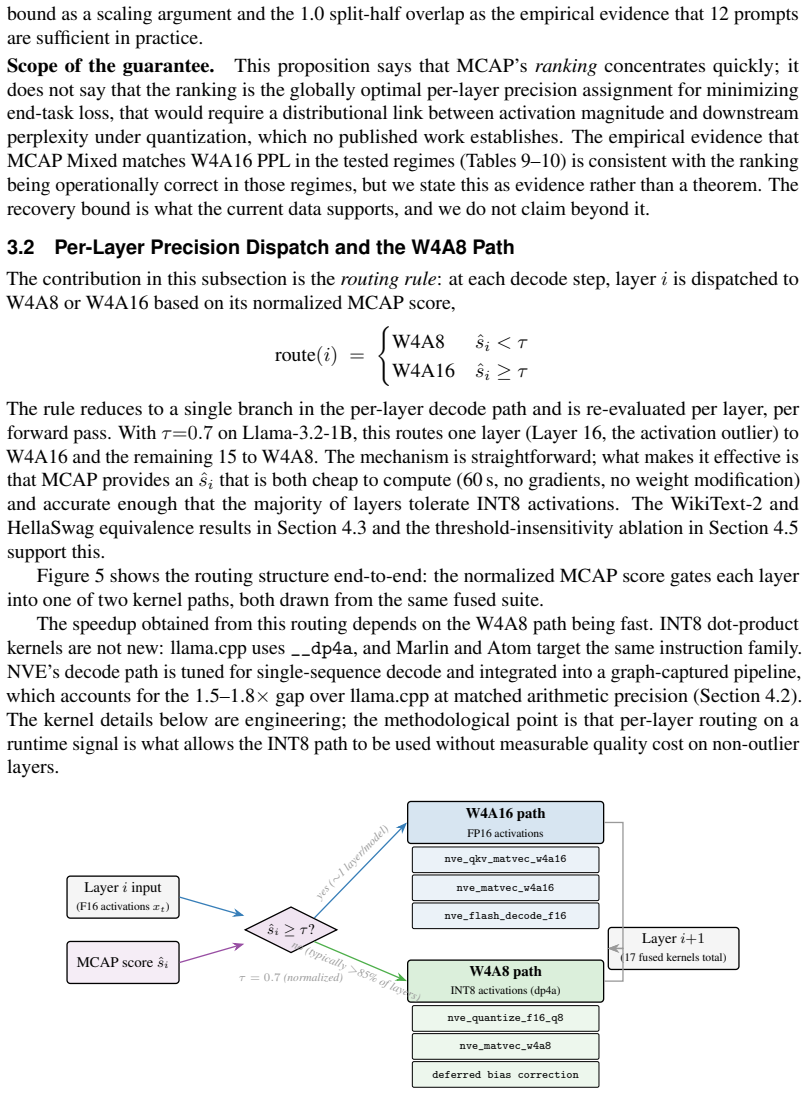
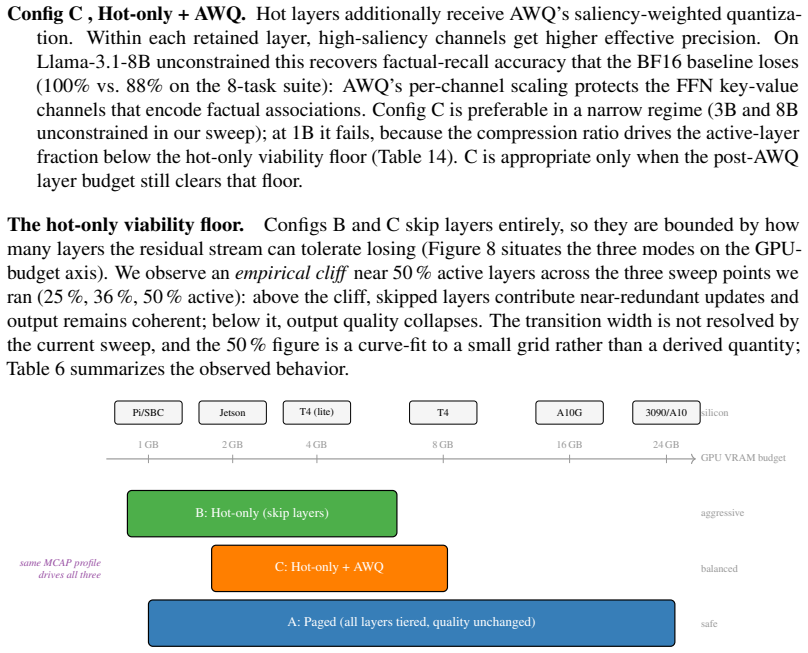
MCAP produces a lightweight per-layer signal at load time that drives both precision dispatch (W4A8 versus W4A16) and residency tier (GPU, RAM, SSD), allowing a single set of weights to operate across diverse memory budgets.
What carries the argument
Monte Carlo Activation Profiling (MCAP), a deployment-time sampler that measures activation statistics to rank each layer's contribution to output quality for use in precision and placement decisions.
If this is right
- A single set of weights becomes usable across hardware with widely different memory capacities.
- Models previously too large for a device can now run by off-loading less important layers.
- Decode speed improves without requiring separate quantized versions of the model.
- Memory residency decisions can be made after the model arrives on the target device rather than at training or export time.
Where Pith is reading between the lines
- The same profiling signal could be reused to guide KV-cache eviction or attention-head pruning on the fly.
- Because profiling happens at load time, the method may reduce the need to maintain multiple precision variants of popular open models.
- Extending the sampler to also track activation sparsity could further tighten the memory bounds reported.
Load-bearing premise
The sampled activations give a reliable enough ranking of layer importance that the resulting precision and memory choices keep accuracy loss small and profiling cost low.
What would settle it
Measure end-to-end decode tokens per second and task accuracy for a fixed model on an NVIDIA T4 while sweeping available GPU memory; the claim fails if throughput does not rise 1.5x or if accuracy drops below the baseline by more than a few percent.
Figures






read the original abstract
Deploying large language models to heterogeneous hardware is often constrained by memory, not compute. We introduce MCAP (Monte Carlo Activation Profiling), a load-time per-layer importance estimator that enables dynamic precision and memory placement decisions on the target device. MCAP produces a lightweight per-layer signal that drives both precision dispatch (W4A8 vs. W4A16) and residency tier (GPU, RAM, SSD), allowing a single set of weights to operate across diverse memory budgets. Our system, NVE, achieves 1.5-1.8x higher decode throughput than llama-cpp Q4_0 on NVIDIA T4 and enables models to run in memory regimes previously infeasible without modifying weights.
Editorial analysis
A structured set of objections, weighed in public.
Referee Report
Summary. The manuscript introduces MCAP (Monte Carlo Activation Profiling), a load-time per-layer importance estimator for LLMs that informs dynamic precision dispatch (W4A8 vs. W4A16) and memory placement decisions across GPU, RAM, and SSD tiers. The NVE system built on this achieves 1.5-1.8× higher decode throughput than llama-cpp Q4_0 on NVIDIA T4 and allows models to run under memory constraints previously requiring weight modifications.
Significance. If the central claims hold, this work would offer a practical method for adapting LLM inference to heterogeneous memory environments without retraining or altering weights. The Monte Carlo sampling approach for importance estimation could be valuable for deployment-time optimization. The absence of detailed validation in the provided material, however, limits assessment of its broader impact.
major comments (2)
- [Abstract] Abstract: The abstract states performance numbers (1.5-1.8x throughput) but provides no methodology details, accuracy measurements, experimental setup, or error analysis. This is load-bearing for the central claim because the reported throughput gain and low-memory feasibility rest entirely on unshown evidence that MCAP produces a reliable importance signal.
- [Abstract] Abstract: The Monte Carlo Activation Profiling signal is presented as driving both precision dispatch and residency decisions, yet there is no cross-task validation or analysis of sensitivity to prompt distribution, task, or sequence length. Activation statistics are known to vary with these factors; without such checks the per-layer ranking may mis-rank layers, eroding the claimed gains or causing unacceptable accuracy loss.
minor comments (1)
- [Abstract] Abstract: The system name NVE is introduced without expansion or definition; clarify its meaning and relation to MCAP.
Simulated Author's Rebuttal
We thank the referee for the constructive feedback on our manuscript. We address each major comment below and have revised the manuscript to improve clarity and completeness where the concerns are valid.
read point-by-point responses
-
Referee: The abstract states performance numbers (1.5-1.8x throughput) but provides no methodology details, accuracy measurements, experimental setup, or error analysis. This is load-bearing for the central claim because the reported throughput gain and low-memory feasibility rest entirely on unshown evidence that MCAP produces a reliable importance signal.
Authors: We agree that the abstract is highly condensed and does not reference the supporting evidence. The full manuscript details the MCAP Monte Carlo sampling procedure and importance metric in Section 3, reports accuracy results (perplexity on WikiText-2 and zero-shot task accuracy) in Section 4 to confirm the importance signal preserves model quality, and describes the NVIDIA T4 experimental setup, baselines, and throughput measurements in Section 5. We will revise the abstract to briefly note the evaluation methodology and that accuracy is preserved within 1% of the baseline, making the central claim more traceable without exceeding typical length limits. revision: yes
-
Referee: The Monte Carlo Activation Profiling signal is presented as driving both precision dispatch and residency decisions, yet there is no cross-task validation or analysis of sensitivity to prompt distribution, task, or sequence length. Activation statistics are known to vary with these factors; without such checks the per-layer ranking may mis-rank layers, eroding the claimed gains or causing unacceptable accuracy loss.
Authors: The referee is correct that activation statistics can vary with input factors and that explicit sensitivity analysis strengthens the work. Our current experiments compute MCAP profiles from a diverse prompt set spanning general, coding, and reasoning tasks, with layer rankings showing stability in the reported results. However, we did not include a dedicated sensitivity study varying sequence length or task distribution. We will add a new subsection with additional experiments measuring ranking correlation (e.g., Kendall tau) across prompt sets of different lengths and task types, plus accuracy impact when using profiles from mismatched distributions. This directly addresses the validation gap. revision: yes
Circularity Check
No circularity: MCAP is an independent empirical estimator; claims rest on device measurements rather than definitional reduction.
full rationale
The derivation introduces MCAP as a load-time Monte Carlo sampling procedure that computes a per-layer importance signal directly from observed activations during sampled forward passes. This signal is then applied downstream to select precision formats and residency tiers. No equation defines the importance score in terms of the resulting throughput or memory decisions, nor does any step rename a fitted parameter as a prediction. No self-citation chain is invoked to justify uniqueness or to smuggle an ansatz. The reported 1.5-1.8x throughput is presented as an empirical outcome measured on NVIDIA T4 hardware, not as a quantity forced by the profiling definition itself. The method therefore remains self-contained against external benchmarks.
Axiom & Free-Parameter Ledger
Reference graph
Works this paper leans on
-
[1]
GPTQ: Accurate Post-Training Quantization for Generative Pre-trained Transformers
Frantar, E., Ashkboos, S., Hoefler, T., and Alistarh, D. GPTQ: Accurate Post-Training Quantization for Generative Pre-trained Transformers.arXiv preprint arXiv:2210.17323,
work page internal anchor Pith review arXiv
-
[2]
AWQ: Activation-aware Weight Quantization for LLM Compression and Acceleration
Lin, J., Tang, J., Tang, H., Yang, S., Dang, X., and Han, S. AWQ: Activation-Aware Weight Quantization for LLM Compression and Acceleration.arXiv preprint arXiv:2306.00978,
work page internal anchor Pith review Pith/arXiv arXiv
-
[3]
Smoothquant: Accurate and efficient post-training quantization for large language models,
Xiao, G., Lin, J., Seznec, M., Wu, H., Demouth, J., and Han, S. SmoothQuant: Accurate and Efficient Post-Training Quantization for Large Language Models.arXiv preprint arXiv:2211.10438,
-
[4]
Grattafiori, A. et al. The Llama 3 Herd of Models.arXiv preprint arXiv:2407.21783,
work page internal anchor Pith review Pith/arXiv arXiv
- [5]
-
[6]
Zandieh, A., Daliri, M., Hadian, M., and Mirrokni, V . TurboQuant: Online Vector Quantization with Near-optimal Distortion Rate.arXiv preprint arXiv:2504.17755,
-
[7]
Spinquant: Llm quantization with learned rotations.arXiv preprint arXiv:2405.16406, 2024
Liu, Z., Zhao, C., Fedorov, I., Soran, B., Choudhary, D., Krishnamoorthi, R., Chandra, V ., Tian, Y ., and Blankevoort, T. SpinQuant: LLM Quantization with Learned Rotations.arXiv preprint arXiv:2405.16406,
-
[8]
Castro, Jiale Chen, Torsten Hoefler, and Dan Alistarh
Frantar, E., Castro, R. L., Chen, J., Hoefler, T., and Alistarh, D. MARLIN: Mixed-Precision Auto- Regressive Parallel Inference on Large Language Models.arXiv preprint arXiv:2408.11743,
-
[9]
PowerInfer-2: Fast Large Language Model Inference on a Smartphone.arXiv preprint arXiv:2406.06282,
Xue, Z., Song, Y ., Mi, Z., Chen, L., Xia, Y ., and Chen, H. PowerInfer-2: Fast Large Language Model Inference on a Smartphone.arXiv preprint arXiv:2406.06282,
-
[10]
Headinfer: Memory-efficient llm inference by head-wise offloading
Luo, C., Cai, Z., Sun, Z., Huang, X., Yuan, Y ., Liu, Z., Wang, W., Yang, Q., and Liu, Y . HeadInfer: Memory-Efficient LLM Inference by Head-wise Offloading.arXiv preprint arXiv:2502.12574,
-
[11]
Instinfer: In-storage attention offloading for cost-effective long-context llm inference,
Pan, X., Li, E., Li, Q., Liang, S., Shan, Y ., Zhou, K., Luo, Y ., Wang, X., and Zhang, J. InstInfer: In-Storage Attention Offloading for Cost-Effective Long-Context LLM Inference.arXiv preprint arXiv:2409.04992,
-
[12]
Accelerating Large Language Model Decoding with Speculative Sampling
Chen, C., Borgeaud, S., Irving, G., Lespiau, J.-B., Sifre, L., and Jumper, J. Accelerating Large Language Model Decoding with Speculative Sampling.arXiv preprint arXiv:2302.01318,
work page internal anchor Pith review arXiv
-
[13]
Ma, S., Wang, H., Ma, L., Wang, L., Wang, W., Huang, S., Dong, L., Wang, R., Xue, J., and Wei, F. The Era of 1-bit LLMs: All Large Language Models are in 1.58 Bits.arXiv preprint arXiv:2402.17764,
- [14]
-
[15]
Jiang, X., Zhou, Y ., Cao, S., Stoica, I., and Yu, M. NEO: Saving GPU Memory Crisis with CPU Offloading for Online LLM Inference.arXiv preprint arXiv:2411.01142,
-
[16]
arXiv preprint arXiv:2303.08302 , year=
Yao, Z., Wu, X., Li, C., Youn, S., and He, Y . ZeroQuant-V2: Exploring Post-training Quantization in LLMs from Comprehensive Study to Low Rank Compensation.arXiv preprint arXiv:2303.08302,
-
[17]
•src/decode_graph.rs — CUDA graph-captured decode path (Section 3.2, §CUDA graph capture)
•src/quantize.rs , src/cuda_kernels.rs — W4A8 / W4A16 dispatch and CUDA kernels (Section 3.2). •src/decode_graph.rs — CUDA graph-captured decode path (Section 3.2, §CUDA graph capture). •src/pager.rs ,src/tier.rs,src/paged_model.rs — three-tier (GPU / RAM / SSD) weight pager (Section 3.3). •src/arch.rs , src/generic_model.rs — generic transformer front-en...
2026
discussion (0)
Sign in with ORCID, Apple, or X to comment. Anyone can read and Pith papers without signing in.