Recognition: unknown
Conformal prediction for uncertainties in the neutron star equation of state
Pith reviewed 2026-05-09 22:27 UTC · model grok-4.3
The pith
Conformal prediction applied to Bayesian posterior samples yields reliable uncertainty bands for neutron star equations of state without assuming any error distribution.
A machine-rendered reading of the paper's core claim, the machinery that carries it, and where it could break.
Core claim
The central claim is that Conformalized Quantile Regression can be applied directly to posterior samples from Bayesian inference and to quantum Monte Carlo results for pure neutron matter, producing uncertainty bands for neutron star mass-radius relations that achieve valid coverage without requiring any assumption on the form of the underlying distribution, as verified through empirical coverage studies.
What carries the argument
Conformalized Quantile Regression (CQR) used as post-processing on posterior samples to adjust quantile-based intervals via conformity scores.
If this is right
- Existing Bayesian analyses of neutron star data can receive guaranteed uncertainty bands without rerunning the original inference.
- The same post-processing applies to theoretical quantum Monte Carlo calculations of neutron matter.
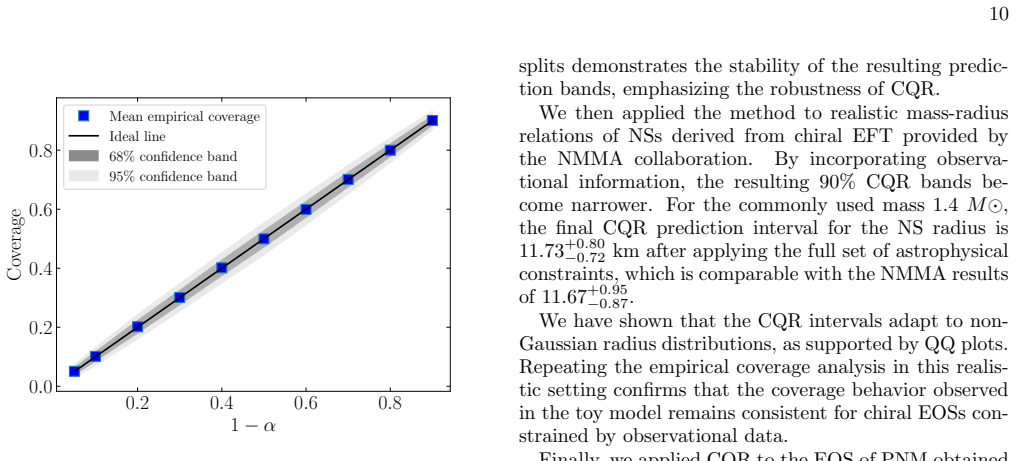
- Empirical coverage remains reliable when the method is tested on both observational mass-radius posteriors and pure neutron matter results.
Where Pith is reading between the lines
- The technique could be tried on other nuclear physics outputs that already exist as sample sets, such as simulations of dense matter.
- It might allow direct comparison of uncertainty bands across different equation-of-state models without forcing them into a common distributional form.
- New observations of neutron stars could be incorporated by recalibrating the conformal scores on the updated posterior samples.
Load-bearing premise
The input posterior samples from Bayesian inference or quantum Monte Carlo calculations are representative of the actual variability in the equation of state.
What would settle it
A collection of new neutron star mass and radius measurements where the constructed CQR bands cover the observed values at a rate clearly below the nominal target, such as 70 percent coverage when 90 percent is expected.
Figures




read the original abstract
We study uncertainties in the equation of state of neutron stars using conformal prediction as a distribution-free and model-agnostic method that provides coverage guarantees. In particular, we apply the Conformalized Quantile Regression (CQR) method to posterior samples calculated from Bayesian inference, creating reliable uncertainty bands without assuming a specific form of the underlying distribution. We first construct CQR bands as a postprocessing step to the posterior samples of neutron star mas-radius relations provided by the NMMA collaboration and to Quantum Monte Carlo calculations of pure neutron matter. In all cases, empirical coverage studies confirm the robustness of the method.
Editorial analysis
A structured set of objections, weighed in public.
Referee Report
Summary. The manuscript applies the Conformalized Quantile Regression (CQR) method as a post-processing step to posterior samples obtained from Bayesian inference (NMMA collaboration mass-radius relations) and Quantum Monte Carlo calculations of pure neutron matter. It claims that this yields reliable, distribution-free uncertainty bands for the neutron star equation of state with coverage guarantees, supported by empirical coverage studies that confirm robustness without assuming a specific form for the underlying distribution.
Significance. If the coverage properties hold under the stated conditions, the approach supplies a model-agnostic tool for uncertainty quantification that could be useful in nuclear astrophysics, where posterior distributions from Bayesian EOS inference are often complex and non-Gaussian. The explicit mention of empirical coverage checks is a constructive element that helps ground the claims.
major comments (1)
- [Abstract] Abstract: the central claim of 'coverage guarantees' and 'reliable uncertainty bands' rests on the standard CQR exchangeability assumption between calibration and test points. The input samples are MCMC-derived posteriors from NMMA Bayesian inference, which are serially dependent due to chain autocorrelation; the manuscript does not describe thinning, effective sample size checks, or any adjustment for dependence, so the finite-sample guarantee does not automatically transfer and empirical coverage alone does not restore it.
minor comments (1)
- Clarify the exact preprocessing steps applied to the posterior samples before CQR (e.g., any subsampling, ordering, or feature construction) and state whether the same procedure is used for both NMMA and QMC inputs.
Simulated Author's Rebuttal
We thank the referee for the careful review and for identifying this important technical point concerning the exchangeability assumption. We address it directly below.
read point-by-point responses
-
Referee: [Abstract] Abstract: the central claim of 'coverage guarantees' and 'reliable uncertainty bands' rests on the standard CQR exchangeability assumption between calibration and test points. The input samples are MCMC-derived posteriors from NMMA Bayesian inference, which are serially dependent due to chain autocorrelation; the manuscript does not describe thinning, effective sample size checks, or any adjustment for dependence, so the finite-sample guarantee does not automatically transfer and empirical coverage alone does not restore it.
Authors: We agree that the finite-sample coverage guarantee of CQR requires exchangeability between the calibration and test sets, and that raw MCMC posterior samples generally exhibit serial dependence due to autocorrelation. The manuscript applies CQR as a post-processing step to the NMMA-provided samples without explicitly discussing thinning or effective sample size. Although the reported empirical coverage studies indicate reliable performance in practice, we acknowledge that these studies alone do not restore the theoretical guarantee under dependence. In the revised version we will (i) add a dedicated paragraph in the methods section discussing the exchangeability assumption and its implications for MCMC inputs, (ii) report effective sample sizes for the chains used (or note that the supplied NMMA samples are already thinned), and (iii) qualify the abstract and main text to state that the coverage guarantees hold under approximate exchangeability after standard MCMC diagnostics and thinning. These changes will make the scope of the claims precise while preserving the practical utility demonstrated by the empirical results. revision: yes
Circularity Check
No circularity: CQR applied as post-processing to external posterior samples
full rationale
The paper applies the standard Conformalized Quantile Regression (CQR) technique as an explicit post-processing step to pre-existing posterior samples from the NMMA collaboration and independent Quantum Monte Carlo calculations of neutron matter. No parameters are fitted inside the paper and then relabeled as predictions; the central output consists of uncertainty bands whose coverage is checked empirically on the supplied external data. There are no self-citations that bear the load of the main claim, no self-definitional loops, and no renaming of known results. The derivation chain is therefore the direct application of a known distribution-free method to independent inputs and remains self-contained.
Axiom & Free-Parameter Ledger
Reference graph
Works this paper leans on
-
[1]
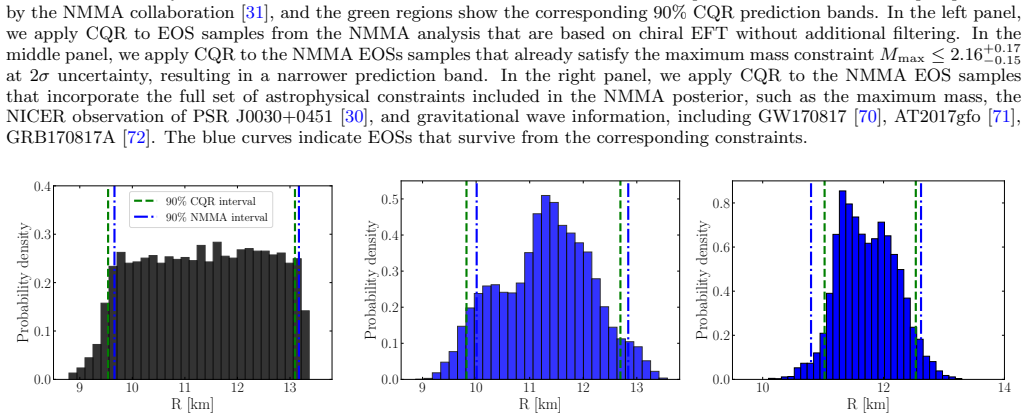
can also be used to calculate CQR intervals. 3 III. APPLICA TIONS In this section, we demonstrate the application of CQR for uncertainty quantification across three different sce- narios. We begin with a toy model setup to construct and validate CQR prediction bands using the TOV equa- tions. Following this, we apply the method to two real- istic datasets...
2000
-
[2]
J. M. Lattimer and M. Prakash, ApJ550, 426 (2001). [2] J. M. Lattimer, Annu. Rev. Nucl. Part. Sci62, 485 (2012). 11
2001
-
[3]
¨Ozel and P
F. ¨Ozel and P. Freire, Annu. Rev. Astron. Astrophys.54, 401 (2016)
2016
-
[4]
Hebeler, J
K. Hebeler, J. M. Lattimer, C. J. Pethick, and A. Schwenk, ApJ773, 11 (2013)
2013
-
[5]
A. L. Watts, N. Andersson, D. Chakrabarty, M. Fe- roci, K. Hebeler, G. Israel, F. K. Lamb, M. C. Miller, S. Morsink, F. ¨Ozel, A. Patruno, J. Poutanen, D. Psaltis, A. Schwenk, A. W. Steiner, L. Stella, L. Tolos, and M. van der Klis, Rev. Mod. Phys.88, 021001 (2016)
2016
-
[6]
B. R. Barrett, P. Navr´ atil, and J. P. Vary, Prog. Part. Nucl. Phys.69, 131 (2013)
2013
-
[7]
Carbone, A
A. Carbone, A. Cipollone, C. Barbieri, A. Rios, and A. Polls, Phys. Rev. C88, 054326 (2013)
2013
-
[8]
Drischler, J
C. Drischler, J. W. Holt, and C. Wellenhofer, Annu. Rev. Nucl. Part. Sci71, 403 (2021)
2021
-
[9]
Hergert, S
H. Hergert, S. K. Bogner, T. D. Morris, A. Schwenk, and K. Tsukiyama, Phys. Rep.621, 165 (2016)
2016
-
[10]
J. E. Lynn, I. Tews, S. Gandolfi, and A. Lovato, Annu. Rev. Nucl. Part. Sci69, 279 (2019)
2019
-
[11]
Epelbaum, H.-W
E. Epelbaum, H.-W. Hammer, and U.-G. Meißner, Rev. Mod. Phys.81, 1773 (2009)
2009
-
[12]
Machleidt and D
R. Machleidt and D. R. Entem, Phys. Rep.503, 1 (2011)
2011
-
[13]
Gezerlis, I
A. Gezerlis, I. Tews, E. Epelbaum, S. Gandolfi, K. Hebeler, A. Nogga, and A. Schwenk, Phys. Rev. Lett. 111, 032501 (2013)
2013
-
[14]
Gezerlis, I
A. Gezerlis, I. Tews, E. Epelbaum, M. Freunek, S. Gan- dolfi, K. Hebeler, A. Nogga, and A. Schwenk, Phys. Rev. C90, 054323 (2014)
2014
-
[15]
Epelbaum, H
E. Epelbaum, H. Krebs, and U. G. Meißner, Eur. Phys. J. A51, 53 (2015)
2015
-
[16]
Hammer, S
H.-W. Hammer, S. K¨ onig, and U. van Kolck, Rev. Mod. Phys.92, 025004 (2020)
2020
-
[17]
S. K. Greif, G. Raaijmakers, K. Hebeler, A. Schwenk, and A. L. Watts, Mon Not R Astron Soc485, 5363 (2019)
2019
-
[19]
Jiang, S.-P
J.-L. Jiang, S.-P. Tang, Y.-Z. Wang, Y.-Z. Fan, and D.- M. Wei, ApJ892, 55 (2020)
2020
-
[20]
Al-Mamun, A
M. Al-Mamun, A. W. Steiner, J. N¨ attil¨ a, J. Lange, R. O’Shaughnessy, I. Tews, S. Gandolfi, C. Heinke, and S. Han, Phys. Rev. Lett126, 061101 (2021)
2021
-
[21]
Raaijmakers, S
G. Raaijmakers, S. K. Greif, K. Hebeler, T. Hinderer, S. Nissanke, A. Schwenk, T. E. Riley, A. L. Watts, J. M. Lattimer, and W. C. G. Ho, ApJ918, L29 (2021)
2021
-
[22]
Tang, J.-L
S.-P. Tang, J.-L. Jiang, M.-Z. Han, Y.-Z. Fan, and D.-M. Wei, Phys. Rev. D104, 063032 (2021)
2021
-
[23]
Jiang, C
J.-L. Jiang, C. Ecker, and L. Rezzolla, ApJ949, 11 (2023)
2023
-
[24]
Lim and J
Y. Lim and J. W. Holt, Phys. Rev. Lett.121, 062701 (2018)
2018
-
[25]
Canizares, S
P. Canizares, S. E. Field, J. Gair, V. Raymond, R. Smith, and M. Tiglio, Phys. Rev. Lett.114, 071104 (2015)
2015
-
[26]
Bonilla, P
E. Bonilla, P. Giuliani, K. Godbey, and D. Lee, Phys. Rev. C106, 054322 (2022)
2022
-
[27]
Liodis, E
I. Liodis, E. Smyrniotis, and N. Stergioulas, Phys. Rev. D109, 104008 (2024)
2024
-
[28]
B. T. Reed, R. Somasundaram, S. De, C. L. Armstrong, P. Giuliani, C. Capano, D. A. Brown, and I. Tews, ApJ 974, 285 (2024)
2024
-
[29]
C. L. Armstrong, P. Giuliani, K. Godbey, R. Soma- sundaram, and I. Tews, Phys. Rev. Lett.135, 142501 (2025)
2025
- [30]
-
[31]
Dietrich, M
T. Dietrich, M. W. Coughlin, P. T. H. Pang, M. Bulla, J. Heinzel, L. Issa, I. Tews, and S. Antier, Science370, 1450 (2020)
2020
-
[32]
Constraining Hamilto- nians from chiral effective field theory with neutron-star data,
C. L. Armstrong, B. T. Reed, T. Plohr, H. Rose, S. De, R. Somasundaram, and I. Tews, “Constraining Hamilto- nians from chiral effective field theory with neutron-star data,” (2026), arXiv:2601.05999 [nucl-th]
-
[33]
Somasundaram, I
R. Somasundaram, I. Svensson, S. De, A. E. Deneris, Y. Dietz, P. Landry, A. Schwenk, and I. Tews, Nat Com- mun16, 9819 (2025)
2025
-
[34]
Dobaczewski, W
J. Dobaczewski, W. Nazarewicz, and P.-G. Reinhard, J. Phys. G: Nucl. Part. Phys.41, 074001 (2014)
2014
-
[35]
D. G. Ireland and W. Nazarewicz, J. Phys. G: Nucl. Part. Phys.42, 030301 (2015)
2015
-
[36]
B. D. Carlsson, A. Ekstr¨ om, C. Forss´ en, D. F. Str¨ omberg, G. R. Jansen, O. Lilja, M. Lindby, B. A. Mattsson, and K. A. Wendt, Phys. Rev. X6, 011019 (2016)
2016
-
[37]
Drischler, J
C. Drischler, J. A. Melendez, R. J. Furnstahl, and D. R. Phillips, Phys. Rev. C102, 054315 (2020)
2020
-
[38]
Duguet, A
T. Duguet, A. Ekstr¨ om, R. J. Furnstahl, S. K¨ onig, and D. Lee, Rev. Mod. Phys.96, 031002 (2024)
2024
-
[39]
M. R. Schindler and D. R. Phillips, Ann. Phys.324, 682 (2009)
2009
-
[40]
R. J. Furnstahl, D. R. Phillips, and S. Wesolowski, J. Phys. G: Nucl. Part. Phys.42, 034028 (2015)
2015
-
[41]
Wesolowski, R
S. Wesolowski, R. J. Furnstahl, J. A. Melendez, and D. R. Phillips, J. Phys. G: Nucl. Part. Phys.46, 045102 (2019)
2019
-
[42]
R. J. Furnstahl, N. Klco, D. R. Phillips, and S. Wesolowski, Phys. Rev. C92, 024005 (2015)
2015
-
[43]
J. A. Melendez, S. Wesolowski, and R. J. Furnstahl, Phys. Rev. C96, 024003 (2017)
2017
-
[44]
Drischler, R
C. Drischler, R. Furnstahl, J. Melendez, and D. Phillips, Phys. Rev. Lett.125, 202702 (2020)
2020
-
[45]
A. C. Semposki, C. Drischler, R. J. Furnstahl, J. A. Me- lendez, and D. R. Phillips, Phys. Rev. C111, 035804 (2025)
2025
-
[46]
H. G¨ ottling, L. Hoff, K. Hebeler, and A. Schwenk, “Neu- tron star crust and outer core equation of state from chi- ral effective field theory with quantified uncertainties,” (2025), arXiv:2512.19593 [nucl-th]
work page internal anchor Pith review arXiv 2025
-
[47]
H. Y. Dezdarani, R. Curry, and A. Gezerlis, Phys. Rev. C113, 014004 (2026)
2026
-
[48]
V. Vovk, A. Gammerman, and G. Shafer,Algorith- mic Learning in a Random World(Springer, New York, 2005)
2005
-
[49]
Shafer and V
G. Shafer and V. Vovk, J. Mach. Learn. Res.9, 371 (2008)
2008
-
[50]
R. F. Barber, E. J. Cand` es, A. Ramdas, and R. J. Tib- shirani, Ann. Stat.51, 816 (2023)
2023
-
[51]
Bates, E
S. Bates, E. Cand` es, L. Lei, Y. Romano, and M. Sesia, Ann. Stat.51, 149 (2023)
2023
-
[52]
Lei and L
J. Lei and L. Wasserman, J. R. Stat. Soc. Ser. B Stat. Method.76, 71 (2014)
2014
-
[53]
A. N. Angelopoulos and S. Bates, Found. Trends Mach. Learn.16, 494 (2023)
2023
-
[54]
Cand` es, L
E. Cand` es, L. Lei, and Z. Ren, J. R. Stat. Soc. Ser. B Stat. Method.85, 24 (2023)
2023
-
[55]
Cauchois, S
M. Cauchois, S. Gupta, A. Ali, and J. C. and Duchi, J. Am. Stat. Assoc.119, 3033 (2024)
2024
-
[56]
Chernozhukov, K
V. Chernozhukov, K. W¨ uthrich, and Y. Zhu, inProceed- ings of the 31st Conference On Learning Theory(PMLR, 12
-
[57]
Gibbs and E
I. Gibbs and E. Candes, inAdvances in Neural Infor- mation Processing Systems, Vol. 34 (Curran Associates, Inc., 2021) pp. 1660–1672
2021
-
[58]
arXiv preprint arXiv:2411.11824 , year=
A. N. Angelopoulos, R. F. Barber, and S. Bates, “The- oretical Foundations of Conformal Prediction,” (2025), arXiv:2411.11824 [math]
-
[59]
arXiv preprint arXiv:2502.03609 , year=
M. Klein, L. Bethune, E. Ndiaye, and M. Cuturi, “Multi- variate Conformal Prediction using Optimal Transport,” (2025), arXiv:2502.03609 [stat]
-
[60]
Ashton, N
G. Ashton, N. Colombo, I. Harry, and S. Sachdev, Phys. Rev. D109, 123027 (2024)
2024
-
[61]
M. M. S. Mendes, R. D. Pereira, M. D. d. R. Louren, and C. H. Lenzi, “Certified Uncertainty for Surrogate Models of Neutron Star Equations of State via Mondrian Conformal Prediction,” (2026), arXiv:2602.19363 [astro- ph]
-
[62]
Singer, J
N. Singer, J. P. Williams, and S. Ghosh, MNRAS539, 1372 (2025)
2025
-
[63]
Gaussian process interpola- tion with conformal prediction: methods and compara- tive analysis,
A. Pion and E. Vazquez, “Gaussian process interpola- tion with conformal prediction: methods and compara- tive analysis,” (2024), arXiv:2407.08271
-
[64]
MAPIE - Model Agnostic Prediction Interval Estima- tor,
“MAPIE - Model Agnostic Prediction Interval Estima- tor,”
-
[65]
Numerical Methods in Physics with Python,
Alex Gezerlis, “Numerical Methods in Physics with Python,” (2nd ed., Cambridge University Press, 2023)
2023
-
[66]
J. S. Read, B. D. Lackey, B. J. Owen, and J. L. Friedman, Phys. Rev. D79, 124032 (2009)
2009
-
[67]
Casares, J
J. Casares, J. I. G. Hern´ andez, G. Israelian, and R. Re- bolo, Mon. Not. R. Astron. Soc401, 2517 (2010)
2010
-
[68]
Mu˜ noz-Darias, J
T. Mu˜ noz-Darias, J. Casares, and I. G. Mart´ ınez-Pais, ApJ635, 502 (2005)
2005
-
[69]
A. B. Mason, J. S. Clark, A. J. Norton, P. A. Crowther, T. M. Tauris, N. Langer, I. Negueruela, and P. Roche, Mon Not R Astron Soc422, 199 (2012)
2012
-
[70]
B. P. Abbott,et al, Phys. Rev. Lett.119, 161101 (2017)
2017
-
[71]
B. P. Abbott,et al, ApJL848, L12 (2017)
2017
-
[72]
B. P. Abbott,et al, ApJL848, L13 (2017), arXiv:1710.05834 [astro-ph]
work page Pith review arXiv 2017
-
[73]
Carlson, S
J. Carlson, S. Gandolfi, F. Pederiva, S. C. Pieper, R. Schi- avilla, K. Schmidt, and R. Wiringa, Rev. Mod. Phys.87, 1067 (2015)
2015
discussion (0)
Sign in with ORCID, Apple, or X to comment. Anyone can read and Pith papers without signing in.