Recognition: unknown
A High-Order Nodal Galerkin Formulation for the M\"uller Equation: Bypassing Divergence Conformity via Kernel Cancellation
Pith reviewed 2026-05-08 13:06 UTC · model grok-4.3
The pith
The double-gradient operator in the Müller equation acts on the difference between interior and exterior kernels, canceling the hypersingularity exactly and allowing nodal high-order bases instead of divergence-conforming ones.
A machine-rendered reading of the paper's core claim, the machinery that carries it, and where it could break.
Core claim
The double-gradient operator in the Müller formulation acts on the kernel difference φ_a - φ_i, so that the O(R^{-3}) hypersingularity cancels identically, reducing the operators to weakly singular O(R^{-1}) kernels. Exploiting this cancellation, a nodal, high-order Galerkin formulation is developed using P2 isoparametric shape functions on curved manifolds, with the surface vector field constructed via a metric-weighted orthonormal tangent frame, singular integrals evaluated by Sauter-Schwab quadrature, and a Morton-ordered Block Jacobi preconditioner introduced that yields robust, superlinear GMRES convergence under extreme material and geometric parameters.
What carries the argument
The kernel difference φ_a - φ_i inside the double-gradient operator, which produces exact cancellation of the hypersingular term and reduces all kernels to weakly singular form.
If this is right
- Nodal P2 isoparametric elements can be used directly on curved surfaces without enforcing divergence conformity.
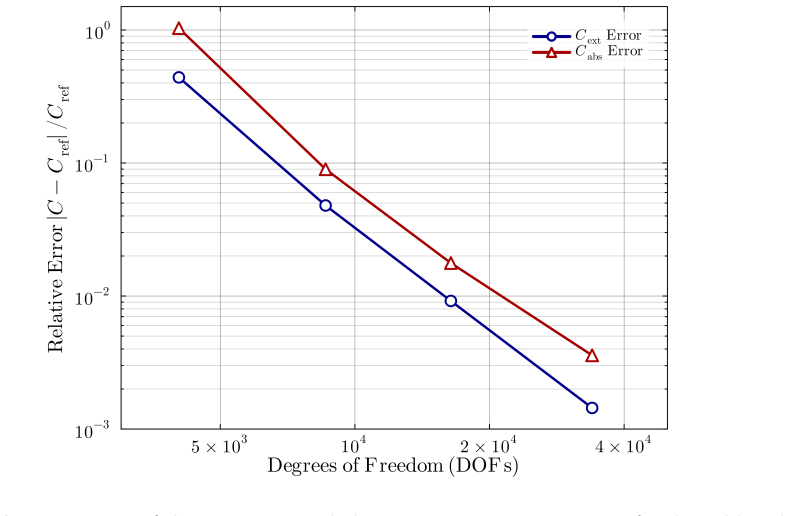
- High-order spatial accuracy is retained while the optical theorem is satisfied to high precision.
- The Morton-ordered block Jacobi preconditioner produces superlinear GMRES convergence even for extreme contrasts and geometries.
- Sauter-Schwab quadrature suffices to integrate the remaining weakly singular kernels at the design order.
Where Pith is reading between the lines
- The same kernel-difference cancellation could be examined in other integral formulations that contain similar double-gradient structures.
- Higher-order isoparametric elements beyond P2 might be substituted directly if the cancellation persists.
- The geometric clustering used in the preconditioner may transfer to other boundary-element problems dominated by near-field interactions.
- The approach could simplify code for penetrable scatterers by removing the need to maintain divergence-conforming spaces.
Load-bearing premise
The exact cancellation of the hypersingularity continues to hold at high accuracy after P2 isoparametric discretization on curved surfaces, and the chosen quadrature handles the remaining weakly singular integrals without losing the expected convergence rate.
What would settle it
A mesh-refinement study on a curved penetrable scatterer with strong material contrast in which the L2 error fails to decrease at the rate expected for P2 elements, or in which the optical theorem residual remains above a small tolerance independent of mesh size, would show that the cancellation does not survive discretization.
Figures




read the original abstract
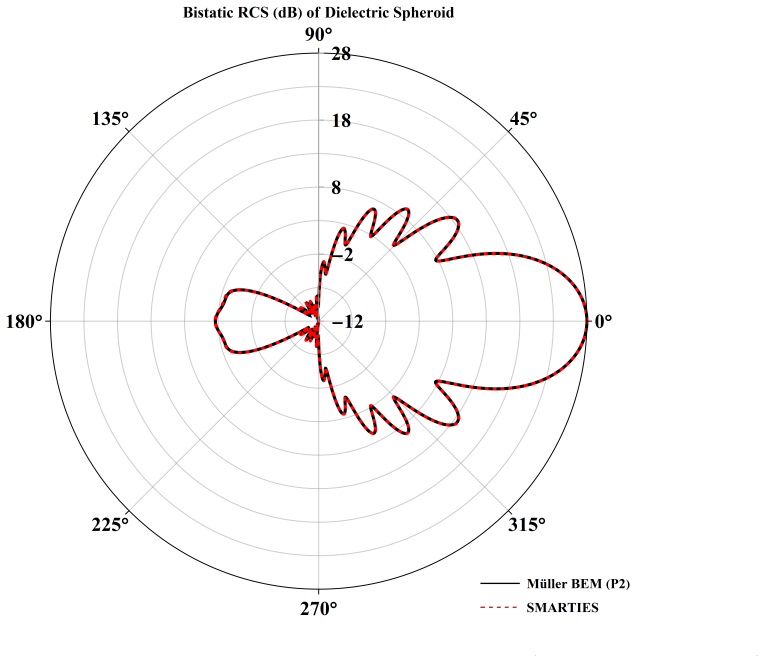
The M\"{u}ller boundary integral equation for penetrable electromagnetic scattering is conventionally discretized using divergence-conforming basis functions, a restriction inherited from the PMCHWT framework. This paper demonstrates that this constraint can be bypassed. The double-gradient operator in the M\"uller formulation acts on the kernel difference $\varphi_a - \varphi_i$, so that the $\mathcal{O}(R^{-3})$ hypersingularity cancels identically, reducing the operators to weakly singular $\mathcal{O}(R^{-1})$ kernels. Exploiting this cancellation, we develop a nodal, high-order Galerkin formulation using $\mathrm{P}_2$ isoparametric shape functions on curved manifolds. The surface vector field is constructed via a metric-weighted orthonormal tangent frame. The singular integrals are evaluated by Sauter--Schwab quadrature, and a Morton-ordered Block Jacobi preconditioner is introduced. By capturing the dominant near-field interactions within geometrically clustered diagonal blocks, it yields robust, superlinear GMRES convergence under extreme material and geometric parameters. Validation against semi-analytical EBCM references confirms high-order spatial accuracy and optical-theorem satisfaction to high precision.
Editorial analysis
A structured set of objections, weighed in public.
Referee Report
Summary. The manuscript proposes a high-order nodal Galerkin discretization of the Müller boundary integral equation for penetrable electromagnetic scattering. It exploits the fact that the double-gradient operator acts on the kernel difference φ_a - φ_i, producing exact cancellation of the O(R^{-3}) hypersingularity and reducing the operators to weakly singular O(R^{-1}) kernels. This permits the use of non-divergence-conforming P2 isoparametric nodal basis functions on curved surfaces, constructed via a metric-weighted orthonormal tangent frame. Singular integrals are handled by Sauter-Schwab quadrature, and a Morton-ordered Block Jacobi preconditioner is introduced to achieve robust GMRES convergence. Validation against semi-analytical EBCM references is reported to confirm high-order spatial accuracy and optical-theorem satisfaction.
Significance. If the cancellation mechanism remains effective under the proposed discretization, the work offers a meaningful simplification for Müller formulations by removing the conventional requirement for divergence-conforming spaces inherited from PMCHWT. The parameter-free nature of the kernel cancellation and the demonstrated superlinear GMRES convergence under extreme material contrasts constitute clear strengths. The approach could broaden access to high-order methods for complex penetrable scattering problems.
major comments (2)
- The central claim that the O(R^{-3}) hypersingularity cancels identically (reducing operators to weakly singular kernels) is derived in the continuous setting. However, the manuscript provides no analysis showing that this cancellation persists to the required accuracy under P2 isoparametric discretization, where the surface, metric-weighted frame, and tangent vectors are approximated only to O(h^3). This is load-bearing for bypassing divergence conformity, as any residual hypersingular component would interact with Sauter-Schwab quadrature (tuned for O(R^{-1}) kernels) and potentially degrade the reported high-order convergence.
- The validation section reports high-order accuracy against EBCM references, yet lacks a dedicated error analysis or tables quantifying observed convergence rates (e.g., L2 or far-field errors versus mesh size for varying material contrasts). Without such detail, it is difficult to confirm that the discrete kernel difference retains the expected cancellation order.
minor comments (2)
- The abstract and early sections contain LaTeX rendering artifacts (e.g., M¨uller) that should be corrected for the final manuscript.
- Kernel definitions φ_a and φ_i should be introduced with explicit reference to the underlying Green's functions at their first appearance to improve readability.
Simulated Author's Rebuttal
We thank the referee for the careful reading and constructive comments on our manuscript. We address each major comment point by point below.
read point-by-point responses
-
Referee: The central claim that the O(R^{-3}) hypersingularity cancels identically (reducing operators to weakly singular kernels) is derived in the continuous setting. However, the manuscript provides no analysis showing that this cancellation persists to the required accuracy under P2 isoparametric discretization, where the surface, metric-weighted frame, and tangent vectors are approximated only to O(h^3). This is load-bearing for bypassing divergence conformity, as any residual hypersingular component would interact with Sauter-Schwab quadrature (tuned for O(R^{-1}) kernels) and potentially degrade the reported high-order convergence.
Authors: We agree that the exact cancellation is shown only in the continuous setting. In the discrete P2 isoparametric case the geometry and tangent frame are approximated to O(h^3), so a residual hypersingular term of that order could in principle remain. A complete a priori analysis of the discrete kernel difference is not provided in the manuscript. However, the reported numerical experiments achieve the expected high-order rates against EBCM references even under extreme contrasts; such rates would be impossible if a non-negligible hypersingular residual were present and interacting with the weakly-singular quadrature. In the revision we will add a brief discussion of the approximation orders and their effect on the kernel difference, together with additional numerical checks that quantify any observed residual. revision: partial
-
Referee: The validation section reports high-order accuracy against EBCM references, yet lacks a dedicated error analysis or tables quantifying observed convergence rates (e.g., L2 or far-field errors versus mesh size for varying material contrasts). Without such detail, it is difficult to confirm that the discrete kernel difference retains the expected cancellation order.
Authors: We accept that explicit tabulated convergence data would strengthen the validation. In the revised manuscript we will insert tables that report L2 surface-current errors and far-field pattern errors versus mesh size h for several material contrasts (including extreme cases). These tables will be computed against the same EBCM reference solutions already used in the paper and will document the observed orders, thereby providing quantitative evidence that the discrete cancellation is retained to the accuracy needed for the reported convergence. revision: yes
Circularity Check
No circularity: cancellation follows from explicit kernel structure
full rationale
The paper's core step is the observation that the double-gradient operator in the Müller formulation, when applied to the kernel difference φ_a - φ_i, cancels the O(R^{-3}) hypersingularity identically by direct algebraic reduction from the known kernel definitions, leaving only O(R^{-1}) weakly singular terms. This identity is independent of discretization and does not rely on fitted parameters, self-citations, or ansatzes imported from prior work by the same author. The nodal P2 isoparametric discretization, metric-weighted frame, Sauter-Schwab quadrature, and Block Jacobi preconditioner are presented as consequences of this continuous cancellation, with external validation supplied by semi-analytical EBCM references and optical-theorem checks. No load-bearing claim reduces to its own input by construction.
Axiom & Free-Parameter Ledger
axioms (2)
- standard math Electromagnetic Green's functions satisfy the standard Helmholtz equation and radiation conditions that define the kernels φ_a and φ_i.
- domain assumption The scatterer surface is sufficiently smooth to support P2 isoparametric approximation on curved manifolds.
Reference graph
Works this paper leans on
-
[1]
Radi- ation Laboratory Series
Samuel Silver, editor.Microwave Antenna Theory and Design, volume 12 ofM.I.T. Radi- ation Laboratory Series. McGraw-Hill, New York, NY, USA, 1949
1949
-
[2]
Claus M¨ uller.¨Uber die Beugung elektromagnetischer Schwingungen an endlichen homoge- nen K¨ orpern.Mathematische Annalen, 123:345–378, 1951
1951
-
[3]
Springer-Verlag, Berlin, G¨ ottingen, Heidelberg, 1957
Claus M¨ uller.Grundprobleme der mathematischen Theorie elektromagnetischer Schwingun- gen. Springer-Verlag, Berlin, G¨ ottingen, Heidelberg, 1957
1957
-
[4]
A. J. Poggio and E. K. Miller. Integral equation solutions of three-dimensional scattering problems. In R. Mittra, editor,Computer Techniques for Electromagnetics, chapter 4. Pergamon, Oxford, U.K., 1973
1973
-
[5]
Chang and R
Y. Chang and R. F. Harrington. A surface formulation for characteristic modes of material bodies.IEEE Transactions on Antennas and Propagation, 25(6):789–795, Nov. 1977
1977
-
[6]
T. K. Wu and L. L. Tsai. Scattering from arbitrarily-shaped lossy dielectric bodies of revolution.Radio Science, 12(5):709–718, Sep./Oct. 1977
1977
-
[7]
S. M. Rao, D. R. Wilton, and A. W. Glisson. Electromagnetic scattering by surfaces of arbitrary shape.IEEE Transactions on Antennas and Propagation, 30(3):409–418, May 1982
1982
-
[8]
Yl¨ a-Oijala and M
P. Yl¨ a-Oijala and M. Taskinen. Well-conditioned M¨ uller formulation for electromag- netic scattering by dielectric objects.IEEE Transactions on Antennas and Propagation, 53(10):3316–3323, Oct. 2005. 21
2005
-
[9]
Andriulli, and Hakan Ba˘ gcı
Ignace Bogaert, Kristof Cools, Francesco P. Andriulli, and Hakan Ba˘ gcı. Low-frequency scaling of the standard and mixed magnetic field and M¨ uller integral equations.IEEE Transactions on Antennas and Propagation, 62(2):822–831, Feb 2014
2014
-
[10]
Accuracy improvement of the second-kind integral equations for generally shaped objects.IEEE Transactions on Antennas and Propagation, 61(2):788–797, Feb 2013
Su Yan, Jian-Ming Jin, and Zaiping Nie. Accuracy improvement of the second-kind integral equations for generally shaped objects.IEEE Transactions on Antennas and Propagation, 61(2):788–797, Feb 2013
2013
-
[11]
R. D. Graglia, D. R. Wilton, and A. F. Peterson. Higher order interpolatory vector bases for computational electromagnetics.IEEE Transactions on Antennas and Propagation, 45(3):329–342, Mar. 1997
1997
-
[12]
Mark Meyer, Mathieu Desbrun, Peter Schr¨ oder, and Alan H. Barr. Discrete differential- geometry operators for triangulated 2-manifolds. InVisualization and mathematics III, pages 35–57. Springer, Berlin, Heidelberg, 2003
2003
-
[13]
Weights for computing vertex normals from facet normals.Journal of Graphics Tools, 4(2):1–6, 1999
Nelson Max. Weights for computing vertex normals from facet normals.Journal of Graphics Tools, 4(2):1–6, 1999
1999
-
[14]
Sauter and Christoph Schwab.Boundary Element Methods
Stefan A. Sauter and Christoph Schwab.Boundary Element Methods. Springer Berlin Heidelberg, Berlin, Heidelberg, 2011
2011
-
[15]
Guy M. Morton. A computer oriented geodetic data base and a new technique in file sequencing. Technical report, IBM Ltd., Ottawa, Canada, 1966
1966
-
[16]
Springer Berlin, Heidelberg, 2013
Michael Bader.Space-Filling Curves: An Introduction with Applications in Scientific Com- puting, volume 9 ofTexts in Computational Science and Engineering. Springer Berlin, Heidelberg, 2013
2013
-
[17]
Bohren and Donald R
Craig F. Bohren and Donald R. Huffman.Absorption and Scattering of Light by Small Particles. Wiley-VCH, Weinheim, 1998
1998
-
[18]
Maier.Plasmonics: Fundamentals and Applications
Stefan A. Maier.Plasmonics: Fundamentals and Applications. Springer Science+Business Media LLC, New York, NY, 2007
2007
-
[19]
F. D. Witherden and P. E. Vincent. On the identification of symmetric quadrature rules for finite element methods.Computers and Mathematics with Applications, 69(10):1232–1241, 2015
2015
-
[20]
do Carmo.Differential Geometry of Curves and Surfaces
Manfredo P. do Carmo.Differential Geometry of Curves and Surfaces. Prentice-Hall, Englewood Cliffs, NJ, 1976
1976
-
[21]
Applied Mathematical Sciences
Rainer Kress.Linear Integral Equations. Applied Mathematical Sciences. Springer, New York, 3rd edition, 2014
2014
-
[22]
Lectures in Mathematics ETH Z¨ urich
Olavi Nevanlinna.Convergence of Iterations for Linear Equations. Lectures in Mathematics ETH Z¨ urich. Birkh¨ auser, Basel, 1993
1993
-
[23]
Qiang Sun, Evert Klaseboer, and Derek Y. C. Chan. Robust multiscale field-only formula- tion of electromagnetic scattering.Physical Review B, 95:045137, Jan 2017
2017
-
[24]
W. R. C. Somerville, B. Augui´ e, and E. C. Le Ru. Smarties: User-friendly codes for fast and accurate calculations of light scattering by spheroids.Journal of Quantitative Spectroscopy and Radiative Transfer, 174:39–55, 2016
2016
-
[25]
P. C. Waterman. Symmetry, unitarity, and geometry in electromagnetic scattering.Physical Review D, 3(4):825–839, 1971. 22
1971
-
[26]
T-matrix computations of light scattering by nonspherical particles: A review.Journal of Quantitative Spectroscopy and Radiative Transfer, 55(5):535–575, 1996
Michael I Mishchenko, Larry D Travis, and Daniel W Mackowski. T-matrix computations of light scattering by nonspherical particles: A review.Journal of Quantitative Spectroscopy and Radiative Transfer, 55(5):535–575, 1996
1996
-
[27]
Mishchenko, Larry D
Michael I. Mishchenko, Larry D. Travis, and Andrew A. Lacis.Scattering, Absorption, and Emission of Light by Small Particles. Cambridge University Press, Cambridge, 2002
2002
-
[28]
P. B. Johnson and R. W. Christy. Optical constants of the noble metals.Phys. Rev. B, 6:4370–4379, Dec 1972
1972
-
[29]
Springer-Verlag, New York, 2001
Jean-Claude N´ ed´ elec.Acoustic and Electromagnetic Equations: Integral Representations for Harmonic Problems, volume 144 ofApplied Mathematical Sciences. Springer-Verlag, New York, 2001
2001
-
[30]
Ganesh and S
M. Ganesh and S. C. Hawkins. A high-order tangential basis algorithm for electromagnetic scattering by curved surfaces.Journal of Computational Physics, 227(9):4543–4562, 2008
2008
-
[31]
Chandler-Wilde, Ivan G
Simon N. Chandler-Wilde, Ivan G. Graham, Stephen Langdon, and Euan A. Spence. Numerical-asymptotic boundary integral methods in high-frequency acoustic scattering. Acta Numerica, 21:89–305, 2012
2012
-
[32]
Timo Betcke, Joel Phillips, and Euan A. Spence. Spectral decompositions and nonnormality of boundary integral operators in acoustic scattering.IMA Journal of Numerical Analysis, 34(4):1517–1545, 2014
2014
-
[33]
Wiscombe and Alberto Mugnai
Warren J. Wiscombe and Alberto Mugnai. Single scattering from nonspherical Chebyshev particles: A compendium of calculations. NASA Reference Publication NASA-RP-1157, National Aeronautics and Space Administration, Washington, D.C., jan 1986
1986
-
[34]
TransitionMatrices.jl.https://github.com/JuliaRemote Sensing/TransitionMatrices.jl, 2026
Gabriel Wu and contributors. TransitionMatrices.jl.https://github.com/JuliaRemote Sensing/TransitionMatrices.jl, 2026. v0.3.1
2026
-
[35]
Lee.Introduction to Riemannian Manifolds
John M. Lee.Introduction to Riemannian Manifolds. Springer, Cham, Switzerland, 2nd edition, 2018. 23
2018
discussion (0)
Sign in with ORCID, Apple, or X to comment. Anyone can read and Pith papers without signing in.