Recognition: unknown
Octupole correlation effects on two-neutron transfer intensity in rare-earth nuclei
Pith reviewed 2026-05-08 13:33 UTC · model grok-4.3
The pith
Octupole correlations make sizable contributions to two-neutron transfer intensities and explain discontinuities near N=88 or 90 in rare-earth nuclei.
A machine-rendered reading of the paper's core claim, the machinery that carries it, and where it could break.
Core claim
Incorporating octupole bosons into the interacting boson model based on nuclear density functional theory generates numerous low-energy 0+ states with substantial octupole admixtures. These correlations contribute substantially to the intensities of two-neutron transfer reactions and specifically account for the discontinuous changes in (p,t) and (t,p) cross sections near N ≈ 88 or 90, matching experimental signatures of the shape phase transition.
What carries the argument
The interacting boson model extended with octupole degrees of freedom, with all parameters fixed by density functional theory calculations, which mixes negative-parity components into positive-parity 0+ states and thereby modifies two-neutron transfer matrix elements.
If this is right
- Octupole effects must be retained to reproduce the observed pattern of transfer strengths across the phase transition.
- Transfer intensities become a direct probe of octupole admixtures even in states of positive parity.
- The model yields concrete predictions for which nuclei exhibit the strongest octupole-driven changes in transfer cross sections.
- Similar calculations can be used to interpret transfer data in other regions exhibiting shape transitions.
Where Pith is reading between the lines
- The same framework could be applied to actinide nuclei where octupole correlations are also expected to influence transfer reactions.
- Two-neutron transfer data might allow quantitative extraction of octupole mixing amplitudes without needing direct spectroscopy of negative-parity states.
- Refinements using different density functionals could test how sensitive the reproduced discontinuities are to the underlying mean-field input.
Load-bearing premise
The density functional theory-derived parameters for the interacting boson model, when extended with octupole bosons, correctly capture the mixing into positive-parity 0+ states without requiring post-hoc adjustments that would bias the transfer-intensity results.
What would settle it
A measurement of the (p,t) cross section to an excited 0+ state in a nucleus such as 152Sm that deviates markedly from the model's prediction when octupole correlations are included but agrees with the version that omits them.
Figures




read the original abstract
Impacts of octupole correlations on the low-lying $0^+$ states and two-neutron transfer intensities in rare-earth nuclei are investigated in terms of the interacting boson model that is based on the nuclear density functional theory. The octupole degrees of freedom are not only essential building blocks to describe properties of negative-parity states in the model, but also influence low-spin positive-parity states including excited $0^+$ states. The calculation produces a large number of low-energy $0^+$ states that contain significant amounts of octupole components, indicating important roles played by the octupole degrees freedom in this mass region. Octupole correlations are shown to make sizable contributions to the $(p,t)$ and $(t,p)$ transfer intensities and, in particular, to reproduce the discontinuous changes of these quantities near those nuclei with $N\approx88$ or 90, which are observed experimentally as a signature of the shape phase transition.
Editorial analysis
A structured set of objections, weighed in public.
Referee Report
Summary. The manuscript investigates the effects of octupole correlations on low-lying 0+ states and two-neutron transfer intensities in rare-earth nuclei using an interacting boson model (IBM) mapped from nuclear density functional theory (DFT). The model is extended with octupole (f) bosons, and the authors claim that these correlations produce sizable contributions to (p,t) and (t,p) intensities while reproducing the experimentally observed discontinuous changes near N≈88 or 90, interpreted as signatures of shape phase transitions.
Significance. If the central results hold without hidden parameter adjustments, the work provides a useful bridge between microscopic DFT calculations and collective IBM descriptions, demonstrating how octupole mixing can influence positive-parity 0+ wave functions and transfer observables in the rare-earth region. This could strengthen theoretical understanding of shape transitions and motivate targeted transfer experiments.
major comments (2)
- [IBM-DFT mapping and Hamiltonian] The manuscript does not explicitly document the full procedure for extracting IBM Hamiltonian parameters (including octupole terms) from DFT calculations or confirm that no post-mapping renormalization or fitting to positive-parity spectra/transfer data was performed. This is load-bearing for the claim that the discontinuous intensity jumps arise purely from f-boson mixing, as any such adjustment would introduce circularity. (See the sections describing the IBM-DFT mapping and Hamiltonian construction.)
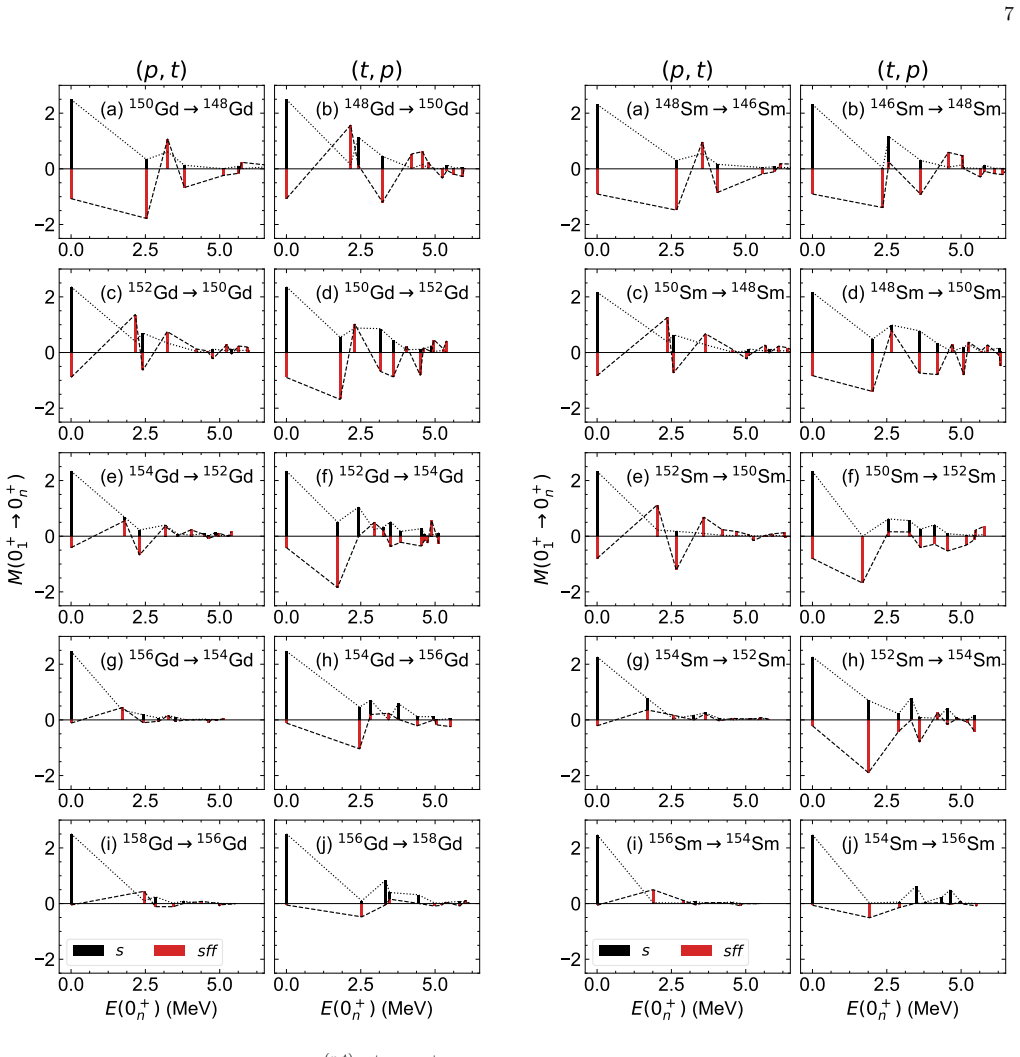
- [Results on transfer intensities] No quantitative measures of agreement (e.g., χ² values, error bands, or direct overlay of calculated vs. experimental transfer intensities) are provided to support the reproduction of the N≈88-90 discontinuities. Without these, it is not possible to assess whether the octupole contribution is the dominant driver or if the agreement is qualitative only. (See the results section on transfer intensities and comparison to data.)
minor comments (2)
- [Results on 0+ states] The abstract states that 'a large number of low-energy 0+ states' contain octupole components, but the main text should include a table or figure quantifying the octupole boson content (e.g., percentages) for the lowest few 0+ states across the isotopic chains.
- [Model and operators] Notation for the transfer operators and boson-number dependence should be clarified in the methods to avoid ambiguity when comparing (p,t) vs. (t,p) intensities.
Simulated Author's Rebuttal
We thank the referee for the careful reading of our manuscript and the constructive comments. We address each major point below and have revised the manuscript to improve clarity and provide the requested quantitative details.
read point-by-point responses
-
Referee: The manuscript does not explicitly document the full procedure for extracting IBM Hamiltonian parameters (including octupole terms) from DFT calculations or confirm that no post-mapping renormalization or fitting to positive-parity spectra/transfer data was performed. This is load-bearing for the claim that the discontinuous intensity jumps arise purely from f-boson mixing, as any such adjustment would introduce circularity. (See the sections describing the IBM-DFT mapping and Hamiltonian construction.)
Authors: We thank the referee for highlighting this point. The IBM-DFT mapping follows the standard coherent-state procedure used in our prior works on this framework, where parameters (including octupole f-boson terms) are fixed by equating the DFT potential energy surfaces and moments of inertia to the corresponding IBM expressions. No post-mapping renormalization or fitting to positive-parity spectra or transfer intensities was performed; all results are direct predictions from the DFT inputs. In the revised manuscript we have added an explicit subsection detailing the mapping equations for both quadrupole and octupole terms and a clear statement confirming the absence of any adjustments to positive-parity data. revision: yes
-
Referee: No quantitative measures of agreement (e.g., χ² values, error bands, or direct overlay of calculated vs. experimental transfer intensities) are provided to support the reproduction of the N≈88-90 discontinuities. Without these, it is not possible to assess whether the octupole contribution is the dominant driver or if the agreement is qualitative only. (See the results section on transfer intensities and comparison to data.)
Authors: We agree that quantitative metrics strengthen the comparison. The revised manuscript now includes a table directly comparing calculated and experimental (p,t) and (t,p) intensities for the relevant nuclei, a χ² analysis focused on the N≈88-90 region, and error bands derived from variations in the underlying DFT calculations. These additions show that the octupole mixing is essential for reproducing the observed discontinuities, while calculations without f bosons yield markedly worse agreement. revision: yes
Circularity Check
No significant circularity in IBM-DFT octupole extension for transfer intensities
full rationale
The paper maps DFT results to IBM parameters, extends the boson space with octupole degrees of freedom, and computes 0+ wave functions and (p,t)/(t,p) intensities from the resulting Hamiltonian and transfer operator. The reproduction of jumps at N≈88-90 is obtained by applying the extended model to the nuclei in question; no equation or step reduces the output intensities to a direct fit or redefinition of the input DFT parameters or transfer data themselves. The derivation chain remains independent of the target observable and is therefore self-contained.
Axiom & Free-Parameter Ledger
free parameters (1)
- IBM Hamiltonian parameters
axioms (1)
- domain assumption Nuclear density functional theory supplies a reliable microscopic basis for constructing the interacting boson model Hamiltonian including octupole terms.
Reference graph
Works this paper leans on
-
[1]
Ahmad and P
I. Ahmad and P. A. Butler, Annu. Rev. Nucl. Part. Sci. 43, 71 (1993)
1993
-
[2]
P. A. Butler and W. Nazarewicz, Rev. Mod. Phys.68, 349 (1996)
1996
-
[3]
P. A. Butler, J. Phys. G: Nucl. Part. Phys.43, 073002 (2016)
2016
-
[4]
P. A. Butler, Proc. R. Soc. A476, 20200202 (2020)
2020
-
[5]
P. A. Butler, Phys. Scr.99, 035302 (2024)
2024
-
[6]
L. P. Gaffney, P. A. Butler, M. Scheck, A. B. Hayes, F. Wenander, M. Albers, B. Bastin, C. Bauer, A. Blazhev, S. B¨ onig, N. Bree, J. Cederk¨ all, T. Chupp, D. Cline, T. E. Cocolios, T. Davinson, H. D. Witte, J. Diriken, T. Grahn, A. Herzan, M. Huyse, D. G. Jenk- ins, D. T. Joss, N. Kesteloot, J. Konki, M. Kowal- czyk, T. Kr¨ oll, E. Kwan, R. Lutter, K. M...
2013
-
[7]
Bucher, S
B. Bucher, S. Zhu, C. Y. Wu, R. V. F. Janssens, D. Cline, A. B. Hayes, M. Albers, A. D. Ayangeakaa, P. A. But- ler, C. M. Campbell, M. P. Carpenter, C. J. Chiara, J. A. Clark, H. L. Crawford, M. Cromaz, H. M. David, C. Dick- erson, E. T. Gregor, J. Harker, C. R. Hoffman, B. P. Kay, F. G. Kondev, A. Korichi, T. Lauritsen, A. O. Macchi- avelli, R. C. Pardo,...
2016
-
[8]
Bucher, S
B. Bucher, S. Zhu, C. Y. Wu, R. V. F. Janssens, R. N. Bernard, L. M. Robledo, T. R. Rodr´ ıguez, D. Cline, A. B. Hayes, A. D. Ayangeakaa, M. Q. Buckner, C. M. Camp- bell, M. P. Carpenter, J. A. Clark, H. L. Crawford, H. M. David, C. Dickerson, J. Harker, C. R. Hoffman, B. P. Kay, F. G. Kondev, T. Lauritsen, A. O. Macchiavelli, R. C. Pardo, G. Savard, D. S...
2017
-
[9]
Heyde, P
K. Heyde, P. Van Isacker, M. Waroquier, J. L. Wood, and R. A. Meyer, Phys. Rep.102, 291 (1983)
1983
-
[10]
J. L. Wood, K. Heyde, W. Nazarewicz, M. Huyse, and P. van Duppen, Phys. Rep.215, 101 (1992)
1992
-
[11]
Heyde and J
K. Heyde and J. L. Wood, Rev. Mod. Phys.83, 1467 (2011)
2011
-
[12]
P. E. Garrett, M. Zieli´ nska, and E. Cl´ ement, Prog. Part. Nucl. Phys.124, 103931 (2022)
2022
-
[13]
Leoni, B
S. Leoni, B. Fornal, A. Bracco, Y. Tsunoda, and T. Ot- suka, Prog. Part. Nucl. Phys.139, 104119 (2024)
2024
-
[14]
R. F. Casten, Prog. Part. Nucl. Phys.62, 183 (2009)
2009
-
[15]
Cejnar, J
P. Cejnar, J. Jolie, and R. F. Casten, Rev. Mod. Phys. 82, 2155 (2010)
2010
-
[16]
Carr, ed.,Understanding Quantum Phase Transitions (CRC Press, 2010)
L. Carr, ed.,Understanding Quantum Phase Transitions (CRC Press, 2010)
2010
-
[17]
Fortunato, Prog
L. Fortunato, Prog. Part. Nucl. Phys.121, 103891 (2021)
2021
-
[18]
B` es and R
D. B` es and R. Broglia, Nucl. Phys.80, 289 (1966)
1966
-
[19]
B` es, R
D. B` es, R. Broglia, and B. Nilsson, Phys. Lett. B40, 338 (1972)
1972
-
[20]
R. A. Broglia, O. Hansen, and C. Riedel, Two-neutron transfer reactions and the pairing model, inAdvances in Nuclear Physics: Volume 6, edited by M. Baranger and E. Vogt (Springer US, Boston, MA, 1973) pp. 287–457
1973
-
[21]
Pr´ ochniak, K
L. Pr´ ochniak, K. Zaj¸ ac, K. Pomorski, S. Rohozi´ nski, and J. Srebrny, Nucl. Phys. A648, 181 (1999)
1999
-
[22]
D. M. Brink and R. A. Broglia,Nuclear superfluidity: pairing in finite systems(Cambridge University Press, 2005)
2005
-
[23]
Srebrny, T
J. Srebrny, T. Czosnyka, C. Droste, S. G. Rohozi´ nski, L. Pr´ ochniak, K. Zaj¸ ac, K. Pomorski, D. Cline, C. Y. Wu, A. B¨ acklin, L. Hasselgren, R. M. Diamond, D. Habs, H. J. K¨ orner, F. S. Stephens, C. Baktash, and R. P. Kostecki, Nucl. Phys. A766, 25 (2006)
2006
-
[24]
Pr´ ochniak, Int
L. Pr´ ochniak, Int. J. Mod. Phys. E16, 352 (2007)
2007
-
[25]
Xiang, Z
J. Xiang, Z. P. Li, T. Nikˇ si´ c, D. Vretenar, and W. H. Long, Phys. Rev. C101, 064301 (2020)
2020
-
[26]
Nomura, D
K. Nomura, D. Vretenar, Z. P. Li, and J. Xiang, Phys. Rev. C102, 054313 (2020)
2020
-
[27]
Bohr and B
A. Bohr and B. R. Mottelson,Nuclear Structure, Vol. II (Benjamin, New York, USA, 1975)
1975
-
[28]
A. I. Levon, G. Graw, R. Hertenberger, S. Pascu, P. G. Thirolf, H.-F. Wirth, and P. Alexa, Phys. Rev. C88, 014310 (2013)
2013
-
[29]
Spieker, D
M. Spieker, D. Bucurescu, J. Endres, T. Faestermann, R. Hertenberger, S. Pascu, S. Skalacki, S. Weber, H.-F. Wirth, N.-V. Zamfir, and A. Zilges, Phys. Rev. C88, 041303 (2013). 15
2013
-
[30]
Spieker, S
M. Spieker, S. Pascu, D. Bucurescu, T. M. Shneidman, T. Faestermann, R. Hertenberger, H.-F. Wirth, N.-V. Zamfir, and A. Zilges, Phys. Rev. C97, 064319 (2018)
2018
-
[31]
N. V. Zamfir, J.-y. Zhang, and R. F. Casten, Phys. Rev. C66, 057303 (2002)
2002
-
[32]
D. A. Meyer, V. Wood, R. F. Casten, C. R. Fitz- patrick, G. Graw, D. Bucurescu, J. Jolie, P. v. Brentano, R. Hertenberger, H.-F. Wirth, N. Braun, T. Faester- mann, S. Heinze, J. L. Jerke, R. Kr¨ ucken, M. Mahgoub, O. M¨ oller, D. M¨ ucher, and C. Scholl, Phys. Rev. C74, 044309 (2006)
2006
-
[33]
Pascu, G
S. Pascu, G. C˘ ata-Danil, D. Bucurescu, N. M˘ arginean, N. V. Zamfir, G. Graw, A. Gollwitzer, D. Hofer, and B. D. Valnion, Phys. Rev. C79, 064323 (2009)
2009
-
[34]
Pascu, G
S. Pascu, G. C˘ ata-Danil, D. Bucurescu, N. M˘ arginean, C. M¨ uller, N. V. Zamfir, G. Graw, A. Gollwitzer, D. Hofer, and B. D. Valnion, Phys. Rev. C81, 014304 (2010)
2010
-
[35]
Bucurescu, S
D. Bucurescu, S. Pascu, G. Suliman, H.-F. Wirth, R. Hertenberger, T. Faestermann, R. Kr¨ ucken, and G. Graw, Phys. Rev. C100, 044316 (2019)
2019
-
[36]
A. I. Levon, D. Bucurescu, C. Costache, T. Faester- mann, R. Hertenberger, A. Ionescu, R. Lica, A. G. Mag- ner, C. Mihai, R. Mihai, C. R. Nita, S. Pascu, K. P. Shevchenko, A. A. Shevchuk, A. Turturica, and H.-F. Wirth, Phys. Rev. C102, 014308 (2020)
2020
-
[37]
Iachello and A
F. Iachello and A. Arima,The interacting boson model (Cambridge University Press, Cambridge, 1987)
1987
-
[38]
Otsuka, A
T. Otsuka, A. Arima, F. Iachello, and I. Talmi, Phys. Lett. B76, 139 (1978)
1978
-
[39]
Otsuka, A
T. Otsuka, A. Arima, and F. Iachello, Nucl. Phys. A309, 1 (1978)
1978
-
[40]
Arima and F
A. Arima and F. Iachello, Phys. Rev. C16, 2085 (1977)
2085
-
[41]
Scholten, F
O. Scholten, F. Iachello, and A. Arima, Ann. Phys. (NY) 115, 325 (1978)
1978
-
[42]
Fossion, C
R. Fossion, C. E. Alonso, J. M. Arias, L. Fortunato, and A. Vitturi, Phys. Rev. C76, 014316 (2007)
2007
-
[43]
Zhang and F
Y. Zhang and F. Iachello, Phys. Rev. C95, 034306 (2017)
2017
-
[44]
Nomura and Y
K. Nomura and Y. Zhang, Phys. Rev. C99, 024324 (2019)
2019
-
[45]
Garc´ ıa-Ramos, J
J. Garc´ ıa-Ramos, J. Arias, and A. Vitturi, Chin. Phys. C44, 124101 (2020)
2020
-
[46]
Ring and P
P. Ring and P. Schuck,The Nuclear Many-Body Problem (Springer-Verlag, Berlin, 1980)
1980
-
[47]
Bender, P.-H
M. Bender, P.-H. Heenen, and P.-G. Reinhard, Rev. Mod. Phys.75, 121 (2003)
2003
-
[48]
Nomura, N
K. Nomura, N. Shimizu, and T. Otsuka, Phys. Rev. Lett. 101, 142501 (2008)
2008
-
[49]
Nomura, N
K. Nomura, N. Shimizu, and T. Otsuka, Phys. Rev. C 81, 044307 (2010)
2010
-
[50]
Nomura, Eur
K. Nomura, Eur. Phys. J. A61, 139 (2025)
2025
-
[51]
Nomura, R
K. Nomura, R. Rodr´ ıguez-Guzm´ an, and L. M. Robledo, Phys. Rev. C101, 024311 (2020)
2020
-
[52]
Nomura, R
K. Nomura, R. Rodr´ ıguez-Guzm´ an, and L. M. Robledo, Phys. Rev. C101, 044318 (2020)
2020
-
[53]
Nomura, Phys
K. Nomura, Phys. Rev. C109, 034319 (2024)
2024
-
[54]
Nomura, Phys
K. Nomura, Phys. Rev. C105, 044301 (2022)
2022
-
[55]
Nomura, Phys
K. Nomura, Phys. Rev. C112, 054310 (2025)
2025
-
[56]
Nomura, Phys
K. Nomura, Phys. Lett. B871, 139995 (2025)
2025
-
[57]
Nomura, Int
K. Nomura, Int. J. Mod. Phys. E32, 2340001 (2023)
2023
-
[58]
T. H. R. Skyrme, Nucl. Phys.9, 615 (1958)
1958
-
[59]
Bartel, P
J. Bartel, P. Quentin, M. Brack, C. Guet, and H.-B. H˚ akansson, Nucl. Phys. A386, 79 (1982)
1982
-
[60]
Nomura, R
K. Nomura, R. Rodr´ ıguez-Guzm´ an, and L. M. Robledo, Phys. Rev. C92, 014312 (2015)
2015
-
[61]
Nomura, R
K. Nomura, R. Rodr´ ıguez-Guzm´ an, L. M. Robledo, J. E. Garc´ ıa-Ramos, and N. C. Hern´ andez, Phys. Rev. C104, 044324 (2021)
2021
-
[62]
L. M. Robledo, T. R. Rodr´ ıguez, and R. R. Rodr´ ıguez- Guzm´ an, J. Phys. G: Nucl. Part. Phys.46, 013001 (2019)
2019
-
[63]
Decharge, M
J. Decharge, M. Girod, and D. Gogny, Phys. Lett. B55, 361 (1975)
1975
-
[64]
Goriely, S
S. Goriely, S. Hilaire, M. Girod, and S. P´ eru, Phys. Rev. Lett.102, 242501 (2009)
2009
-
[65]
Engel and F
J. Engel and F. Iachello, Phys. Rev. Lett.54, 1126 (1985)
1985
-
[66]
Engel and F
J. Engel and F. Iachello, Nucl. Phys. A472, 61 (1987)
1987
-
[67]
J. N. Ginocchio and M. W. Kirson, Nucl. Phys. A350, 31 (1980)
1980
-
[68]
Nomura, Phys
K. Nomura, Phys. Rev. C106, 024330 (2022)
2022
-
[69]
Otsuka, Phys
T. Otsuka, Phys. Lett. B182, 256 (1986)
1986
-
[70]
nndc.bnl.gov
Brookhaven National Nuclear Data Center,http://www. nndc.bnl.gov
-
[71]
Pascu, E
S. Pascu, E. Y¨ uksel, Abhishek, P. Stevenson, G. H. Bhat, R. N. Mao, K. Nomura, C. Costache, Z. P. Li, N. M˘ arginean, C. Mihai, T. Naz, Z. Podoly´ ak, P. H. Re- gan, A. E. Turturic˘ a, R. Borcea, M. Boromiza, D. Bu- curescu, S. C˘ alinescu, C. Clisu, A. Coman, I. Dinescu, S. Doshi, D. Filipescu, N. M. Florea, A. Gandhi, I. Ghe- orghe, A. Ionescu, R. Lic...
2025
-
[72]
D. G. Fleming, C. G¨ unther, G. Hagemann, B. Herskind, and P. O. Tjøm, Phys. Rev. C8, 806 (1973)
1973
-
[73]
Shahabuddin, D
M. Shahabuddin, D. Burke, I. Nowikow, and J. Wadding- ton, Nucl. Phys. A340, 109 (1980)
1980
-
[74]
Løvhøiden, T
G. Løvhøiden, T. Thorsteinsen, E. Andersen, M. Kizil- tan, and D. Burke, Nucl. Phys. A494, 157 (1989)
1989
-
[75]
Debenham and N
P. Debenham and N. M. Hintz, Nucl. Phys. A195, 385 (1972)
1972
-
[76]
Bjerregaard, O
J. Bjerregaard, O. Hansen, O. Nathan, and S. Hinds, Nucl. Phys.86, 145 (1966)
1966
-
[77]
Ponomarev, M
V. Ponomarev, M. Pignanelli, N. Blasi, A. Bontempi, J. Bordewijk, R. De Leo, G. Graw, M. Harakeh, D. Hofer, M. Hofstee, S. Micheletti, R. Perrino, and S. van der Werf, Nucl. Phys. A601, 1 (1996)
1996
-
[78]
P. E. Garrett, W. D. Kulp, J. L. Wood, D. Bandyopad- hyay, S. Choudry, D. Dashdorj, S. R. Lesher, M. T. McEl- listrem, M. Mynk, J. N. Orce, and S. W. Yates, Phys. Rev. Lett.103, 062501 (2009)
2009
-
[79]
Tsunoda, N
Y. Tsunoda, N. Shimizu, and T. Otsuka, Phys. Rev. C 108, L021302 (2023)
2023
-
[80]
Nomura, D
K. Nomura, D. Vretenar, T. Nikˇ si´ c, and B.-N. Lu, Phys. Rev. C89, 024312 (2014)
2014
discussion (0)
Sign in with ORCID, Apple, or X to comment. Anyone can read and Pith papers without signing in.