Recognition: unknown
On the importance of hyperparameters in initializing parameterized quantum circuits
Pith reviewed 2026-05-09 22:36 UTC · model grok-4.3
The pith
An evolutionary search tunes hyperparameters of initialization distributions for parameterized quantum circuits to achieve faster convergence without worsening barren plateaus.
A machine-rendered reading of the paper's core claim, the machinery that carries it, and where it could break.
Core claim
The authors claim that an evolutionary-search algorithm can identify hyperparameters for any chosen initialization distribution such that the resulting initial parameters are tuned specifically to the ansatz and the quantum task; these parameters produce faster convergence and improved performance while leaving the gradient-variance scaling of the barren-plateau phenomenon unaffected.
What carries the argument
Evolutionary-search algorithm that optimizes the hyperparameters of a chosen parameter-initialization distribution for a given PQC and task.
If this is right
- The chosen initial parameters are specific to both the circuit ansatz and the target task.
- Training converges faster than with untuned initialization.
- Final performance on the quantum task improves.
- Gradient variance scaling with system size remains the same, preserving barren-plateau behavior.
- The procedure applies to any base distribution chosen by the user.
Where Pith is reading between the lines
- Initialization hyperparameters may need to be treated as a standard design choice alongside circuit architecture in variational quantum algorithms.
- The method could be combined with other trainability techniques such as layerwise training or ansatz modification.
- Similar evolutionary searches might be applied to related choices like the choice of optimizer or the number of layers.
- On hardware with noise, the tuned initials might interact with decoherence in ways that require separate testing.
Load-bearing premise
The evolutionary search reliably finds hyperparameters that generalize to new ansatzes and tasks without overfitting or hidden bias from the search process itself.
What would settle it
Running the algorithm on an ansatz and task not used during hyperparameter search and finding that the returned initial parameters produce slower convergence or worse final performance than standard choices.
Figures



read the original abstract
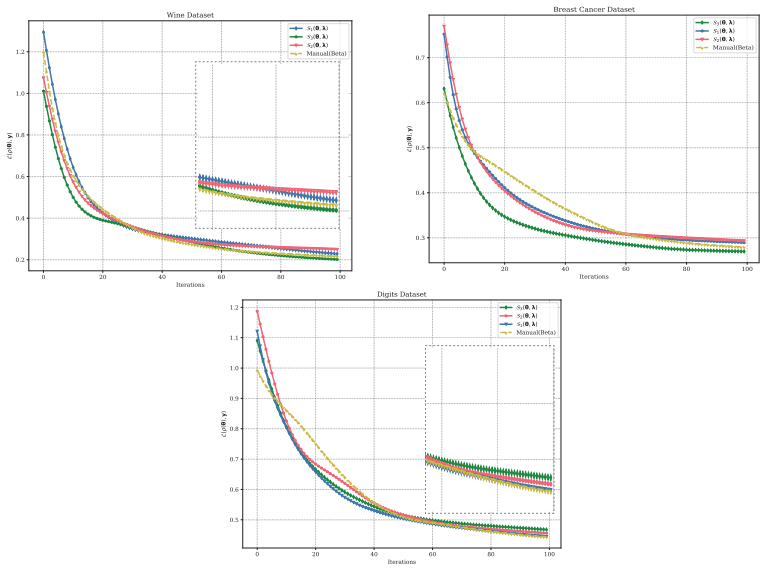
There has been intensive research on increasing the utility and performance of Parameterized Quantum Circuits (PQCs) in the past couple of years. Owing to this research, there are now several inductive biases available to a quantum algorithms researchers to design a good circuit for their chosen task. In this paper, we focus on the problem of finding performant initial parameters for a given PQC. Different from previous research that focuses on finding the right \emph{distribution}, we focus on finding the \emph{hyperparameters} for any given distribution. To that end we introduce an evolutionary-search based algorithm that finds optimal hyperparameter given a PQC and quantum task. Our empirical results indicate that our algorithm consistently leads to selection of performant initial parameters tuned specifically to the ansatz and the quantum task leading to faster convergence and performance. More importantly, our algorithm does not \emph{negatively} affect the barren plateau phenomenon. In other words, the initial parameters suggested by algorithm do not worsen the gradient variance scaling for a given initializing distribution.
Editorial analysis
A structured set of objections, weighed in public.
Referee Report
Summary. The manuscript proposes an evolutionary-search algorithm to optimize the hyperparameters of a chosen initialization distribution for parameterized quantum circuits (PQCs). It claims that the resulting hyperparameters yield initial parameters that improve convergence speed and final performance on quantum tasks while leaving the barren-plateau scaling (gradient variance versus qubit number) unchanged for the underlying distribution.
Significance. If the empirical claims are substantiated with proper controls and scaling tests, the method could supply a practical, ansatz- and task-specific initialization heuristic that accelerates variational quantum algorithms without introducing new trainability obstacles. The work is distinguished by its explicit focus on hyperparameters rather than distribution families and by its attempt to separate performance gains from changes in gradient scaling.
major comments (3)
- [Experimental Results] The central claim that the algorithm 'does not negatively affect the barren plateau phenomenon' (abstract) requires that the selected hyperparameters preserve the asymptotic scaling of gradient variance with system size. Because the evolutionary search is performed at fixed qubit number, the manuscript must demonstrate that the chosen hyperparameters do not alter the scaling exponent when the circuit is evaluated at larger n; no such extrapolation or scaling plot is reported.
- [Experimental Results] The abstract asserts 'consistent' empirical improvements and 'no negative effect' on barren plateaus, yet the experimental section supplies no information on the number of independent trials, statistical tests, error bars, or explicit baselines against which the evolutionary-search initialization is compared. Without these details the reproducibility and magnitude of the reported gains cannot be assessed.
- [Method and Results] The evolutionary fitness function optimizes task performance at a single system size. This objective does not directly constrain the scaling of gradient variance; therefore the claim that the barren-plateau scaling remains unchanged must be verified by an explicit comparison of variance-versus-n curves before and after hyperparameter selection, which is not provided.
minor comments (2)
- [Method] Notation for the hyperparameter vector and the evolutionary operators should be introduced with explicit definitions and consistent symbols throughout the text.
- [Figures] Figure captions should state the number of qubits, the ansatz depth, and the number of shots or samples used in each panel.
Simulated Author's Rebuttal
We thank the referee for their thorough review and constructive suggestions. We agree that strengthening the experimental validation, particularly regarding scaling and statistical details, will improve the manuscript. We address each major comment below and will incorporate the necessary revisions.
read point-by-point responses
-
Referee: The central claim that the algorithm 'does not negatively affect the barren plateau phenomenon' (abstract) requires that the selected hyperparameters preserve the asymptotic scaling of gradient variance with system size. Because the evolutionary search is performed at fixed qubit number, the manuscript must demonstrate that the chosen hyperparameters do not alter the scaling exponent when the circuit is evaluated at larger n; no such extrapolation or scaling plot is reported.
Authors: We concur that demonstrating preservation of the scaling is essential. Although the evolutionary optimization was conducted at a fixed qubit number, the hyperparameters modify only the parameters of the initialization distribution without changing its functional form. To substantiate the claim, we will add scaling plots in the revised manuscript that compare the gradient variance as a function of qubit number for the original and optimized hyperparameters, showing that the asymptotic scaling remains the same. revision: yes
-
Referee: The abstract asserts 'consistent' empirical improvements and 'no negative effect' on barren plateaus, yet the experimental section supplies no information on the number of independent trials, statistical tests, error bars, or explicit baselines against which the evolutionary-search initialization is compared. Without these details the reproducibility and magnitude of the reported gains cannot be assessed.
Authors: The current manuscript indeed omits these experimental details. In the revision, we will specify that all results are averaged over 20 independent random seeds, include error bars representing one standard deviation, provide comparisons to standard baselines (e.g., uniform distribution with hyperparameters in [0, 2π]), and report p-values from statistical tests to confirm the significance of the observed improvements. revision: yes
-
Referee: The evolutionary fitness function optimizes task performance at a single system size. This objective does not directly constrain the scaling of gradient variance; therefore the claim that the barren-plateau scaling remains unchanged must be verified by an explicit comparison of variance-versus-n curves before and after hyperparameter selection, which is not provided.
Authors: This observation is correct, and the fitness function focuses on task performance rather than directly on gradient scaling. However, since the distribution family is preserved, we expect the scaling to be unaffected. To rigorously verify this, the revised version will include explicit variance-versus-n curves for both the baseline and optimized initializations across a range of qubit numbers. revision: yes
Circularity Check
No circularity: empirical evolutionary search with independent experimental validation
full rationale
The paper introduces an evolutionary algorithm to select hyperparameters for initialization distributions of PQCs and supports its claims solely through direct empirical runs on specific ansatzes and tasks. No mathematical derivation chain exists that equates any performance prediction or barren-plateau observation to quantities fitted or defined by the same search; the results are reported as measured outcomes rather than constructed identities. No self-citations are used to justify uniqueness, ansatzes, or load-bearing premises, and the algorithm description does not smuggle in prior results by the same authors. The derivation is therefore self-contained as an empirical procedure.
Axiom & Free-Parameter Ledger
axioms (1)
- domain assumption Parameterized quantum circuits admit initialization via distributions whose hyperparameters can be optimized independently of the circuit structure
Reference graph
Works this paper leans on
-
[1]
Barren plateaus in quantum neural network training landscapes,
J. R. McClean, S. Boixo, V . N. Smelyanskiy, R. Babbush, and H. Neven, “Barren plateaus in quantum neural network training landscapes,”Nature communications, vol. 9, no. 1, p. 4812, 2018. [Online]. Available: https://www.nature.com/articles/s41467-018-07090-4
2018
-
[2]
An initialization strategy for addressing barren plateaus in parametrized quantum circuits,
E. Grant, L. Wossnig, M. Ostaszewski, and M. Benedetti, “An initialization strategy for addressing barren plateaus in parametrized quantum circuits,”Quantum, vol. 3, p. 214, 2019. [Online]. Available: https://quantum-journal.org/papers/q-2019-12-09-214/
2019
-
[3]
BEINIT: Avoiding barren plateaus in variational quantum algorithms,
A. Kulshrestha and I. Safro, “BEINIT: Avoiding barren plateaus in variational quantum algorithms,” in2022 IEEE International Conference on Quantum Computing and Engineering (QCE). IEEE, 2022, pp. 197– 203
2022
-
[4]
Escaping from the barren plateau via gaussian initializations in deep variational quantum circuits,
K. Zhang, L. Liu, M.-H. Hsieh, and D. Tao, “Escaping from the barren plateau via gaussian initializations in deep variational quantum circuits,”Advances in Neural Information Processing Systems, vol. 35, pp. 18 612–18 627, 2022
2022
-
[5]
Hamiltonian variational ansatz without barren plateaus,
C.-Y . Park and N. Killoran, “Hamiltonian variational ansatz without barren plateaus,”Quantum, vol. 8, p. 1239, 2024. [Online]. Available: https://quantum-journal.org/papers/q-2024-02-01-1239/
2024
-
[6]
Hardware-efficient variational quantum eigensolver for small molecules and quantum magnets,
A. Kandala, A. Mezzacapo, K. Temme, M. Takita, M. Brink, J. M. Chow, and J. M. Gambetta, “Hardware-efficient variational quantum eigensolver for small molecules and quantum magnets,” Nature, vol. 549, no. 7671, p. 242–246, 2017. [Online]. Available: https://www.nature.com/articles/nature23879
2017
-
[7]
Introduction to quantum fisher information,
D. Petz and C. Ghinea, “Introduction to quantum fisher information,” inQuantum probability and related topics. World Scientific, 2011, pp. 261–281
2011
-
[8]
Algorithms for hyper- parameter optimization,
J. Bergstra, R. Bardenet, Y . Bengio, and B. K ´egl, “Algorithms for hyper- parameter optimization,”Advances in neural information processing systems, vol. 24, 2011
2011
-
[9]
T. Salimans, J. Ho, X. Chen, S. Sidor, and I. Sutskever, “Evolution strategies as a scalable alternative to reinforcement learning,”arXiv preprint arXiv:1703.03864, 2017
-
[10]
Natural evolution strategies,
D. Wierstra, T. Schaul, T. Glasmachers, Y . Sun, J. Peters, and J. Schmid- huber, “Natural evolution strategies,”The Journal of Machine Learning Research, vol. 15, no. 1, pp. 949–980, 2014
2014
-
[11]
Efficient natural evolution strategies,
Y . Sun, D. Wierstra, T. Schaul, and J. Schmidhuber, “Efficient natural evolution strategies,” inProceedings of the 11th Annual conference on Genetic and evolutionary computation, 2009, pp. 539–546
2009
-
[12]
PennyLane: Automatic differentiation of hybrid quantum-classical computations
V . Bergholm, J. Izaac, M. Schuld, C. Gogolin, M. S. Alam, S. Ahmed, J. M. Arrazola, C. Blank, A. Delgado, S. Jahangiriet al., “Pennylane: Automatic differentiation of hybrid quantum-classical computations,”arXiv preprint arXiv:1811.04968, 2018. [Online]. Available: https://arxiv.org/abs/1811.04968
work page internal anchor Pith review arXiv 2018
-
[13]
Adam: A Method for Stochastic Optimization
D. P. Kingma and J. Ba, “Adam: A method for stochastic optimization,” arXiv preprint arXiv:1412.6980, 2014
work page internal anchor Pith review Pith/arXiv arXiv 2014
-
[14]
On bayesian methods for seeking the extremum,
J. Mo ˇckus, “On bayesian methods for seeking the extremum,” inIFIP Technical Conference on Optimization Techniques. Springer, 1974, pp. 400–404
1974
-
[15]
Random search for hyper-parameter opti- mization
J. Bergstra and Y . Bengio, “Random search for hyper-parameter opti- mization.”Journal of machine learning research, vol. 13, no. 2, 2012
2012
-
[16]
Quantum natural gradient,
J. Stokes, J. Izaac, N. Killoran, and G. Carleo, “Quantum natural gradient,”Quantum, vol. 4, p. 269, 2020. [Online]. Available: https://quantum-journal.org/papers/q-2020-05-25-269/
2020
-
[17]
Measurement cost of metric-aware variational quantum algorithms,
B. van Straaten and B. Koczor, “Measurement cost of metric-aware variational quantum algorithms,”PRX Quantum, vol. 2, no. 3, p. 030324, 2021
2021
-
[18]
The power of quantum neural networks,
A. Abbas, D. Sutter, C. Zoufal, A. Lucchi, A. Figalli, and S. Woerner, “The power of quantum neural networks,”arXiv preprint arXiv:2011.00027, 2020. [Online]. Available: https://arxiv.org/abs/2011. 00027
-
[19]
Capacity and quantum geometry of parametrized quantum circuits,
T. Haug, K. Bharti, and M. Kim, “Capacity and quantum geometry of parametrized quantum circuits,”PRX Quantum, vol. 2, no. 4, p. 040309, 2021
2021
-
[20]
Optimal training of variational quantum algorithms without barren plateaus,
T. Haug and M. Kim, “Optimal training of variational quantum algo- rithms without barren plateaus,”arXiv preprint arXiv:2104.14543, 2021
-
[21]
On optimizing hyperparameters for quantum neural networks,
S. Herbst, V . De Maio, and I. Brandic, “On optimizing hyperparameters for quantum neural networks,” in2024 IEEE International Conference on Quantum Computing and Engineering (QCE), vol. 1. IEEE, 2024, pp. 1478–1489
2024
discussion (0)
Sign in with ORCID, Apple, or X to comment. Anyone can read and Pith papers without signing in.