Recognition: unknown
Third Quantization for Order Parameter (I): BCS-BEC crossover with macroscopically coherent state
Pith reviewed 2026-05-09 22:18 UTC · model grok-4.3
The pith
The commutation relation between phase and number operators for the superconducting order parameter emerges naturally from second quantization in the thermodynamic limit rather than as an added postulate.
A machine-rendered reading of the paper's core claim, the machinery that carries it, and where it could break.
Core claim
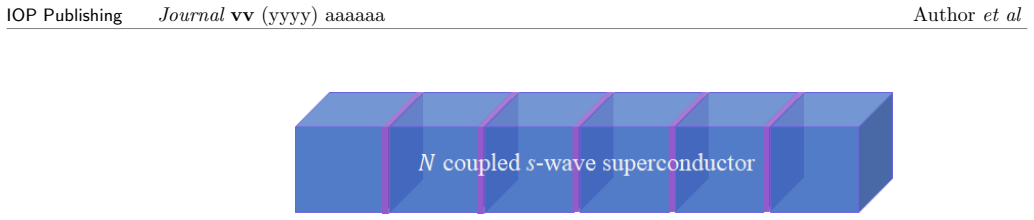
We show that the macroscopic commutation relation between the phase operator of the order parameter and the particle-number operator emerges naturally from second quantization in the thermodynamic limit for both bosonic and fermionic many-body systems. Consequently, both BECs and BCS states can be understood as macroscopic quantum states described by bosonic coherent states. Modeling the superconductor as an assembly of macroscopically separated segments whose intra-segment coupling drives a BCS-to-BEC evolution, inter-segment tunneling then locks phases and establishes a bulk condensate, framing the crossover as a macroscopic quantum process governed by coherent-state dynamics.
What carries the argument
The macroscopic commutation relation between the phase operator of the order parameter and the particle-number operator that arises in the thermodynamic limit from second quantization, together with the model of macroscopically separated superconducting segments connected by tunable intra-segment coupling and inter-segment tunneling.
If this is right
- BEC and BCS superconductivity both admit descriptions in terms of bosonic coherent states for the order parameter.
- The BCS-BEC crossover can be understood as a phase-locking process between coherent segments rather than solely through microscopic pairing changes.
- Global phase coherence in bulk superconductors arises from tunneling between segments that have each reached a coherent regime.
- No independent postulate is required for the phase-number uncertainty relation at the macroscopic level.
- The phase diagram of the crossover reflects the dynamics of these coherent states.
Where Pith is reading between the lines
- This segmentation model might be realizable in artificial superconducting lattices or arrays to experimentally probe the crossover dynamics.
- The approach could extend to other systems exhibiting macroscopic coherence, such as superfluid helium or polariton condensates, by identifying analogous segment-like structures.
- If the derivation holds, it suggests that third quantization is a derived concept, potentially simplifying theoretical treatments of Josephson effects and related phenomena.
Load-bearing premise
That a conventional superconductor can be faithfully modeled as macroscopically separated segments with tunable intra-segment couplings and inter-segment tunneling without further microscopic derivation for that segmentation.
What would settle it
A direct calculation showing that the phase-number commutation relation fails to emerge in the thermodynamic limit for a standard many-body Hamiltonian, or an experiment where the segmented model predicts a different crossover behavior than observed in real materials.
Figures



read the original abstract
We revisit the quantization of the order parameter, which we refer to as third quantization, from the perspective of the commutation relation between the phase operator of the order parameter and the particle-number operator. We show that this macroscopic commutation relation does not constitute an independent fundamental postulate added to quantum mechanics, but instead emerges naturally from second quantization in the thermodynamic limit for both bosonic and fermionic many-body systems. In this sense, both Bose-Einstein condensates (BECs) and Bardeen-Cooper-Schrieffer (BCS) states can be understood as macroscopic quantum states described by bosonic coherent states: in BEC, bosons condense into a single coherent mode with a well-defined phase, while in BCS systems, collective excitations of Cooper pairs can also acquire an effectively bosonic coherent description. On this basis, we propose a new macroscopic interpretation of the BCS-BEC crossover. To characterize this crossover, we model a conventional superconductor as an assembly of macroscopically separated superconducting segments. As the intra-segment coupling increases, the system evolves from a BCS-like regime toward a BEC-like regime, in which the segments collectively behave as macroscopic coherent states. Inter-segment tunneling then locks their phases, establishes global phase coherence, and gives rise to a bulk Bose-Einstein condensate. The phase diagram of the BCS-BEC crossover can thus be understood as a manifestation of a macroscopic quantum process governed by the coherent-state dynamics of the order parameter. Our results provide a unified perspective on BEC, BCS superconductivity, and the BCS-BEC crossover within the framework of third quantization.
Editorial analysis
A structured set of objections, weighed in public.
Referee Report
Summary. The paper claims that the commutation relation between the phase operator of the order parameter and the particle-number operator emerges naturally from second quantization in the thermodynamic limit for both bosonic and fermionic many-body systems. This allows BEC and BCS states to be understood as macroscopic quantum states described by bosonic coherent states. The authors propose modeling a conventional superconductor as an assembly of macroscopically separated superconducting segments, where increasing intra-segment coupling drives a BCS-to-BEC evolution, and inter-segment tunneling establishes global phase coherence, providing a unified perspective on the BCS-BEC crossover within third quantization.
Significance. If the central claim regarding the natural emergence of the macroscopic commutation relation is substantiated with explicit derivations, the paper would offer a significant unified framework for BEC, BCS superconductivity, and their crossover. It reframes these phenomena in terms of coherent-state dynamics of the order parameter. However, the current manuscript does not provide the necessary derivations or microscopic justification for the segment model, limiting its immediate impact.
major comments (2)
- [Abstract and introduction to the commutation relation] The assertion that the macroscopic commutation relation 'emerges naturally from second quantization in the thermodynamic limit' is made without any accompanying equations, limit-taking procedure, or explicit calculation showing how [Φ, N] = i arises for fermionic systems. This is central to the paper's main claim and must be demonstrated explicitly.
- [Proposal for the BCS-BEC crossover model] The modeling of the superconductor as an assembly of macroscopically separated segments with tunable intra-segment coupling is introduced as a modeling choice without derivation from a microscopic Hamiltonian or lattice model. No justification is given for why the segments are macroscopically separated or how the intra-segment coupling parameter is fixed by prior theory or data. This undermines the claim that the crossover is a manifestation of the coherent-state dynamics alone.
minor comments (1)
- [Abstract] The abstract is dense and could benefit from clearer separation between the general claim and the specific model proposed.
Simulated Author's Rebuttal
We thank the referee for the careful reading and constructive feedback on our manuscript. The comments highlight areas where additional explicit derivations and justifications will strengthen the presentation. We address each major comment below and have prepared revisions to incorporate the requested clarifications.
read point-by-point responses
-
Referee: The assertion that the macroscopic commutation relation 'emerges naturally from second quantization in the thermodynamic limit' is made without any accompanying equations, limit-taking procedure, or explicit calculation showing how [Φ, N] = i arises for fermionic systems. This is central to the paper's main claim and must be demonstrated explicitly.
Authors: We agree that the central claim requires an explicit derivation. The original manuscript outlines the result in the introduction and abstract but presents the detailed limit procedure more concisely than ideal. In the revised version we have expanded the relevant section to include the full step-by-step calculation: starting from the second-quantized fermionic field operators, constructing the macroscopic order-parameter operators, and taking the thermodynamic limit while retaining the leading commutator contributions. This yields [Φ, N] = i for the collective phase and number operators of the BCS state, with the same structure recovered for the bosonic case. The added equations and intermediate steps make the emergence from second quantization fully transparent. revision: yes
-
Referee: The modeling of the superconductor as an assembly of macroscopically separated segments with tunable intra-segment coupling is introduced as a modeling choice without derivation from a microscopic Hamiltonian or lattice model. No justification is given for why the segments are macroscopically separated or how the intra-segment coupling parameter is fixed by prior theory or data. This undermines the claim that the crossover is a manifestation of the coherent-state dynamics alone.
Authors: The segment construction is offered as a macroscopic effective picture that isolates the role of coherent-state dynamics in the crossover. We acknowledge that the original text does not derive the segmentation from a specific microscopic Hamiltonian. In the revision we have added a dedicated paragraph that connects the model to the attractive Hubbard Hamiltonian in the strong-coupling regime, identifies the intra-segment coupling with the local pairing strength, and relates the macroscopic separation scale to the superconducting coherence length. This provides the requested microscopic anchoring while preserving the interpretation in terms of third-quantized coherent states. revision: partial
Circularity Check
No significant circularity; core emergence claim is independent of the interpretive model.
full rationale
The paper derives the macroscopic phase-number commutation relation as a consequence of taking the thermodynamic limit of standard second-quantized operators for bosons and fermions. This limit procedure is external to the paper and does not reduce to any input defined within the work itself. The BCS-BEC crossover is then addressed by explicitly proposing a segmented-superconductor model ('we model a conventional superconductor as an assembly of macroscopically separated superconducting segments') as a new interpretive framework, not as a derived or fitted prediction. No equations are shown to equal their own inputs by construction, no parameters are fitted and then relabeled as predictions, and no load-bearing self-citations or uniqueness theorems are invoked to close the argument. The derivation of the commutation relation therefore stands as self-contained against ordinary many-body quantum mechanics.
Axiom & Free-Parameter Ledger
Reference graph
Works this paper leans on
-
[1]
Plancks Gesetz und Lichtquantenhypothese
Bose. Plancks Gesetz und Lichtquantenhypothese. Zeitschrift f¨ ur Physik. 1924;26:178–181. Available from:https://doi.org/10.1007/BF01327326
-
[2]
Quantentheorie des einatomigen idealen Gases I
Einstein A. Quantentheorie des einatomigen idealen Gases I. Sitzungsberichte der Preussischen Akademie der Wissenschaften. 1924
1924
-
[3]
Quantentheorie des einatomigen idealen Gases II
Einstein A. Quantentheorie des einatomigen idealen Gases II. Sitzungsberichte der Preussischen Akademie der Wissenschaften. 1925
1925
-
[4]
Bardeen J, Cooper LN, Schrieffer JR. Theory of Superconductivity. Phys Rev. 1957 Dec;108:1175–1204. Available from: https://link.aps.org/doi/10.1103/PhysRev.108.1175
-
[5]
Bose-Einstein Condensation and Liquid Helium
Penrose O, Onsager L. Bose-Einstein Condensation and Liquid Helium. Phys Rev. 1956 Nov;104:576–584. Available from:https://link.aps.org/doi/10.1103/PhysRev.104.576
-
[6]
Random-Phase Approximation in the Theory of Superconductivity
Anderson PW. Random-Phase Approximation in the Theory of Superconductivity. Phys Rev. 1958 Dec;112:1900–1916. Available from: https://link.aps.org/doi/10.1103/PhysRev.112.1900
-
[7]
Concept of Off-Diagonal Long-Range Order and the Quantum Phases of Liquid He and of Superconductors
Yang CN. Concept of Off-Diagonal Long-Range Order and the Quantum Phases of Liquid He and of Superconductors. Rev Mod Phys. 1962 Oct;34:694–704. Available from: https://link.aps.org/doi/10.1103/RevModPhys.34.694
-
[8]
Why a condensate can be thought of as having a definite phase
Barnett S, Burnett K, Vaccaro J. Why a condensate can be thought of as having a definite phase. Journal of research of the National Institute of Standards and Technology. 1996;101(4):593. Available from:https://pmc.ncbi.nlm.nih.gov/articles/PMC4907620/
1996
-
[9]
Considerations on the Flow of Superfluid Helium
ANDERSON PW. Considerations on the Flow of Superfluid Helium. Rev Mod Phys. 1966 Apr;38:298–310. Available from:https://link.aps.org/doi/10.1103/RevModPhys.38.298
-
[10]
Bose-Einstein condensation in the alkali gases: Some fundamental concepts
Leggett AJ. Bose-Einstein condensation in the alkali gases: Some fundamental concepts. Rev Mod Phys. 2001 Apr;73:307–356. Available from: https://link.aps.org/doi/10.1103/RevModPhys.73.307
-
[11]
Introduction to superconductivity
Tinkham M. Introduction to superconductivity. Courier Corporation; 2004
2004
-
[12]
Macroscopic quantum systems and the quantum theory of measurement
Leggett AJ. Macroscopic quantum systems and the quantum theory of measurement. Progress of Theoretical Physics Supplement. 1980;69:80–100. Available from: https://doi.org/10.1143/PTP.69.80
-
[13]
Leggett AJ, Garg A. Quantum mechanics versus macroscopic realism: Is the flux there when nobody looks? Phys Rev Lett. 1985 Mar;54:857–860. Available from: https://link.aps.org/doi/10.1103/PhysRevLett.54.857
-
[14]
Energy-Level Quantization in the Zero-Voltage State of a Current-Biased Josephson Junction
Martinis JM, Devoret MH, Clarke J. Energy-Level Quantization in the Zero-Voltage State of a Current-Biased Josephson Junction. Phys Rev Lett. 1985 Oct;55:1543–1546. Available from: https://link.aps.org/doi/10.1103/PhysRevLett.55.1543
-
[15]
Devoret MH, Martinis JM, Clarke J. Measurements of Macroscopic Quantum Tunneling out of the Zero-Voltage State of a Current-Biased Josephson Junction. Phys Rev Lett. 1985 Oct;55:1908–1911. Available from: https://link.aps.org/doi/10.1103/PhysRevLett.55.1908
-
[16]
Clarke J, Cleland AN, Devoret MH, Esteve D, Martinis JM. Quantum Mechanics of a Macroscopic Variable: The Phase Difference of a Josephson Junction. Science. 1988;239(4843):992–997. Available from: https://www.science.org/doi/abs/10.1126/science.239.4843.992
-
[17]
Diatomic Molecules and Cooper Pairs
Leggett AJ. Diatomic Molecules and Cooper Pairs. Journal de Physique Colloques. 1980;41(C7):C7–19–C7–26
1980
-
[18]
Bose condensation in an attractive fermion gas: From weak to strong coupling superconductivity
Nozi` eres P, Schmitt-Rink S. Bose condensation in an attractive fermion gas: From weak to strong coupling superconductivity. Journal of Low Temperature Physics. 1985;59(3-4):195–211. 15 IOP PublishingJournalvv(yyyy) aaaaaa Authoret al
1985
-
[19]
Randeria M, Taylor E. Crossover from Bardeen-Cooper-Schrieffer to Bose-Einstein Condensation and the Unitary Fermi Gas [Journal Article]. Annual Review of Condensed Matter Physics. 2014;5(Volume 5, 2014):209–232. Available from:https://www. annualreviews.org/content/journals/10.1146/annurev-conmatphys-031113-133829
-
[20]
When superconductivity crosses over: From BCS to BEC
Chen Q, Wang Z, Boyack R, Yang S, Levin K. When superconductivity crosses over: From BCS to BEC. Rev Mod Phys. 2024 May;96:025002. Available from: https://link.aps.org/doi/10.1103/RevModPhys.96.025002
-
[21]
Rev.127(3) 965–970 URL https://link.aps.org/doi/10.1103/PhysRev.127.965
Goldstone J, Salam A, Weinberg S. Broken Symmetries. Phys Rev. 1962 Aug;127:965–970. Available from:https://link.aps.org/doi/10.1103/PhysRev.127.965
-
[22]
Variational study of fermionic and bosonic systems with non-Gaussian states: Theory and applications
Shi T, Demler E, Ignacio Cirac J. Variational study of fermionic and bosonic systems with non-Gaussian states: Theory and applications. Annals of Physics. 2018;390:245–302. Available from:https://www.sciencedirect.com/science/article/pii/S0003491617303251
2018
-
[23]
Gaussian time-dependent variational principle for the Bose-Hubbard model
Guaita T, Hackl L, Shi T, Hubig C, Demler E, Cirac JI. Gaussian time-dependent variational principle for the Bose-Hubbard model. Phys Rev B. 2019 Sep;100:094529. Available from: https://link.aps.org/doi/10.1103/PhysRevB.100.094529
-
[24]
Trapped Bose-Einstein Condensates with Attractive s-wave Interaction
Shi T, Pan J, Yi S. Trapped Bose-Einstein Condensates with Attractive s-wave Interaction
- [25]
-
[26]
Unitary Phase Operator in Quantum Mechanics
Pegg DT, Barnett SM. Unitary Phase Operator in Quantum Mechanics. Europhysics Letters. 1988 jul;6(6):483. Available from:https://doi.org/10.1209/0295-5075/6/6/002
-
[27]
Yu S. Quantized Phase Difference. Phys Rev Lett. 1997 Aug;79:780–783. Available from: https://link.aps.org/doi/10.1103/PhysRevLett.79.780
-
[28]
Lynch R. The quantum phase problem: a critical review. Physics Reports. 1995;256(6):367–436. Available from: https://www.sciencedirect.com/science/article/pii/037015739400095K
-
[29]
Kouzoudis D. Proof of the phase coherence in the Bardeen–Cooper–Schrieffer theory of superconductivity from first principles. European Journal of Physics. 2009 dec;31(1):239. Available from:https://dx.doi.org/10.1088/0143-0807/31/1/021
-
[30]
Superconductivity of metals and alloys
De Gennes PG. Superconductivity of metals and alloys. CRC press; 2018
2018
-
[31]
Chapter I The Josephson Effect and Quantum Coherence Measurements in Superconductors and Superfluids
Anderson PW. Chapter I The Josephson Effect and Quantum Coherence Measurements in Superconductors and Superfluids. vol. 5 of Progress in Low Temperature Physics. Elsevier
-
[32]
p. 1–43. Available from: https://www.sciencedirect.com/science/article/pii/S0079641708601195
-
[33]
Bound Electron Pairs in a Degenerate Fermi Gas
Cooper LN. Bound Electron Pairs in a Degenerate Fermi Gas. Physical Review. 1956;104(4):1189–1190
1956
-
[34]
QUASI-SPIN TREATMENT OF JOSEPHSON TUNNELING BETWEEN SUPERCONDUCTORS
Wallace PR, Stavn MJ. QUASI-SPIN TREATMENT OF JOSEPHSON TUNNELING BETWEEN SUPERCONDUCTORS. Canadian Journal of Physics. 1965;43(3):411–417. Available from:https://doi.org/10.1139/p65-037
-
[35]
Lee PA, Scully MO. Theory of Josephson Radiation. I. General Theory. Phys Rev B. 1971 Feb;3:769–779. Available from:https://link.aps.org/doi/10.1103/PhysRevB.3.769
-
[36]
Quantum fluctuations in chains of Josephson junctions
Bradley RM, Doniach S. Quantum fluctuations in chains of Josephson junctions. Phys Rev B. 1984 Aug;30:1138–1147. Available from: https://link.aps.org/doi/10.1103/PhysRevB.30.1138
-
[37]
Phase transition in granulated superconductors
Efetov KB. Phase transition in granulated superconductors. Sov Phys-JETP. 1980;51(5)
1980
-
[38]
The Bose-Hubbard model: from Josephson junction arrays to optical lattices
Bruder C, Fazio R, Sch¨ on G. The Bose-Hubbard model: from Josephson junction arrays to optical lattices. Annalen der Physik. 2005;517(9-10):566–577. Available from: https://onlinelibrary.wiley.com/doi/abs/10.1002/andp.200551709-1005
-
[39]
Cooper-pair charge solitons: The electrodynamics of localized charge in a superconductor
Haviland DB, Delsing P. Cooper-pair charge solitons: The electrodynamics of localized charge in a superconductor. Phys Rev B. 1996 Sep;54:R6857–R6860. Available from: https://link.aps.org/doi/10.1103/PhysRevB.54.R6857. 16 IOP PublishingJournalvv(yyyy) aaaaaa Authoret al
-
[40]
Superconducting and insulating behavior in one-dimensional Josephson junction arrays
Haviland DB, Andersson K, ˚Agren P. Superconducting and insulating behavior in one-dimensional Josephson junction arrays. Journal of Low Temperature Physics. 2000;118(5):733–749
2000
-
[41]
Quantum phase transition in one-dimensional Josephson junction arrays
Haviland DB, Andersson K, ˚Agren P, Johansson J, Sch¨ ollmann V, Watanabe M. Quantum phase transition in one-dimensional Josephson junction arrays. Physica C: Superconductivity. 2001;352(1):55–60. Available from: https://www.sciencedirect.com/science/article/pii/S0921453400016750
2001
-
[42]
Two soluble models of an antiferromagnetic chain,
Caldeira AO, Leggett AJ. Quantum tunnelling in a dissipative system. Annals of Physics. 1983;149(2):374–456. Available from: https://www.sciencedirect.com/science/article/pii/0003491683902026
-
[43]
Evolution of the wave function in a dissipative system
Yu LH, Sun CP. Evolution of the wave function in a dissipative system. Phys Rev A. 1994 Jan;49:592–595. Available from:https://link.aps.org/doi/10.1103/PhysRevA.49.592
-
[44]
Exact dynamics of a quantum dissipative system in a constant external field
Sun CP, Yu LH. Exact dynamics of a quantum dissipative system in a constant external field. Phys Rev A. 1995 Mar;51:1845–1853. Available from: https://link.aps.org/doi/10.1103/PhysRevA.51.1845. 17
discussion (0)
Sign in with ORCID, Apple, or X to comment. Anyone can read and Pith papers without signing in.