Recognition: unknown
A Study of Non-Singular Bounce in Myrzakulov-type f(R,T) Gravity with Chaplygin Gas
Pith reviewed 2026-05-09 21:25 UTC · model grok-4.3
The pith
In Myrzakulov-type f(R,T) gravity with a Chaplygin gas, a negative quadratic trace coefficient generates geometric repulsion that violates the null energy condition at high densities and produces a non-singular bounce.
A machine-rendered reading of the paper's core claim, the machinery that carries it, and where it could break.
Core claim
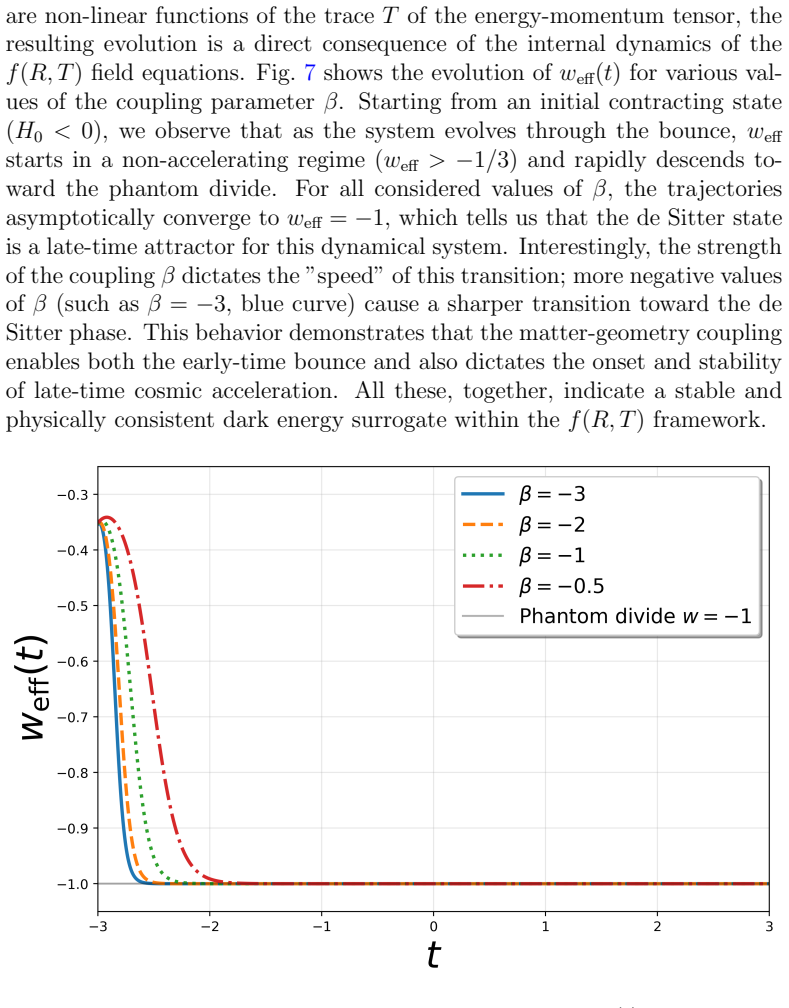
For β < 0 the quadratic term βT² in the f(R,T) action produces a density-dependent geometric repulsion through the matter-geometry coupling. This repulsion is strong enough at high densities to violate the null energy condition, permitting a non-singular bounce. The result is obtained both by assuming a symmetric scale factor to reconstruct the dynamics and by studying the autonomous system of equations; in both cases the effective equation of state approaches -1 at late times and the squared speed of sound satisfies 0 ≤ c_s² ≤ 1.
What carries the argument
The βT² term in the Myrzakulov-type f(R,T) Lagrangian, which couples the trace of the energy-momentum tensor to the geometry and induces a repulsive contribution that grows with density.
If this is right
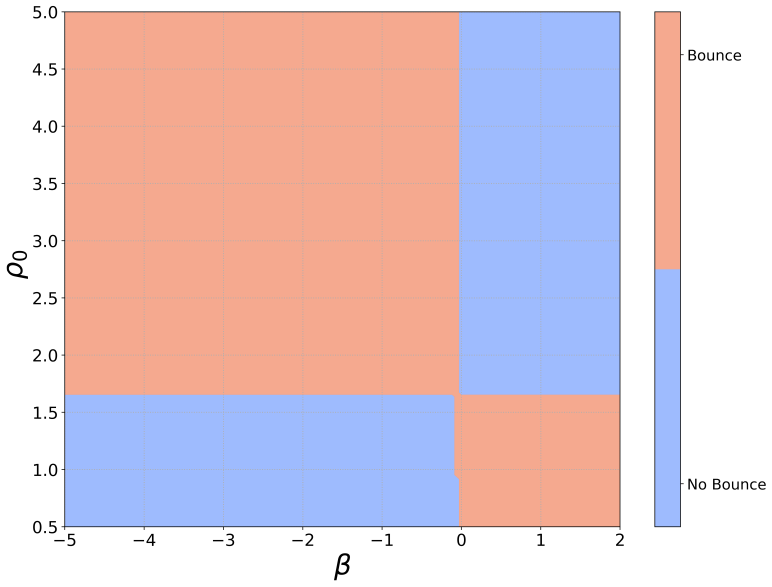
- The bounce is triggered only above a critical density set by the pair (β, ρ₀); below this threshold the evolution reduces to a singular general-relativity trajectory.
- The effective equation of state asymptotically reaches the de Sitter value w_eff = -1.
- The squared speed of sound remains inside the interval [0,1], preserving both stability and causality.
- The early-universe bounce is achieved without any exotic matter fields.
Where Pith is reading between the lines
- The same trace-coupling mechanism could be examined in other f(R,T) or f(R,G) models to see whether it generically resolves singularities.
- The critical density threshold might be compared with Planck-scale cutoffs to test whether classical geometry can supplant quantum-gravity effects near the bounce.
- Signatures of the bounce phase, such as modifications to the primordial power spectrum, could be searched for in future cosmological data.
Load-bearing premise
The symmetric scale factor ansatz together with the Chaplygin gas equation of state is assumed to capture the dominant early-universe physics.
What would settle it
A numerical integration of the Friedmann equations or an explicit calculation of the null energy condition showing that violation fails to occur for any β < 0 in the high-density regime, or that no bounce develops below the claimed critical density.
Figures




read the original abstract
This study investigates the non-singular bounce within the framework of Myrzakulov-type $f(R,T) = R + \alpha T + \beta T^2$ gravity by adopting a Chaplygin gas equation of state. We employ two methodologies: a reconstruction scheme via a symmetric scale factor ansatz (Model I) and an autonomous dynamical system analysis (Model II). Our results indicate that the quadratic trace parameter $\beta$ acts as a primary physical driver; specifically, for $\beta < 0$, the matter-geometry coupling generates sufficient geometric repulsion to effectively violate the Null Energy Condition (NEC) at high densities without the requirement of exotic matter fields. A numerical scan of the $(\beta, \rho_0)$ parameter space indicates a critical density threshold required to initiate the bounce, below which the Universe follows a singular General Relativity trajectory. The models are shown to be physically viable, with the effective equation of state asymptotically approaching a de Sitter attractor ($w_{\text{eff}} \to -1$) and the squared speed of sound remaining within the stability and causality bounds ($0 \le c_s^2 \le 1$). This study shows that the $f(R,T)$ framework provides a stable, classically geometric alternative to the Big Bang singularity, consistent with both early-universe requirements and late-time accelerated expansion.
Editorial analysis
A structured set of objections, weighed in public.
Referee Report
Summary. The paper examines non-singular bounces in Myrzakulov-type f(R,T) = R + αT + βT² gravity coupled to a Chaplygin gas. It employs a reconstruction approach with a symmetric scale factor ansatz (Model I) and an autonomous dynamical-systems analysis (Model II). The central results are that β < 0 produces geometric repulsion sufficient to violate the NEC at high densities without exotic matter, a critical density threshold exists below which GR-like singularities occur, and the models are stable with w_eff → -1 and 0 ≤ c_s² ≤ 1.
Significance. If the dynamical-systems analysis establishes that bounce solutions (H=0, Ḣ>0 at finite ρ) are attractors for β<0 without presupposing the symmetric ansatz, the work would supply a concrete geometric mechanism for avoiding the Big Bang singularity while remaining consistent with late-time acceleration. The dual methodology (reconstruction plus phase space) and explicit stability checks are strengths; the parameter scan supplies falsifiable conditions on (β, ρ0).
major comments (3)
- [§3] §3 (Model I reconstruction): The symmetric scale factor ansatz a(t) = a_b + c t² + higher even powers enforces H=0 and ä(0)>0 at t=0 by construction. Solving the modified Friedmann equations for β and the Chaplygin parameters then matches this pre-chosen trajectory but does not demonstrate that the β T² term dynamically generates repulsion for generic initial data. This makes the abstract claim that the coupling 'generates sufficient geometric repulsion' dependent on the ansatz rather than an independent consequence of the field equations.
- [§4] §4 (Model II autonomous system): The phase-space analysis reports bounce fixed points and attractors for β<0, yet the manuscript does not display the explicit autonomous equations for the dimensionless variables or the Jacobian matrix used for stability classification. Without these derivations it is impossible to verify that the reported attractors exist independently of the ansatz-derived initial conditions or that the NEC violation arises solely from the β term.
- [§5] §5 (numerical scan): The critical density threshold is identified by scanning (β, ρ0), but the ranges, sampling method, and fixing of the Chaplygin parameter A are not stated. Consequently the threshold appears conditioned on parameter choices chosen to realize the bounce rather than emerging as a robust prediction from the equations.
minor comments (3)
- [§1] The original Myrzakulov reference for the f(R,T) form is not cited in the introduction.
- [§5] The explicit expression for the squared sound speed c_s² in terms of β, ρ, and the Chaplygin parameters is omitted from the stability discussion.
- Figure captions for the phase portraits and w_eff plots lack labels for axis variables and trajectory styles.
Simulated Author's Rebuttal
We thank the referee for the careful reading and constructive comments on our manuscript. We address each major point below and will revise the manuscript to improve clarity, provide missing derivations, and specify parameter details.
read point-by-point responses
-
Referee: [§3] §3 (Model I reconstruction): The symmetric scale factor ansatz a(t) = a_b + c t² + higher even powers enforces H=0 and ä(0)>0 at t=0 by construction. Solving the modified Friedmann equations for β and the Chaplygin parameters then matches this pre-chosen trajectory but does not demonstrate that the β T² term dynamically generates repulsion for generic initial data. This makes the abstract claim that the coupling 'generates sufficient geometric repulsion' dependent on the ansatz rather than an independent consequence of the field equations.
Authors: We acknowledge that the symmetric ansatz in Model I is constructed to enable reconstruction of a bounce trajectory and therefore enforces the required conditions at t=0. This is a standard feature of reconstruction techniques used to identify viable parameter regimes. The claim of geometric repulsion for β < 0 is supported by the explicit solutions obtained from the modified Friedmann equations, but we agree that independence from the ansatz requires the dynamical-systems treatment. Model II addresses this by identifying bounce fixed points as attractors without presupposing the scale-factor form. In the revision we will add a clarifying paragraph in §3 distinguishing the illustrative role of Model I from the dynamical evidence in Model II. revision: partial
-
Referee: [§4] §4 (Model II autonomous system): The phase-space analysis reports bounce fixed points and attractors for β<0, yet the manuscript does not display the explicit autonomous equations for the dimensionless variables or the Jacobian matrix used for stability classification. Without these derivations it is impossible to verify that the reported attractors exist independently of the ansatz-derived initial conditions or that the NEC violation arises solely from the β term.
Authors: We agree that the explicit autonomous equations and Jacobian are necessary for independent verification. These derivations were performed during the analysis but omitted from the submitted text for brevity. In the revised manuscript we will insert the full set of dimensionless variables (including the definitions of x, y, z, etc.), the complete autonomous system, and the Jacobian matrix evaluated at the fixed points, together with the eigenvalues used for stability classification. This addition will confirm that the attractors and NEC violation are properties of the field equations for β < 0 and are independent of the Model I ansatz. revision: yes
-
Referee: [§5] §5 (numerical scan): The critical density threshold is identified by scanning (β, ρ0), but the ranges, sampling method, and fixing of the Chaplygin parameter A are not stated. Consequently the threshold appears conditioned on parameter choices chosen to realize the bounce rather than emerging as a robust prediction from the equations.
Authors: We thank the referee for highlighting this omission. The numerical scan was performed over a uniform grid in the (β, ρ0) plane with β ranging from -10 to 0 and ρ0 from 0.1 to 10 (in Planck units), while A was fixed to the value 0.1 consistent with late-time acceleration constraints. In the revised §5 we will explicitly state these ranges, describe the uniform-grid sampling method, and document the choice of A. This will show that the critical density threshold is a robust outcome of the equations whenever β < 0. revision: yes
Circularity Check
Symmetric scale factor ansatz in Model I presupposes the bounce; β<0 NEC violation and critical density emerge only after fitting parameters to the pre-chosen trajectory.
specific steps
-
fitted input called prediction
[Abstract (Model I reconstruction and numerical scan)]
"We employ two methodologies: a reconstruction scheme via a symmetric scale factor ansatz (Model I) ... A numerical scan of the (β, ρ0) parameter space indicates a critical density threshold required to initiate the bounce, below which the Universe follows a singular General Relativity trajectory. ... for β < 0, the matter-geometry coupling generates sufficient geometric repulsion to effectively violate the Null Energy Condition (NEC) at high densities without the requirement of exotic matter fields."
The symmetric ansatz directly imposes the bounce (minimum scale factor, positive second derivative at t=0). The paper then scans β and ρ0 to produce a matching trajectory and the critical density value at which bounce occurs. The claimed NEC violation and repulsion for β<0 are therefore outputs of this parameter choice conditioned on the ansatz, not predictions derived from generic solutions of the modified Friedmann equations.
full rationale
The paper's central claim that β<0 generates geometric repulsion to violate NEC without exotic matter is demonstrated via Model I reconstruction, which adopts a symmetric scale factor ansatz that enforces a minimum a(t) and ä(0)>0 by construction, then scans (β, ρ0) to match and identify the threshold. This makes the reported behavior a consistency check on fitted inputs rather than an independent derivation from the field equations. Model II autonomous analysis is invoked but does not remove the load-bearing role of the ansatz-based scan for the strongest claim. No self-citations or external uniqueness theorems are load-bearing here; the circularity is internal to the reconstruction methodology.
Axiom & Free-Parameter Ledger
free parameters (2)
- β
- ρ0
axioms (2)
- domain assumption FLRW metric governs the background cosmology
- domain assumption Chaplygin gas equation of state p = -A/ρ
Reference graph
Works this paper leans on
-
[1]
Antonino Del Popolo and Morgan Le Delliou. Small scale problems of theλcdm model: a short review.Galaxies, 5(1):17, 2017. doi: 10.3390/galaxies5010017
-
[3]
Λ CDM is alive and well.arXiv preprint arXiv:2205.05017, 2022
Alain Blanchard, Jean-Yves H´ eloret, St´ ephane Ili´ c, Brahim Lamine, and Isaac Tutusaus. Λ CDM is alive and well.arXiv preprint arXiv:2205.05017, 2022. doi: 10.48550/arXiv.2205.05017
-
[4]
Big bang? a critical review.Journal of Cosmology, 6(11):1533–47, 2010
Ashwini Kumar Lal and Rhawn Gabriel Joseph. Big bang? a critical review.Journal of Cosmology, 6(11):1533–47, 2010
2010
-
[5]
The singularities of gravitational collapse and cosmology.Proceedings of the Royal Society of London
Stephen William Hawking and Roger Penrose. The singularities of gravitational collapse and cosmology.Proceedings of the Royal Society of London. A. Mathematical and Physical Sciences, 314(1519):529–548,
-
[6]
doi: 10.1098/rspa.1970.0021
-
[7]
Ali H Chamseddine and Viatcheslav Mukhanov. Resolving cosmologi- cal singularities.Journal of Cosmology and Astroparticle Physics, 2017 (03):009–009, 2017. doi: 10.1088/1475-7516/2017/03/009
-
[8]
Bouncing cosmologies.Physics reports, 463(4):127–213, 2008
Mario Novello and SE Perez Bergliaffa. Bouncing cosmologies.Physics reports, 463(4):127–213, 2008. doi: 10.1016/j.physrep.2008.04.006. 30
-
[9]
The raychaudhuri equations: A brief review.Pramana, 69(1):49–76, 2007
Sayan Kar and Soumitra Sengupta. The raychaudhuri equations: A brief review.Pramana, 69(1):49–76, 2007. doi: 10.1007/ s12043-007-0110-9
2007
-
[10]
M Libanov, S Mironov, and V Rubakov. Generalized galileons: instabil- ities of bouncing and genesis cosmologies and modified genesis.Journal of Cosmology and Astroparticle Physics, 2016(08):037–037, 2016. doi: 10.1088/1475-7516/2016/08/037
-
[11]
S Mironov and V Volkova. Non-singular cosmological scenarios in scalar-tensor theories and their stability: a review.arXiv preprint arXiv:2409.16108, 2024. doi: 10.48550/arXiv.2409.16108
-
[12]
Francesco Bajardi, Daniele Vernieri, and Salvatore Capozziello. Bounc- ing cosmology in f (q) symmetric teleparallel gravity.The Euro- pean Physical Journal Plus, 135(11):912, 2020. doi: 10.1140/epjp/ s13360-020-00918-3
-
[13]
Bouncing cosmology in fourth-order gravity.Universe, 8(3):161, 2022
Marcello Miranda, Daniele Vernieri, Salvatore Capozziello, and Fran- cisco SN Lobo. Bouncing cosmology in fourth-order gravity.Universe, 8(3):161, 2022. doi: 10.3390/universe8030161
-
[14]
Riccardo Moriconi, Giovanni Montani, and Salvatore Capozziello. Big-bounce cosmology from quantum gravity: The case of a cycli- cal bianchi i universe.Physical Review D, 94(2):023519, 2016. doi: 10.1103/PhysRevD.94.023519
-
[15]
Bouncing cosmology with future singularity from modified gravity.Physical Review D, 92(2):024016,
SD Odintsov and VK Oikonomou. Bouncing cosmology with future singularity from modified gravity.Physical Review D, 92(2):024016,
-
[16]
doi: 10.1103/PhysRevD.92.024016
-
[17]
Matter bounce loop quantum cos- mology from f (r) gravity.Physical Review D, 90(12):124083, 2014
SD Odintsov and VK Oikonomou. Matter bounce loop quantum cos- mology from f (r) gravity.Physical Review D, 90(12):124083, 2014. doi: 10.1103/PhysRevD.90.124083
-
[18]
Bounce universe with finite-time singularity.Universe, 8(5):292, 2022
Sergei D Odintsov and Tanmoy Paul. Bounce universe with finite-time singularity.Universe, 8(5):292, 2022. doi: 10.3390/universe8050292
-
[19]
Realization of bounce in a modified gravity framework and information theoretic approach 31 to the bouncing point.Universe, 9(3):136, 2023
Sanghati Saha and Surajit Chattopadhyay. Realization of bounce in a modified gravity framework and information theoretic approach 31 to the bouncing point.Universe, 9(3):136, 2023. doi: 10.3390/ universe9030136
2023
-
[20]
Surajit Chattopadhyay. Cosmological bounce in a modified gravity framework.Astronomische Nachrichten, 344(1-2):e220103, 2023. doi: 10.1002/asna.20220103
-
[21]
f (r) theories of grav- ity.Reviews of Modern Physics, 82(1):451–497, 2010
Thomas P Sotiriou and Valerio Faraoni. f (r) theories of grav- ity.Reviews of Modern Physics, 82(1):451–497, 2010. doi: 10.1103/ RevModPhys.82.451
2010
-
[22]
Orfeu Bertolami and J P´ aramos. Do f (r) theories matter?Physi- cal Review D—Particles, Fields, Gravitation, and Cosmology, 77(8): 084018, 2008. doi: 10.1103/PhysRevD.77.084018
-
[23]
Salvatore Capozziello, Christian Corda, and Maria Felicia De Lauren- tis. Massive gravitational waves from f (r) theories of gravity: Poten- tial detection with lisa.Physics Letters B, 669(5):255–259, 2008. doi: 10.1016/j.physletb.2008.10.001
-
[24]
Cosmography in f (t) gravity.Physical Review D—Particles, Fields, Gravitation, and Cosmology, 84(4):043527, 2011
Salvatore Capozziello, VF Cardone, H Farajollahi, and A Ravan- pak. Cosmography in f (t) gravity.Physical Review D—Particles, Fields, Gravitation, and Cosmology, 84(4):043527, 2011. doi: 10.1103/ PhysRevD.84.043527
2011
-
[25]
Andronikos Paliathanasis, John D Barrow, and PGL Leach. Cosmolog- ical solutions of f (t) gravity.Physical Review D, 94(2):023525, 2016. doi: 10.1103/PhysRevD.94.023525
-
[26]
f (t) gravity after gw170817 and grb170817a.Physical Review D, 97(10): 103513, 2018
Yi-Fu Cai, Chunlong Li, Emmanuel N Saridakis, and Ling-Qin Xue. f (t) gravity after gw170817 and grb170817a.Physical Review D, 97(10): 103513, 2018. doi: 10.1103/PhysRevD.97.103513
-
[28]
Tiberiu Harko, Francisco SN Lobo, Shin’ichi Nojiri, and Sergei D Odintsov. f (R, T) gravity.Physical Review D—Particles, Fields, Grav- itation, and Cosmology, 84(2):024020, 2011. doi: 10.1103/PhysRevD. 84.024020. 32
-
[29]
Hamid Shabani and Mehrdad Farhoudi. Cosmological and solar system consequences of f (r, t) gravity models.Physical Review D, 90(4): 044031, 2014. doi: 10.1103/PhysRevD.90.044031
-
[30]
M Sharif and Z Yousaf. Dynamical analysis of self-gravitating stars in f (r, t) gravity.Astrophysics and space science, 354(2):471–479, 2014. doi: 10.1007/s10509-014-2113-6
-
[32]
Gravastars inf(R, T) gravity.Physical Review D, 95 (12):124011, 2017
Amit Das, Shounak Ghosh, BK Guha, Swapan Das, Farook Rahaman, and Saibal Ray. Gravastars inf(R, T) gravity.Physical Review D, 95 (12):124011, 2017. doi: 10.1103/PhysRevD.95.124011
-
[33]
f(R, T) gravity
Jos´ e Barrientos O and Guillermo F Rubilar. Comment on “f(R, T) gravity”.Physical Review D, 90(2):028501, 2014. doi: 10.1103/ PhysRevD.90.028501
2014
-
[34]
F. G. Alvarenga, M. J. S. Houndjo, A. V. Monwanou, and J. B. Chabi Orou. Testing some f(r,t) gravity models from energy conditions.Jour- nal of Modern Physics, 4(1):130–139, jan 2013. doi: 10.4236/jmp.2013. 41019. URLhttps://doi.org/10.4236/jmp.2013.41019
-
[35]
M Sharif, S Rani, and R Myrzakulov. Analysis off(R, T) gravity models through energy conditions.The European Physical Journal Plus, 128(10):123, 2013. doi: 10.1140/epjp/i2013-13123-0
-
[36]
Sarah B Fisher and Eric D Carlson. Reexaminingf(R, T) gravity. Physical Review D, 100(6):064059, 2019. doi: 10.1103/PhysRevD.100. 064059
-
[37]
FG Alvarenga, A De La Cruz-Dombriz, MJS Houndjo, ME Rodrigues, and Diego S´ aez-G´ omez. Dynamics of scalar perturbations inf(R, T) gravity.Physical Review D—Particles, Fields, Gravitation, and Cos- mology, 87(10):103526, 2013. doi: 10.1103/PhysRevD.87.103526
-
[38]
Debabrata Deb, Farook Rahaman, Saibal Ray, and BK Guha. Strange stars inf(R, T) gravity.Journal of Cosmology and Astroparticle 33 Physics, 2018(03):044–044, 2018. doi: 10.1088/1475-7516/2018/03/ 044
-
[39]
Metric-affine myrzakulov gravity and its gen- eralizations.arXiv preprint arXiv:1205.5266, 2012
Ratbay Myrzakulov. Metric-affine myrzakulov gravity and its gen- eralizations.arXiv preprint arXiv:1205.5266, 2012. URLhttps: //doi.org/10.48550/arXiv.1205.5266
-
[40]
Metric-affine myrzakulov gravity theories.Symmetry, 13(10):1855, 2021
Nurgissa Myrzakulov, Ratbay Myrzakulov, and Lucrezia Ravera. Metric-affine myrzakulov gravity theories.Symmetry, 13(10):1855, 2021
2021
-
[41]
Metric-affine myrzakulov gravity theories: models, applications and theoretical developments
Davood Momeni and Ratbay Myrzakulov. Metric-affine myrzakulov gravity theories: models, applications and theoretical developments. International Journal of Theoretical Physics, 64(4):95, 2025
2025
-
[42]
Myrzakulov gravity in viel- bein formalism: A study in weitzenb¨ ock spacetime.Nuclear Physics B, 1015:116903, 2025
Davood Momeni and Ratbay Myrzakulov. Myrzakulov gravity in viel- bein formalism: A study in weitzenb¨ ock spacetime.Nuclear Physics B, 1015:116903, 2025
2025
-
[43]
Toward the alleviation of the h 0 tension in myrza- kulov f (r, t) gravity.Universe, 11(8):252, 2025
Mashael A Aljohani, Emad E Mahmoud, Koblandy Yerzhanov, and Almira Sergazina. Toward the alleviation of the h 0 tension in myrza- kulov f (r, t) gravity.Universe, 11(8):252, 2025
2025
-
[44]
Viable constraints on some myrzakulov f (r, t, q, t) models to study baryon asymmetry.Chinese Journal of Physics, 84:471–485, 2023
R Saleem and Aqsa Saleem. Viable constraints on some myrzakulov f (r, t, q, t) models to study baryon asymmetry.Chinese Journal of Physics, 84:471–485, 2023
2023
-
[45]
Davood Momeni and Ratbay Myrzakulov. Myrzakulov gravity in viel- bein formalism: A study in weitzenb¨ ock spacetime.Nuclear Physics B, 1015:116903, 2025. ISSN 0550-3213. doi: https://doi.org/10. 1016/j.nuclphysb.2025.116903. URLhttps://www.sciencedirect. com/science/article/pii/S0550321325001129
-
[46]
Wald entropy in extended modified myrzakulov gravity theories.International Journal of Theo- retical Physics, 64(10):268, 2025
Davood Momeni and Ratbay Myrzakulov. Wald entropy in extended modified myrzakulov gravity theories.International Journal of Theo- retical Physics, 64(10):268, 2025
2025
-
[47]
Che-Yu Chen, Mariam Bouhmadi-L´ opez, and Pisin Chen. Black hole solutions in mimetic born-infeld gravity.The European Physi- cal Journal C, 78(1), January 2018. ISSN 1434-6052. doi: 10.1140/ 34 epjc/s10052-018-5556-z. URLhttp://dx.doi.org/10.1140/epjc/ s10052-018-5556-z
-
[48]
Metric-affine vector–tensor corre- spondence and implications in f (r, t, q, t, d) gravity.Physics of the Dark Universe, 37:101094, 2022
Damianos Iosifidis, Ratbay Myrzakulov, Lucrezia Ravera, Gulmira Yer- galiyeva, and Koblandy Yerzhanov. Metric-affine vector–tensor corre- spondence and implications in f (r, t, q, t, d) gravity.Physics of the Dark Universe, 37:101094, 2022
2022
-
[49]
T Myrzakul, K Yesmakhanova, N Myrzakulov, S Myrzakul, K Myrza- kulov, K Yerzhanov, R Myrzakulov, and G Nugmanova. Metric-affine myrzakulov gravity theories with gauss-bonnet and boundary term scalars.arXiv preprint arXiv:2101.05318, 2021
-
[50]
Cosmological reconstruc- tions in einstein–cartan–myrzakulov gravity with torsion and non- metricity in the weitzenb¨ ock geometrical sector.Nuclear Physics B, page 117060, 2025
Davood Momeni and Ratbay Myrzakulov. Cosmological reconstruc- tions in einstein–cartan–myrzakulov gravity with torsion and non- metricity in the weitzenb¨ ock geometrical sector.Nuclear Physics B, page 117060, 2025
2025
-
[51]
Einstein–gauss–bonnet– myrzakulov gravity from r+ f (t, g): Numerical insights and torsion– gauss–bonnet dynamics in weitzenb¨ ock spacetime.Nuclear Physics B, 1017:116966, 2025
Davood Momeni and Ratbay Myrzakulov. Einstein–gauss–bonnet– myrzakulov gravity from r+ f (t, g): Numerical insights and torsion– gauss–bonnet dynamics in weitzenb¨ ock spacetime.Nuclear Physics B, 1017:116966, 2025
2025
-
[52]
Observational constraints on myrzakulov gravity.Physical Re- view D, 103(10):104013, 2021
Fotios K Anagnostopoulos, Spyros Basilakos, and Emmanuel N Sari- dakis. Observational constraints on myrzakulov gravity.Physical Re- view D, 103(10):104013, 2021
2021
-
[53]
Cosmological study in myrzakulov f (r, t) quasi-dilaton massive gravity.Astroparticle Physics, 165:103060, 2025
Sobhan Kazempour and Amin Rezaei Akbarieh. Cosmological study in myrzakulov f (r, t) quasi-dilaton massive gravity.Astroparticle Physics, 165:103060, 2025
2025
-
[54]
Dark matter constraints in myrzakulov f (r, t) gravity: a vielbein approach in weitzenb¨ ock space- time with observational data.Nuclear Physics B, page 117042, 2025
Davood Momeni and Ratbay Myrzakulov. Dark matter constraints in myrzakulov f (r, t) gravity: a vielbein approach in weitzenb¨ ock space- time with observational data.Nuclear Physics B, page 117042, 2025
2025
-
[55]
Dynamical system analysis of myrzakulov gravity.Physical Review D, 106(10):103512, 2022
G Papagiannopoulos, Spyros Basilakos, and Emmanuel N Saridakis. Dynamical system analysis of myrzakulov gravity.Physical Review D, 106(10):103512, 2022
2022
-
[56]
Cosmological applications of f (r, t) gravity with 35 dynamical curvature and torsion.Physical Review D, 102(2):023525, 2020
Emmanuel N Saridakis, Shynaray Myrzakul, Kairat Myrzakulov, and Koblandy Yerzhanov. Cosmological applications of f (r, t) gravity with 35 dynamical curvature and torsion.Physical Review D, 102(2):023525, 2020
2020
-
[57]
Exact cosmology in myrzakulov gravity.arXiv preprint arXiv:2402.02123, 2024
Dinesh Chandra Maurya and Ratbay Myrzakulov. Exact cosmology in myrzakulov gravity.arXiv preprint arXiv:2402.02123, 2024
-
[58]
Transit cosmological models in f (r, t) gravity theory.The European Physical Journal C, 84 (5):534, 2024
Dinesh Chandra Maurya and Ratbay Myrzakulov. Transit cosmological models in f (r, t) gravity theory.The European Physical Journal C, 84 (5):534, 2024
2024
-
[59]
Flrw cosmology in metric-affine f (r, q) gravity.Chinese Physics C, 48(12):125101, 2024
Dinesh Chandra Maurya, K Yesmakhanova, R Myrzakulov, and G Nugmanova. Flrw cosmology in metric-affine f (r, q) gravity.Chinese Physics C, 48(12):125101, 2024
2024
-
[60]
Metric-affine f (t, q) gravity: cosmological implications and constraints.Physica Scripta, 99(10):105014, 2024
Dinesh Chandra Maurya, K Yesmakhanova, R Myrzakulov, and G Nugmanova. Metric-affine f (t, q) gravity: cosmological implications and constraints.Physica Scripta, 99(10):105014, 2024
2024
-
[61]
Inflation in myrzakulov f (r, t) gravity: a comparative study in metric, symmetric teleparallel, and weitzenb¨ ock formalisms.Nuclear Physics B, page 117022, 2025
Davood Momeni and Ratbay Myrzakulov. Inflation in myrzakulov f (r, t) gravity: a comparative study in metric, symmetric teleparallel, and weitzenb¨ ock formalisms.Nuclear Physics B, page 117022, 2025
2025
-
[62]
Cor- respondence between myrzakulovf(r, q) gravity and tsallis cosmology
Andreas Lymperis, Gulgassyl Nugmanova, and Almira Sergazina. Cor- respondence between myrzakulovf(r, q) gravity and tsallis cosmology. arXiv preprint arXiv:2502.04462, 2025
-
[63]
The late-time dark matter distribution in mg-i formalism with thermo- dynamic analysis.Fortschritte der Physik, 74(1):e70069, 2026
Shaily, Mohit Tyagi, Jainendra Kumar Singh, and Joao RL Santos. The late-time dark matter distribution in mg-i formalism with thermo- dynamic analysis.Fortschritte der Physik, 74(1):e70069, 2026
2026
-
[64]
Laurent ¸iu Bubuianu, Sergiu I Vacaru, El¸ sen Veli Veliev, and Assel Zhamysheva. Dark energy and dark matter configurations for worm- holes and solitionic hierarchies of nonmetric ricci flows and f (r, t, q, t m) gravity.The European Physical Journal C, 84(2):211, 2024
2024
-
[65]
Exploring hybrid scalar factor and ekpyrotic bouncing cosmology in f (q, r) gravity.High Energy Density Physics, 55:101188, 2025
Aimen Rauf, Bander Almutairi, and AS Khan. Exploring hybrid scalar factor and ekpyrotic bouncing cosmology in f (q, r) gravity.High Energy Density Physics, 55:101188, 2025
2025
-
[66]
Dinesh Chandra Maurya and Harjit Kumar. Quintom-like transit uni- verse models in metric-affine myrzakulovf(r, t, q, t m) gravity.arXiv preprint arXiv:2508.01770, 2025. 36
-
[67]
Non- singular bounce solutions in myrzakulovf(r, t) gravity, 2025
Andreas Lymperis, Gulgassyl Nugmanova, and Almira Sergazina. Non- singular bounce solutions in myrzakulovf(r, t) gravity, 2025. URL https://arxiv.org/abs/2501.18524
-
[68]
Flrw cosmology with horava- lifshitz gravity: Impacts of equations of state.International Journal of Theoretical Physics, 56(7):2122–2139, 2017
Abdel Tawfik and E Abou El Dahab. Flrw cosmology with horava- lifshitz gravity: Impacts of equations of state.International Journal of Theoretical Physics, 56(7):2122–2139, 2017
2017
-
[69]
M. C. Bento, O. Bertolami, and A. A. Sen. Generalized chaplygin gas, accelerated expansion, and dark-energy-matter unification.Phys. Rev. D, 66(4):043507, 2002
2002
-
[70]
M. C. Bento, O. Bertolami, and A. A. Sen. Generalized chaplygin gas and cosmic microwave background radiation constraints.Phys. Rev. D, 67(6):063003, 2003
2003
-
[71]
M. C. Bento, O. Bertolami, and A. A. Sen. Generalized chaplygin gas model: dark energy–dark matter unification and cmbr constraints. Gen. Relativ. Gravit., 35(11):2063–2069, 2003
2063
-
[72]
Kamenshchik, U
A. Kamenshchik, U. Moschella, and V. Pasquier. Chaplygin-like gas and branes in black hole bulks.Phys. Lett. B, 487(1-2):7–13, 2000
2000
-
[73]
P. H. R. S. Moraes, G. Ribeiro, and R. A. C. Correa. A transition from a decelerated to an accelerated phase of the universe expansion from the simplest non-trivial polynomial function oftin thef(r, t) formalism.Astrophysics and Space Science, 361(7):227, jun 2016. ISSN 1572-946X. doi: 10.1007/s10509-016-2788-y. URLhttps://doi.org/ 10.1007/s10509-016-2788-y
-
[74]
Can the chaplygin gas be a plausible model for dark energy?Physical Review D, 67(6):063509, 2003
Vittorio Gorini, Alexander Kamenshchik, and Ugo Moschella. Can the chaplygin gas be a plausible model for dark energy?Physical Review D, 67(6):063509, 2003
2003
-
[75]
A primer on energy conditions
Erik Curiel. A primer on energy conditions. InTowards a theory of spacetime theories, pages 43–104. Springer, 2017
2017
-
[76]
Energy conditions in modified gravity.Physics Letters B, 730:280–283, 2014
Salvatore Capozziello, Francisco SN Lobo, and Jos´ e P Mimoso. Energy conditions in modified gravity.Physics Letters B, 730:280–283, 2014. 37
2014
-
[77]
The effective speed of sound in cosmological perturbation the- ory
Sanil Unnikrishnan. The effective speed of sound in cosmological per- turbation theory.arXiv preprint arXiv:2411.07045, 2024
-
[78]
Theory of cosmological perturbations.Physics reports, 215 (5-6):203–333, 1992
Viatcheslav F Mukhanov, Hume A Feldman, and Robert Hans Bran- denberger. Theory of cosmological perturbations.Physics reports, 215 (5-6):203–333, 1992
1992
-
[79]
Hadronic equation of state and speed of sound in thermal and dense medium.International Journal of Modern Physics A, 29(27):1450152, 2014
Abdel Nasser Tawfik and H Magdy. Hadronic equation of state and speed of sound in thermal and dense medium.International Journal of Modern Physics A, 29(27):1450152, 2014
2014
-
[80]
Hadronic equation of state and speed of sound in thermal and dense medium.International Journal of Modern Physics A, 29(27):1450152, 2014
Abdel Nasser Tawfik and Hend Magdy. Hadronic equation of state and speed of sound in thermal and dense medium.International Journal of Modern Physics A, 29(27):1450152, 2014
2014
-
[81]
Radau methods, 2015
Ernst Hairer and Gerhard Wanner. Radau methods, 2015
2015
-
[82]
Loop quantum cosmology gravita- tional baryogenesis.Europhysics Letters, 116(4):49001, 2016
SD Odintsov and VK Oikonomou. Loop quantum cosmology gravita- tional baryogenesis.Europhysics Letters, 116(4):49001, 2016
2016
-
[83]
Effective actions for loop quantum cosmology in fourth- order gravity.The European Physical Journal C, 81(11):975, 2021
Marcello Miranda, Daniele Vernieri, Salvatore Capozziello, and Fran- cisco SN Lobo. Effective actions for loop quantum cosmology in fourth- order gravity.The European Physical Journal C, 81(11):975, 2021
2021
discussion (0)
Sign in with ORCID, Apple, or X to comment. Anyone can read and Pith papers without signing in.