Recognition: unknown
Collisionless Phase Mixing Mimics Diffusive Transport in Radiation Belt Observations
Pith reviewed 2026-05-08 13:41 UTC · model grok-4.3
The pith
Radiation belt observations can look diffusive even when particles follow purely collisionless paths, because spacecraft sampling mixes drift phases into decorrelating signals.
A machine-rendered reading of the paper's core claim, the machinery that carries it, and where it could break.
Core claim
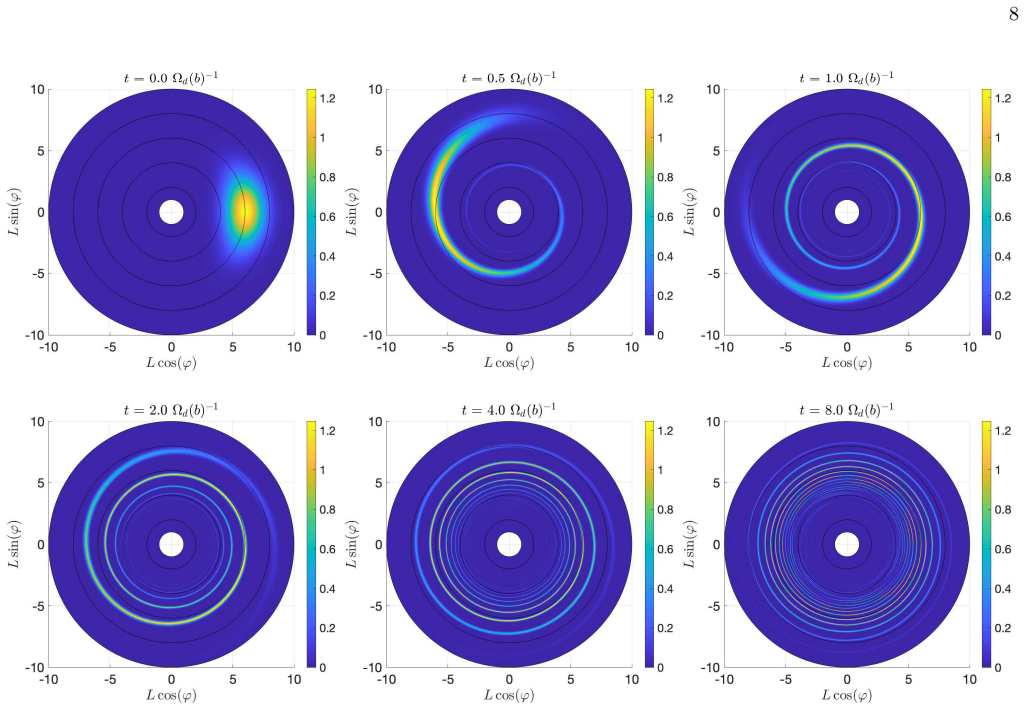
Spatially localized drift-phase structures evolving under collisionless dynamics are converted by spacecraft sampling of neighboring drift shells into rapidly decorrelating temporal signals whose effective lifetimes last only a few drift periods, rendering the observations indistinguishable from diffusive transport independent of any stochastic wave-particle interactions.
What carries the argument
The observational phase-mixing effect, in which spacecraft sampling of neighboring drift shells converts spatially localized drift-phase structures into decorrelating temporal signals as particles undergo electromagnetic drifts.
If this is right
- Diffusion models fitted to radiation belt data may systematically misestimate transport rates and misidentify acceleration mechanisms.
- Fine-scale phase-space structures remain unresolvable with standard single-spacecraft measurements on timescales of a few drift periods.
- The mimicry applies equally to radiation belts at Earth, other solar system planets, and ultra-cool brown dwarfs.
- Existing interpretations of particle lifetimes and source locations drawn from flux time series require reassessment.
Where Pith is reading between the lines
- Multi-spacecraft constellations could separate the phase-mixing artifact from true diffusion by cross-correlating data across drift shells.
- The same sampling-induced decorrelation may bias transport inferences in other magnetized plasma environments that contain coherent structures.
- Correcting for this effect in analysis pipelines could tighten constraints on wave-particle interaction rates.
Load-bearing premise
Acceleration processes must produce phase-space structures that are sufficiently localized in space and coherent in drift phase for the spacecraft sampling geometry to turn them into decorrelating signals within a few drift periods.
What would settle it
Simultaneous observations from two or more spacecraft on adjacent drift shells that either recover the original localized structures when the sampling geometry is accounted for or show the apparent diffusion rate changing with spacecraft separation.
Figures



read the original abstract
Since the dawn of the space age, observations of energetic particles in planetary radiation belts have been interpreted within a diffusive transport framework, even though the processes that populate and deplete these belts produce highly structured and spatially localized distributions. This exposes a fundamental problem: how can coherent phase-space structures evolving under collisionless dynamics give rise to observational signatures that appear consistent with diffusion-based transport? Here we show that diffusion-like behaviour can arise from an observational phase-mixing effect, independent of stochastic wave-particle transport. As spacecraft sample neighbouring drift shells while particles undergo electromagnetic drifts, spatially localized drift-phase structures are converted into rapidly decorrelating temporal signals, making them observationally indistinguishable from stochastic processes. We show that the effective lifetime of these structures is only a few drift periods, preventing the resolution of fine-scale structure. These results demonstrate that collisionless dynamics can mimic diffusive transport on short timescales, limiting the inference of particle acceleration processes and biasing transport estimates. This calls for a reassessment of diffusion-based interpretations of radiation belts at Earth, across the solar system, and in the radiation belts of ultra-cool brown dwarfs.
Editorial analysis
A structured set of objections, weighed in public.
Referee Report
Summary. The paper claims that diffusion-like behaviour in radiation belt observations can arise from an observational phase-mixing effect, independent of stochastic wave-particle transport. As spacecraft sample neighbouring drift shells while particles undergo electromagnetic drifts, spatially localized drift-phase structures are converted into rapidly decorrelating temporal signals with an effective lifetime of only a few drift periods, making them observationally indistinguishable from diffusive processes and limiting inference of acceleration mechanisms.
Significance. If the central claim holds, the result would have broad implications for radiation-belt physics, indicating that many apparent diffusive signatures may be observational artifacts rather than evidence of stochastic transport. This would require reassessment of transport models and acceleration inferences for Earth, other solar-system bodies, and ultra-cool brown dwarfs, and would highlight the need to separate sampling effects from physical dynamics in data interpretation.
major comments (2)
- The assertion that the effective lifetime of the structures is 'only a few drift periods' is stated without a derivation or quantitative estimate. A calculation showing the decorrelation timescale as a function of structure radial width, drift-shell separation, and realistic spacecraft orbit parameters (e.g., Van Allen Probes or THEMIS) is required to support this load-bearing claim.
- The mechanism converts spatial localization into temporal decorrelation only if the phase-space structures have radial widths much smaller than the drift-shell separation sampled by the spacecraft orbit and remain phase-coherent over at least one drift period. No comparison is made to the spatial scales expected from typical acceleration processes such as chorus or ULF interactions.
minor comments (2)
- A schematic figure showing the spacecraft trajectory relative to drift shells and localized phase structures would clarify the sampling geometry.
- The abstract could briefly note the specific missions or data sets used to motivate or illustrate the effect.
Simulated Author's Rebuttal
We thank the referee for the careful reading of our manuscript and the insightful comments. We address the major comments point by point below, indicating where revisions will be made to the manuscript.
read point-by-point responses
-
Referee: The assertion that the effective lifetime of the structures is 'only a few drift periods' is stated without a derivation or quantitative estimate. A calculation showing the decorrelation timescale as a function of structure radial width, drift-shell separation, and realistic spacecraft orbit parameters (e.g., Van Allen Probes or THEMIS) is required to support this load-bearing claim.
Authors: We acknowledge that while the manuscript states the effective lifetime is a few drift periods, an explicit derivation is not provided in the main text. In the revised manuscript, we will add a quantitative calculation of the decorrelation timescale. This will express the timescale in terms of the structure's radial width, the radial separation between drift shells sampled by the spacecraft, and parameters such as the spacecraft's radial velocity and the particle drift period. For example, using Van Allen Probes orbital data, we will show that for structures with radial widths much less than the sampled shell separation, the decorrelation occurs within approximately 3-5 drift periods, thereby supporting the claim with specific estimates. revision: yes
-
Referee: The mechanism converts spatial localization into temporal decorrelation only if the phase-space structures have radial widths much smaller than the drift-shell separation sampled by the spacecraft orbit and remain phase-coherent over at least one drift period. No comparison is made to the spatial scales expected from typical acceleration processes such as chorus or ULF interactions.
Authors: The referee correctly notes the necessary conditions for the observational phase-mixing mechanism to produce decorrelating signals. The manuscript implicitly assumes structures that are radially localized on scales smaller than the drift-shell sampling interval and coherent over drift timescales. To address the absence of comparison, we will revise the manuscript to include a discussion of typical spatial scales from chorus and ULF wave interactions. Chorus-driven structures often have radial widths of order 0.01-0.1 L, while ULF interactions can produce larger scales. We will compare these to the drift-shell separations of ~0.02 L for Van Allen Probes, demonstrating that the condition is satisfied for many observed localized features, and discuss implications for when the effect may or may not apply. revision: yes
Circularity Check
No circularity; phase-mixing mechanism derived from sampling geometry
full rationale
The paper derives diffusion-like decorrelation from the geometric conversion of spatially localized drift-phase structures into temporal signals as spacecraft traverse neighboring drift shells. This follows directly from electromagnetic drift motion and orbital sampling without fitting parameters to data, without renaming known results, and without load-bearing self-citations that presuppose the target conclusion. The effective lifetime of a few drift periods emerges from the relative scales of structure width, drift period, and shell separation rather than being imposed by definition or prior author work. The argument is self-contained against external benchmarks of particle motion and spacecraft trajectories.
Axiom & Free-Parameter Ledger
axioms (2)
- domain assumption Particles undergo electromagnetic drifts along drift shells
- domain assumption Acceleration processes produce spatially localized, drift-phase-coherent structures
Reference graph
Works this paper leans on
-
[1]
Dipole magnetic field model We consider a centred magnetic dipole with magnetic moment M =BER3 E. In spherical coordinates ( r,θ,ϕ ), with colatitude θ and azimuthal angle ϕ , the field components are given by: Br = 2M cosθ r3 , B θ = M sinθ r3 , B ϕ = 0, (A1) and the magnetic field magnitude by B(r,θ ) = M r3 √ 1 + 3 cos2θ. (A2) From here, we switch to the ...
-
[2]
The Larmor frequency f or species s is Ωs = qsB γms , (A13) which includes the relativistic Lorentz factor γ = √ 1 + p2 ⊥ m2 sc2 + p2 ∥ m2 sc2
Guiding centre trajectories In this work, we use the relativistic guiding-centre equations, first derived by Vandervoort [ 112] (see also Northrop [11], Hazeltine [ 113], Cary and Brizard [ 13] and Son and Stephanov [ 114], especially the later for a short but elegant Hamiltonian derivation), to compute particle trajectories: ⟨ ˙r⟩φ ≃ v∥b + E × b B − v2 ∥ ...
-
[3]
In the absence of external sources and electric fields, these relations provide a closed drift-k inetic description of the system [ 42, 113, 116]
Drift-kinetic equation Equations ( A21, A28, A29, A35), together with the magnetic-field magnitude given by Equation ( A8), fully deter- mine the kinetic evolution of a collection of guiding centres in a dipolar ma gnetic field. In the absence of external sources and electric fields, these relations provide a closed drift-k inetic description of the system [...
-
[4]
Scale separation of bounce and drift motion Our objective is to quantify the evolution of drift-timescale struct ures in the distribution function. While we retain particles undergoing bounce motion away from the equator, we exp loit the widely disparate timescales of the bounce and drift motion to reduce the dimensionality of the drift-kinetic equ ation....
-
[5]
Bounce-averaged drift-kinetic equation We now present the procedure to remove the fast bounce motion b etween mirror points of any quantity Q, as ⟨Q⟩b = 1 τb ∫ τb 0 Q(t)dt, (A61) whereτb is the bounce period. Along a dipole field line one may equivalently write th e bounce average as an integral along the latitude λ as: ⟨Q⟩b = 4 τb ∫ λ m 0 Q(λ) 1 |v∥(λ)| d...
-
[6]
The first step is therefore to relate α (λ) to α eq along a bounce orbit, using Equation ( A69)
Bounce-averaged pitch-angle diffusion operator We seek the bounce average of the standard pitch-angle diffusion o perator [ 59] written in the local pitch angle α (λ), Lα [f ] = 1 sinα ∂ ∂α ( Dαα sinα ∂f ∂α ) , (B3) and we wish to express the resulting term as an operator acting on t he bounce-averaged distribution function written in terms of the equatoria...
-
[7]
Proof that pitch-angle diffusion cannot increase the effec tive lifetime of structures in drift phase In the computation of the correlation function in Section III, we found that drift-phase structures localized in MLT or in drift shells, or in both, exhibit an effective lifetime of only a few drift periods. Consequently, on such timescales pitch-angle diffus...
-
[8]
J. A. Van Allen, G. H. Ludwig, E. C. Ray, and C. E. McIlwain, Observation of high intensity radiation by satellites 1958 Alpha and Gamma, Journal of Jet Propulsion 28, 588 (1958)
1958
-
[9]
S. J. Bolton, M. Janssen, R. Thorne, S. Levin, M. Klein, S. Gulkis, T. Bastian, R. Sault, C. Elachi, M. Hofstadter, A. Bunker, G. Dulk, E. Gudim, G. Hamilton, W. T. K. Johnson, Y. Leblanc, O. Liepack, R. McLeod, J. Roller, L. Roth, and R. West, Ultra-relativistic electrons in Jupiter’s rad iation belts, Nature 415, 987 (2002)
2002
-
[10]
Kollmann, E
P. Kollmann, E. Roussos, A. Kotova, C. Paranicas, and N. K rupp, The evolution of Saturn’s radiation belts modulated by changes in radial diffusion, Nature Astronomy 1, 872 (2017)
2017
-
[11]
R. C. Allen, S. K. Vines, and G. C. Ho, Solving the mystery o f the electron radiation belt at Uranus: Leveraging knowledge of earth’s radiation belts in a re-examination of voyager 2 ob- servations, Geophysical Research Letters 52, e2025GL119311 (2025) , e2025GL119311 2025GL119311, https://agupubs.onlinelibrary.wiley.com/doi/pdf/10.1029/2025GL119311
-
[12]
Clark, P
G. Clark, P. Kollmann, B. H. Mauk, C. Paranicas, D. Hagger ty, A. Rymer, H. T. Smith, J. Saur, F. Allegrini, S. Duling, R. W. Ebert, W. S. Kurth, R. Gladstone, T. K. Greathouse, W. Li , F. Bagenal, J. E. P. Connerney, S. Bolton, J. R. Szalay, A. H. Sulaiman, C. J. Hansen, and D. L. Turner, Energe tic charged particle observations during Juno’s close flyby ...
2022
-
[13]
P. Kollmann, G. Clark, C. Paranicas, B. Mauk, D. Haggerty , A. Rymer, and F. Allegrini, Ganymede’s radiation cavity and radiation belts, Geophysical Research Letters 49, e2022GL098474 (2022) , e2022GL098474 2022GL098474, https://agupubs.onlinelibrary.wiley.com/doi/pdf/10.1029/2022GL098474. 40
-
[14]
M. M. Kao, A. J. Mioduszewski, J. Villadsen, and E. L. Shko lnik, Resolved imaging confirms a radiation belt around an ultracool dwarf, Nature 619, 272 (2023)
2023
-
[15]
J. B. Climent, J. C. Guirado, M. P´ erez-Torres, J. M. Marc aide, and L. Pe˜ na-Mo˜ nino, Evidence for a radiation belt around a brown dwarf, Science 381, 1120 (2023)
2023
-
[16]
P. J. Kellogg, Van Allen radiation of solar origin, Nature 183, 1295 (1959)
1959
-
[17]
Davis Jr
L. Davis Jr. and D. B. Chang, On the effect of geomagnetic fl uctuations on trapped particles, Journal of Geophysical Research (1896-1977) 67, 2169 (1962)
1977
-
[18]
T. G. Northrop, The adiabatic motion of charged particles , John Wiley & Sons, Vol. 21 (Interscience Publishers, New York–London–Sidney, 1963)
1963
-
[19]
T. J. Birmingham, T. G. Northrop, and C. F¨ althammar, Ch arged particle diffusion by violation of the third adiabatic invariant, The Physics of Fluids 10, 2389 (1967)
1967
-
[20]
J. R. Cary and A. J. Brizard, Hamiltonian theory of guidi ng-center motion, Rev. Mod. Phys. 81, 693 (2009)
2009
-
[21]
Parker, Geomagnetic fluctuations and the form of the o uter zone of the Van Allen radiation belt, J
E. Parker, Geomagnetic fluctuations and the form of the o uter zone of the Van Allen radiation belt, J. Geophys. Res. 65, 3117 (1960)
1960
-
[22]
F¨ althammar, Effects of time-dependent electric fields on geomagnetically trapped radiation, Journal of Geophysical Research: Space Physics 70, 2503 (1965)
C.-G. F¨ althammar, Effects of time-dependent electric fields on geomagnetically trapped radiation, Journal of Geophysical Research: Space Physics 70, 2503 (1965)
1965
-
[23]
A. J. Brizard and A. A. Chan, Relativistic bounce-avera ged quasilinear diffusion equation for low-frequency elect romag- netic fluctuations, Physics of Plasmas 8, 4762 (2001)
2001
-
[24]
Y. Y. Shprits, R. M. Thorne, R. Friedel, G. D. Reeves, J. F ennell, D. N. Baker, and S. G. Kanekal, Outward radial diffusion driven by losses at magnetopause, Journal of Geophysical Research: Space Physics 111 (2006)
2006
-
[25]
Y. Y. Shprits, D. Subbotin, and B. Ni, Evolution of elect ron fluxes in the outer radiation belt computed with the verb code, Journal of Geophysical Research: Space Physics 114 (2009)
2009
-
[26]
L. G. Ozeke, I. R. Mann, K. R. Murphy, I. J. Rae, D. K. Milli ng, S. R. Elkington, A. A. Chan, and H. J. Singer, ULF wave derived radiation belt radial diffusion coefficients , Journal of Geophysical Research: Space Physics 117 (2012), https://agupubs.onlinelibrary.wiley.com/doi/pdf/10.1029/2011JA017463
-
[27]
R. M. Thorne, W. Li, B. Ni, Q. Ma, J. Bortnik, L. Chen, D. N. Baker, H. E. Spence, G. D. Reeves, M. G. Henderson, C. A. Kletzing, W. S. Kurth, G. B. Hospodarsky, J. B. Blake, J. F. Fennell, S. G. Claudepierre, and S. G. Kanekal, Rapid local acceleration of relativistic radiation-belt electr ons by magnetospheric chorus, Nature 504, 411 (2013)
2013
-
[28]
G. D. Reeves, H. E. Spence, M. G. Henderson, S. K. Morley, R. H. W. Friedel, H. O. Funsten, D. N. Baker, S. G. Kanekal, J. B. Blake, J. F. Fennell, S. G. Claudepierre, R. M. Thorne, D . L. Turner, C. A. Kletzing, W. S. Kurth, B. A. Larsen, and J. T. Niehof, Electron acceleration in the heart of the Va n Allen radiation belts, Science 341, 991 (2013)
2013
-
[29]
W. Tu, G. S. Cunningham, Y. Chen, M. G. Henderson, E. Camp oreale, and G. D. Reeves, Mod- eling radiation belt electron dynamics during gem challeng e intervals with the dream3d diffusion model, Journal of Geophysical Research: Space Physics 118, 6197 (2013)
2013
-
[30]
D. N. Baker, A. N. Jaynes, V. C. Hoxie, R. M. Thorne, J. C. F oster, X. Li, J. F. Fennell, J. R. Wygant, S. G. Kanekal, P. J. Erickson, W. Kurth, W. Li, Q. Ma, Q. Schiller, L. Blum, D. M. Malaspina, A. Gerrard, and L. J. Lanzerotti, An impenetrable barrier to ultrarelativistic electrons in th e Van Allen radiation belts, Nature 515, 531 (2014)
2014
-
[31]
L. G. Ozeke, I. R. Mann, D. L. Turner, K. R. Murphy, A. W. De geling, I. J. Rae, and D. K. Milling, Modeling cross l shell impacts of magnetop ause shadowing and ulf wave radial diffusion in the van allen belts, Geophysical Research Letters 41, 6556 (2014) , https://agupubs.onlinelibrary.wiley.com/doi/pdf/10.1002/2014GL060787
-
[32]
A. N. Jaynes, D. N. Baker, H. J. Singer, J. V. Rodriguez, T . M. Loto’aniu, A. F. Ali, S. R. Elkington, X. Li, S. G. Kanekal, S. G. Claudepierre, J. F. Fennell, W. Li, R. M. Thorne, C. A. Kletzing, H. E. Spence, and G. D. Reeves, Source and seed populations for relativist ic electrons: Their roles in radiation belt changes, Journal of Geophysical Research...
2015
-
[33]
I. R. Mann, L. G. Ozeke, K. R. Murphy, S. G. Claudepierre, D. L. Turner, D. N. Baker, I. J. Rae, A. Kale, D. K. Milling, A. J. Boyd, H. E. Spence, G. D. Reeves, H. J. Singer, S. Dimitra koudis, I. A. Daglis, and F. Honary, Explaining the dynamics of the ultra-relativistic third van allen radiati on belt, Nature Physics 12, 978 (2016)
2016
-
[34]
Cunningham, Radial diffusion of radiation belt parti cles in nondipolar magnetic fields, Journal of Geophysical Research: Space Physics 121, 5149 (2016)
G. Cunningham, Radial diffusion of radiation belt parti cles in nondipolar magnetic fields, Journal of Geophysical Research: Space Physics 121, 5149 (2016)
2016
-
[35]
A. F. Ali, S. R. Elkington, W. Tu, L. G. Ozeke, A. A. Chan, a nd R. H. W. Friedel, Magnetic field power spectra and magnetic radial di ffusion coefficients us- ing crres magnetometer data, Journal of Geophysical Research: Space Physics 120, 973 (2015) , https://agupubs.onlinelibrary.wiley.com/doi/pdf/10.1002/2014JA020419
-
[36]
A. F. Ali, D. M. Malaspina, S. R. Elkington, A. N. Jaynes, A. A. Chan, J. Wygant, and C. A. Kletzing, Electric and magnetic radial d iffusion coefficients us- ing the van allen probes data, Journal of Geophysical Research: Space Physics 121, 9586 (2016) , https://agupubs.onlinelibrary.wiley.com/doi/pdf/10.1002/2016JA023002
-
[37]
A. N. Jaynes, A. F. Ali, S. R. Elkington, D. M. Malaspina, D. N. Baker, X. Li, S. G. Kanekal, M. G. Henderson, C. A. Kletzing, and J. R. Wygant, Fast diffusion of ultrarelativis tic electrons in the outer radiation belt: 17 march 2015 stor m event, Geophysical Research Letters 45, 10,874 (2018)
2015
-
[38]
Olifer, I
L. Olifer, I. R. Mann, L. G. Ozeke, I. J. Rae, and S. K. Morl ey, On the relative strength of electric and magnetic ULF wave radial diffusion during the march 2015 geomagnetic stor m, J. Geophys. Res: Space Physics 124, 2569 (2019)
2015
-
[39]
W. Tu, Z. Xiang, and S. K. Morley, Modeling the magnetopa use shadowing loss during the june 2015 dropout event, 41 Geophysical Research Letters 46, 9388 (2019)
2015
-
[40]
Lejosne and P
S. Lejosne and P. Kollmann, Radiation belt radial diffus ion at Earth and beyond, Space Sci. Rev. 216, 1 (2020)
2020
-
[41]
F. A. Staples, A. Kellerman, K. R. Murphy, I. J. Rae, J. K. Sandhu, and C. Forsyth, Resolving magnetopause shadowing using multimission meas urements of phase space density, Journal of Geophysical Research: Space Physics 127, e2021JA029298 (2022) , e2021JA029298 2021JA029298
2022
-
[42]
George, G
H. George, G. Reeves, G. Cunningham, M. M. H. Kalliokosk i, E. Kilpua, A. Osmane, M. G. Henderson, S. K. Mor- ley, S. Hoilijoki, and M. Palmroth, Contributions to loss ac ross the magnetopause during an electron dropout event, Journal of Geophysical Research: Space Physics 127, e2022JA030751 (2022) , e2022JA030751 2022JA030751
2022
-
[43]
S. Lejosne, H. J. Allison, L. W. Blum, A. Y. Drozdov, M. D. Hartinger, M. K. Hudson, A. N. Jaynes, L. Ozeke, E. Roussos, and H. Zhao, Differentiating between the leading processes f or electron radiation belt acceleration, Frontiers in Astr onomy and Space Sciences Volume 9 - 2022 , 10.3389/fspas.2022.896245 (2022)
-
[44]
H. George, A. Osmane, E. K. J. Kilpua, S. Lejosne, L. Turc , M. Grandin, M. M. H. Kalliokoski, S. Hoilijoki, U. Ganse, M. Alho, M. Battarbee, M. Bussov, M. Dubart, A. Johlander, T. Manglayev, K. Papadakis, Y. Pfau-Kempf, J. Suni, V. Tarvus, H. Zhou, and M. Palmroth, Estimating inner magnet ospheric radial diffusion using a hybrid-vlasov simulation , Fronti...
-
[45]
Olifer, S
L. Olifer, S. K. Morley, L. G. Ozeke, I. R. Mann, M. M. H. Ka lliokoski, M. G. Hender- son, M. R. Carver, and A. Hoover, Rapid acceleration bursts i n the Van Allen radiation belt, Journal of Geophysical Research: Space Physics 129, e2024JA032544 (2024) , e2024JA032544 2024JA032544
2024
-
[46]
T. E. Sarris, X. Li, H. Zhao, W. Tu, K. Papadakis, S. Tourg aidis, W. Liu, L. Yan, R. Rankin, Z. Xiang, Y. Mei, D. O’Brien, B. Hogan, D. Brennan, R. E. Ergun, V. Angelopoulo s, D. Baloukidis, and P. Pirnaris, On the contribu- tion of latitude-dependent ulf waves to the radial transpor t of off-equatorial relativistic electrons in the radiation belts, Journ...
2024
-
[47]
S. N. Bentley, J. R. Stout, R. L. Thompson, D. J. Ratliff, a nd C. E. J. Watt, Two methods to analyze radial diffusion ensembles: The perils of space- and time-dependent diffusio n, Physics of Plasmas 31, 112901 (2024)
2024
-
[48]
L. G. Ozeke, I. R. Mann, S. G. Claudepierre, M. Henderson , S. K. Morley, K. R. Murphy, L. Olifer, H. E. Spence, and D. N. Baker, The march 2015 superstorm revisited: Phase spac e density profiles and fast ulf wave diffusive transport, Journal of Geophysical Research: Space Physics 124, 1143 (2019)
2015
-
[49]
Osmane, E
A. Osmane, E. Kilpua, H. George, O. Allanson, and M. Kall iokoski, Radial transport in the Earth’s radiation belts: Linear, quasi-linear, and higher-order processes, The Astrophysical Journal Supplement Series 269, 44 (2023)
2023
-
[50]
M. F. Thomsen, C. K. Goertz, and J. A. Van Allen, On determ ining magnetospheric diffusion coefficients from the observed effects of Jupiter’s satellite Io, J. Geophys. Res. 82, 5541 (1977)
1977
-
[51]
J. A. Van Allen, M. F. Thomsen, and B. A. Randall, The ener getic charged particle absorption signature of mimas, Journal of Geophysical Research: Space Physics 85, 5709 (1980)
1980
-
[52]
R. S. Selesnick, Micro- and macro-signatures of energe tic charged particles in planetary magnetospheres., Advan ces in Space Research 13, 221 (1993)
1993
-
[53]
Roussos, G
E. Roussos, G. H. Jones, N. Krupp, C. Paranicas, D. G. Mit chell, A. Lagg, J. Woch, U. Motschmann, S. M. Krimigis, and M. K. Dougherty, Electron microdiffusion in the Saturnian ra diation belts: Cassini mimi/lemms observations of energet ic electron absorption by the icy moons, Journal of Geophysical Research: Space Physics 112, A06214 (2007)
2007
-
[54]
D. L. Turner, J. F. Fennell, J. B. Blake, S. G. Claudepier re, J. H. Clemmons, A. N. Jaynes, T. Leonard, D. N. Baker, I. J. Cohen, M. Gkioulidou, A. Y. Ukhorskiy, B. H. Mauk, C. Gabriel se, V. Angelopoulos, R. J. Strangeway, C. A. Kletzing, O. Le Contel, H. E. Spence, R. B. Torbert, J. L. Burch, and G. D. Reeves, Multipoint observations of energetic parti...
2017
-
[55]
Olifer, I
L. Olifer, I. R. Mann, S. K. Morley, L. G. Ozeke, and D. Cho i, On the role of last closed drift shell dynamics in driving fast losses and Van Allen radiation belt extinction, Journal of Geophysical Research: Space Physics 123, 3692 (2018)
2018
-
[56]
Kim, D.-Y
H.-J. Kim, D.-Y. Lee, R. Wolf, J. Bortnik, K.-C. Kim, L. L yons, W. Choe, S.-J. Noh, K.-E. Choi, C. Yue, and J. Li, Rapid injections of MeV electrons and extremely fa st step-like outer radiation belt enhancements, Geophysical Research Letters 48, e2021GL093151 (2021)
2021
-
[57]
Kim, K.-C
H.-J. Kim, K.-C. Kim, S.-J. Noh, L. Lyons, D.-Y. Lee, and W. Choe, New perspective on phase space density analysis for outer radiation belt enhancemen ts: The influence of MeV electron injections, Geophysical Research Letters 50, e2023GL104614 (2023)
2023
-
[58]
Xiong, L
S. Xiong, L. Dai, C. Wang, X. Yang, J. R. Wygant, and D. N. B aker, Rapid relativis- tic electron enhancements and associated particle injecti ons: A multi-spacecraft statistical study, Journal of Geophysical Research: Space Physics 129, e2023JA032095 (2024) , e2023JA032095 2023JA032095
2024
-
[59]
S. R. Kamaletdinov, A. V. Artemyev, and V. Angelopoulos , Energetic electron enhancements near the dayside magnetopause: Outward radial transport due to a symmetric drift-orbit bifurcation, Geophysical Research Letters 52, e2025GL116514 (2025) , e2025GL116514 2025GL116514
2025
-
[60]
R. C. Wentworth, W. M. MacDonald, and S. F. Singer, Lifet imes of trapped radiation belt particles determined by coulomb scattering, The Physics of Fluids 2, 499 (1959)
1959
-
[61]
Walt, The effects of atmospheric collisions on geomag netically trapped electrons, Journal of Geophysical Research (1896-1977) 69, 3947 (1964)
M. Walt, The effects of atmospheric collisions on geomag netically trapped electrons, Journal of Geophysical Research (1896-1977) 69, 3947 (1964)
1977
-
[62]
Abel and R
B. Abel and R. M. Thorne, Electron scattering loss in ear th’s inner magnetosphere: 1. dominant physical processes, Journal of Geophysical Research: Space Physics 103, 2385 (1998)
1998
-
[63]
R. S. Selesnick, Atmospheric scattering and decay of in ner radiation belt electrons, 42 Journal of Geophysical Research: Space Physics 117 (2012)
2012
-
[64]
Schulz and L
M. Schulz and L. J. Lanzerotti, Particle diffusion in the radiation belts , Physics and Chemistry in Space (Springer Berlin, Heidelberg, 1974)
1974
-
[65]
J. G. Roederer, Dynamics of Geomagnetically Trapped Radiation , Physics and Chemistry in Space, Vol. 2 (Springer, Berlin, Heidelberg, 1970)
1970
-
[66]
L. R. Lyons, R. M. Thorne, and C. F. Kennel, Pitch-angle d iffusion of radiation belt electrons within the plasmaspher e, Journal of Geophysical Research (1896-1977) 77, 3455 (1972)
1977
-
[67]
While exact analytical solutions can be obtained for eq uatorially trapped particles, approximate expressions ar e also available for particles confined close to the equatorial pla ne, where v ≃ v⊥ , λ ≪ 1 (so that sin λ ≃ λ and cos λ ≃ 1). In the general case, however, one must first determine the mirro r latitude λ m as a function of the equatorial pitch ...
-
[68]
Abramowitz and I
M. Abramowitz and I. A. Stegun, Handbook of mathematical functions with formulas, graphs, and mathematical tables , Dover Publications, Inc., Vol. 55 (US Government printing o ffice, New York, 1968)
1968
-
[69]
Osmane, J
A. Osmane, J. K. Sandhu, T. Elsden, O. Allanson, and L. Tu rc, Radial diffusion driven by spatially localized ULF waves in the earth’s magnetosphere, Journal of Geophysical Research: Space Physics 130, e2024JA033393 (2025)
2025
-
[70]
Osmane, E
A. Osmane, E. Roussos, and P. Kollmann, Phase-space syn chronization driven by moon-magnetosphere coupling in gas giants, Journal of Geophysical Research: Space Physics 131, e2025JA034451 (2026) , e2025JA034451 2025JA034451
2026
-
[71]
S. D. Walton, S. Lejosne, and S. G. Claudepierre, The glo bal characteristics of electrons near the inner edge of the inner radiation belt, Journal of Geophysical Research: Space Physics 129, e2024JA032883 (2024) , e2024JA032883 2024JA032883
2024
-
[72]
B. H. Mauk, N. J. Fox, S. G. Kanekal, R. L. Kessel, D. G. Sib eck, and A. Ukhorskiy, Science objectives and rationale for the radiation belt storm probes mission, Space Science Reviews 179, 3 (2013)
2013
-
[73]
J. S. Bendat and A. G. Piersol, Random Data: Analysis and Measurement Procedures , 4th ed., Wiley Series in Probability and Statistics (Wiley, New York, 2010)
2010
-
[74]
Y. Miyoshi, I. Shinohara, T. Takashima, H. Usui, S. Tori i, K. Asamura, N. Higashio, T. Mitani, Y. Kazama, A. Matsuoka, et al. , The arase (erg) satellite: Exploring the inner magnetosph ere, Earth, Planets and Space 70, 10.1186/s40623-018-0862-0 (2018)
-
[75]
The corresponding Nyquist limit is therefore unlikely to impose a practical restriction in the present context
The measurement cadence of particle fluxes is typically very short, of the order of ∼ 10 s or less, though operational space weather products can be distributed at 1-5 minute resolutio n. The corresponding Nyquist limit is therefore unlikely to impose a practical restriction in the present context. Inde ed, as shown in the following section, the dominant l...
-
[76]
S. Lejosne, J. M. Albert, and D. Ratliff, Characteristic times for radiation belt drift phase mixing, Frontiers in As tronomy and Space Sciences 11, 10.3389/fspas.2024.1385472 (2024)
-
[77]
effective viscosity
Here “effective viscosity” refers to the observational consequence of phase mixing: sampling of spatially localiz ed structures leads to a progressive smoothing of the measured signal, ana logous to the action of viscosity on gradients in a fluid. This analogy is purely kinematic and does not imply any underlyin g dissipation
-
[78]
This assumption is well justified for energetic and rela tivistic electrons in the Earth’s radiation belts, where gr adient and curvature drifts dominate over convection-driven E × B motion. Its extension to other regimes, such as the ring curr ent in the Earth’s magnetosphere or energetic particle populat ions at giant planets, may require the explicit in...
-
[79]
A. V. Artemyev, D. Mourenas, X. J. Zhang, O. Agapitov, A. I. Neishtadt, D. L. Vainchtein, A. A. Vasiliev, X. Zhang, Q. Ma, J. Bortnik, and V. V. Krasnoselskikh, Nonlinear reson ant interactions of radiation belt electrons with intense whistler-mode waves, Space Science Reviews 221, 18 (2025)
2025
-
[80]
Albert and Y
J. Albert and Y. Shprits, Estimates of lifetimes agains t pitch angle diffusion, Journal of Atmospheric and Solar-Terrestrial Physics 71, 1647 (2009)
2009
discussion (0)
Sign in with ORCID, Apple, or X to comment. Anyone can read and Pith papers without signing in.