Recognition: unknown
Reconstructing the full kinematic dependence of GPDs from pseudo-distributions
Pith reviewed 2026-05-08 12:59 UTC · model grok-4.3
The pith
Lattice QCD now reconstructs the full (x, ξ, t) dependence of proton GPDs by extracting double distributions directly from pseudo-distribution data.
A machine-rendered reading of the paper's core claim, the machinery that carries it, and where it could break.
Core claim
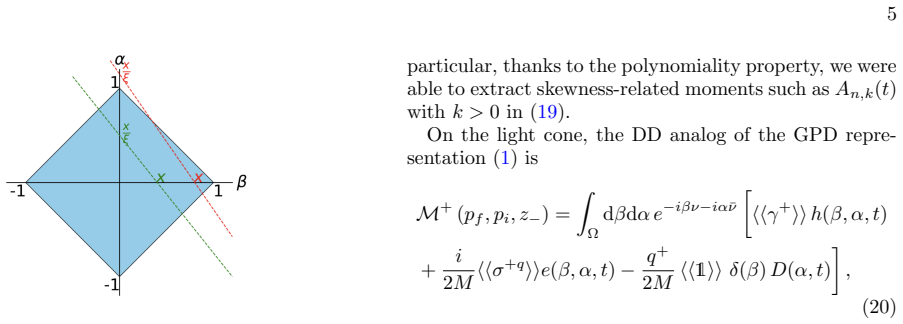
Starting from lattice pseudo-distributions at several hadron momenta, the full kinematic dependence of the GPDs is recovered through an intermediate step that extracts the corresponding double distributions directly; this step automatically incorporates the polynomiality property required by Lorentz symmetry, while the multidimensional Gaussian process supplies the regularization needed to control the inverse problem.
What carries the argument
Multidimensional Gaussian process regression applied to recover double distributions from pseudo-distribution lattice data.
If this is right
- GPDs become available over the full kinematic domain without additional functional parametrizations.
- The extracted double distributions guarantee that the GPDs obey polynomiality in skewness.
- Skewness-dependent moments of the GPDs are obtained directly from the lattice data.
- Systematic uncertainty from regularization can be quantified by varying the Gaussian process hyperparameters.
Where Pith is reading between the lines
- The same regularization framework could be applied to polarized GPDs once corresponding lattice data become available.
- At the physical pion mass the method would supply tighter three-dimensional constraints on nucleon structure.
- Direct comparison of the reconstructed GPDs against phenomenological extractions from deeply virtual Compton scattering would test the reconstruction independently.
- The approach provides a route toward fully symmetry-constrained, parameter-light determinations of GPDs.
Load-bearing premise
The Gaussian process regression introduces only controllable model dependence and the chosen lattice ensemble at 358 MeV pion mass with its available kinematic points is sufficient to constrain the entire (x, ξ, t) dependence.
What would settle it
Repeating the reconstruction on a finer lattice spacing or lighter pion mass and finding that the resulting double distributions violate support properties or produce GPDs inconsistent with the forward limit would falsify the method.
Figures




read the original abstract
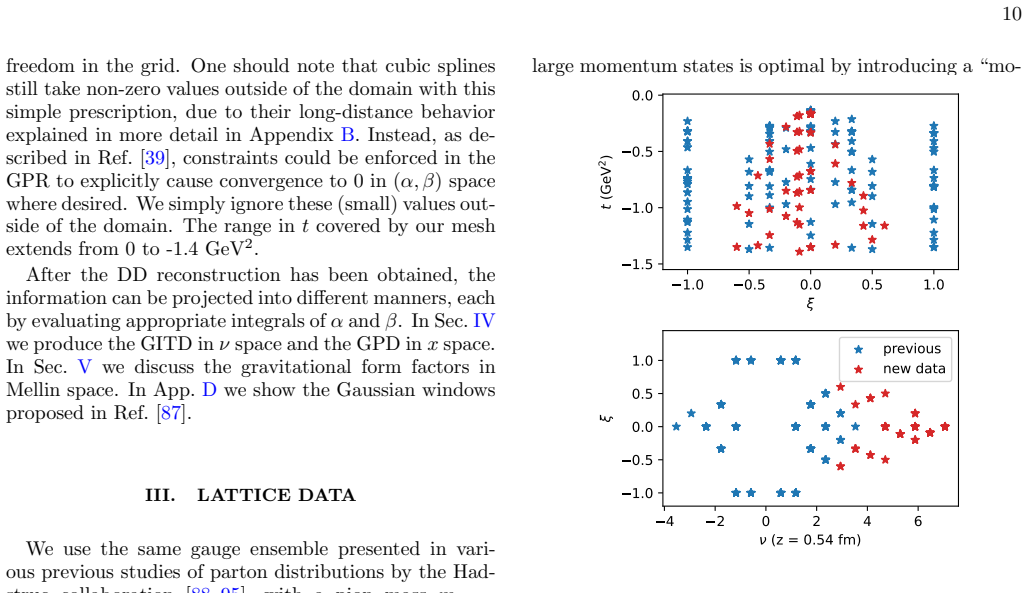
We propose a reconstruction of the full $(x, \xi, t)$ dependence of unpolarized isovector proton generalized parton distributions (GPDs) $H^{u-d}$ and $E^{u-d}$ from lattice QCD data in the pseudo-distribution formalism. For the first time, we extract double distributions (DDs) directly from lattice data, enforcing therefore an important property of GPDs linked to Lorentz symmetry. We use the flexible framework of multidimensional Gaussian process regression to regularize the inverse problem and present an assessment of the impact of model dependence on the systematic uncertainty. Our lattice ensemble corresponds to a pion mass $m_\pi = 358$~MeV and a lattice spacing $a = 0.094$~fm. We use larger hadron momenta, up to 2.7~GeV, and kinematic coverage compared to our previous computations and extract additional skewness-dependent moments of the GPD.
Editorial analysis
A structured set of objections, weighed in public.
Referee Report
Summary. The manuscript proposes reconstructing the full (x, ξ, t) dependence of the unpolarized isovector proton GPDs H^{u-d} and E^{u-d} from lattice QCD pseudo-distribution data. It claims the first direct extraction of double distributions (DDs) F(β, α, t) from lattice data on a single ensemble (m_π = 358 MeV, a = 0.094 fm, |P| up to 2.7 GeV), thereby enforcing the Lorentz-symmetry support property of GPDs. Multidimensional Gaussian process regression is used to regularize the inverse problem, with an assessment of model dependence, plus extraction of additional skewness-dependent moments.
Significance. If the central results hold, the work would mark a notable advance in lattice GPD studies by achieving the first direct DD extraction from lattice pseudo-distributions rather than post-processing GPDs. The GP framework offers a data-driven route to full kinematic coverage with quantified systematics, potentially improving consistency with phenomenological parametrizations and enabling better tests of Lorentz invariance in the extracted distributions.
major comments (2)
- [Gaussian process regression and DD extraction sections] The central claim that DDs are extracted directly from lattice data (enforcing Lorentz symmetry) rests on the multidimensional GP regression not dominating the reconstruction. With only one ensemble, m_π = 358 MeV, and a finite set of Ioffe-time points, the paper must demonstrate through explicit hyperparameter/kernel variations that the support property and (x, ξ, t) dependence are data-constrained rather than prior-driven; the current assessment of model dependence appears insufficient to establish this.
- [Results and systematic uncertainty assessment] The weakest assumption—that the chosen lattice kinematics and GP regularization sufficiently constrain the full three-dimensional surface—requires quantitative support. Limited coverage up to |P| = 2.7 GeV on a single ensemble risks under-constraining the prior; the manuscript should include a dedicated study (e.g., leave-one-out or synthetic data tests) showing stability of the extracted F(β, α, t) under changes to the GP length scales.
minor comments (2)
- [Introduction and formalism] Clarify the precise definition and normalization of the double distribution F(β, α, t) relative to the standard GPD integral representation; this notation appears in the abstract but would benefit from an explicit equation in the methods.
- [Abstract and results] The abstract states that 'additional skewness-dependent moments' are extracted; specify which moments (e.g., which powers of ξ) and in which figure or table they are shown, to aid readers comparing with prior lattice work.
Simulated Author's Rebuttal
We thank the referee for their careful review and for recognizing the potential significance of our work on reconstructing GPDs and extracting double distributions from lattice pseudo-distributions. We address the two major comments point by point below. Where the comments identify areas for strengthening the analysis of model dependence and systematic uncertainties, we agree to incorporate additional quantitative studies in a revised manuscript.
read point-by-point responses
-
Referee: The central claim that DDs are extracted directly from lattice data (enforcing Lorentz symmetry) rests on the multidimensional GP regression not dominating the reconstruction. With only one ensemble, m_π = 358 MeV, and a finite set of Ioffe-time points, the paper must demonstrate through explicit hyperparameter/kernel variations that the support property and (x, ξ, t) dependence are data-constrained rather than prior-driven; the current assessment of model dependence appears insufficient to establish this.
Authors: We agree that explicit demonstration is required to establish that the extracted double distributions and the enforced support property are driven by the lattice data. The manuscript already presents an assessment of model dependence through variations in GP hyperparameters and kernels, with the support property preserved in these tests. To address the referee's concern more rigorously, we will expand this section in the revision with additional explicit hyperparameter and kernel variations, including quantitative metrics (such as variation in the extracted F(β, α, t) surfaces) to show the degree to which the (x, ξ, t) dependence is constrained by the data rather than the prior. revision: yes
-
Referee: The weakest assumption—that the chosen lattice kinematics and GP regularization sufficiently constrain the full three-dimensional surface—requires quantitative support. Limited coverage up to |P| = 2.7 GeV on a single ensemble risks under-constraining the prior; the manuscript should include a dedicated study (e.g., leave-one-out or synthetic data tests) showing stability of the extracted F(β, α, t) under changes to the GP length scales.
Authors: We acknowledge that the limited kinematic coverage on a single ensemble requires additional quantitative validation to confirm that the GP regularization does not under-constrain the three-dimensional reconstruction. While the current analysis incorporates some stability checks, we will add a dedicated subsection presenting leave-one-out cross-validation and synthetic data tests (generated from phenomenological GPD models) to demonstrate the stability of the extracted F(β, α, t) under variations in GP length scales. These studies will be performed on the existing dataset and included in the revised manuscript. revision: yes
Circularity Check
No significant circularity in GPD reconstruction from pseudo-distributions
full rationale
The derivation uses lattice pseudo-distribution data as primary input and applies multidimensional Gaussian process regression to regularize the inverse problem while parametrizing via the standard double-distribution representation of GPDs. This representation enforces the Lorentz-invariance support property by construction of the known formalism rather than deriving it from the current fit. No equation or step reduces the extracted DD or full (x, ξ, t) dependence to a tautology, a fitted parameter relabeled as prediction, or a self-citation chain whose validity depends on the present work. The GP kernel and length-scale choices introduce assessed model dependence but do not make the central claim equivalent to the inputs by definition. The lattice ensemble and kinematic coverage supply independent constraints, rendering the reconstruction self-contained against external benchmarks.
Axiom & Free-Parameter Ledger
free parameters (1)
- Gaussian process hyperparameters
axioms (1)
- domain assumption Lorentz symmetry implies that GPDs can be represented by double distributions
Reference graph
Works this paper leans on
-
[1]
This systematic ef- fect translates in our reconstruction being systematically larger than the GK model forH u−d(+) (upper-right plot of Fig
gives⟨x⟩ u−d = 0.150(5), the GK model stands at 0.17, and our own extraction at non-physical pion mass at 0.21(1) (see next section). This systematic ef- fect translates in our reconstruction being systematically larger than the GK model forH u−d(+) (upper-right plot of Fig. 21). An interesting aspect of GPD phenomenology isposi- tivity bounds[64, 114]. U...
2020
-
[2]
Integrated behavior overα Let us start with the simple casek= 0, where theα- dependence is integrated over. From Eq. (A2), the DD moment is simplyA n,0(t), which in turn is a Mellin mo- ment of the GPD atξ= 0.A n,0(t) behaves with respect to evolution exactly like a PDF moment. In particular, one has: An,0(t, µ2
-
[3]
In Section 3.3 of [70], we studied the evolution operator in the limitn→0: αs(µ2 0) αs(µ2 1) γn/(2πβ0) n→0 ∼ αs(µ2 0) αs(µ2 1) CF /(2πβ0)[1/n+1/2]
=A n,0(t, µ2 0) αs(µ2 0) αs(µ2 1) γn/(2πβ0) ,(A5) whereγ n are the Mellin moments of the DGLAP evolu- tion operator: γn =C F Z 1 0 dα 1 +α 2 1−α (αn−1 −1) =C F −2ψ(0)(n)−2γ E + 3 2 − 1 n − 1 n+ 1 ,(A6) withψ (0)(n) = d ln Γ(n)/dnthe digamma function and γE =−ψ (0)(1) the Euler-Mascheroni constant.β 0 = (33−2n f)/(12π)≈0.716. In Section 3.3 of [70], we stu...
-
[4]
(A9) informs on the rate of divergence at smallx induced solely by evolution
= Z 1 x dy y E(y;µ 2 0, µ2 1)q x y , µ2 0 ,(A8) we find the behavior of the evolution operatorEat small yto be dominated at one-loop by: E(y;µ 2 0, µ2 1) y→0 ∼A 0F1 (; 2;−Bln(y)),(A9) whereAandBdepend on the scales, but not ony, and 0F1 (; 2;x) is the confluent hypergeometric limit function defined by its series expansion: 0F1(; 2;x) = ∞X n=0 xn n!(n+ 1)!...
-
[5]
Understanding theα-dependence at smallβ To go beyond the previous observation, we need to address the skewness dependence of the GPD evolution. It is well-known that conformal moments, defined as On(ξ, t, µ2) = √πΓ(n) 2nΓ(n+ 1/2) ξn−1 Z 1 −1 dx C(3/2) n−1 x ξ H q(x, ξ, t, µ2),(A11) diagonalize the leading-order evolution of GPDs, such that they obey a sim...
-
[6]
(A11) ensures thatc n,n = 1
=O n(ξ, t, µ2 0) αs(µ2 0) αs(µ2 1) γn/(2πβ0) .(A12) Let us write the explicit decomposition of Gegenbauer polynomials as: C(3/2) n (x) = nX k=0 k≡n[2] cn,kxk .(A13) The initial factor in the definition of Eq. (A11) ensures thatc n,n = 1. Then the conformal moments write: On(ξ) = [An,0 +A n,2ξ2 +...] +ξ 2cn−1,n−3[An−2,0 +A n−2,2ξ2 +...] +...(A14) 28 Theref...
-
[7]
The first term in the right hand side of Eq
= 1 2 d2 dξ2 On(ξ= 0, µ 2 0) αs(µ2 0) αs(µ2 1) γn/(2πβ0) + (n−1)(n−2) 2(2n−1) An−2,0(µ2 0) αs(µ2 0) αs(µ2 1) γn−2/(2πβ0) .(A18) We are interested in the limitn→2, which will give us insight on the small-βbehavior of the moment⟨α 2⟩of the DD. The first term in the right hand side of Eq. (A18) is simply finite whenn→2. On the other hand,A n−2,0 typically di...
-
[8]
Not only does it mean that every DD moment⟨α k⟩ has the same asymptotic scale evolution atβ→0, but it only depends on the⟨α 0⟩moment at initial scale
and the anomalous dimension γn−k. Not only does it mean that every DD moment⟨α k⟩ has the same asymptotic scale evolution atβ→0, but it only depends on the⟨α 0⟩moment at initial scale. In other words, evolution at very smallβtends towards a universal profile inαindependent of the shape at starting scale. To compute this universal profile, we start by deri...
-
[9]
Value oftspanning{0,−0.2,−0.4,−0.6,−0.8,−1.0,−1.2,−1.4}GeV 2 in [’t0’, ’t-20’, ’t-40’, ’t-60’, ’t-80’, ’t-100’, ’t-120’, ’t-140’]
-
[10]
Value ofξspanning{0,0.25,0.5,0.75,1}in [’xi0’, ’xi25’, ’xi50’, ’xi75’, ’xi100’]
-
[11]
--", color=
Choice between[’samples’, ’z5ts4’, ’z6ts3’] ’samples/data’is an array of shape (1000,100) containing 1000 samples of the value of the GPD at the chosen (ξ, t) values on a regular grid of 100 points inx∈[0,1]. This is the result of the fit with hyperparameter variation on the data (z= 5a= 0.47 fm, t s = 3). ’z5ts4/data’is a vector of length 100 containing ...
-
[12]
K.-F. Liu and S.-J. Dong, Phys. Rev. Lett.72, 1790 (1994), arXiv:hep-ph/9306299
-
[13]
V. Braun and D. M¨ uller, Eur. Phys. J. C55, 349 (2008), arXiv:0709.1348 [hep-ph]
-
[14]
Ji,Parton physics on a euclidean lattice,Phys
X. Ji, Phys. Rev. Lett.110, 262002 (2013), arXiv:1305.1539 [hep-ph]
- [15]
-
[16]
A. Radyushkin, Phys. Lett. B767, 314 (2017), arXiv:1612.05170 [hep-ph]
- [17]
-
[18]
Y.-Q. Ma and J.-W. Qiu, Phys. Rev. D98, 074021 (2018), arXiv:1404.6860 [hep-ph]
-
[19]
Y.-Q. Ma and J.-W. Qiu, Phys. Rev. Lett.120, 022003 (2018), arXiv:1709.03018 [hep-ph]
- [20]
-
[21]
J. Arrington et al., Prog. Part. Nucl. Phys.127, 103985 (2022), arXiv:2112.00060 [nucl-ex]
- [22]
-
[23]
Science Requirements and Detector Concepts for the Electron-Ion Collider: EIC Yellow Report
R. Abdul Khalek et al., Nucl. Phys. A1026, 122447 (2022), arXiv:2103.05419 [physics.ins-det]
work page internal anchor Pith review arXiv 2022
-
[24]
D. M¨ uller, D. Robaschik, B. Geyer, F. M. Dittes, and J. Hoˇ rejˇ si, Fortsch. Phys.42, 101 (1994), arXiv:hep- ph/9812448
- [25]
- [26]
-
[27]
A. V. Radyushkin, Phys. Lett. B380, 417 (1996), arXiv:hep-ph/9604317
work page Pith review arXiv 1996
- [28]
- [29]
-
[30]
M. Burkardt, Phys. Rev. D62, 071503 (2000), [Er- ratum: Phys.Rev.D 66, 119903 (2002)], arXiv:hep- ph/0005108
-
[31]
Impact Parameter Space Interpretation for Generalized Parton Distributions
M. Burkardt, Int. J. Mod. Phys. A18, 173 (2003), arXiv:hep-ph/0207047
work page Pith review arXiv 2003
-
[32]
M. V. Polyakov, Phys. Lett. B555, 57 (2003), arXiv:hep-ph/0210165
work page Pith review arXiv 2003
- [33]
-
[34]
Deconvolution problem of deeply virtual Compton scattering,
V. Bertone, H. Dutrieux, C. Mezrag, H. Moutarde, and P. Sznajder, Phys. Rev. D103, 114019 (2021), arXiv:2104.03836 [hep-ph]
-
[35]
J.-W. Qiu and Z. Yu, Phys. Rev. Lett.131, 161902 (2023), arXiv:2305.15397 [hep-ph]
- [36]
-
[37]
H. Dutrieux, T. Meisgny, C. Mezrag, and H. Moutarde, Eur. Phys. J. C85, 105 (2025), arXiv:2410.13518 [hep- ph]
- [38]
-
[39]
P. Hagler et al. (LHPC), Phys. Rev. D77, 094502 (2008), arXiv:0705.4295 [hep-lat]
- [40]
-
[41]
C. Alexandrou et al., Phys. Rev. D101, 034519 (2020), arXiv:1908.10706 [hep-lat]
- [42]
- [43]
-
[44]
A. V. Radyushkin, Phys. Rev. D100, 116011 (2019), 35 1 2 3 4 n 0.00 0.01 0.02 0.03 0.04 0.05 0.06 0.07 gn(ξ = 0.25, t) H u−d(−) t = 0.0 GeV2 t = −0.2 GeV2 t = −0.4 GeV2 t = −0.6 GeV2 t = −0.8 GeV2 t = −1.0 GeV2 t = −1.2 GeV2 t = −1.4 GeV2 1 2 3 4 n 0.00 0.01 0.02 0.03 0.04 0.05 gn(ξ = 0.50, t) H u−d(−) t = 0.0 GeV2 t = −0.2 GeV2 t = −0.4 GeV2 t = −0.6 GeV...
- [45]
- [46]
-
[47]
H. Dutrieux, J. Karpie, K. Orginos, and S. Zafeiropou- los, Phys. Rev. D111, 034515 (2025), arXiv:2412.05227 [hep-lat]
-
[48]
Inverse problem in the LaMET framework
H. Dutrieux, J. Karpie, C. J. Monahan, K. Orginos, A. Radyushkin, D. Richards, and S. Zafeiropoulos, (2025), arXiv:2504.17706 [hep-lat]
work page internal anchor Pith review Pith/arXiv arXiv 2025
- [49]
- [50]
-
[51]
Chen et al., Phys
J.-W. Chen et al., Phys. Rev. D113, 014509 (2026)
2026
-
[52]
V. Mart´ ınez-Fern´ andez, D. Binosi, C. Mezrag, and Z.- Q. Yao, (2025), arXiv:2509.06669 [hep-ph]
-
[53]
V. Mart´ ınez-Fern´ andez and C. Mezrag, (2025), arXiv:2509.05059 [hep-ph]
-
[54]
J.-W. Chen, H.-W. Lin, and J.-H. Zhang, Nucl. Phys. B952, 114940 (2020), arXiv:1904.12376 [hep-lat]
-
[55]
H.-W. Lin, Phys. Rev. Lett.127, 182001 (2021), arXiv:2008.12474 [hep-ph]
-
[56]
C. Alexandrou, K. Cichy, M. Constantinou, K. Had- jiyiannakou, K. Jansen, A. Scapellato, and F. Steffens, Phys. Rev. Lett.125, 262001 (2020), arXiv:2008.10573 [hep-lat]
- [57]
-
[58]
C. Alexandrou, K. Cichy, M. Constantinou, K. Had- jiyiannakou, K. Jansen, A. Scapellato, and F. Steffens, Phys. Rev. D105, 034501 (2022), arXiv:2108.10789 [hep-lat]
-
[59]
S. Bhattacharya, K. Cichy, M. Constantinou, J. Dodson, X. Gao, A. Metz, S. Mukherjee, A. Scapellato, F. Stef- fens, and Y. Zhao, Phys. Rev. D106, 114512 (2022), arXiv:2209.05373 [hep-lat]
-
[60]
S. Bhattacharya, K. Cichy, M. Constantinou, X. Gao, A. Metz, J. Miller, S. Mukherjee, P. Petreczky, F. Stef- fens, and Y. Zhao, Phys. Rev. D108, 014507 (2023), arXiv:2305.11117 [hep-lat]
-
[61]
S. Bhattacharya et al., Phys. Rev. D109, 034508 (2024), arXiv:2310.13114 [hep-lat]
-
[62]
S. Bhattacharya, K. Cichy, M. Constantinou, J. Dodson, A. Metz, A. Scapellato, and F. Steffens, Phys. Rev. D 108, 054501 (2023), arXiv:2306.05533 [hep-lat]
- [63]
-
[64]
S. Bhattacharya, K. Cichy, M. Constantinou, A. Metz, N. Nurminen, and F. Steffens, Phys. Rev. D110, 054502 (2024), arXiv:2405.04414 [hep-lat]
-
[65]
A. Hannaford-Gunn, K. U. Can, J. A. Craw- ford, R. Horsley, P. E. L. Rakow, G. Schierholz, H. St¨ uben, R. D. Young, and J. M. Zanotti (CSSM/QCDSF/UKQCD), Phys. Rev. D110, 014509 (2024), arXiv:2405.06256 [hep-lat]
-
[66]
H. Dutrieux, R. G. Edwards, C. Egerer, J. Karpie, C. Monahan, K. Orginos, A. Radyushkin, D. Richards, E. Romero, and S. Zafeiropoulos (HadStruc), JHEP 08, 162 (2024), arXiv:2405.10304 [hep-lat]
- [67]
-
[68]
S. Bhattacharya, K. Cichy, M. Constantinou, X. Gao, A. Metz, J. Miller, S. Mukherjee, P. Petreczky, F. Steffens, and Y. Zhao, JHEP01, 146 (2025), arXiv:2410.03539 [hep-lat]
-
[69]
J. Schoenleber, R. S. Sufian, T. Izubuchi, and Y.-B. Yang, Phys. Rev. D111, 094510 (2025), arXiv:2412.14110 [hep-lat]
-
[70]
S. Bhattacharya, K. Cichy, M. Constantinou, A. Metz, J. Miller, P. Petreczky, and F. Steffens, Phys. Rev. D 112, 114504 (2025), arXiv:2505.11288 [hep-lat]
-
[71]
J. Holligan, H.-W. Lin, R. Zhang, and Y. Zhao, JHEP 207, 241 (2025), arXiv:2501.19225 [hep-ph]
- [72]
- [73]
- [74]
- [75]
-
[76]
Unpolar- ized isovector gpds from lattice qcd in the pseudo- distribution formalism,
H. Dutrieux, R. G. Edwards, J. Karpie, C. Mezrag, C. Monahan, K. Orginos, A. Radyushkin, D. Richards, E. Romero Alcalde, and S. Zafeiropoulos, “Unpolar- ized isovector gpds from lattice qcd in the pseudo- distribution formalism,” (2026)
2026
- [77]
-
[78]
K. Orginos, A. Radyushkin, J. Karpie, and S. Zafeiropoulos, Phys. Rev. D96, 094503 (2017), arXiv:1706.05373 [hep-ph]
-
[79]
T. Ishikawa, Y.-Q. Ma, J.-W. Qiu, and S. Yoshida, Phys. Rev. D96, 094019 (2017), arXiv:1707.03107 [hep- ph]
- [80]
discussion (0)
Sign in with ORCID, Apple, or X to comment. Anyone can read and Pith papers without signing in.