Recognition: unknown
Precision measurement of positron decay modes of Xe-125 in the LUX-ZEPLIN experiment
Pith reviewed 2026-05-08 13:26 UTC · model grok-4.3
The pith
LUX-ZEPLIN measures Xe-125 positron emission at 0.29 percent branching ratio with 5.5 sigma significance
A machine-rendered reading of the paper's core claim, the machinery that carries it, and where it could break.
Core claim
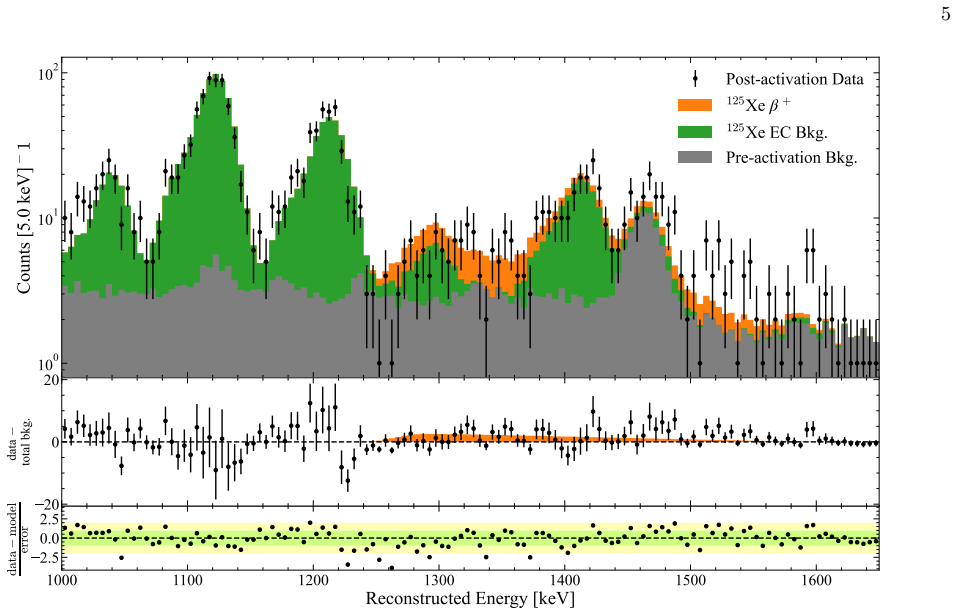
By analyzing multiple-scatter events in the LUX-ZEPLIN time projection chamber and subtracting backgrounds with pre-activation data, the experiment detects positron emission from Xe-125 with 5.5 sigma statistical significance. This corresponds to a total branching ratio of 0.29 plus or minus 0.08 statistical plus or minus 0.04 systematic percent and supplies the first constraints on the separate decay probabilities to the 243 keV and 188 keV excited states of I-125.
What carries the argument
Multiple-scatter event selection in the liquid xenon time projection chamber, which registers the 511 keV annihilation photons together with subsequent gamma rays, combined with pre-activation data to constrain backgrounds.
Load-bearing premise
The analysis assumes that multiple-scatter event selection combined with pre-activation data cleanly isolates the positron signal and constrains backgrounds without introducing unaccounted efficiency losses or contamination.
What would settle it
An independent high-statistics coincidence measurement in a germanium detector that fails to observe the predicted 511 keV plus 243 keV or 188 keV gamma-ray lines at the reported rate would falsify the 5.5 sigma claim.
Figures

read the original abstract
The radioisotope $^{125}\text{Xe}$ is a short-lived ($T_{1/2}\sim16.9 h$) activation product of the neutron calibrations performed in the LUX-ZEPLIN experiment. Subsequently, $^{125}$Xe decays primarily ($>99\%$) via electron capture, but positron emission has been confirmed by direct measurement to at least the 243 keV level of $^{125}\text{I}$. An additional decay to the 188keV level is expected from triple-coincident measurements of the annihilation and relaxation $\gamma$ rays, but has not been directly confirmed. By utilizing multiple-scatter event analysis and the pre-activation data to constrain backgrounds, this work reports positron emission with a statistical significance of 5.5$\sigma$. This corresponds to a total branching ratio of $0.29\pm0.08_{\text{stat.}}\pm0.04_{\text{sys.}}$ %, and is the first constraint to the individual branching levels of $^{125}\text{I}$.
Editorial analysis
A structured set of objections, weighed in public.
Referee Report
Summary. The manuscript reports a precision measurement of the positron decay modes of the radioisotope ^{125}Xe, a short-lived activation product in the LUX-ZEPLIN (LZ) dark matter experiment. Using multiple-scatter event analysis to tag the two 511 keV annihilation photons and pre-activation data to constrain backgrounds, the authors claim a 5.5σ statistical significance for positron emission. This yields a total branching ratio of 0.29 ± 0.08_stat ± 0.04_sys %, and provides the first direct constraints on the individual branching ratios to the 188 keV and 243 keV excited states of ^{125}I.
Significance. If the analysis is validated, this result would be of moderate significance for nuclear physics and low-background detector communities. It supplies the first individual-level constraints on these rare positron branches, which can refine the ^{125}Xe decay scheme and improve background modeling in xenon TPCs. The use of pre-activation data for background estimation is a methodological strength that could be adopted in similar activation studies.
major comments (2)
- [Analysis section (multiple-scatter selection and background estimation)] Analysis section (multiple-scatter selection and background estimation): The 5.5σ excess and the derived total branching ratio of 0.29% rest on the claim that multiple-scatter events plus pre-activation data cleanly isolate the positron signal from all other backgrounds. The manuscript must explicitly demonstrate that time-dependent or position-dependent background differences between pre- and post-activation periods are negligible and that the efficiency for true positron events (including the 188 keV and 243 keV branches) is not biased by the cuts; any unaccounted residual contamination or efficiency loss would directly bias the excess count and the individual branching ratios.
- [Results section] Results section: The systematic uncertainty of ±0.04% on the branching ratio must be itemized by source (e.g., efficiency determination, background modeling, energy calibration, and cut variations) so that the reader can assess whether the error budget fully covers the dominant contributions to the 5.5σ claim.
minor comments (1)
- [Abstract and title] The abstract and title use inconsistent isotope notation ('Xe-125' vs. ^{125}Xe); uniform use of standard LaTeX notation throughout would improve readability.
Simulated Author's Rebuttal
We thank the referee for their careful review and constructive comments, which help strengthen the presentation of our results. We appreciate the positive assessment of the methodological approach using pre-activation data. We address each major comment below and will incorporate revisions to provide the requested explicit demonstrations and breakdowns.
read point-by-point responses
-
Referee: Analysis section (multiple-scatter selection and background estimation): The 5.5σ excess and the derived total branching ratio of 0.29% rest on the claim that multiple-scatter events plus pre-activation data cleanly isolate the positron signal from all other backgrounds. The manuscript must explicitly demonstrate that time-dependent or position-dependent background differences between pre- and post-activation periods are negligible and that the efficiency for true positron events (including the 188 keV and 243 keV branches) is not biased by the cuts; any unaccounted residual contamination or efficiency loss would directly bias the excess count and the individual branching ratios.
Authors: We agree that more explicit validation is warranted to support the 5.5σ claim and individual branching ratio constraints. In the revised manuscript, we will expand the analysis section with: (i) direct comparisons of event rates in multiple control regions (e.g., single-scatter sidebands and out-of-fiducial volumes) between pre- and post-activation datasets to quantify any time-dependent or position-dependent differences, showing they are negligible within statistical precision; (ii) full Monte Carlo simulations of positron decays to both the 188 keV and 243 keV levels of 125I, including annihilation photon tagging and the exact multiple-scatter selection criteria, to demonstrate that the selection efficiency is unbiased and that no significant residual contamination remains after background subtraction. These additions will confirm the robustness of the excess count. revision: yes
-
Referee: Results section: The systematic uncertainty of ±0.04% on the branching ratio must be itemized by source (e.g., efficiency determination, background modeling, energy calibration, and cut variations) so that the reader can assess whether the error budget fully covers the dominant contributions to the 5.5σ claim.
Authors: We concur that an itemized breakdown will enhance transparency and allow readers to evaluate the systematic contributions to the significance. In the revised results section (and associated table), we will explicitly decompose the ±0.04% systematic uncertainty into the following sources: efficiency determination (from MC-data comparisons and branching ratio assumptions), background modeling (from pre-activation fit uncertainties and time-stability checks), energy calibration variations, and cut selection variations (e.g., energy thresholds and multiplicity requirements). This will show that the total systematic is dominated by efficiency and background modeling, fully covering the main effects on the 5.5σ excess. revision: yes
Circularity Check
No circularity: direct experimental measurement with no self-referential derivations.
full rationale
This is a pure experimental result reporting a 5.5σ excess and branching ratio from LUX-ZEPLIN data. The analysis chain relies on observed multiple-scatter events and pre-activation background constraints, which are independent data-driven steps rather than any fitted parameter renamed as a prediction, self-definitional loop, or load-bearing self-citation. No equations or uniqueness theorems reduce the output to the input by construction; the measurement stands on its own statistical significance and systematic evaluation.
Axiom & Free-Parameter Ledger
axioms (1)
- domain assumption Standard assumptions about liquid xenon detector response, energy reconstruction, and background modeling hold for this activation product.
Reference graph
Works this paper leans on
- [1]
-
[2]
Dark Matter Search Results from 4.2 Tonne-Years of Exposure of the LUX-ZEPLIN (LZ) Experiment,
J. Aalberset al.(LZ), Phys. Rev. Lett.135, 011802 (2025), arXiv:2410.17036 [hep-ex]
- [3]
- [4]
-
[5]
J. Aalberset al.(LZ), Phys. Rev. D108, 072006 (2023), arXiv:2307.15753 [hep-ex]
- [6]
-
[7]
Aalberset al.(LZ), JINST19(08), P08027, arXiv:2406.12874 [physics.ins-det]
J. Aalberset al.(LZ), JINST19(08), P08027, arXiv:2406.12874 [physics.ins-det]
-
[8]
A. E. Shustov, I. V. Chernysheva, V. V. Dmitrenko, A. G. Dukhvalov, K. V. Krivova, A. S. Novikov, D. V. Pe- trenko, K. F. Vlasik, S. E. Ulin, and Z. M. Uteshev, J. Phys. Conf. Ser.675, 042024 (2016)
2016
-
[9]
Katakura, Nucl
J. Katakura, Nucl. Data Sheets112, 495 (2011)
2011
-
[10]
Ludziejewskiet al., Acta Phys
J. Ludziejewskiet al., Acta Phys. Pol. 36: 939-50(Dec 1969). (1968)
1969
-
[11]
J. Aalberset al.(LZ), Phys. Rev. D108, 012010 (2023), arXiv:2211.17120 [hep-ex]
-
[12]
J. Aalberset al.(LZ), Phys. Rev. Lett.131, 041002 (2023), arXiv:2207.03764 [hep-ex]
-
[13]
Aalberset al.(LZ), (2025), arXiv:2508.19117 [physics.ins-det]
J. Aalberset al.(LZ), (2025), arXiv:2508.19117 [physics.ins-det]
- [14]
-
[15]
Szydagiset al., Instruments5, 13 (2021), arXiv:2102.10209 [hep-ex]
M. Szydagiset al., Instruments5, 13 (2021), arXiv:2102.10209 [hep-ex]
-
[16]
E. Aprile and T. Doke, Rev. Mod. Phys.82, 2053 (2010), arXiv:0910.4956 [physics.ins-det]
- [17]
-
[18]
Agostinelliet al.(GEANT4), Nucl
S. Agostinelliet al.(GEANT4), Nucl. Instrum. Meth. A 506, 250 (2003)
2003
- [19]
-
[20]
M. Szydagis, N. Barry, K. Kazkaz, J. Mock, D. Stolp, M. Sweany, M. Tripathi, S. Uvarov, N. Walsh, and M. Woods, JINST6, P10002, arXiv:1106.1613 [physics.ins-det]
-
[21]
R. J. Barlow and C. Beeston, Comput. Phys. Commun. 77, 219 (1993)
1993
-
[22]
Asymptotic formulae for likelihood-based tests of new physics
G. Cowan, K. Cranmer, E. Gross, and O. Vitells, Eur. Phys. J. C71, 1554 (2011), [Erratum: Eur.Phys.J.C 73, 2501 (2013)], arXiv:1007.1727 [physics.data-an]
work page internal anchor Pith review arXiv 2011
-
[23]
C. Wittweg, B. Lenardo, A. Fieguth, and C. Weinheimer, Eur. Phys. J. C80, 1161 (2020), arXiv:2002.04239 [nucl- 7 ex]
-
[24]
P. J. W. Faulkneret al.(GridPP), J. Phys. G32, N1 (2006)
2006
-
[25]
Brittonet al., Phil
D. Brittonet al., Phil. Trans. Roy. Soc. Lond. A367, 2447 (2009)
2009
discussion (0)
Sign in with ORCID, Apple, or X to comment. Anyone can read and Pith papers without signing in.