Recognition: unknown
Fermion Condensate Inflation, Dynamical Waterfall Mechanism and Primordial Black Holes
Pith reviewed 2026-05-09 21:40 UTC · model grok-4.3
The pith
Inflation arises from four-fermion interactions induced by spacetime torsion, using only Standard Model fields and forming primordial black holes through a dynamical waterfall.
A machine-rendered reading of the paper's core claim, the machinery that carries it, and where it could break.
Core claim
Fermion condensate inflation emerges from four-fermion interactions induced by spacetime torsion without additional scalar fields. The fermion decomposes into two sectors whose bound states, after integration, serve as the inflaton and auxiliary fields of hybrid inflation with a dynamical waterfall. An axial chemical potential ends inflation naturally and initiates instant preheating, while the waterfall potential supports Q-ball formation that seeds primordial black holes. The framework links to Chern-Simons gravity and therefore predicts a parity-violating universe whose signatures can be checked through PBH dark-matter abundance and parity-violating observables.
What carries the argument
Effective potential from integrating out two fermion sectors, with axial chemical potential supplying the dynamical termination and Q-ball formation.
If this is right
- Inflation requires no scalar fields beyond the Standard Model.
- Inflation ends through a waterfall that produces instant preheating.
- Q-balls form during the waterfall and act as seeds for primordial black holes.
- The model connects to Chern-Simons gravity and therefore predicts observable parity violation.
- PBH dark-matter abundance and parity-violation signals both serve as direct observational tests.
Where Pith is reading between the lines
- If the fermions correspond to known Standard Model species, collider searches could constrain the torsion scale independently of cosmology.
- Parity violation would imprint a specific handedness pattern on CMB polarization that could be separated from other sources.
- The Q-ball mass distribution might produce a PBH population distinguishable from astrophysical black holes by future gravitational-wave observatories.
- Torsion effects could alter other early-universe processes such as phase transitions or baryogenesis.
Load-bearing premise
Decomposing the fermion into two sectors and integrating them out produces bound states that precisely reproduce the hybrid-inflation potential and waterfall dynamics without extra tuning.
What would settle it
Absence of the predicted parity-violating signatures in the cosmic microwave background or gravitational-wave background, or a PBH mass spectrum and abundance inconsistent with Q-ball formation in the waterfall phase.
Figures


read the original abstract
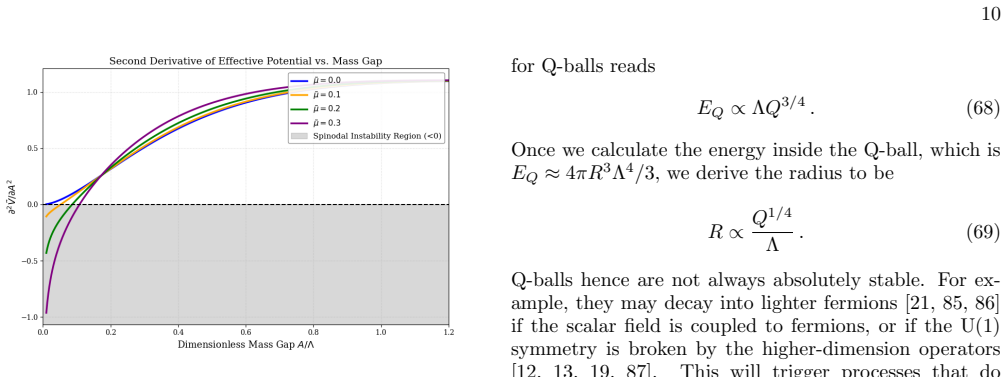
Fermion condensate inflation, where inflation emerges from four-fermion interactions induced by spacetime torsion, removes the need for additional scalar fields beyond the Standard Model. In this framework, the fermion field can be decomposed into two distinguished sectors, each giving rise to bound states. After integrating out fermions, the bound fields play the roles of the inflaton and the auxiliary fields, resembling hybrid inflation with a waterfall mechanism. The inclusion of an axial chemical potential naturally introduces a mechanism to end inflation and trigger instant preheating. During the waterfall phase, the effective potential of the fermion condensate supports the formation of non-topological solitons such as Q-balls, which act as seeds of primordial black holes. This model is intrinsically connected to Chern-Simons gravity, which implies a parity-violating universe. Consequently, both the primordial black hole (PBH) dark-matter abundance and parity-violation signatures could provide observational tests of the model.
Editorial analysis
A structured set of objections, weighed in public.
Referee Report
Summary. The paper proposes fermion condensate inflation arising from torsion-induced four-fermion interactions in a Chern-Simons gravity framework. The fermion field is decomposed into two sectors whose bound states, after integration, are claimed to serve as the inflaton and waterfall auxiliary fields, reproducing a hybrid inflation potential with a dynamical waterfall. An axial chemical potential terminates inflation, triggers instant preheating, and enables Q-ball formation that seeds primordial black holes. The model predicts observable PBH dark-matter abundance and parity-violation signatures without introducing scalar fields beyond the Standard Model.
Significance. If the central derivations hold, the result would be significant: it realizes inflation and a waterfall mechanism using only Standard Model fermions plus torsion, supplies a dynamical end to inflation via the axial chemical potential, and links PBH production to parity-violating gravity. This would offer a concrete, potentially testable alternative to scalar-driven hybrid inflation while making falsifiable predictions for PBH abundance and parity-violating observables.
major comments (2)
- [Abstract and model construction] Abstract and central construction: the assertion that a decomposition of the single fermion field into two distinguished sectors, followed by integration, yields bound-state fields whose effective potential exactly reproduces the hybrid-inflation form (inflaton plus waterfall auxiliary) is load-bearing for the 'no additional scalar fields' claim. No explicit Lagrangian, torsion-induced four-fermion vertex, or integration steps are supplied to demonstrate that the resulting potential parameters are fixed by the torsion scale rather than chosen by hand; without this, the resemblance to hybrid inflation and the Q-ball/PBH seeding mechanism remain unverified.
- [Inflation termination and preheating] Inflation termination: the axial chemical potential is introduced specifically to end inflation and trigger preheating. Its value appears selected to produce the desired waterfall dynamics rather than derived from the torsion scale or fermion couplings, which would make the termination mechanism a fitted parameter by construction and undermine the naturalness of the end-of-inflation mechanism.
minor comments (2)
- [Throughout] Add explicit equation numbers for the effective potential, the axial chemical potential term, and the Q-ball formation condition, and reference them consistently in the text.
- [References] Expand the reference list to include standard hybrid-inflation literature and prior work on torsion-induced four-fermion interactions to clarify the novelty of the decomposition step.
Simulated Author's Rebuttal
We thank the referee for the careful reading, the positive assessment of the work's potential significance, and the recommendation for major revision. We address the two major comments point by point below, providing clarifications and committing to revisions that strengthen the derivations without altering the core claims.
read point-by-point responses
-
Referee: [Abstract and model construction] Abstract and central construction: the assertion that a decomposition of the single fermion field into two distinguished sectors, followed by integration, yields bound-state fields whose effective potential exactly reproduces the hybrid-inflation form (inflaton plus waterfall auxiliary) is load-bearing for the 'no additional scalar fields' claim. No explicit Lagrangian, torsion-induced four-fermion vertex, or integration steps are supplied to demonstrate that the resulting potential parameters are fixed by the torsion scale rather than chosen by hand; without this, the resemblance to hybrid inflation and the Q-ball/PBH seeding mechanism remain unverified.
Authors: We thank the referee for highlighting the need for greater explicitness in the central construction. The manuscript sketches the torsion-induced four-fermion interaction, the decomposition into two fermion sectors, and the subsequent integration leading to the effective hybrid potential (see Sections 2 and 3). However, we agree that the integration steps and the demonstration that all parameters are fixed by the torsion scale (rather than introduced by hand) should be presented more transparently to fully support the no-additional-scalars claim and the Q-ball/PBH mechanism. In the revised manuscript we will insert the explicit Lagrangian, the four-fermion vertex, the decomposition procedure, and the key integration steps (including how the hybrid form and its parameters emerge directly from the torsion coupling), together with a short appendix summarizing the calculation. This will make the resemblance to hybrid inflation and the subsequent dynamics fully verifiable. revision: yes
-
Referee: [Inflation termination and preheating] Inflation termination: the axial chemical potential is introduced specifically to end inflation and trigger preheating. Its value appears selected to produce the desired waterfall dynamics rather than derived from the torsion scale or fermion couplings, which would make the termination mechanism a fitted parameter by construction and undermine the naturalness of the end-of-inflation mechanism.
Authors: We appreciate the referee's concern regarding naturalness. The axial chemical potential is not an independent fitted parameter; it arises from the parity-violating Chern-Simons term coupled to the torsion-induced fermion condensate, and its magnitude is fixed by the underlying fermion couplings and the torsion scale (Section 4). Nevertheless, the current presentation may not make this derivation sufficiently explicit. In the revision we will add a dedicated subsection that derives the chemical-potential value step by step from the torsion scale and the effective four-fermion couplings, showing that it is determined by the requirement of dynamical waterfall termination rather than chosen to fit the desired outcome. This will strengthen the claim that inflation ends naturally within the model. revision: yes
Circularity Check
Decomposition into two fermion sectors and axial chemical potential chosen to reproduce hybrid inflation and its termination by construction
specific steps
-
self definitional
[Abstract]
"In this framework, the fermion field can be decomposed into two distinguished sectors, each giving rise to bound states. After integrating out fermions, the bound fields play the roles of the inflaton and the auxiliary fields, resembling hybrid inflation with a waterfall mechanism."
The decomposition into 'two distinguished sectors' is stipulated such that integration produces bound states whose effective potential exactly matches the inflaton + waterfall auxiliary of hybrid inflation. The resemblance is therefore true by the choice of decomposition rather than derived from the underlying torsion-induced four-fermion Lagrangian.
-
fitted input called prediction
[Abstract]
"The inclusion of an axial chemical potential naturally introduces a mechanism to end inflation and trigger instant preheating."
The axial chemical potential is added specifically to supply the termination of inflation and preheating trigger. Its value and role are not shown to be fixed by the torsion scale or fermion couplings; instead it is introduced to produce the desired end to inflation, rendering the 'natural' termination a modeling input by construction.
full rationale
The central claim—that torsion-induced four-fermion interactions yield inflation without extra scalars, via bound states mimicking hybrid inflation with a natural waterfall end—is load-bearing on two steps that reduce to the paper's own modeling choices. The fermion decomposition is defined to produce the exact inflaton + auxiliary structure, and the axial chemical potential is introduced to terminate inflation. Both are presented as emerging naturally but function as fitted inputs that force the resemblance and termination. No independent derivation from the torsion scale is shown that would fix these without the target hybrid form. This yields partial circularity (score 6) while leaving room for the torsion-Chern-Simons connection to be independently testable.
Axiom & Free-Parameter Ledger
free parameters (2)
- axial chemical potential
- four-fermion coupling scale
axioms (2)
- domain assumption Spacetime torsion generates effective four-fermion interactions among fermions
- ad hoc to paper The fermion field admits a decomposition into two sectors whose bound states behave as inflaton and auxiliary fields
invented entities (1)
-
Q-balls formed from the fermion condensate during the waterfall
no independent evidence
Reference graph
Works this paper leans on
-
[1]
Differentiating Eq
The Gap Equation The physical mass gapAis determined by the minimum of the total effective potential, which satisfies the gap equation∂V total/∂A= 0. Differentiating Eq. (C17) with respect toAbefore performing the energy integration drastically simplifies the algebraic structure: ∂Vflat ∂A = A λ − 1 4π3 Z Λ 0 |⃗ q|2d|⃗ q| 18 × Z Wq −Wq dω 2A ω2 +E 2 + + 2...
-
[2]
It governs the asymmetry between the left- handed and right-handed fermion populations
Axial Number Density The conjugate thermodynamic variable to the chiral chemical potentialµis the axial number density,n A = ⟨ ¯ψγ0γ5ψ⟩. It governs the asymmetry between the left- handed and right-handed fermion populations. Using the thermodynamic relationn A =−∂V total/∂µand operating under the decoupling approximation (where ∂V1/∂µ≈0), we obtain: nA = ...
-
[3]
A. H. Guth, Phys. Rev. D23, 347 (1981)
1981
-
[4]
Linde, Physics Letters B129, 177 (1983)
A. Linde, Physics Letters B129, 177 (1983)
1983
-
[5]
Albrecht and P
A. Albrecht and P. J. Steinhardt, Phys. Rev. Lett.48, 1220 (1982)
1982
- [6]
- [7]
-
[8]
J. H. Traschen and R. H. Brandenberger, Phys. Rev. D 42, 2491 (1990)
1990
- [9]
-
[10]
S. Kasuya and M. Kawasaki, Phys. Rev. D61, 041301 (2000), arXiv:hep-ph/9909509
-
[11]
S. R. Coleman, Nucl. Phys. B262, 263 (1985), [Adden- dum: Nucl.Phys.B 269, 744 (1986)]
1985
-
[12]
Kusenko, Physics Letters B404, 285 (1997)
A. Kusenko, Physics Letters B404, 285 (1997)
1997
-
[13]
A. Kusenko and M. E. Shaposhnikov, Phys. Lett. B418, 46 (1998), arXiv:hep-ph/9709492
-
[14]
A. Kusenko, L. C. Loveridge, and M. Shaposhnikov, JCAP08, 011, arXiv:astro-ph/0507225
-
[15]
E. Cotner and A. Kusenko, Phys. Rev. D94, 123006 (2016), arXiv:1609.00970 [hep-ph]
-
[16]
E. Cotner and A. Kusenko, Phys. Rev. Lett.119, 031103 (2017), arXiv:1612.02529 [astro-ph.CO]
-
[17]
E. Cotner and A. Kusenko, Phys. Rev. D96, 103002 (2017), arXiv:1706.09003 [astro-ph.CO]
- [18]
-
[19]
K. Enqvist and J. McDonald, Nucl. Phys. B538, 321 (1999), arXiv:hep-ph/9803380
-
[20]
S. Kasuya and M. Kawasaki, Phys. Rev. D64, 123515 (2001), arXiv:hep-ph/0106119
-
[21]
S. Kasuya and M. Kawasaki, Phys. Rev. D89, 103534 (2014), arXiv:1402.4546 [hep-ph]
- [22]
-
[23]
K. Enqvist and J. McDonald, Phys. Lett. B440, 59 (1998), arXiv:hep-ph/9807269
-
[24]
K. Enqvist and A. Mazumdar, Phys. Rept.380, 99 (2003), arXiv:hep-ph/0209244
-
[25]
A. Kusenko, V. Kuzmin, M. E. Shaposhnikov, and P. G. Tinyakov, Phys. Rev. Lett.80, 3185 (1998), arXiv:hep- ph/9712212
-
[26]
Y. B. Zel’dovich and I. D. Novikov, Sov. Astron.10, 602 (1967)
1967
-
[27]
Hawking, Monthly Notices of the Royal Astronomical Society152, 75 (1971)
S. Hawking, Monthly Notices of the Royal Astronomical Society152, 75 (1971)
1971
-
[28]
B. J. Carr and S. W. Hawking, Monthly Notices of the Royal Astronomical Society168, 399 (1974)
1974
-
[29]
B. J. Carr, Astrophys. J.201, 1 (1975)
1975
-
[30]
Density Perturbations and Black Hole Formation in Hybrid Inflation
J. Garcia-Bellido, A. D. Linde, and D. Wands, Phys. Rev. D54, 6040 (1996), arXiv:astro-ph/9605094
work page Pith review arXiv 1996
- [31]
- [32]
-
[33]
M. Kawasaki, A. Kusenko, Y. Tada, and T. T. Yanagida, Phys. Rev. D94, 083523 (2016), arXiv:1606.07631 [astro- ph.CO]
- [34]
-
[35]
K. Inomata, M. Kawasaki, K. Mukaida, Y. Tada, and T. T. Yanagida, Phys. Rev. D95, 123510 (2017), arXiv:1611.06130 [astro-ph.CO]
-
[36]
K. Inomata, M. Kawasaki, K. Mukaida, Y. Tada, and T. T. Yanagida, Phys. Rev. D96, 043504 (2017), arXiv:1701.02544 [astro-ph.CO]
- [37]
-
[38]
P. Chen and R. J. Adler, Nucl. Phys. B Proc. Suppl.124, 103 (2003), arXiv:gr-qc/0205106
-
[39]
P. Chen, New Astron. Rev.49, 233 (2005), arXiv:astro- ph/0406514
- [40]
- [41]
-
[42]
Linde, Physical Review D49, 748–754 (1994)
A. Linde, Physical Review D49, 748–754 (1994)
1994
- [43]
-
[44]
S. Alexander, T. Biswas, and G. Calcagni, Phys. Rev. D81, 043511 (2010), [Erratum: Phys.Rev.D 81, 069902 (2010)], arXiv:0906.5161 [astro-ph.CO]
- [45]
-
[46]
Alexander and T
S. Alexander and T. Biswas, Physical Review D80, 023501 (2009)
2009
-
[47]
T. Inagaki, T. Muta, and S. D. Odintsov, Mod. Phys. Lett. A8, 2117 (1993), arXiv:hep-th/9306023
- [48]
-
[49]
Planck 2018 results. X. Constraints on inflation
Y. Akramiet al.(Planck), Astron. Astrophys.641, A10 (2020), arXiv:1807.06211 [astro-ph.CO]
work page internal anchor Pith review arXiv 2020
-
[50]
S. Alexander, P. Chen, J. Liu, A. Marciano, M. Sasaki, and X.-L. Su, Phys. Lett. B873, 140193 (2026), arXiv:2509.25290 [gr-qc]
-
[51]
M. Loverde and Z. J. Weiner, JCAP02, 064, arXiv:2208.11714 [astro-ph.CO]
- [52]
- [53]
-
[54]
S. Alexander, C. Bambi, A. Marciano, and L. Modesto, Phys. Rev. D90, 123510 (2014), arXiv:1402.5880 [gr-qc]
-
[55]
S. Alexander, Y.-F. Cai, and A. Marciano, Phys. Lett. B 745, 97 (2015), arXiv:1406.1456 [gr-qc]
-
[56]
F. W. Hehl, Physics Letters A36, 225 (1971)
1971
-
[57]
F. W. Hehl, General relativity and gravitation4, 333 (1973)
1973
-
[58]
F. W. Hehl, General relativity and gravitation5, 491 (1974)
1974
-
[59]
Lord,Tensors, Relativity and Cosmology(Tata McGraw-Hill, 1976)
E. Lord,Tensors, Relativity and Cosmology(Tata McGraw-Hill, 1976)
1976
-
[60]
M. Gasperini and V. de Sabbata,Introduc- tion to Gravitation(World Scientific, 1986) https://www.worldscientific.com/doi/pdf/10.1142/0233
-
[61]
De Sabbata and C
V. De Sabbata and C. Sivaram,Spin and Torsion in Gravitation, G - Reference,Information and Interdisci- plinary Subjects Series (World Scientific, 1994)
1994
-
[62]
R. T. Hammond, Reports on Progress in Physics65, 599 (2002)
2002
- [63]
-
[64]
Perez and C
A. Perez and C. Rovelli, Phys. Rev. D73, 044013 (2006)
2006
-
[65]
L. Freidel, D. Minic, and T. Takeuchi, Phys. Rev. D72, 104002 (2005), arXiv:hep-th/0507253
-
[66]
J. de Blas, M. Chala, and J. Santiago, Phys. Rev. D88, 095011 (2013), arXiv:1307.5068 [hep-ph]
-
[67]
Inomata and W
A. Inomata and W. A. McKinley, Phys. Rev.140, B1467 (1965)
1965
-
[68]
Parker and D
L. Parker and D. J. Toms, Phys. Rev. D29, 1584 (1984)
1984
-
[69]
S. Alexander and C. Creque-Sarbinowski, Phys. Rev. D 108, 104046 (2023), arXiv:2207.05094 [hep-ph]
-
[70]
P. Adshead and E. I. Sfakianakis, JCAP11, 021, arXiv:1508.00891 [hep-ph]
- [71]
-
[72]
P. Adshead, L. Pearce, M. Peloso, M. A. Roberts, and L. Sorbo, JCAP06, 020, arXiv:1803.04501 [astro- ph.CO]
- [73]
- [74]
- [75]
-
[76]
Lee and Y
T.-D. Lee and Y. Pang, Physics Reports221, 251 (1992)
1992
-
[77]
J. A. Frieman, G. B. Gelmini, M. Gleiser, and E. W. Kolb, Physical Review Letters60, 2101 (1988)
1988
- [78]
-
[79]
T. Multamaki and I. Vilja, Nucl. Phys. B574, 130 (2000), arXiv:hep-ph/9908446
-
[80]
M. Axenides, S. Komineas, L. Perivolaropoulos, and M. Floratos, Phys. Rev. D61, 085006 (2000), arXiv:hep- ph/9910388
discussion (0)
Sign in with ORCID, Apple, or X to comment. Anyone can read and Pith papers without signing in.