Recognition: unknown
Superconductivity induced by altermagnetic spin fluctuations in high-pressure MnB₄
Pith reviewed 2026-05-08 13:39 UTC · model grok-4.3
The pith
MnB4 superconductivity under high pressure is driven by altermagnetic spin fluctuations yielding extended-s pairing.
A machine-rendered reading of the paper's core claim, the machinery that carries it, and where it could break.
Core claim
The authors find that MnB4 is close to an altermagnetic instability in density-functional theory calculations. They propose that the superconductivity is driven by altermagnetic spin fluctuations. Using a two-orbital tight-binding model in which boron states at the Fermi level are integrated out, they identify an extended-s symmetry as the leading pairing instability.
What carries the argument
Altermagnetic spin fluctuations analyzed through a two-orbital tight-binding model obtained by integrating out boron states.
Load-bearing premise
The assumption that proximity to an altermagnetic instability in DFT calculations is sufficient to produce the observed high Tc without significant phonon or other contributions.
What would settle it
Tunneling or ARPES measurements that find a pairing gap inconsistent with extended-s symmetry, or neutron scattering that shows no altermagnetic fluctuations near the superconducting transition.
Figures

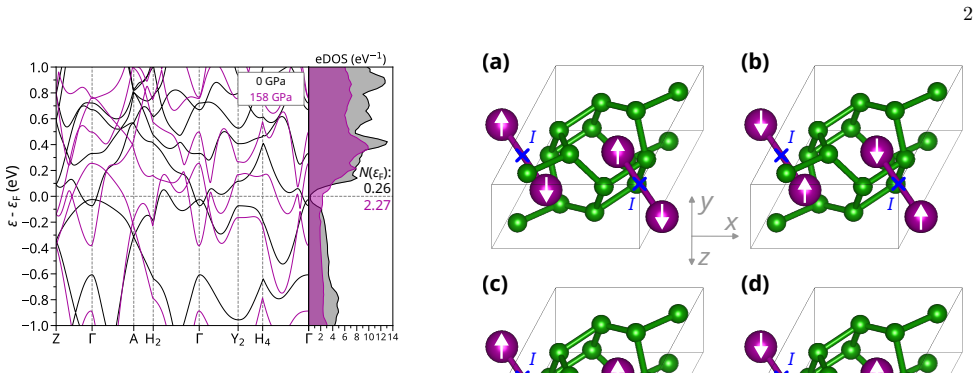


read the original abstract
Recent experiments found superconductivity in nonmagnetic MnB$_4$ with a high critical temperature ($T_{c}$) reaching 14 K at 158 GPa. However, ab initio calculations of the electron-phonon coupling predict a $T_{c}$ below 1 K, suggesting that a conventional mechanism cannot explain this phenomenon. In this Letter, we find that MnB$_4$ is close to an altermagnetic instability in density-functional theory calculations. We propose that the superconductivity is driven by altermagnetic spin fluctuations. To verify the pairing symmetry, we have constructed a two-orbital tight-binding model, where boron states at the Fermi level are integrated out. Using this model, we identify an extended-$s$ symmetry as the leading pairing instability. If confirmed, this will be the first reported case of superconductivity driven by altermagnetic spin fluctuations.
Editorial analysis
A structured set of objections, weighed in public.
Referee Report
Summary. The manuscript reports superconductivity in nonmagnetic MnB4 under high pressure (Tc reaching 14 K at 158 GPa), notes that ab initio electron-phonon calculations yield Tc below 1 K, finds proximity to an altermagnetic instability in DFT, proposes that altermagnetic spin fluctuations drive the pairing, constructs a two-orbital tight-binding model by integrating out boron states at the Fermi level, and identifies extended-s symmetry as the leading pairing instability.
Significance. If the proposal is substantiated by quantitative calculations, this would constitute the first reported case of superconductivity mediated by altermagnetic spin fluctuations. The combination of DFT instability detection and symmetry analysis in a reduced model provides a concrete, falsifiable framework that could stimulate searches for similar phenomena in other altermagnetic candidates and clarify the role of spin fluctuations beyond conventional mechanisms.
major comments (2)
- [Abstract] Abstract: The central claim that altermagnetic spin fluctuations explain the observed Tc=14 K is not supported by any quantitative estimate of Tc (or eigenvalue spectrum) obtained from the pairing interaction in the two-orbital model; no energy-scale comparison or error analysis is supplied to show that the mechanism can reach the experimental value.
- [Two-orbital tight-binding model] Two-orbital tight-binding model (as described in the abstract): The step of integrating out boron states at the Fermi level implicitly assumes these states do not qualitatively alter the effective interaction or the dominance of the altermagnetic channel, yet no RPA susceptibility on the full bands, no larger-basis comparison, and no check against residual phonon or other channels are reported to validate this reduction.
Simulated Author's Rebuttal
We thank the referee for the careful reading and constructive comments on our manuscript. We address each major point below and agree that the current analysis is primarily qualitative and symmetry-based. Revisions will be made to clarify the scope and limitations of our claims.
read point-by-point responses
-
Referee: [Abstract] The central claim that altermagnetic spin fluctuations explain the observed Tc=14 K is not supported by any quantitative estimate of Tc (or eigenvalue spectrum) obtained from the pairing interaction in the two-orbital model; no energy-scale comparison or error analysis is supplied to show that the mechanism can reach the experimental value.
Authors: We agree that no quantitative Tc is computed from the pairing interaction in the two-orbital model. The work shows DFT proximity to altermagnetic order and identifies extended-s as the leading instability via the reduced model, offering a plausible mechanism for the observed high Tc. A full quantitative calculation would require solving the Eliashberg equations with the fluctuation-mediated interaction, which is beyond the scope of this Letter. We will revise the abstract and main text to present the result as a proposed mechanism supported by symmetry analysis, with quantitative verification noted as future work. revision: partial
-
Referee: [Two-orbital tight-binding model] The step of integrating out boron states at the Fermi level implicitly assumes these states do not qualitatively alter the effective interaction or the dominance of the altermagnetic channel, yet no RPA susceptibility on the full bands, no larger-basis comparison, and no check against residual phonon or other channels are reported to validate this reduction.
Authors: The two-orbital model projects onto Mn d-states near the Fermi level, as boron p-states are secondary according to our DFT calculations, and the altermagnetic instability is already present in the full DFT band structure. We acknowledge that explicit RPA on the complete bands and checks against other channels would provide stronger validation. In the revised manuscript we will expand the discussion of the model construction, its physical justification, and the associated limitations. revision: yes
- Quantitative estimate of Tc from the altermagnetic spin-fluctuation pairing interaction in the two-orbital model
Circularity Check
No significant circularity; derivation remains self-contained
full rationale
The paper's chain proceeds from DFT identification of proximity to an altermagnetic instability, to construction of a two-orbital tight-binding model (with boron states integrated out), to explicit determination of extended-s as the leading eigenvalue of the pairing interaction. None of these steps reduces by construction to a fitted parameter, self-referential definition, or load-bearing self-citation; the pairing symmetry is an output of the model rather than presupposed in its construction. The integration-out step is an explicit approximation whose validity can be checked externally, and no uniqueness theorem or ansatz is smuggled in via prior author work. This is the normal case of an independent modeling pipeline.
Axiom & Free-Parameter Ledger
axioms (2)
- domain assumption Density functional theory reliably detects proximity to altermagnetic instabilities.
- ad hoc to paper Integrating out boron states at the Fermi level preserves the essential pairing physics.
invented entities (1)
-
Altermagnetic spin fluctuations as pairing mediator
no independent evidence
Reference graph
Works this paper leans on
-
[1]
Although thet i parameters are the most important in the TB model, the terms withu j parameters are also allowed by symmetry and improve the agreement with the DFT results
for details regarding the Wannierization procedure). Although thet i parameters are the most important in the TB model, the terms withu j parameters are also allowed by symmetry and improve the agreement with the DFT results. All TB parameters extracted from the Wannierization are reported in Table I. The resulting TB Fermi surface is compared to the DFT ...
-
[2]
L. ˇSmejkal, J. Sinova, and T. Jungwirth,Beyond conven- tional ferromagnetism and antiferromagnetism: A phase with nonrelativistic spin and crystal rotation symmetry, Phys. Rev. X12, 031042 (2022),https://link.aps. org/doi/10.1103/PhysRevX.12.031042
-
[3]
ˇSmejkal, J
L. ˇSmejkal, J. Sinova, and T. Jungwirth,Emerg- ing research landscape of altermagnetism, Phys. Rev. X12, 040501 (2022),https://link.aps.org/doi/10. 1103/PhysRevX.12.040501
2022
-
[4]
I. I. Mazin,Notes on altermagnetism and superconductiv- ity, AAPPS Bulletin35, 18 (2025),https://doi.org/ 10.1007/s43673-025-00158-6. I. I. Mazin,Notes on altermagnetism and superconduc- tivity(2022),https://doi.org/10.48550/arXiv.2203. 05000
- [5]
-
[6]
Sigrist and K
M. Sigrist and K. Ueda,Phenomenological theory of unconventional superconductivity, Rev. Mod. Phys. 63, 239 (1991),https://link.aps.org/doi/10.1103/ RevModPhys.63.239
1991
-
[7]
Moriya and K
T. Moriya and K. Ueda,Antiferromagnetic spin fluc- tuation and superconductivity, Reports on Progress in Physics66, 1299 (2003),https://doi.org/10.1088/ 0034-4885/66/8/202
2003
-
[8]
P. A. Lee, N. Nagaosa, and X.-G. Wen,Doping a Mott insulator: Physics of high-temperature superconductivity, Rev. Mod. Phys.78, 17 (2006),https://link.aps.org/ doi/10.1103/RevModPhys.78.17
-
[9]
I. I. Mazin,Unconventional superconductivity, inEn- cyclopedia of Condensed Matter Physics (Second Edi- tion), edited by T. Chakraborty (Academic Press, Oxford, 2024), pp. 598–599, second edition ed., ISBN 978-0-323-91408-6,https://www.sciencedirect. com/science/article/pii/B9780323908009001608. 5
2024
-
[10]
I. I. Mazin and D. J. Singh,Ferromagnetic spin fluctua- tion induced superconductivity inSr 2RuO4, Phys. Rev. Lett.79, 733 (1997),https://link.aps.org/doi/10. 1103/PhysRevLett.79.733
1997
-
[11]
P. J. Hirschfeld, M. M. Korshunov, and I. I. Mazin, Gap symmetry and structure of Fe-based superconduc- tors, Reports on Progress in Physics74, 124508 (2011), https://doi.org/10.1088/0034-4885/74/12/124508
-
[12]
Hosono and K
H. Hosono and K. Kuroki,Iron-based superconduc- tors: Current status of materials and pairing mech- anism, Physica C: Superconductivity and its Ap- plications514, 399 (2015), superconducting Ma- terials: Conventional, Unconventional and Unde- termined,https://www.sciencedirect.com/science/ article/pii/S0921453415000477
2015
-
[13]
Y.-M. Wu, Y. Wang, and R. M. Fernandes,Intra-unit- cell singlet pairing mediated by altermagnetic fluctua- tions, Phys. Rev. Lett.135, 156001 (2025),https:// link.aps.org/doi/10.1103/dlpb-gfct
-
[14]
M. Roig, A. Kreisel, Y. Yu, B. M. Andersen, and D. F. Agterberg,Minimal models for altermagnetism, Physi- cal Review B110(2024),http://dx.doi.org/10.1103/ PhysRevB.110.144412
2024
-
[15]
D. S. Antonenko, R. M. Fernandes, and J. W. Vender- bos,Mirror chern bands and weyl nodal loops in al- termagnets, Physical Review Letters134(2025),http: //dx.doi.org/10.1103/PhysRevLett.134.096703
-
[17]
See Supplemental Material at for additional details regarding the crystallographic data, DFPT calcula- tions, superconducting gap equation, Wannierization, and MnB4 historical background
-
[18]
Fruchart and A
R. Fruchart and A. Michel,Un nouveau borure de man- gan` ese, MnB4, Comptes Rendus Hebdomadaires des S´ eances de l’Acad´ emie des Sciences251, 2953 (1960)
1960
-
[19]
Andersson, G
S. Andersson, G. G. Jacobsen, H. M. Seip, C.-G. Lindblad, A. A. Lindberg, G. Jansen, B. Lamm, and B. Samuelsson,A note on the crystal structure of MnB 4, Acta Chem. Scand.23, 687 (1969)
1969
-
[20]
Andersson, J.-O
S. Andersson, J.-O. Carlsson, E. E. Astrup, S. Liaaen- Jensen, A. Lamvik, E. Sunde, and N. A. Sørensen,The crystal structure of MnB 4, Acta Chem. Scand.24, 1791 (1970)
1970
-
[21]
A. N. Kolmogorov, S. Shah, E. R. Margine, A. F. Bialon, T. Hammerschmidt, and R. Drautz,New su- perconducting and semiconducting fe-b compounds pre- dicted with an ab initio evolutionary search, Phys. Rev. Lett.105, 217003 (2010),https://link.aps.org/doi/ 10.1103/PhysRevLett.105.217003
-
[22]
B. Wang, X. Li, Y. X. Wang, and Y. F. Tu,Phase stability and physical properties of manganese borides: A first-principles study, The Journal of Physical Chem- istry C115, 21429 (2011),https://doi.org/10.1021/ jp2073683
2011
-
[23]
A. F. Bialon, T. Hammerschmidt, R. Drautz, S. Shah, E. R. Margine, and A. N. Kolmogorov,Possible routes for synthesis of new boron-rich Fe–B and Fe 1−xCrxB4 compounds, Applied Physics Letters98, 081901 (2011), https://doi.org/10.1063/1.3556564
-
[24]
H. Gou, Z. Li, H. Niu, F. Gao, J. Zhang, R. C. Ewing, and J. Lian,Unusual rigidity and ideal strength of CrB 4 and MnB 4, Applied Physics Letters100, 111907 (2012), https://doi.org/10.1063/1.3692777
-
[25]
H. Niu, J. Wang, X.-Q. Chen, D. Li, Y. Li, P. Lazar, R. Podloucky, and A. N. Kolmogorov,Structure, bond- ing, and possible superhardness of CrB 4, Phys. Rev. B85, 144116 (2012),https://link.aps.org/doi/10. 1103/PhysRevB.85.144116
2012
-
[26]
H. Gou, N. Dubrovinskaia, E. Bykova, A. A. Tsirlin, D. Kasinathan, W. Schnelle, A. Richter, M. Merlini, M. Hanfland, A. M. Abakumov, D. Batuk, G. Van Ten- deloo, Y. Nakajima, A. N. Kolmogorov, and L. Dubrovin- sky,Discovery of a superhard iron tetraboride supercon- ductor, Phys. Rev. Lett.111, 157002 (2013),https:// link.aps.org/doi/10.1103/PhysRevLett.111.157002
-
[27]
H. Gou, A. A. Tsirlin, E. Bykova, A. M. Abakumov, G. Van Tendeloo, A. Richter, S. V. Ovsyannikov, A. V. Kurnosov, D. M. Trots, Z. Konˆ opkov´ a, H.-P. Liermann, L. Dubrovinsky, and N. Dubrovinskaia,Peierls distor- tion, magnetism, and high hardness of manganese tetra- boride, Phys. Rev. B89, 064108 (2014),https://link. aps.org/doi/10.1103/PhysRevB.89.064108
-
[29]
Van Der Geest and A
A. Van Der Geest and A. Kolmogorov,Stability of 41 metal–boron systems at 0 GPa and 30 GPa from first principles, Calphad46, 184 (2014), https://www.sciencedirect.com/science/article/ pii/S0364591614000364
2014
-
[30]
Y. Liang, Z. Wu, and S. Wang,Magnetostructural, me- chanical and electronic properties of manganese tetra- boride, AIP Advances5, 117208 (2015),https://doi. org/10.1063/1.4935485
-
[31]
Bykova, Dissertation, University of Bayreuth, Bayreuth, Germany (2015), available athttps: //epub.uni-bayreuth.de/id/eprint/2124/1/Thesis_ Bykova_final_version.pdf
E. Bykova, Dissertation, University of Bayreuth, Bayreuth, Germany (2015), available athttps: //epub.uni-bayreuth.de/id/eprint/2124/1/Thesis_ Bykova_final_version.pdf
2015
-
[32]
Steinki, J
N. Steinki, J. Winter, D. S. Grachtrup, D. Men- zel, S. S¨ ullow, A. Knappschneider, and B. Albert, Electronic and magnetic ground state of MnB 4, Jour- nal of Alloys and Compounds695, 2149 (2017), https://www.sciencedirect.com/science/article/ pii/S0925838816335277
2017
-
[33]
S. Hajinazar, A. Thorn, E. D. Sandoval, S. Kharabadze, and A. N. Kolmogorov,MAISE: construction of neu- ral network interatomic models and evolutionary struc- ture optimization, Computer Physics Communications 259, 107679 (2021),http://dx.doi.org/10.1016/j. cpc.2020.107679
work page doi:10.1016/j 2021
-
[35]
J. A. Wilson,A perspective on the fe-based supercon- ductors, Journal of Physics: Condensed Matter22, 203201 (2010),https://doi.org/10.1088/0953-8984/ 22/20/203201. 6
-
[36]
Y. Luo, F. Ronning, N. Wakeham, X. Lu, T. Park, Z.-A. Xu, and J. D. Thompson,Pressure-tuned quan- tum criticality in the antiferromagnetic Kondo semimetal CeNi2−δAs2, Proceedings of the National Academy of Sciences112, 13520 (2015),https://www.pnas.org/ doi/abs/10.1073/pnas.1509581112
-
[37]
Pauling,The nature of the chemical bond
L. Pauling,The nature of the chemical bond. ii. the one- electron bond and the three-electron bond, Journal of the American Chemical Society53, 3225 (1931),https:// doi.org/10.1021/ja01360a004
-
[38]
Zener,Interaction between thed-shells in the transi- tion metals
C. Zener,Interaction between thed-shells in the transi- tion metals. ii. ferromagnetic compounds of manganese with perovskite structure, Phys. Rev.82, 403 (1951), https://link.aps.org/doi/10.1103/PhysRev.82.403
-
[39]
J. B. Goodenough,Theory of the role of covalence in the perovskite-type manganites[La, m(II)]Mno 3, Phys. Rev. 100, 564 (1955),https://link.aps.org/doi/10.1103/ PhysRev.100.564
1955
-
[40]
J. K¨ ubler, A. R. William, and C. B. Sommers,Forma- tion and coupling of magnetic moments in heusler alloys, Phys. Rev. B28, 1745 (1983),https://link.aps.org/ doi/10.1103/PhysRevB.28.1745
-
[41]
N. D. Mathur, F. M. Grosche, S. R. Julian, I. R. Walker, D. M. Freye, R. K. W. Haselwimmer, and G. G. Lon- zarich,Magnetically mediated superconductivity in heavy fermion compounds, Nature394, 39 (1998),https:// doi.org/10.1038/27838
-
[42]
T. Shibauchi, A. Carrington, and Y. Matsuda,A quantum critical point lying beneath the super- conducting dome in iron pnictides, Annual Re- view of Condensed Matter Physics5, 113 (2014), https://www.annualreviews.org/content/journals/ 10.1146/annurev-conmatphys-031113-133921
-
[43]
A. G. Petukhov, I. I. Mazin, L. Chioncel, and A. I. Licht- enstein,Correlated metals and theLDA+umethod, Phys. Rev. B67, 153106 (2003),https://link.aps.org/doi/ 10.1103/PhysRevB.67.153106
-
[44]
S. Das, H. Paudyal, E. R. Margine, D. F. Agterberg, and I. I. Mazin,Electron-phonon coupling and spin fluc- tuations in the Ising superconductor NbSe 2, npj Compu- tational Materials9, 66 (2023),https://doi.org/10. 1038/s41524-023-01017-4
2023
-
[45]
Texas Advanced Computing Center,Frontera & Stam- pede3, Service provided by the University of Texas at Austin (2025),http://www.tacc.utexas.edu
2025
-
[46]
San Diego Supercomputer Center,Expanse, Service pro- vided by the University of California San Diego (2025)
2025
-
[47]
Physical Review B47, 558–561 (1993)
G. Kresse and J. Hafner,Ab initio molecular dynamics for liquid metals, Phys. Rev. B47, 558 (1993),https: //link.aps.org/doi/10.1103/PhysRevB.47.558
-
[48]
Kresse and J
G. Kresse and J. Hafner,Ab initio molecular- dynamics simulation of the liquid-metal–amorphous- semiconductor transition in germanium, Phys. Rev. B 49, 14251 (1994),https://link.aps.org/doi/10.1103/ PhysRevB.49.14251
1994
-
[49]
G. Kresse and J. Furthm¨ uller,Efficient iterative schemes for ab initio total-energy calculations using a plane-wave basis set, Phys. Rev. B54, 11169 (1996),https://link. aps.org/doi/10.1103/PhysRevB.54.11169
-
[50]
G. Kresse and J. Furthm¨ uller,Efficiency of ab-initio to- tal energy calculations for metals and semiconductors using a plane-wave basis set, Computational Materials Science6, 15 (1996),https://www.sciencedirect.com/ science/article/pii/0927025696000080
-
[51]
G. Kresse and D. Joubert,From ultrasoft pseudopo- tentials to the projector augmented-wave method, Phys. Rev. B59, 1758 (1999),https://link.aps.org/doi/ 10.1103/PhysRevB.59.1758
-
[52]
P. E. Bl¨ ochl,Projector augmented-wave method, Phys. Rev. B50, 17953 (1994),https://link.aps.org/doi/ 10.1103/PhysRevB.50.17953
-
[53]
J. P. Perdew, K. Burke, and M. Ernzerhof,Generalized gradient approximation made simple, Phys. Rev. Lett. 77, 3865 (1996),https://link.aps.org/doi/10.1103/ PhysRevLett.77.3865
1996
-
[54]
Methfessel and A
M. Methfessel and A. T. Paxton,High-precision sampling for brillouin-zone integration in metals, Phys. Rev. B 40, 3616 (1989),https://link.aps.org/doi/10.1103/ PhysRevB.40.3616
1989
-
[55]
Giannozzi, S
P. Giannozzi, S. Baroni, N. Bonini, M. Calandra, R. Car, C. Cavazzoni, D. Ceresoli, G. L. Chiarotti, M. Cococ- cioni, I. Dabo, A. Dal Corso, S. de Gironcoli, S. Fab- ris, G. Fratesi, R. Gebauer, et al.,Quantum espresso: a modular and open-source software project for quantum simulations of materials, Journal of Physics: Condensed Matter21, 395502 (2009),ht...
2009
-
[56]
P. Giannozzi, O. Andreussi, T. Brumme, O. Bunau, M. Buongiorno Nardelli, M. Calandra, R. Car, C. Cavaz- zoni, D. Ceresoli, M. Cococcioni, N. Colonna, I. Carn- imeo, A. Dal Corso, S. de Gironcoli, P. Delugas, et al., Advanced capabilities for materials modelling with quan- tum espresso, Journal of Physics: Condensed Matter29, 465901 (2017),https://doi.org/...
-
[57]
P. Giannozzi, O. Baseggio, P. Bonf` a, D. Brunato, R. Car, I. Carnimeo, C. Cavazzoni, S. de Gironcoli, P. Delugas, F. Ferrari Ruffino, A. Ferretti, N. Marzari, I. Timrov, A. Urru, and S. Baroni,Quantum espresso toward the exascale, The Journal of Chemical Physics152, 154105 (2020),https://doi.org/10.1063/5.0005082. [57]Quantum ESPRESSO,https://www. quantu...
-
[58]
D. R. Hamann,Optimized norm-conserving Vanderbilt pseudopotentials, Phys. Rev. B88, 085117 (2013)
2013
-
[59]
D. R. Hamann,Erratum: Optimized norm-conserving Vanderbilt pseudopotentials [Phys. Rev. B 88, 085117 (2013)], Phys. Rev. B95, 239906 (2017)
2013
-
[60]
van Setten, M
M. van Setten, M. Giantomassi, E. Bousquet, M. Ver- straete, D. Hamann, X. Gonze, and G.-M. Rignanese, The PseudoDojo: Training and grading a 85 element op- timized norm-conserving pseudopotential table, Comput. Phys. Commun.226, 39 (2018)
2018
-
[61]
K. F. Garrity, J. W. Bennett, K. M. Rabe, and D. Van- derbilt,Pseudopotentials for high-throughput DFT calcu- lations, Comput. Phys. Commun.81, 446 (2014)
2014
-
[62]
Lejaeghere, G
K. Lejaeghere, G. Bihlmayer, T. Bj¨ orkman, P. Blaha, S. Bl¨ ugel, V. Blum, D. Caliste, I. E. Castelli, S. J. Clark, A. Dal Corso, S. de Gironcoli, T. Deutsch, J. Kay De- whurst, I. Di Marco, C. Draxl, et al.,Reproducibility in density functional theory calculations of solids, Science 351, 1415 (2016)
2016
-
[63]
VESTA3 for three-dimensional visualization of crystal, volumetric and morphology data
K. Momma and F. Izumi,VESTA3 for three-dimensional visualization of crystal, volumetric and morphology data, Journal of Applied Crystallography44, 1272 (2011), https://doi.org/10.1107/S0021889811038970
-
[64]
M. Kawamura,Fermisurfer: Fermi-surface viewer providing multiple representation schemes, Com- 7 puter Physics Communications239, 197 (2019), https://www.sciencedirect.com/science/article/ pii/S0010465519300347
2019
-
[65]
A. Smolyanyuk, L. ˇSmejkal, and I. I. Mazin,A tool to check whether a symmetry-compensated collinear mag- netic material is antiferro- or altermagnetic, SciPost Phys. Codebases p. 30 (2024),https://scipost.org/ 10.21468/SciPostPhysCodeb.30
-
[66]
Smolyanyuk, L
A. Smolyanyuk, L. ˇSmejkal, and I. I. Mazin,Code- base release r1.0 for amcheck, SciPost Phys. Codebases pp. 30–r1.0 (2024),https://scipost.org/10.21468/ SciPostPhysCodeb.30-r1.0
2024
-
[67]
Wannier90 as a community code: New features and applications
G. Pizzi, V. Vitale, R. Arita, S. Bl¨ ugel, F. Freimuth, G. G´ eranton, M. Gibertini, D. Gresch, C. Johnson, T. Koretsune, J. Iba˜ nez-Azpiroz, H. Lee, J.-M. Lihm, D. Marchand, A. Marrazzo, et al.,Wannier90 as a community code: new features and applications, Jour- nal of Physics: Condensed Matter32, 165902 (2020), https://doi.org/10.1088/1361-648X/ab51ff
-
[68]
Marzari, A
N. Marzari, A. A. Mostofi, J. R. Yates, I. Souza, and D. Vanderbilt,Maximally localized Wannier func- tions: Theory and applications, Rev. Mod. Phys. 84, 1419 (2012),https://link.aps.org/doi/10.1103/ RevModPhys.84.1419. Supplemental Material Superconductivity induced by altermagnetic spin fluctuations in high-pressure MnB 4 Danylo Radevych,1,∗ Merc` e Roi...
2012
-
[69]
Z.-N. Xiang, Y.-J. Zhang, Q. Lu, Q. Li, Y. Li, T. Huang, Y. Zhu, Y. Ye, J. Sun, and H.-H. Wen, Superconductivity up to 14.2 K in MnB 4 Under Pressure, Advanced Materials37, 2416882 (2025), https://advanced.onlinelibrary.wiley.com/doi/pdf/10.1002/adma.202416882
-
[70]
H. T. Stokes, D. M. Hatch, and B. J. Campbell, FINDSYM, ISOTROPY software suite,http://iso.byu.edu
-
[71]
H. T. Stokes and D. M. Hatch, FINDSYM: program for identifying the space-group symmetry of a crystal, Journal of Applied Crystallography38, 237 (2005), https://onlinelibrary.wiley.com/doi/pdf/10.1107/S0021889804031528
-
[72]
Y.-M. Wu, Y. Wang, and R. M. Fernandes, Intra-unit-cell singlet pairing mediated by altermagnetic fluctuations, Phys. Rev. Lett.135, 156001 (2025)
2025
-
[73]
M. Wierzbowska, S. de Gironcoli, and P. Giannozzi, Origins of low- and high-pressure discontinuities ofT c in niobium (2006), arXiv:cond-mat/0504077 [cond-mat.supr-con]
-
[74]
Eliashberg, Interaction of electrons with lattice vibrations in a superconductor, Zh
G. Eliashberg, Interaction of electrons with lattice vibrations in a superconductor, Zh. eksp. teor. Fiz38, 966 (1960)
1960
-
[75]
W. L. McMillan, Transition Temperature of Strong-Coupled Superconductors, Phys. Rev.167, 331 (1968)
1968
-
[76]
Dynes, Mcmillan’s equation and the tc of superconductors, Solid State Communications10, 615 (1972)
R. Dynes, Mcmillan’s equation and the tc of superconductors, Solid State Communications10, 615 (1972)
1972
-
[77]
Pizzi, V
G. Pizzi, V. Vitale, R. Arita, S. Bl¨ ugel, F. Freimuth, G. G´ eranton, M. Gibertini, D. Gresch, C. Johnson, T. Koretsune, J. Iba˜ nez-Azpiroz, H. Lee, J.-M. Lihm, D. Marchand, A. Marrazzo, Y. Mokrousov, J. I. Mustafa, Y. Nohara, Y. Nomura, L. Paulatto, S. Ponc´ e, T. Ponweiser, J. Qiao, F. Th¨ ole, S. S. Tsirkin, M. Wierzbowska, N. Marzari, D. Vanderbilt...
2020
-
[78]
Marzari, A
N. Marzari, A. A. Mostofi, J. R. Yates, I. Souza, and D. Vanderbilt, Maximally localized Wannier functions: Theory and applications, Rev. Mod. Phys.84, 1419 (2012)
2012
-
[79]
Souza, N
I. Souza, N. Marzari, and D. Vanderbilt, Maximally localized wannier functions for entangled energy bands, Phys. Rev. B 65, 035109 (2001)
2001
-
[80]
Fruchart and A
R. Fruchart and A. Michel, Un nouveau borure de mangan` ese, MnB 4, Comptes Rendus Hebdomadaires des S´ eances de l’Acad´ emie des Sciences251, 2953 (1960)
1960
-
[81]
Andersson, G
S. Andersson, G. G. Jacobsen, H. M. Seip, C.-G. Lindblad, A. A. Lindberg, G. Jansen, B. Lamm, and B. Samuelsson, A note on the crystal structure of MnB 4, Acta Chem. Scand.23, 687 (1969)
1969
-
[82]
Andersson, J.-O
S. Andersson, J.-O. Carlsson, E. E. Astrup, S. Liaaen-Jensen, A. Lamvik, E. Sunde, and N. A. Sørensen, The crystal structure of MnB 4, Acta Chem. Scand.24, 1791 (1970)
1970
-
[83]
H. Gou, Z. Li, H. Niu, F. Gao, J. Zhang, R. C. Ewing, and J. Lian, Unusual rigidity and ideal strength of CrB 4 and MnB4, Applied Physics Letters100, 111907 (2012)
2012
discussion (0)
Sign in with ORCID, Apple, or X to comment. Anyone can read and Pith papers without signing in.