Recognition: unknown
Research Streams in Biodiversity Finance: A Bibliometric Analysis and Research Agenda
Pith reviewed 2026-05-08 12:46 UTC · model grok-4.3
The pith
Bibliometric analysis of nearly 4,000 papers maps biodiversity finance into eight distinct research streams with limited interaction.
A machine-rendered reading of the paper's core claim, the machinery that carries it, and where it could break.
Core claim
By examining 189,456 references underlying 3,998 articles on biodiversity and finance, the analysis identifies eight primary research streams: strategic and financial approaches in global biodiversity conservation, the impact and implementation of payments for environmental services in developing countries, neoliberal influences and implications in environmental conservation, biodiversity offsets and conservation, ecosystem services and biodiversity, integrating conservation and community interests in biodiversity management, balancing agricultural intensification with biodiversity conservation, and global and corporate biodiversity reporting. The study outlines each stream's characteristics
What carries the argument
Bibliometric clustering and co-citation analysis applied to the reference lists of 3,998 articles to delineate and characterize eight research streams and their interconnections.
If this is right
- Pronounced silos limit information exchange, especially between economically oriented and critical or political-economy research streams.
- The temporal patterns in stream development can inform priorities for future studies and funding.
- Policymakers, financial institutions, and corporate actors gain a structured overview that supports more targeted use of existing knowledge.
- A focused research agenda follows directly from the identified gaps in cross-stream integration.
Where Pith is reading between the lines
- Greater integration across the economic and critical streams could improve the design of real-world financial instruments by incorporating both efficiency metrics and equity concerns.
- Similar bibliometric mapping applied to related areas such as climate finance might reveal comparable fragmentation and guide cross-field learning.
- Corporate biodiversity reporting practices could be benchmarked against the eighth stream to identify where disclosure standards lag behind academic insight.
Load-bearing premise
The search strategy and database selection produced a corpus of 3,998 articles that comprehensively and without major bias represents the entire biodiversity finance literature, and the clustering methods validly separate it into eight distinct streams.
What would settle it
Re-running the analysis on an expanded corpus that includes additional papers from overlooked journals or disciplines and finding that the original eight clusters merge, split, or leave out major themes would undermine the claimed map of the field.
Figures

read the original abstract
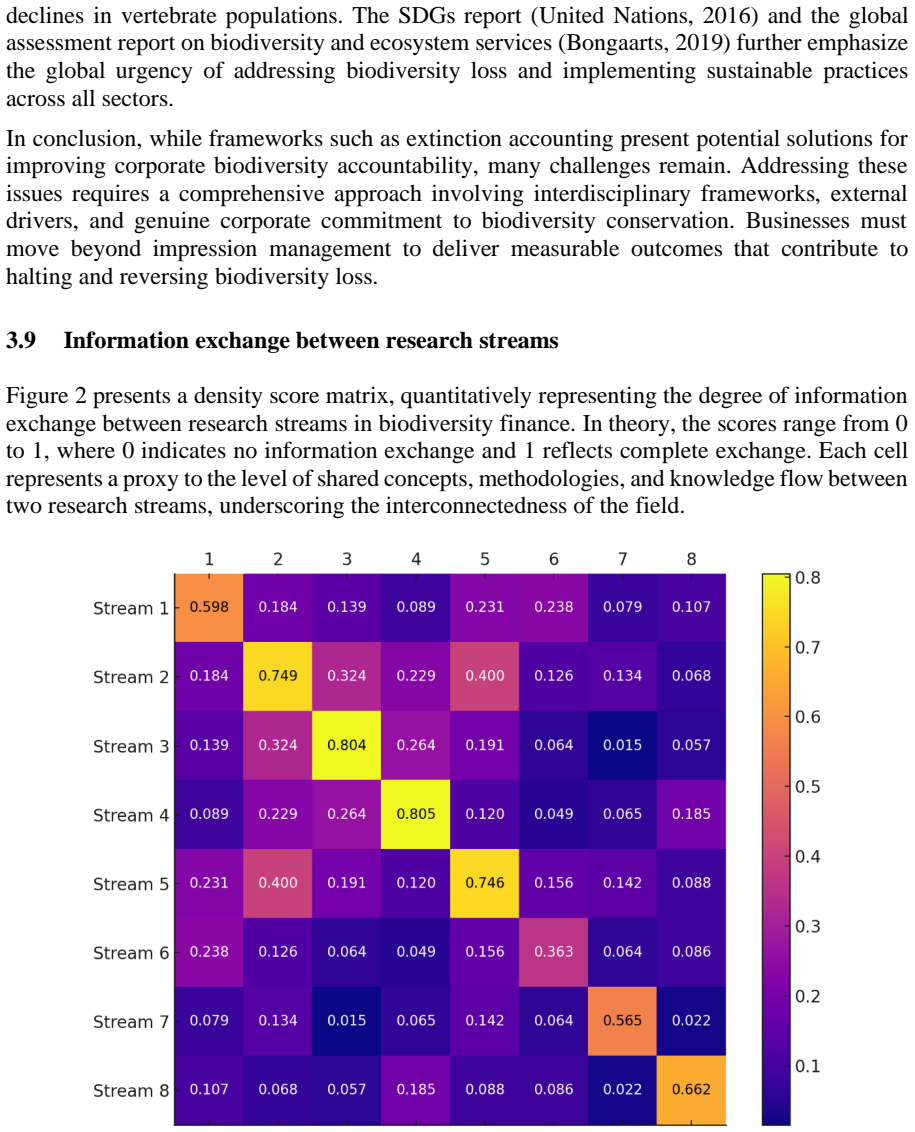
Biodiversity loss is accelerating at an unprecedented pace, threatening ecosystem stability, economic resilience, and human well-being, with billions required to reverse current trends. Against this backdrop, biodiversity finance has emerged as a rapidly expanding but highly fragmented field spanning ecology, economics, finance, accounting, and policy. However, it remains emerging and complex, with the majority of relevant knowledge being produced in non-finance journals. This study employs quantitative bibliometric analysis to examine a corpus of 189,456 references underlying 3,998 articles related to biodiversity and finance. The analysis identifies eight primary research streams within the field that concern (1) strategic and financial approaches in global biodiversity conservation, (2) the impact and implementation of payments for environmental services (PES) in developing countries, (3) neoliberal influences and implications in environmental conservation, (4) biodiversity offsets and conservation, (5) ecosystem services and biodiversity, (6) integrating conservation and community interests in biodiversity management, (7) balancing agricultural intensification with biodiversity conservation, and (8) global and corporate biodiversity reporting. The characteristics of each research stream and its prevalent publications are outlined, alongside an analysis of their temporal evolution and the degree of information exchange among the research streams. The findings provide a structured map of the intellectual architecture of biodiversity finance, document pronounced silos between economically-oriented and critical/political-economy research streams, and translate these patterns into a focused research agenda and implications for policymakers, financial institutions, and corporate actors.
Editorial analysis
A structured set of objections, weighed in public.
Referee Report
Summary. The manuscript performs a bibliometric analysis of 3,998 articles (189,456 references) on biodiversity finance. It identifies eight research streams, characterizes each by prevalent publications and themes, tracks their temporal evolution, quantifies information exchange among streams, and derives a research agenda that emphasizes silos between economically oriented and critical/political-economy approaches.
Significance. The large corpus size provides a broad empirical basis for mapping an emerging, fragmented field. If the clustering is robust, the work supplies a structured overview that can help researchers locate gaps, policymakers understand disciplinary divides, and institutions navigate the literature. The explicit translation of bibliometric patterns into a focused agenda and stakeholder implications is a constructive contribution.
major comments (2)
- [Methods] Methods section: the paper provides no explicit search string, database(s), date range, or inclusion/exclusion criteria used to assemble the 3,998-article corpus. Because the eight streams and the silo observation rest directly on this sample, the absence of these details prevents assessment of coverage bias (e.g., under-representation of finance journals) and precludes replication.
- [Results] Results (clustering subsection): no modularity, silhouette, or stability metrics are reported for the community-detection procedure that produced the eight streams, nor are sensitivity checks on resolution parameters or alternative clustering algorithms presented. Without these diagnostics the claim of 'pronounced silos' between economically oriented and critical streams cannot be evaluated for robustness.
minor comments (2)
- [Abstract] Abstract: omits any mention of search terms, database, or clustering method, which would immediately signal the scope and methodological foundation to readers.
- [Figures] Figures 3-5 (network visualizations): node labels and edge weights are difficult to read at the published size; adding a legend that states the clustering algorithm and resolution parameter would improve clarity.
Simulated Author's Rebuttal
We thank the referee for the constructive comments and the recommendation for minor revision. We have addressed the concerns about the methods transparency and the robustness of the clustering analysis by expanding the relevant sections in the revised manuscript.
read point-by-point responses
-
Referee: [Methods] Methods section: the paper provides no explicit search string, database(s), date range, or inclusion/exclusion criteria used to assemble the 3,998-article corpus. Because the eight streams and the silo observation rest directly on this sample, the absence of these details prevents assessment of coverage bias (e.g., under-representation of finance journals) and precludes replication.
Authors: We acknowledge this omission in the original submission. The revised manuscript now includes a detailed description of the data collection process in the Methods section, specifying the search string ('biodiversity* AND (finance OR financing OR investment)'), the database used (Web of Science Core Collection), the time period (January 1990 to December 2023), and the inclusion criteria (peer-reviewed journal articles in English) along with exclusion criteria (non-peer-reviewed items, duplicates, and articles not related to biodiversity finance). This information allows readers to assess potential biases and replicate the corpus assembly. revision: yes
-
Referee: [Results] Results (clustering subsection): no modularity, silhouette, or stability metrics are reported for the community-detection procedure that produced the eight streams, nor are sensitivity checks on resolution parameters or alternative clustering algorithms presented. Without these diagnostics the claim of 'pronounced silos' between economically oriented and critical streams cannot be evaluated for robustness.
Authors: We agree that providing these metrics would enhance the credibility of the clustering results. In the revised version, we have added a new paragraph in the Results section reporting the modularity score, average silhouette width, and cluster stability assessed through bootstrap resampling. Additionally, we present sensitivity analyses for different resolution parameters and an alternative algorithm (Leiden), which yield consistent stream identifications and support the observed silos between the economically oriented and critical research streams. revision: yes
Circularity Check
No significant circularity in the bibliometric derivation
full rationale
The paper performs a standard empirical bibliometric analysis on an external corpus of 3,998 articles and 189,456 references drawn from databases. The eight research streams are produced by applying clustering or co-citation methods to that input data; no equations, fitted parameters, or self-citations are invoked as load-bearing premises that reduce the output streams to the authors' prior results by construction. The derivation is therefore self-contained as a data-driven mapping rather than a tautological restatement of inputs.
Axiom & Free-Parameter Ledger
free parameters (1)
- Number of research streams
axioms (2)
- domain assumption The selected set of 3,998 articles and their references accurately and comprehensively captures the biodiversity finance literature
- domain assumption Quantitative bibliometric techniques such as co-citation or keyword clustering can reliably identify distinct intellectual research streams
Reference graph
Works this paper leans on
-
[1]
https://doi.org/10.1126/science.1187512 Calice, P., Diaz Kalan, F., Dunz, N., Miguel, F., 2023. Biodiversity and Finance: A Preliminary Assessment of Physical Risks for the Banking Sector in Emerging Markets. The World Bank. https://doi.org/10.1596/1813-9450-10432 Cardinale, B.J., Duffy, J.E., Gonzalez, A., Hooper, D.U., Perrings, C., Venail, P., Narwani,...
-
[2]
The value of the world’s ecosystem services and natural capital. Nature 387, 253–260. https://doi.org/10.1038/387253a0 Costello, M.J., Michener, W.K., Gahegan, M., Zhang, Z.-Q., Bourne, P.E., 2013. Biodiversity data should be published, cited, and peer reviewed. Trends Ecol. Evol. 28, 454–461. https://doi.org/10.1016/j.tree.2013.05.002 Costello, M.J., Wie...
-
[3]
https://doi.org/10.1016/j.ecolecon.2008.03.011 Fairhead, J., Leach, M., Scoones, I., 2012. Green Grabbing: a new appropriation of nature? Journal of Peasant Studies 39, 237–261. https://doi.org/10.1080/03066150.2012.671770 Ferraro, P.J., Kiss, A., 2002. Direct Payments to Conserve Biodiversity. Science (1979). 298, 1718–1719. https://doi.org/10.1126/scien...
-
[4]
How the World Bank funds protected areas
https://doi.org/10.1016/j.cosust.2012.12.004 Hickey, V., Pimm, S.L., 2011. How the World Bank funds protected areas. Conserv. Lett. 4, 269–277. https://doi.org/10.1111/j.1755-263X.2011.00172.x Hogarty, K.Y., Hines, C. V., Kromrey, J.D., Ferron, J.M., Mumford, K.R., 2005. The Quality of Factor Solutions in Exploratory Factor Analysis: The Influence of Samp...
-
[5]
https://doi.org/10.1038/35099540 Kleijn, D., Sutherland, W.J., 2003. How effective are European agri‐environment schemes in conserving and promoting biodiversity? Journal of Applied Ecology 40, 947–969. https://doi.org/10.1111/j.1365-2664.2003.00868.x Kochupillai, M., Gallersdörfer, U., Köninger, J., Beck, R., 2021. Incentivizing research & innovation...
-
[6]
Maximizing return on investment in conservation. Biol. Conserv. 139, 375–
-
[7]
Biodiversity hotspots for conservation priorities
https://doi.org/10.1016/j.biocon.2007.07.011 Myers, N., Mittermeier, R.A., Mittermeier, C.G., da Fonseca, G.A.B., Kent, J., 2000. Biodiversity hotspots for conservation priorities. Nature 403, 853–858. https://doi.org/10.1038/35002501 Naidoo, R., Balmford, A., Costanza, R., Fisher, B., Green, R.E., Lehner, B., Malcolm, T.R., Ricketts, T.H., 2008. Global m...
-
[8]
Mapping the Economic Costs and Benefits of Conservation
https://doi.org/10.1016/j.tree.2006.10.003 Naidoo, R., Ricketts, T.H., 2006. Mapping the Economic Costs and Benefits of Conservation. PLoS Biol. 4, e360. https://doi.org/10.1371/journal.pbio.0040360 Naughton-Treves, L., Holland, M.B., Brandon, K., 2005. The role of protected areas in conserving biodiversity and sustaining local livelihoods. Annu. Rev. Env...
discussion (0)
Sign in with ORCID, Apple, or X to comment. Anyone can read and Pith papers without signing in.