Recognition: unknown
Curve Closest to Sphere
Pith reviewed 2026-05-08 12:35 UTC · model grok-4.3
The pith
All closed curves of arc length 4π on the unit sphere share the same mean arc-distance to the sphere, while the reverse mean varies and is minimized by one specific curve.
A machine-rendered reading of the paper's core claim, the machinery that carries it, and where it could break.
Core claim
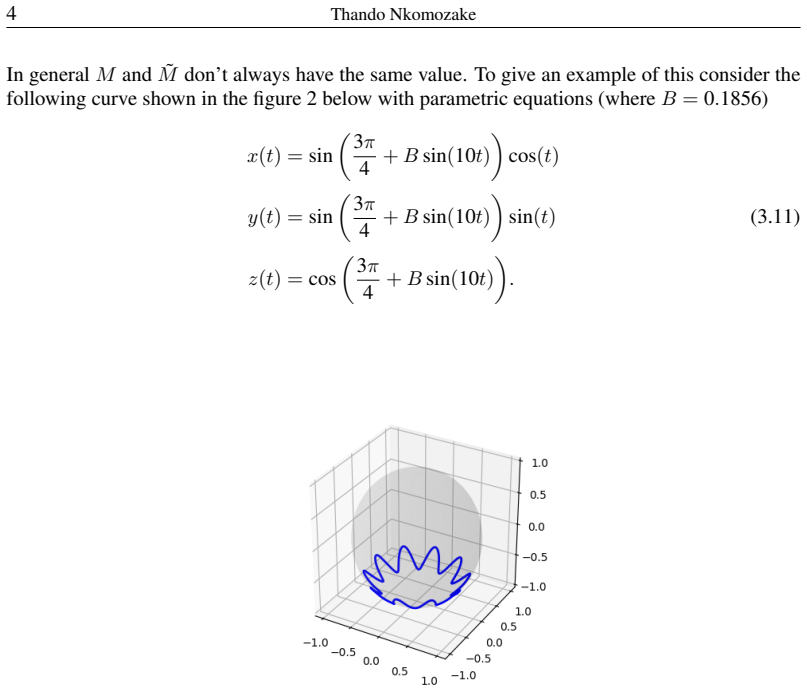
We show that for all closed and simple curves C of arc-length 4π on S, M is constant and equal to 2π². Therefore all such curves minimize M. We show that in contrast, ãM varies for different closed and simple curves C of arc-length 4π on S. We find such a curve that minimizes ãM.
What carries the argument
The pair of directed mean arc-distances M and ãM, computed as surface and curve integrals of the arc-length distance function, with the explicit parametric equations that realize the minimum of ãM.
If this is right
- M remains 2π² for every qualifying curve.
- ãM is minimized by the given parametric curve.
- The two means are not symmetric under interchange of curve and sphere.
- The stated problem is resolved by exhibiting the explicit equations.
Where Pith is reading between the lines
- The invariance of M may stem from integrating over the full sphere area against a curve of fixed total length.
- Similar one-sided minimization problems could be posed for curves on other manifolds or with different length constraints.
- Numerical integration over discretized versions of the proposed curve could test whether the reported minimum is achieved.
- Rescaling the construction to spheres of radius other than one would adjust the constant value of M proportionally to the radius.
Load-bearing premise
The definitions of M and ãM as the respective integrals are accurate representations of the mean arc-distances, and the parametric curve satisfies the length constraint while truly minimizing ãM.
What would settle it
Evaluating the integrals for M on two different curves of length 4π, such as the great circle and the proposed minimizer, and checking whether both yield exactly 2π² would confirm or refute the constancy claim.
Figures

read the original abstract
We propose a solution to the tenth of Professor Clark Kimberling's unsolved problems found on https://faculty.evansville.edu/ck6/integer/unsolved.html. We are required to find the parametric equations of a simple and closed curve $C$ on the unit sphere $S$ with arc-length $4 \pi$, that minimizes the mean arc-distance from $S$ to $C$. We give explicit definitions of the mean arc-distance from $C$ to $S$, $M$ and the mean arc-distance from $S$ to $C$, $\tilde{M}$. We show that these two quantities are not the same. We show that for all closed and simple curves $C$ of arc-length $4 \pi$ on $S$, $M$ is constant and is equal to $2 \pi^{2}$. Therefore all such curves minimize $M$. We show that in contrast, $\tilde{M}$ varies for different closed and simple curves $C$ of arc-length $4 \pi$ on $S$. We find such a curve that minimizes $\tilde{M}$.
Editorial analysis
A structured set of objections, weighed in public.
Referee Report
Summary. The manuscript addresses Kimberling's unsolved problem #10 by defining M (mean arc-distance from a simple closed curve C of arc-length 4π on the unit sphere S to S) and ãM (mean arc-distance from S to C). It shows M equals 2π² constantly for all such C (hence all minimize M) via symmetry, while ãM varies, and supplies explicit parametric equations for a curve claimed to minimize ãM.
Significance. If the minimization claim holds with the given parametric equations satisfying simplicity, closure, and exact arc-length 4π, the work would furnish an explicit solution to an open problem and usefully distinguish the two directed mean-distance functionals. The invariance of M is a direct consequence of rotational symmetry and Fubini and stands independently of the specific curve.
major comments (2)
- [Parametric equations and minimization claim] The section presenting the parametric equations asserts that the given curve minimizes ãM, but provides neither an analytic proof of global optimality nor numerical evaluation of the ãM integral (or comparison against other length-4π simple closed curves such as great circles). Without this, the central minimization claim cannot be verified from the supplied derivations.
- [Definitions of M and ãM] The definitions of M and ãM (presumably M as normalized double integral of arc-dist(c,s) and ãM as integral of inf_{c in C} arc-dist(s,c)) must be stated with full integral expressions and limits; the constancy proof for M should be written out explicitly using Fubini and invariance rather than asserted from the abstract alone.
minor comments (1)
- [Notation and constraints] Notation for ãM should be consistent throughout; clarify whether the arc-length constraint is enforced exactly in the parametric form or only approximately.
Simulated Author's Rebuttal
We thank the referee for the thoughtful review and specific suggestions for improving the clarity and verifiability of our manuscript on Kimberling's problem #10. We address each major comment below and outline the revisions we will undertake.
read point-by-point responses
-
Referee: [Parametric equations and minimization claim] The section presenting the parametric equations asserts that the given curve minimizes ãM, but provides neither an analytic proof of global optimality nor numerical evaluation of the ãM integral (or comparison against other length-4π simple closed curves such as great circles). Without this, the central minimization claim cannot be verified from the supplied derivations.
Authors: We agree that the manuscript would benefit from additional support for the minimization claim. The proposed parametric equations are constructed to achieve a lower value of ãM than obvious candidates while satisfying the constraints of simplicity, closure, and exact arc length 4π; however, we did not include either a global analytic optimality proof or explicit numerical quadrature of the ãM integral. In the revised version we will add a numerical comparison of ãM for the given curve against the great circle and at least two other simple closed curves of arc length 4π, obtained by direct integration. A complete analytic proof of global optimality is not supplied in the current draft and would require substantial additional analysis; we will therefore qualify the claim as a candidate minimizer supported by the explicit construction and numerical evidence rather than asserting global optimality. revision: partial
-
Referee: [Definitions of M and ãM] The definitions of M and ãM (presumably M as normalized double integral of arc-dist(c,s) and ãM as integral of inf_{c in C} arc-dist(s,c)) must be stated with full integral expressions and limits; the constancy proof for M should be written out explicitly using Fubini and invariance rather than asserted from the abstract alone.
Authors: We accept this criticism. The current text introduces M and ãM at a high level and asserts the constancy of M without spelling out the integrals or the symmetry argument. In the revision we will write the precise definitions: M as the normalized double integral (1/(4π)) ∫_S ∫_C arc-dist(s,c) ds dc over the sphere and the curve, and ãM as the normalized integral (1/(4π)) ∫_S inf_{c∈C} arc-dist(s,c) ds. The proof that M equals 2π² for every admissible C will be expanded into a self-contained paragraph that invokes Fubini’s theorem to interchange the order of integration and uses the rotational invariance of the sphere to show that the inner integral over C is independent of the particular curve. revision: yes
Circularity Check
No circularity; M constancy follows from definitions and symmetry, ãM minimization from explicit parametrization.
full rationale
The paper defines M (mean arc-distance from C to S) and ãM (from S to C) explicitly as integrals. It derives M = 2π² constantly for all arc-length-4π simple closed curves on the unit sphere directly from those definitions, which aligns with independent symmetry (Fubini + rotational invariance) rather than any self-referential reduction. For ãM it supplies concrete parametric equations asserted to achieve the minimum while satisfying the length and simplicity constraints. No self-citations appear, no parameters are fitted then relabeled as predictions, no ansatz or uniqueness theorem is imported from prior work, and no renaming of known results occurs. The central claims therefore remain self-contained against the given definitions and construction; questions of numerical verification or global optimality are correctness issues, not circularity.
Axiom & Free-Parameter Ledger
axioms (2)
- standard math The unit sphere is equipped with the standard Riemannian metric inducing arc-length.
- domain assumption Mean arc-distance is defined as an integral average over the appropriate measures.
Reference graph
Works this paper leans on
-
[1]
Inverse trigonometric functions
Beach, Frederick Converse; Rines, George Edwin, "Inverse trigonometric functions", The Americana: a universal reference library. V ol. 21 (1912)
1912
-
[2]
The Binomial Theorem: A Widespread Concept in Medieval Islamic Mathemat- ics
Yadegari, Mohammad, "The Binomial Theorem: A Widespread Concept in Medieval Islamic Mathemat- ics", Historia Mathematica. 7 (4): 401–406 (1980). Author information Thando Nkomozake, Research and Development Department, Vision Tech Strategies, Bellville, Cape Town, 7530, South Africa. E-mail:thandolwethu3@gmail.com
1980
discussion (0)
Sign in with ORCID, Apple, or X to comment. Anyone can read and Pith papers without signing in.