Recognition: unknown
Impact of Primordial Black Hole population on 21 cm observables at high redshift
Pith reviewed 2026-05-08 14:12 UTC · model grok-4.3
The pith
Primordial black holes that seed early AGNs can make the 21-cm global signal shallower and suppress its power spectrum during cosmic dawn.
A machine-rendered reading of the paper's core claim, the machinery that carries it, and where it could break.
Core claim
By incorporating the X-ray contributions from PBHs into the explicitly photon-conserving SCRIPT framework along with standard cosmic dawn physics, the model predicts that this additional heating shallows the global 21-cm absorption trough and reduces the amplitude of the 21-cm power spectrum. The choice of PBH mass function, while obeying observational constraints, leads to significantly different 21-cm predictions.
What carries the argument
The extended SCRIPT semi-numerical code that adds PBH X-ray heating to the reionization and cosmic dawn calculations.
If this is right
- The global 21-cm signal reaches a shallower minimum than in models without PBHs.
- The 21-cm power spectrum amplitude is suppressed during the cosmic dawn epoch.
- Predictions for the 21-cm observables depend strongly on the assumed primordial black hole mass function.
- Self-consistent modeling from z=30 to z=5 becomes possible within one framework.
Where Pith is reading between the lines
- Future 21-cm observations could constrain the abundance or mass distribution of primordial black holes if the heating effect is isolated from other sources.
- Models that ignore early AGN activity may overestimate the contrast of the 21-cm signal and thus the detectability with instruments like HERA or SKA.
- Alternative seeding mechanisms for high-redshift AGNs would produce different heating histories and 21-cm signatures.
Load-bearing premise
That the AGNs seen by JWST at redshifts above 6 are seeded by primordial black holes whose X-ray output can be added directly without other dominant heating channels at those epochs.
What would settle it
A detection of a global 21-cm absorption feature deeper than the PBH-inclusive predictions at redshifts around 15-20 would indicate that the assumed PBH heating is too strong or that the seeding assumption does not hold.
Figures

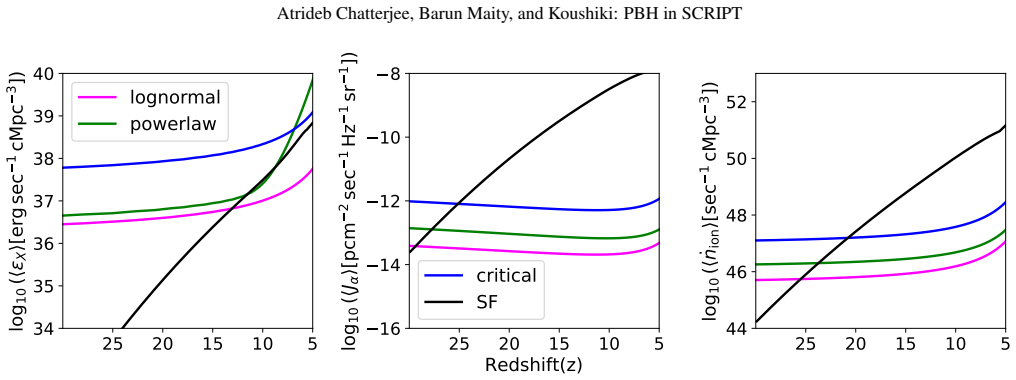


read the original abstract
The 21-cm signal, one of the most promising probes of the high-redshift Universe, has traditionally been modelled without accounting for the effects of active galactic nuclei (AGN) in the pre-JWST era, primarily due to the lack of observational evidence for AGNs at z > 6. However, following the discovery of several AGNs at redshifts as high as z ~ 10 by JWST, it has become imperative to incorporate the impact of these early AGNs when predicting the 21-cm signal. Supposing that these AGNs are seeded by primordial black holes (PBHs), we study their impact with a semi-numerical model setup. Specifically, we extended the explicitly photon-conserving reionization framework, SCRIPT, including essential cosmic dawn physics and PBH contributions. This enables us to compute both the global signal and the power spectrum of the 21-cm line over the redshift range z ~ 30 - 5 within a self-consistent framework. Building on this setup, we then investigate the impact of different PBH mass functions (obeying current observational constraints) on the resulting signal. The X-ray heating from PBHs can substantially make the depth of the global 21-cm signal shallower and suppress the expected power amplitude during cosmic dawn. We also find that the choice of mass function plays a crucial role in shaping the 21-cm signal, and can, in fact, lead to significantly different predictions.
Editorial analysis
A structured set of objections, weighed in public.
Referee Report
Summary. The paper extends the SCRIPT semi-numerical reionization framework to incorporate X-ray heating and ionization from primordial black holes (PBHs) under the assumption that JWST-observed AGNs at z>6 are PBH-seeded. It computes the global 21-cm signal and power spectrum over z~30-5 for several PBH mass functions consistent with current constraints, reporting that PBH X-rays make the global absorption trough shallower and suppress power amplitude during cosmic dawn, with the mass function choice leading to significantly different predictions.
Significance. If the seeding assumption holds, the work demonstrates the sensitivity of high-redshift 21-cm observables to early AGN/PBH X-ray contributions and provides a self-consistent extension of an existing photon-conserving code. The explicit exploration of multiple mass functions is a strength, as it shows how this choice alters signal depth and power without introducing new free parameters beyond those already constrained observationally.
major comments (2)
- [Model description and implementation] The central results (shallower global signal and suppressed power) rest on normalizing PBH X-ray output directly to the observed high-z AGN luminosity function under the fixed premise that these AGNs are PBH-seeded. No section quantifies the effect of scaling this contribution down (e.g., if only a fraction of AGNs are PBH-seeded or if stellar/mini-halo sources dominate the X-ray budget at z~10-20), leaving the headline claim vulnerable to overcounting.
- [Results and discussion] The manuscript describes the SCRIPT extension and resulting signals but supplies no equations for the PBH X-ray emissivity, no validation tests (e.g., recovery of standard 21-cm results when PBH term is set to zero), and no error bars or convergence checks on the reported changes in signal depth and power amplitude.
minor comments (1)
- [Abstract] The abstract states that the model includes 'essential cosmic dawn physics' but does not enumerate the additional processes (e.g., Lyman-alpha coupling, IGM temperature evolution) beyond the PBH term.
Simulated Author's Rebuttal
We thank the referee for their detailed and constructive report. The comments highlight important aspects of model transparency and robustness that we will address in the revised manuscript. Below we respond to each major comment in turn.
read point-by-point responses
-
Referee: [Model description and implementation] The central results (shallower global signal and suppressed power) rest on normalizing PBH X-ray output directly to the observed high-z AGN luminosity function under the fixed premise that these AGNs are PBH-seeded. No section quantifies the effect of scaling this contribution down (e.g., if only a fraction of AGNs are PBH-seeded or if stellar/mini-halo sources dominate the X-ray budget at z~10-20), leaving the headline claim vulnerable to overcounting.
Authors: We agree that the headline results are presented under the assumption that the JWST-observed high-z AGNs are entirely PBH-seeded, as stated in the abstract and introduction. To address the concern about potential overcounting, we will add a dedicated subsection in the discussion that explores the effect of scaling the PBH X-ray contribution by a factor f (0 < f ≤ 1), where f represents the fraction of AGNs that are PBH-seeded (or equivalently, the relative contribution if stellar sources dominate). This will include explicit calculations and figures showing the global 21-cm signal and power spectrum for f = 0.1, 0.5, and 1.0 while holding the PBH mass function fixed. We believe this addition directly mitigates the vulnerability noted by the referee. revision: yes
-
Referee: [Results and discussion] The manuscript describes the SCRIPT extension and resulting signals but supplies no equations for the PBH X-ray emissivity, no validation tests (e.g., recovery of standard 21-cm results when PBH term is set to zero), and no error bars or convergence checks on the reported changes in signal depth and power amplitude.
Authors: We acknowledge these omissions in the current draft. In the revised version we will: (i) insert the explicit analytic expressions for the PBH X-ray emissivity (derived from the observed AGN luminosity function convolved with the chosen PBH mass function) into Section 2; (ii) add a validation subsection demonstrating that setting the PBH term to zero recovers the standard cosmic-dawn and reionization signals previously published with the original SCRIPT code; and (iii) report error bars on the global signal and power-spectrum differences based on the standard deviation across multiple simulation realizations, together with a brief convergence study with respect to grid resolution and simulation volume. These changes will be placed in the methods and results sections respectively. revision: yes
Circularity Check
No circularity: results are computed outputs from model extension under external assumptions
full rationale
The paper explicitly supposes that JWST AGNs at z>6 are PBH-seeded, extends the SCRIPT framework with PBH X-ray terms, adopts PBH mass functions from external observational constraints, and computes the resulting 21-cm global signal and power spectrum. These computed changes in depth and amplitude are generated by the extended model rather than fitted to 21-cm data or defined into the inputs by construction. No self-definitional steps, fitted inputs renamed as predictions, or load-bearing self-citation chains appear in the derivation; the central claims remain independent of the target observables.
Axiom & Free-Parameter Ledger
free parameters (1)
- PBH mass function parameters
axioms (2)
- domain assumption AGNs at z greater than 6 are seeded by primordial black holes
- domain assumption SCRIPT framework accurately captures photon conservation and cosmic dawn physics when PBH heating is added
Reference graph
Works this paper leans on
-
[1]
, " * write output.state after.block = add.period write newline
ENTRY address archiveprefix author booktitle chapter edition editor howpublished institution eprint journal key month note number organization pages publisher school series title type volume year label extra.label sort.label short.list INTEGERS output.state before.all mid.sentence after.sentence after.block FUNCTION init.state.consts #0 'before.all := #1 ...
-
[2]
write newline
" write newline "" before.all 'output.state := FUNCTION n.dashify 't := "" t empty not t #1 #1 substring "-" = t #1 #2 substring "--" = not "--" * t #2 global.max substring 't := t #1 #1 substring "-" = "-" * t #2 global.max substring 't := while if t #1 #1 substring * t #2 global.max substring 't := if while FUNCTION word.in bbl.in " " * FUNCTION format....
-
[3]
& Steinhardt, P
Albrecht, A. & Steinhardt, P. J. 1982, Phys. Rev. Lett., 48, 1220
1982
-
[4]
T., Bogd \'a n , \'A ., Kov \'a cs , O
Ananna , T. T., Bogd \'a n , \'A ., Kov \'a cs , O. E., Natarajan , P., & Hickox , R. C. 2024, , 969, L18
2024
-
[5]
& Loeb , A
Barkana , R. & Loeb , A. 2001, , 349, 125
2001
-
[6]
D., Natarajan , P., et al
Bogd \'a n , \'A ., Goulding , A. D., Natarajan , P., et al. 2024, Nature Astronomy, 8, 126
2024
-
[7]
Bosman , S. E. I., Davies , F. B., Becker , G. D., et al. 2022, , 514, 55
2022
-
[8]
D., Rogers , A
Bowman , J. D., Rogers , A. E. E., Monsalve , R. A., Mozdzen , T. J., & Mahesh , N. 2018, , 555, 67
2018
-
[9]
2021, Reports on Progress in Physics, 84, 116902
Carr , B., Kohri , K., Sendouda , Y., & Yokoyama , J. 2021, Reports on Progress in Physics, 84, 116902
2021
-
[10]
2021, Rept
Carr, B., Kohri, K., Sendouda, Y., & Yokoyama, J. 2021, Rept. Prog. Phys., 84, 116902
2021
-
[11]
& Kuhnel, F
Carr, B. & Kuhnel, F. 2020, Ann. Rev. Nucl. Part. Sci., 70, 355
2020
- [12]
-
[13]
2017, Phys
Carr, B., Raidal, M., Tenkanen, T., Vaskonen, V., & Veerm \"a e, H. 2017, Phys. Rev. D, 96, 023514
2017
-
[14]
Carr, B. J. 1975, Astrophys. J., 201, 1
1975
- [15]
-
[16]
Carr, B. J. & Hawking, S. W. 1974, Mon. Not. Roy. Astron. Soc., 168, 399
1974
-
[17]
J., Kohri, K., Sendouda, Y., & Yokoyama, J
Carr, B. J., Kohri, K., Sendouda, Y., & Yokoyama, J. 2010, Phys. Rev. D, 81, 104019
2010
-
[18]
2026, arXiv e-prints, arXiv:2601.10304
Chatterjee , A. 2026, arXiv e-prints, arXiv:2601.10304
-
[19]
R., & Mitra , S
Chatterjee , A., Choudhury , T. R., & Mitra , S. 2021, , 507, 2405
2021
-
[20]
2023, , 525, 620
Chatterjee , A., Dayal , P., & Mauerhofer , V. 2023, , 525, 620
2023
-
[21]
2016, JCAP, 12, 044
Chen, L., Huang, Q.-G., & Wang, K. 2016, JCAP, 12, 044
2016
-
[22]
Choptuik, M. W. 1993, Phys. Rev. Lett., 70, 9
1993
-
[23]
Choudhury , T. R. & Paranjape , A. 2018, , 481, 3821
2018
-
[24]
Cumner , J., de Lera Acedo , E., de Villiers , D. I. L., et al. 2022, Journal of Astronomical Instrumentation, 11, 2250001
2022
-
[25]
2020, , 898, 149
D'Aloisio , A., McQuinn , M., Trac , H., Cain , C., & Mesinger , A. 2020, , 898, 149
2020
-
[26]
B., Hennawi , J
Davies , F. B., Hennawi , J. F., Ba \ n ados , E., et al. 2018, , 864, 142
2018
-
[27]
2024, , 690, A182
Dayal , P. 2024, , 690, A182
2024
-
[28]
& Maiolino , R
Dayal , P. & Maiolino , R. 2026, , 706, A72
2026
-
[29]
R., et al
Dayal , P., Volonteri , M., Choudhury , T. R., et al. 2020, , 495, 3065
2020
-
[30]
E., et al
Dayal , P., Volonteri , M., Greene , J. E., et al. 2025, , 697, A211
2025
-
[31]
R., Parsons , A
DeBoer , D. R., Parsons , A. R., Aguirre , J. E., et al. 2017, , 129, 045001
2017
-
[32]
2025, , 542, 2292
Dhandha , J., Fialkov , A., Gessey-Jones , T., et al. 2025, , 542, 2292
2025
-
[33]
R., Heurtier, L., Huang, F., Tait, T
Dienes, K. R., Heurtier, L., Huang, F., Tait, T. M. P., & Thomas, B. 2025, Phys. Rev. D, 112, 083547
2025
-
[34]
& Silk , J
Dolgov , A. & Silk , J. 1993, , 47, 4244
1993
-
[35]
& Silk, J
Dolgov, A. & Silk, J. 1993, Phys. Rev. D, 47, 4244
1993
-
[36]
2020, , 636, A73
Duras , F., Bongiorno , A., Ricci , F., et al. 2020, , 636, A73
2020
-
[37]
Ewall-Wice , A., Chang , T.-C., & Lazio , T. J. W. 2020, , 492, 6086
2020
-
[38]
Furlanetto , S. R. & Oh , S. P. 2009, , 701, 94
2009
-
[39]
R., Oh , S
Furlanetto , S. R., Oh , S. P., & Briggs , F. H. 2006, , 433, 181
2006
-
[40]
S., Bevins , H
Gessey-Jones , T., Sartorio , N. S., Bevins , H. T. J., et al. 2025, Nature Astronomy, 9, 1268
2025
-
[41]
K., Ciardi , B., Mellema , G., & Zaroubi , S
Ghara , R., Giri , S. K., Ciardi , B., Mellema , G., & Zaroubi , S. 2021, , 503, 4551
2021
-
[42]
2019, , 484, 282
Gillet , N., Mesinger , A., Greig , B., Liu , A., & Ucci , G. 2019, , 484, 282
2019
-
[43]
& Kitajima , N
Gong , J.-O. & Kitajima , N. 2017, , 2017, 017
2017
-
[44]
2024, , 109, 123002
Gouttenoire , Y., Trifinopoulos , S., Valogiannis , G., & Vanvlasselaer , M. 2024, , 109, 123002
2024
-
[45]
E., Labbe , I., Goulding , A
Greene , J. E., Labbe , I., Goulding , A. D., et al. 2024, , 964, 39
2024
-
[46]
& Mesinger , A
Greig , B. & Mesinger , A. 2015, , 449, 4246
2015
-
[47]
& Mesinger , A
Greig , B. & Mesinger , A. 2018, , 477, 3217
2018
-
[48]
B., et al
Greig , B., Mesinger , A., Davies , F. B., et al. 2022, , 512, 5390
2022
-
[49]
1997, Phys
Gundlach, C. 1997, Phys. Rev. D, 55, 695
1997
-
[50]
& Abel , T
Hahn , O. & Abel , T. 2011, , 415, 2101
2011
-
[51]
1971, Mon
Hawking, S. 1971, Mon. Not. Roy. Astron. Soc., 152, 75
1971
-
[52]
2023, , 945, 124
HERA Collaboration , Abdurashidova , Z., Adams , T., et al. 2023, , 945, 124
2023
-
[53]
& Gnedin , N
Hui , L. & Gnedin , N. Y. 1997, , 292, 27
1997
-
[54]
2021, , 503, 3698
Hutter , A., Dayal , P., Yepes , G., et al. 2021, , 503, 3698
2021
-
[55]
T., Mellema , G., Ahn , K., et al
Iliev , I. T., Mellema , G., Ahn , K., et al. 2014, , 439, 725
2014
-
[56]
2023, , 942, 59
Jin , X., Yang , J., Fan , X., et al. 2023, , 942, 59
2023
-
[57]
D., Gillet , N., & Mesinger , A
Kaur , H. D., Gillet , N., & Mesinger , A. 2020, , 495, 2354
2020
-
[58]
C., Puchwein , E., & Haehnelt , M
Keating , L. C., Puchwein , E., & Haehnelt , M. G. 2018, , 477, 5501
2018
-
[59]
S., Liu , A., Parsons , A
Kern , N. S., Liu , A., Parsons , A. R., Mesinger , A., & Greig , B. 2017, , 848, 23
2017
-
[60]
2022, , 106, 043539
Kohri , K., Sekiguchi , T., & Wang , S. 2022, , 106, 043539
2022
- [61]
-
[62]
Koushiki, Joshi, P. S., & Bhattacharyya, S. 2025 b [ [arXiv] 2501.14695 ]
-
[63]
E., Bogd \'a n , \'A ., Natarajan , P., et al
Kov \'a cs , O. E., Bogd \'a n , \'A ., Natarajan , P., et al. 2024, , 965, L21
2024
-
[64]
Krasnov, M. A. & Nikulin, V. V. 2023, Particles, 6, 580
2023
-
[65]
D., et al
Leitherer , C., Schaerer , D., Goldader , J. D., et al. 1999, , 123, 3
1999
-
[66]
1983, Physics Letters B, 129, 177
Linde, A. 1983, Physics Letters B, 129, 177
1983
-
[67]
& Bromm , V
Liu , B. & Bromm , V. 2022, , 937, L30
2022
-
[68]
Impact of primordial black holes on the formation of the first stars and galaxies
Liu , B. & Bromm , V. 2023, arXiv e-prints, arXiv:2312.04085
work page internal anchor Pith review Pith/arXiv arXiv 2023
-
[69]
& Matarrese, S
Lucchin, F. & Matarrese, S. 1985, Phys. Rev. D, 32, 1316
1985
-
[70]
F., et al
Lusso , E., Worseck , G., Hennawi , J. F., et al. 2015, , 449, 4204
2015
-
[71]
2025, , 538, 1921
Maiolino , R., Risaliti , G., Signorini , M., et al. 2025, , 538, 1921
2025
-
[72]
& Choudhury , T
Maity , B. & Choudhury , T. R. 2022a, , 511, 2239
-
[73]
& Choudhury , T
Maity , B. & Choudhury , T. R. 2022b, , 515, 617
-
[74]
2004, , 351, 169
Marconi , A., Risaliti , G., Gilli , R., et al. 2004, , 351, 169
2004
-
[75]
2025, A&A, 701, A186
Matteri, Antonio , Ferrara, Andrea , & Pallottini, Andrea . 2025, A&A, 701, A186
2025
-
[76]
P., Brammer , G., et al
Matthee , J., Naidu , R. P., Brammer , G., et al. 2024, , 963, 129
2024
-
[77]
2026, , 706, A372
Mazzolari , G., Gilli , R., Maiolino , R., et al. 2026, , 706, A372
2026
-
[78]
2025, , 700, A12
Mazzolari , G., Scholtz , J., Maiolino , R., et al. 2025, , 700, A12
2025
-
[79]
Mena , O., Palomares-Ruiz , S., Villanueva-Domingo , P., & Witte , S. J. 2019, , 100, 043540
2019
-
[80]
G., Mevius , M., Koopmans , L
Mertens , F. G., Mevius , M., Koopmans , L. V. E., et al. 2025, , 698, A186
2025
discussion (0)
Sign in with ORCID, Apple, or X to comment. Anyone can read and Pith papers without signing in.