Recognition: unknown
Monte Carlo PDE Solvers for Nonlinear Radiative Boundary Conditions
Pith reviewed 2026-05-09 23:16 UTC · model grok-4.3
The pith
A relaxed Picard fixed-point iteration lets Monte Carlo PDE solvers handle nonlinear radiative boundary conditions accurately.
A machine-rendered reading of the paper's core claim, the machinery that carries it, and where it could break.
Core claim
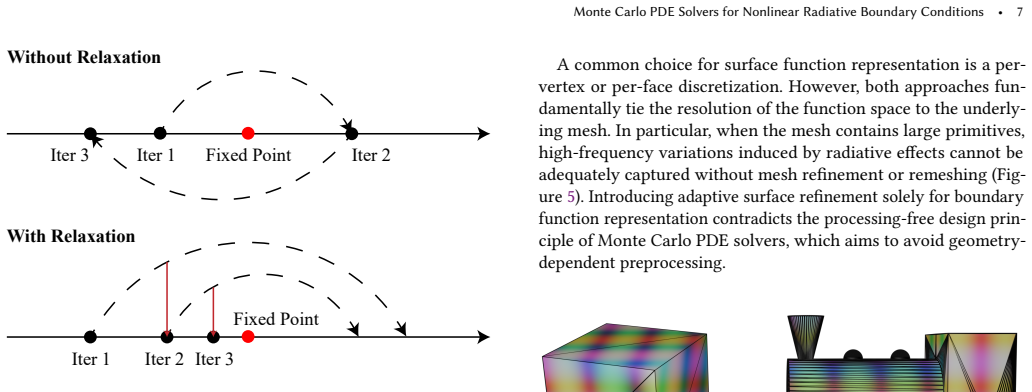
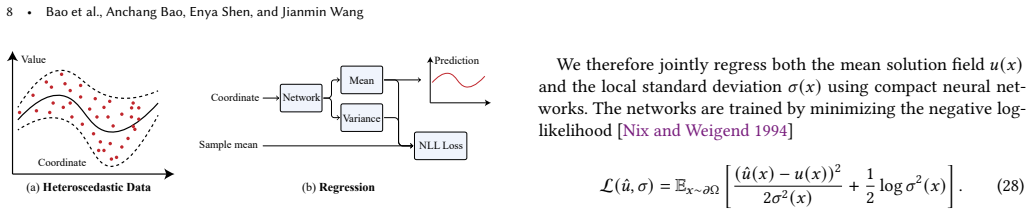
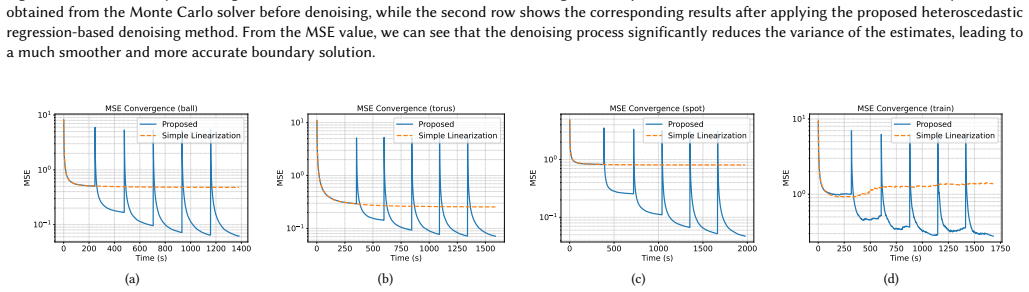
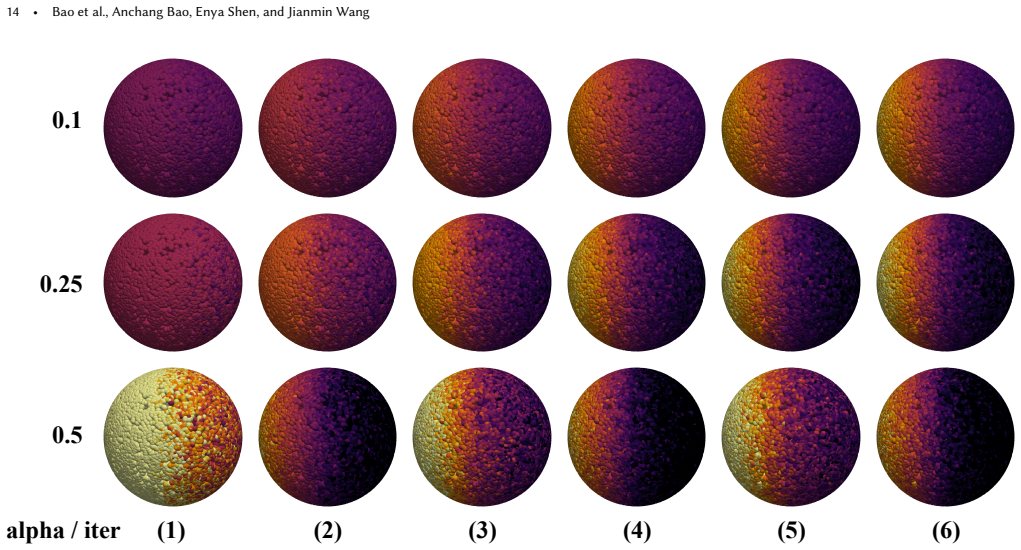
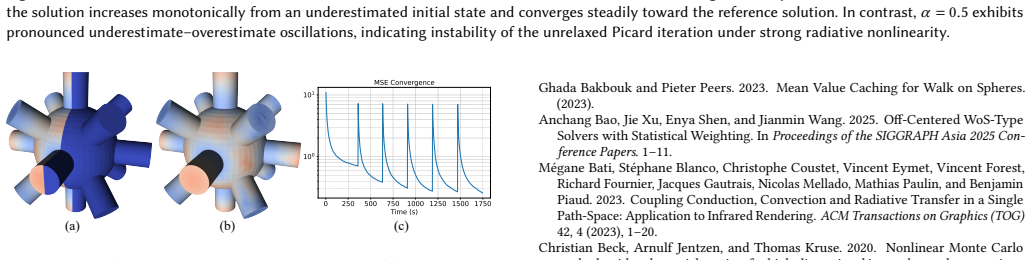
The central claim is that a Picard-style fixed-point iteration framework, equipped with a suitable relaxation coefficient, enables existing Monte Carlo PDE solvers to incorporate nonlinear radiative boundary conditions. The iteration begins from an initial boundary guess and successively refines the boundary values while solving the interior problem at each step; in practice the process converges even from imprecise starting estimates. The resulting solutions exhibit significantly higher accuracy than those produced by the common strategy of linearizing the radiation term. To control the additional variance that appears at boundary points, the paper introduces a heteroscedastic regression–a)
What carries the argument
The central mechanism is a Picard fixed-point iteration with relaxation applied to the nonlinear radiative boundary condition inside the Monte Carlo PDE solver, paired with heteroscedastic regression denoising for on-boundary solution estimates.
If this is right
- Monte Carlo PDE solvers become applicable to practical thermal radiation problems involving complex geometries.
- Solutions for radiative heat transfer achieve measurably higher accuracy than those obtained by linearizing the boundary condition.
- The iteration converges in practice even when started from rough or inaccurate initial boundary values.
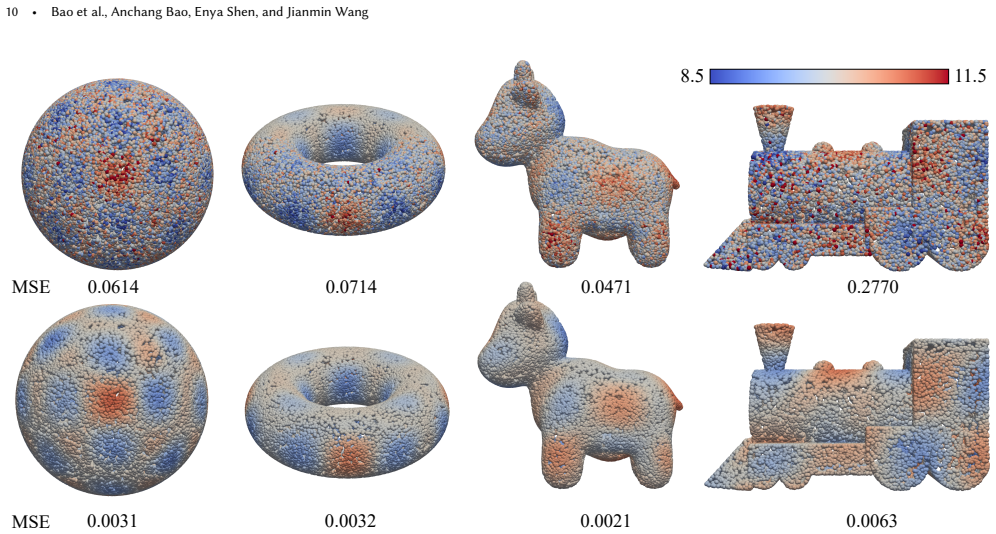
- A dedicated heteroscedastic regression step reduces variance specifically in the on-boundary Monte Carlo estimates.
Where Pith is reading between the lines
- The same relaxed iteration pattern could be tested on other nonlinear boundary conditions that appear in Monte Carlo solvers.
- The approach may raise the fidelity of heat-transfer simulations used in computer graphics and engineering design tools.
- Automatic or adaptive tuning of the relaxation coefficient could be explored to widen the range of problems that converge reliably.
Load-bearing premise
With a properly chosen relaxation coefficient the iteration remains stable and empirically convergent even from imprecise initial boundary estimates.
What would settle it
Apply the method to a synthetic benchmark whose exact solution under nonlinear radiation is known in advance; divergence or accuracy no better than linearization on that benchmark would falsify the central claim.
Figures






read the original abstract
Monte Carlo PDE solvers have become increasingly popular for solving heat-related partial differential equations in geometry processing and computer graphics due to their robustness in handling complex geometries. While existing methods can handle Dirichlet, Neumann, and linear Robin boundary conditions, nonlinear boundary conditions arising from thermal radiation remain largely unexplored. In this paper, we introduce a Picard-style fixed-point iteration framework that enables Monte Carlo PDE solvers to handle nonlinear radiative boundary conditions. While strict theoretical convergence is not generally guaranteed, our method remains stable and empirically convergent with a properly chosen relaxation coefficient. Even with imprecise initial boundary estimates, it progressively approaches the correct solution. Compared to standard linearization strategies, the proposed approach achieves significantly higher accuracy. To further address the high variance inherent in Monte Carlo estimators, we propose a heteroscedastic regression-based denoising technique specifically designed for on-boundary solution estimates, filling a gap left by prior variance reduction methods that focus solely on interior points. We validate our approach through extensive evaluations on synthetic benchmarks and demonstrate its effectiveness on practical heat radiation simulations with complex geometries.
Editorial analysis
A structured set of objections, weighed in public.
Referee Report
Summary. The manuscript introduces a Picard-style fixed-point iteration framework that wraps existing Monte Carlo PDE solvers to accommodate nonlinear radiative boundary conditions. Stability and convergence are asserted to hold empirically when a relaxation coefficient is chosen appropriately, even from imprecise initial boundary values; the method is reported to yield significantly higher accuracy than standard linearization approaches. A heteroscedastic regression denoising technique is additionally proposed to reduce variance in on-boundary Monte Carlo estimates. The claims are supported by synthetic benchmarks and demonstrations on complex-geometry heat-radiation simulations.
Significance. If the empirical stability and accuracy gains prove robust without extensive per-problem tuning, the work would meaningfully extend Monte Carlo PDE solvers—already valued for complex geometries in geometry processing and graphics—to a previously unaddressed class of nonlinear boundary conditions. The boundary-specific denoising technique addresses a documented gap in existing variance-reduction literature.
major comments (3)
- [Abstract] Abstract: the headline claim that the approach 'achieves significantly higher accuracy' than linearization strategies presupposes that the Picard iteration converges sufficiently close to the true nonlinear solution. The text itself states that 'strict theoretical convergence is not generally guaranteed' and that stability requires 'a properly chosen relaxation coefficient,' yet supplies no systematic selection rule, bound, or adaptive procedure based on problem data (initial guess, emissivity, geometry). This renders the accuracy comparison conditional on successful manual tuning rather than an intrinsic property of the method.
- [Method section] Method section (Picard iteration description): the fixed-point update with relaxation is presented without quantitative convergence analysis, error bounds, or sensitivity study with respect to the free relaxation parameter. Because the central accuracy claim rests on the iteration reaching a stable fixed point, the absence of such analysis makes the comparison to linearization load-bearing and in need of additional support.
- [Experiments] Experiments: the reported benchmarks and complex-geometry results do not include error bars, multiple random seeds, or ablation over a range of relaxation coefficients; without these, it is difficult to assess whether the observed accuracy improvement is reproducible or sensitive to the tuning that the abstract acknowledges is required.
minor comments (2)
- [Method section] The notation for the relaxation coefficient and the heteroscedastic regression model could be introduced with a single consistent symbol and a brief equation reference to improve readability.
- [Figures] Figure captions for the complex-geometry results should explicitly state the relaxation coefficient value used and the number of Monte Carlo samples per run.
Simulated Author's Rebuttal
We thank the referee for the constructive comments. We provide point-by-point responses to the major comments and have made revisions to the manuscript to address the concerns raised, particularly by strengthening the experimental validation and adding guidance on parameter selection.
read point-by-point responses
-
Referee: [Abstract] Abstract: the headline claim that the approach 'achieves significantly higher accuracy' than linearization strategies presupposes that the Picard iteration converges sufficiently close to the true nonlinear solution. The text itself states that 'strict theoretical convergence is not generally guaranteed' and that stability requires 'a properly chosen relaxation coefficient,' yet supplies no systematic selection rule, bound, or adaptive procedure based on problem data (initial guess, emissivity, geometry). This renders the accuracy comparison conditional on successful manual tuning rather than an intrinsic property of the method.
Authors: We agree that the accuracy gains are demonstrated empirically and depend on suitable choice of the relaxation coefficient, as already noted in the manuscript. In revision we have qualified the abstract claim to specify that improvements hold upon convergence with appropriate relaxation, and added a short subsection in the methods section with practical heuristics for selecting the coefficient based on emissivity and geometry, drawn from the benchmark results. This reduces reliance on purely manual tuning while preserving the empirical nature of the approach. revision: partial
-
Referee: [Method section] Method section (Picard iteration description): the fixed-point update with relaxation is presented without quantitative convergence analysis, error bounds, or sensitivity study with respect to the free relaxation parameter. Because the central accuracy claim rests on the iteration reaching a stable fixed point, the absence of such analysis makes the comparison to linearization load-bearing and in need of additional support.
Authors: The manuscript already states that strict theoretical convergence is not generally guaranteed. A full theoretical analysis with error bounds remains difficult because of the combination of nonlinearity and Monte Carlo noise. To provide further empirical support we have added a sensitivity study in the revised experiments section that varies the relaxation coefficient across the benchmark problems and reports its effect on convergence behavior and final accuracy. revision: yes
-
Referee: [Experiments] Experiments: the reported benchmarks and complex-geometry results do not include error bars, multiple random seeds, or ablation over a range of relaxation coefficients; without these, it is difficult to assess whether the observed accuracy improvement is reproducible or sensitive to the tuning that the abstract acknowledges is required.
Authors: We thank the referee for this observation. The revised manuscript now includes error bars for all quantitative results, computed from ten independent runs using different random seeds. We have also added an ablation study over a range of relaxation coefficients on the synthetic benchmarks, showing both the reproducibility of the accuracy gains and the sensitivity of the method within a practical operating range. revision: yes
Circularity Check
No circularity detected in derivation chain
full rationale
The paper introduces a Picard-style fixed-point iteration as a wrapper around existing Monte Carlo PDE solvers to handle nonlinear radiative boundary conditions, plus a heteroscedastic regression denoising method for boundary estimates. These are presented as new algorithmic frameworks whose performance (stability for suitable relaxation, higher accuracy vs. linearization) is asserted via empirical benchmarks rather than any closed-form derivation. No equations or steps in the provided text reduce a claimed result back to a fitted parameter, self-citation, or input quantity by construction; the method remains an independent iterative procedure whose convergence behavior is stated to be empirical and coefficient-dependent.
Axiom & Free-Parameter Ledger
free parameters (1)
- relaxation coefficient
axioms (1)
- domain assumption The fixed-point iteration converges empirically for properly chosen relaxation even from imprecise initial guesses.
Reference graph
Works this paper leans on
-
[1]
ACM Transactions on Graphics , volume=
Monte Carlo geometry processing: A grid-free approach to PDE-based methods on volumetric domains , author=. ACM Transactions on Graphics , volume=
-
[2]
ACM Transactions on Graphics (TOG) , volume=
Walkin’Robin: Walk on Stars with Robin Boundary Conditions , author=. ACM Transactions on Graphics (TOG) , volume=. 2024 , publisher=
2024
-
[3]
ACM Transactions on Graphics (TOG) , volume=
Grid-free Monte Carlo for PDEs with spatially varying coefficients , author=. ACM Transactions on Graphics (TOG) , volume=. 2022 , publisher=
2022
- [4]
-
[5]
2001 , publisher=
Acoustic and electromagnetic equations: integral representations for harmonic problems , author=. 2001 , publisher=
2001
-
[6]
ACM SIGGRAPH 2024 Conference Papers , pages=
Neural Control Variates with Automatic Integration , author=. ACM SIGGRAPH 2024 Conference Papers , pages=
2024
-
[7]
ACM Transactions on Graphics (TOG) , volume=
Boundary Value Caching for Walk on Spheres , author=. ACM Transactions on Graphics (TOG) , volume=. 2023 , publisher=
2023
-
[8]
Computer Graphics Forum , volume=
Scalable realistic rendering with many-light methods , author=. Computer Graphics Forum , volume=. 2014 , organization=
2014
-
[9]
ACM Transactions on Graphics (TOG) , volume=
Generalized resampled importance sampling: Foundations of restir , author=. ACM Transactions on Graphics (TOG) , volume=. 2022 , publisher=
2022
-
[10]
2023 , publisher=
Mean Value Caching for Walk on Spheres , author=. 2023 , publisher=
2023
-
[11]
Rendering Techniques’ 96: Proceedings of the Eurographics Workshop in Porto, Portugal, June 17--19, 1996 7 , pages=
Rendering participating media with bidirectional path tracing , author=. Rendering Techniques’ 96: Proceedings of the Eurographics Workshop in Porto, Portugal, June 17--19, 1996 7 , pages=. 1996 , organization=
1996
-
[12]
ACM SIGGRAPH 2019 Courses , pages=
Path guiding in production , author=. ACM SIGGRAPH 2019 Courses , pages=
2019
-
[13]
Computer Graphics Forum , volume=
A bidirectional formulation for Walk on Spheres , author=. Computer Graphics Forum , volume=. 2022 , organization=
2022
-
[14]
Proceedings of the Special Interest Group on Computer Graphics and Interactive Techniques Conference Conference Papers , pages=
Guiding-Based Importance Sampling for Walk on Stars , author=. Proceedings of the Special Interest Group on Computer Graphics and Interactive Techniques Conference Conference Papers , pages=
-
[15]
SIGGRAPH Asia 2023 Conference Papers , pages=
Neural Caches for Monte Carlo Partial Differential Equation Solvers , author=. SIGGRAPH Asia 2023 Conference Papers , pages=
2023
-
[16]
ACM Transactions on Graphics (TOG) , volume=
Solving inverse PDE problems using grid-free Monte Carlo estimators , author=. ACM Transactions on Graphics (TOG) , volume=. 2024 , publisher=
2024
-
[17]
ACM Transactions on Graphics (TOG) , volume=
Differential Walk on Spheres , author=. ACM Transactions on Graphics (TOG) , volume=. 2024 , publisher=
2024
-
[18]
ACM SIGGRAPH 2024 Conference Papers , pages=
A Differential Monte Carlo Solver For the Poisson Equation , author=. ACM SIGGRAPH 2024 Conference Papers , pages=
2024
-
[19]
ACM Transactions on Graphics (TOG) , volume=
P2M: a fast solver for querying distance from point to mesh surface , author=. ACM Transactions on Graphics (TOG) , volume=. 2023 , publisher=
2023
-
[20]
Proceedings of the 2001 symposium on Interactive 3D graphics , pages=
Spatialized normal come hierarchies , author=. Proceedings of the 2001 symposium on Interactive 3D graphics , pages=
2001
-
[21]
Acm transactions on graphics (tog) , volume=
Optix: a general purpose ray tracing engine , author=. Acm transactions on graphics (tog) , volume=. 2010 , publisher=
2010
-
[22]
Proceedings of the ACM on Computer Graphics and Interactive Techniques , volume=
Importance sampling of many lights with adaptive tree splitting , author=. Proceedings of the ACM on Computer Graphics and Interactive Techniques , volume=. 2018 , publisher=
2018
-
[23]
ACM Transactions on Graphics (TOG) , volume=
A monte carlo method for fluid simulation , author=. ACM Transactions on Graphics (TOG) , volume=. 2022 , publisher=
2022
-
[24]
2010 , publisher=
Monte Carlo methods in mechanics of fluid and gas , author=. 2010 , publisher=
2010
-
[25]
ACM SIGGRAPH 2024 Conference Papers , pages=
Velocity-Based Monte Carlo Fluids , author=. ACM SIGGRAPH 2024 Conference Papers , pages=
2024
-
[26]
ACM SIGGRAPH 2024 Conference Papers , pages=
Neural Monte Carlo Fluid Simulation , author=. ACM SIGGRAPH 2024 Conference Papers , pages=
2024
-
[27]
ACM Transactions on Graphics (TOG) , volume=
Coupling Conduction, Convection and Radiative Transfer in a Single Path-Space: Application to Infrared Rendering , author=. ACM Transactions on Graphics (TOG) , volume=. 2023 , publisher=
2023
-
[28]
ACM Transactions on Graphics , year=
A Framework for Solving Parabolic Partial Differential Equations on Discrete Domains , author=. ACM Transactions on Graphics , year=
-
[29]
ACM Transactions on Graphics , year=
A Closest Point Method for PDEs on Manifolds with Interior Boundary Conditions for Geometry Processing , author=. ACM Transactions on Graphics , year=
-
[30]
arXiv preprint arXiv:2410.03844 , year=
Projected Walk on Spheres: A Monte Carlo Closest Point Method for Surface PDEs , author=. arXiv preprint arXiv:2410.03844 , year=
-
[31]
2022 , publisher=
Partial differential equations , author=. 2022 , publisher=
2022
-
[32]
The Annals of Mathematical Statistics , pages=
Some continuous Monte Carlo methods for the Dirichlet problem , author=. The Annals of Mathematical Statistics , pages=. 1956 , publisher=
1956
-
[33]
Proceedings of the 13th annual conference on Computer graphics and interactive techniques , pages=
The rendering equation , author=. Proceedings of the 13th annual conference on Computer graphics and interactive techniques , pages=
-
[34]
two-dimensional brownian motion and harmonic functions , author=
143. two-dimensional brownian motion and harmonic functions , author=. Proceedings of the Imperial Academy , volume=. 1944 , publisher=
1944
-
[35]
ACM Transactions on Graphics , volume=
Stochastic Computation of Barycentric Coordinates , author=. ACM Transactions on Graphics , volume=
-
[36]
ACM Transactions on Graphics (TOG) , volume=
Spatiotemporal reservoir resampling for real-time ray tracing with dynamic direct lighting , author=. ACM Transactions on Graphics (TOG) , volume=. 2020 , publisher=
2020
-
[37]
Computer Graphics Forum , volume=
ReSTIR GI: Path resampling for real-time path tracing , author=. Computer Graphics Forum , volume=. 2021 , organization=
2021
-
[38]
SIGGRAPH Asia 2024 Conference Papers , pages=
A Statistical Approach to Monte Carlo Denoising , author=. SIGGRAPH Asia 2024 Conference Papers , pages=
2024
-
[39]
Rendering Techniques’ 96: Proceedings of the Eurographics Workshop in Porto, Portugal, June 17--19, 1996 7 , pages=
Global illumination using photon maps , author=. Rendering Techniques’ 96: Proceedings of the Eurographics Workshop in Porto, Portugal, June 17--19, 1996 7 , pages=. 1996 , organization=
1996
-
[40]
Sawhney, Rohan , title =
- [41]
-
[42]
Walk-on-Spheres
Off-centered “Walk-on-Spheres”(WOS) algorithm , author=. Journal of Computational Physics , volume=. 2015 , publisher=
2015
-
[43]
ACM Transactions on Graphics (TOG) , volume=
A practical walk-on-boundary method for boundary value problems , author=. ACM Transactions on Graphics (TOG) , volume=. 2023 , publisher=
2023
-
[44]
arXiv preprint arXiv:2406.03494 , year=
Solving Poisson equations using neural walk-on-spheres , author=. arXiv preprint arXiv:2406.03494 , year=
-
[45]
Advances in neural information processing systems , volume=
Fourier features let networks learn high frequency functions in low dimensional domains , author=. Advances in neural information processing systems , volume=
-
[46]
Advances in Neural Information Processing Systems , volume=
Sape: Spatially-adaptive progressive encoding for neural optimization , author=. Advances in Neural Information Processing Systems , volume=
-
[47]
Proceedings of the 22nd annual conference on Computer graphics and interactive techniques , pages=
Optimally combining sampling techniques for Monte Carlo rendering , author=. Proceedings of the 22nd annual conference on Computer graphics and interactive techniques , pages=
-
[48]
ACM Transactions on Graphics (TOG) , volume=
Solving partial differential equations in participating media , author=. ACM Transactions on Graphics (TOG) , volume=. 2025 , publisher=
2025
-
[49]
ACM Transactions on Graphics (TOG) , volume=
Robust Derivative Estimation with Walk on Stars , author=. ACM Transactions on Graphics (TOG) , volume=. 2025 , publisher=
2025
-
[50]
ACM Transactions on Graphics (TOG) , volume=
Harmonic Caching for Walk on Spheres , author=. ACM Transactions on Graphics (TOG) , volume=. 2025 , publisher=
2025
-
[51]
Proceedings of the SIGGRAPH Asia 2025 Conference Papers , pages=
Off-Centered WoS-Type Solvers with Statistical Weighting , author=. Proceedings of the SIGGRAPH Asia 2025 Conference Papers , pages=
2025
-
[52]
Advances in neural information processing systems , volume=
Implicit neural representations with periodic activation functions , author=. Advances in neural information processing systems , volume=
-
[53]
arXiv preprint arXiv:2203.09168 , year=
On the pitfalls of heteroscedastic uncertainty estimation with probabilistic neural networks , author=. arXiv preprint arXiv:2203.09168 , year=
-
[54]
Proceedings of 1994 ieee international conference on neural networks (ICNN'94) , volume=
Estimating the mean and variance of the target probability distribution , author=. Proceedings of 1994 ieee international conference on neural networks (ICNN'94) , volume=. 1994 , organization=
1994
-
[55]
Advances in Neural Information Processing Systems 32 , pages =
PyTorch: An Imperative Style, High-Performance Deep Learning Library , author =. Advances in Neural Information Processing Systems 32 , pages =. 2019 , publisher =
2019
-
[56]
CoRR , year=
Adam: A Method for Stochastic Optimization , author=. CoRR , year=
-
[57]
2015 , publisher=
An Introduction to Nonlinear Finite Element Analysis: with applications to heat transfer, fluid mechanics, and solid mechanics , author=. 2015 , publisher=
2015
-
[58]
Computer Graphics Forum , volume=
Precomputed radiative heat transport for efficient thermal simulation , author=. Computer Graphics Forum , volume=. 2023 , organization=
2023
-
[59]
Computer Graphics Forum , pages=
Inverse Simulation of Radiative Thermal Transport , author=. Computer Graphics Forum , pages=. 2025 , organization=
2025
-
[60]
Engineering Analysis with Boundary Elements , volume=
Heat transfer for nonlinear boundary conditions involving radiation for constant and temperature related thermal conductivity material using the MWLS method , author=. Engineering Analysis with Boundary Elements , volume=. 2021 , publisher=
2021
-
[61]
2021 , publisher=
Radiative heat transfer , author=. 2021 , publisher=
2021
-
[62]
Introduction to comsol multiphysics
Multiphysics, COMSOL , journal=. Introduction to comsol multiphysics
-
[63]
ACM Transactions on Graphics (TOG) , volume=
Stylized Rendering as a Function of Expectation , author=. ACM Transactions on Graphics (TOG) , volume=. 2024 , publisher=
2024
-
[64]
Proceedings of the Special Interest Group on Computer Graphics and Interactive Techniques Conference Conference Papers , pages=
Practical Stylized Nonlinear Monte Carlo Rendering , author=. Proceedings of the Special Interest Group on Computer Graphics and Interactive Techniques Conference Conference Papers , pages=
-
[65]
Computer graphics forum , volume=
Global Illumination-Aware Stylised Shading , author=. Computer graphics forum , volume=. 2021 , organization=
2021
-
[66]
Proceedings of the SIGGRAPH Asia 2025 Conference Papers , pages=
Nonlinear Noise2Noise for Efficient Monte Carlo Denoiser Training , author=. Proceedings of the SIGGRAPH Asia 2025 Conference Papers , pages=
2025
-
[67]
International Conference on Machine Learning , pages=
On nesting monte carlo estimators , author=. International Conference on Machine Learning , pages=. 2018 , organization=
2018
-
[68]
arXiv preprint arXiv:2009.13989 , year=
Nonlinear Monte Carlo methods with polynomial runtime for high-dimensional iterated nested expectations , author=. arXiv preprint arXiv:2009.13989 , year=
-
[69]
Partial Differential Equations and Applications , volume=
Multilevel Picard iterations for solving smooth semilinear parabolic heat equations , author=. Partial Differential Equations and Applications , volume=. 2021 , publisher=
2021
-
[70]
Acm siggraph computer graphics , volume=
The triangle processor and normal vector shader: a VLSI system for high performance graphics , author=. Acm siggraph computer graphics , volume=. 1988 , publisher=
1988
-
[71]
2025 , howpublished =
2025
-
[72]
Journal of the ACM (JACM) , volume=
Iterative procedures for nonlinear integral equations , author=. Journal of the ACM (JACM) , volume=. 1965 , publisher=
1965
-
[73]
Numerical linear algebra with applications , volume=
Two classes of multisecant methods for nonlinear acceleration , author=. Numerical linear algebra with applications , volume=. 2009 , publisher=
2009
-
[74]
SIAM Journal on Numerical Analysis , volume=
Anderson acceleration for fixed-point iterations , author=. SIAM Journal on Numerical Analysis , volume=. 2011 , publisher=
2011
-
[75]
Proceedings of the 16th ACM SIGGRAPH Conference on Motion, Interaction and Games , pages=
Heat Simulation on Meshless Crafted-Made Shapes , author=. Proceedings of the 16th ACM SIGGRAPH Conference on Motion, Interaction and Games , pages=
-
[76]
ACM Transactions on Graphics (TOG) , volume=
Unbiased and consistent rendering using biased estimators , author=. ACM Transactions on Graphics (TOG) , volume=. 2022 , publisher=
2022
-
[77]
2016 , publisher=
Stochastic methods for boundary value problems: numerics for high-dimensional PDEs and applications , author=. 2016 , publisher=
2016
-
[78]
Proceedings of the SIGGRAPH Asia 2025 Technical Communications , pages=
Geometric Queries on Closed Implicit Surfaces for Walk on Stars , author=. Proceedings of the SIGGRAPH Asia 2025 Technical Communications , pages=
2025
-
[79]
Applied mathematical modelling , volume=
Boundary value problems in heat conduction with nonlinear material and nonlinear boundary conditions , author=. Applied mathematical modelling , volume=. 1981 , publisher=
1981
-
[80]
International Journal for Numerical Methods in Engineering , volume=
Transient non-linear heat conduction--radiation problems—a boundary element formulation , author=. International Journal for Numerical Methods in Engineering , volume=. 1999 , publisher=
1999
discussion (0)
Sign in with ORCID, Apple, or X to comment. Anyone can read and Pith papers without signing in.