Recognition: 2 theorem links
· Lean TheoremGround-state properties of superheavy Z=122 isotopes within the deformed relativistic Hartree-Bogoliubov theory in continuum
Pith reviewed 2026-05-12 03:38 UTC · model grok-4.3
The pith
The deformed relativistic Hartree-Bogoliubov theory in continuum determines the proton and neutron drip lines for Z=122 superheavy isotopes and suggests magic numbers at N=184, 258, and 350.
A machine-rendered reading of the paper's core claim, the machinery that carries it, and where it could break.
Core claim
Ground-state properties of Z=122 isotopes are computed in the deformed relativistic Hartree-Bogoliubov theory in continuum and compared with relativistic continuum Hartree-Bogoliubov results. This yields the proton and neutron drip lines within both frameworks from the behavior of Fermi and separation energies, together with the identification of possible magic numbers N=184, 258, and 350.
What carries the argument
Deformed relativistic Hartree-Bogoliubov theory in continuum (DRHBc), which incorporates axial deformation, pairing, and continuum coupling to obtain self-consistent solutions for heavy nuclei.
If this is right
- The proton drip line marks the last bound Z=122 isotope on the proton-rich side.
- The neutron drip line marks the last bound Z=122 isotope on the neutron-rich side.
- Nuclei with N=184, 258, or 350 are expected to exhibit enhanced stability against particle emission.
- Single-particle energies, radii, and pairing gaps change smoothly with neutron number except near the suggested magic values.
Where Pith is reading between the lines
- Confirmation of the magic numbers would narrow the search window for longer-lived superheavy elements in experiments.
- The same computational strategy can be repeated for nearby proton numbers to chart the full superheavy stability region.
- Including triaxial or octupole shapes more systematically could shift the exact drip-line locations in future calculations.
Load-bearing premise
The density functional and its treatment of continuum and pairing effects remain reliable for nuclei with 122 protons whose deformation and neutron excess lie far beyond the region where the functional was originally calibrated.
What would settle it
A measured two-neutron separation energy for a Z=122 nucleus with neutron number near 258 that shows no local maximum relative to neighboring isotopes would falsify the suggested magic number at N=258.
Figures



read the original abstract
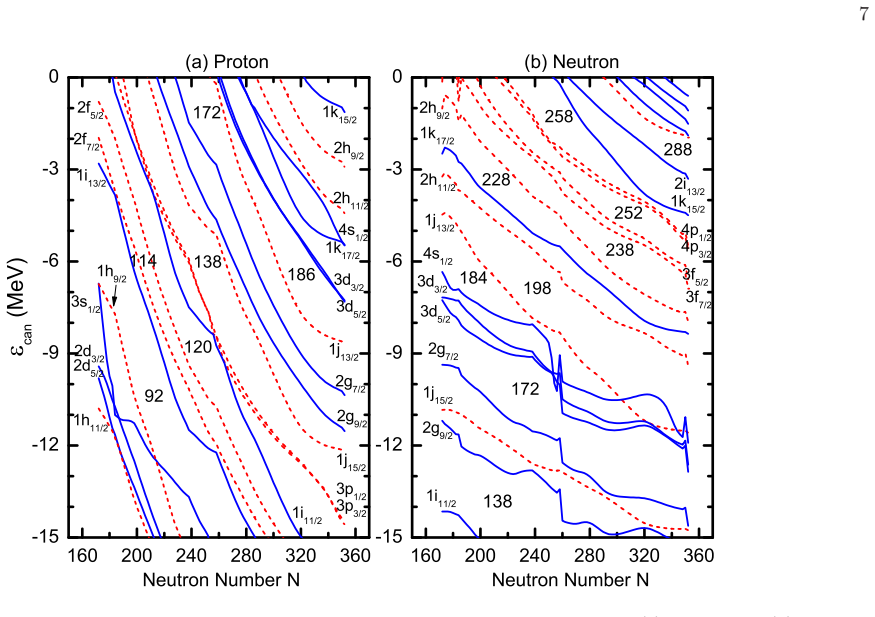
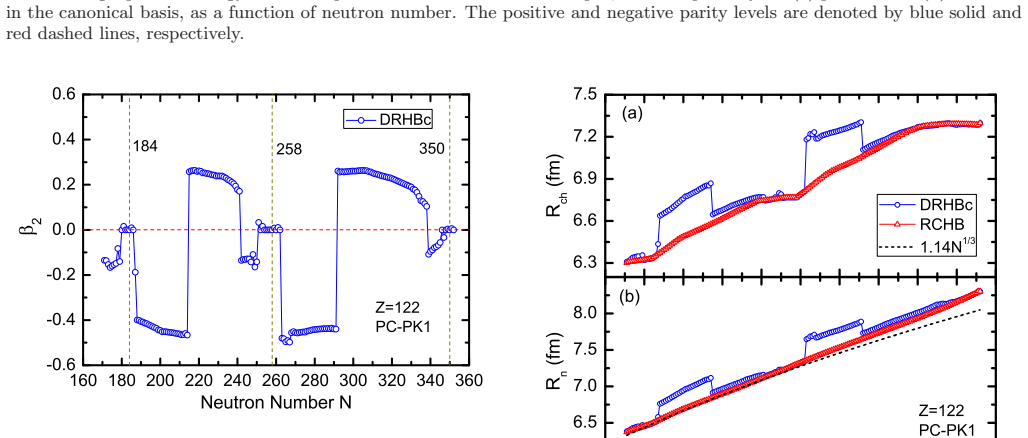
The ground-state properties of superheavy $Z = 122$ isotopes are investigated using the deformed relativistic Hartree-Bogoliubov theory in continuum (DRHBc). Bulk properties, including binding energies, Fermi energies, nucleon separation energies, quadrupole deformations, and root-mean-square radii, are calculated. The results are compared with those obtained from the relativistic continuum Hartree-Bogoliubov (RCHB) theory. By examining the dependence on the angular-momentum cutoff and the effects of triaxial and octupole deformations, a strategy for determining the ground states is suggested. Furthermore, based on an analysis of the Fermi and nucleon separation energies, the proton and neutron drip lines for $Z = 122$ isotopes are determined within both the DRHBc and RCHB frameworks. The possible magic numbers $N=184$, 258, and 350 are also suggested. Finally, the evolution of single-particle levels, deformation, charge and neutron radii as well as average pairing gaps with increasing neutron number, is discussed.
Editorial analysis
A structured set of objections, weighed in public.
Referee Report
Summary. The manuscript applies the deformed relativistic Hartree-Bogoliubov theory in continuum (DRHBc) to compute ground-state properties (binding energies, Fermi energies, separation energies, quadrupole deformations, rms radii) of Z=122 superheavy isotopes. It compares results to the spherical RCHB framework, examines convergence with angular-momentum cutoff and higher-order deformations, determines proton and neutron drip lines from separation energies, and identifies candidate magic numbers at N=184, 258, and 350. Evolution of single-particle levels, deformations, radii, and pairing gaps with neutron number is also discussed.
Significance. If the numerical results are robust, the work supplies concrete predictions for drip-line locations and possible shell closures in an experimentally inaccessible region, using a deformed continuum treatment that is well-suited to the physics. The systematic checks on cutoff and multipole deformations are a positive feature of the implementation.
major comments (1)
- The drip-line and magic-number conclusions rest on separation energies and Fermi energies obtained from a density functional whose parameters were fitted to lighter nuclei. No direct comparison is made to measured binding energies, radii, or deformations of synthesized superheavy nuclei (Z=114–118), leaving the reliability of the extrapolation at Z=122 untested; this is load-bearing for the central claims about drip lines and N=184/258/350 closures.
minor comments (1)
- The strategy for selecting ground states after checking angular-momentum cutoff, triaxiality, and octupole deformation is mentioned in the abstract but would benefit from a concise summary table or flowchart in the methods/results section.
Simulated Author's Rebuttal
We thank the referee for the positive assessment of the work's significance and for the constructive major comment. We respond point by point below.
read point-by-point responses
-
Referee: The drip-line and magic-number conclusions rest on a density functional whose parameters were fitted to lighter nuclei. No direct comparison is made to measured binding energies, radii, or deformations of synthesized superheavy nuclei (Z=114–118), leaving the reliability of the extrapolation at Z=122 untested; this is load-bearing for the central claims about drip lines and N=184/258/350 closures.
Authors: We agree that the density functional parameters were fitted primarily to lighter nuclei and that the present manuscript contains no direct comparisons to the available experimental data on binding energies, radii, or deformations for the synthesized superheavy nuclei with Z=114–118. This is a genuine limitation when assessing the absolute accuracy of the extrapolation to Z=122. The manuscript instead focuses on the methodological advantages of the deformed continuum treatment, the systematic convergence checks with angular-momentum cutoff and higher multipoles, and the differences relative to spherical RCHB results. These internal consistency tests support the reported drip-line locations and candidate shell closures. We will add a concise paragraph in the revised manuscript that references prior applications of the same DRHBc framework to known superheavy systems, thereby placing the Z=122 predictions in the context of existing model validations without performing new calculations. revision: partial
Circularity Check
No circularity: standard model application with independent outputs
full rationale
The manuscript applies the established DRHBc framework to compute binding energies, separation energies, deformations, and radii for Z=122 isotopes, then reads off drip lines and candidate magic numbers directly from those computed quantities. No equation or claim reduces the reported results to the inputs by definition, no fitted parameter is relabeled as a prediction, and no load-bearing premise rests on a self-citation chain whose validity is presupposed. The calculations constitute an extrapolation whose reliability is an open question, but the derivation chain itself remains self-contained and non-circular.
Axiom & Free-Parameter Ledger
free parameters (1)
- relativistic density-functional parameters
axioms (1)
- domain assumption The deformed relativistic Hartree-Bogoliubov equations in continuum accurately capture ground-state properties of Z=122 nuclei.
Lean theorems connected to this paper
-
IndisputableMonolith/Cost/FunctionalEquation.leanwashburn_uniqueness_aczel unclear?
unclearRelation between the paper passage and the cited Recognition theorem.
The relativistic density functional PC-PK1 is adopted... pairing strength V0 = -300 MeV fm³... angular momentum cutoff Jmax = 31/2 ħ
-
IndisputableMonolith/Foundation/RealityFromDistinction.leanreality_from_one_distinction unclear?
unclearRelation between the paper passage and the cited Recognition theorem.
ground-state properties... binding energies, Fermi energies, nucleon separation energies... possible magic numbers N=184, 258, and 350
What do these tags mean?
- matches
- The paper's claim is directly supported by a theorem in the formal canon.
- supports
- The theorem supports part of the paper's argument, but the paper may add assumptions or extra steps.
- extends
- The paper goes beyond the formal theorem; the theorem is a base layer rather than the whole result.
- uses
- The paper appears to rely on the theorem as machinery.
- contradicts
- The paper's claim conflicts with a theorem or certificate in the canon.
- unclear
- Pith found a possible connection, but the passage is too broad, indirect, or ambiguous to say the theorem truly supports the claim.
Reference graph
Works this paper leans on
-
[1]
For the particle-particle channel, the pairing strength V0 = − 300 MeV ·fm3 in Eq
is λ max = 12, which is sufficient for our study. For the particle-particle channel, the pairing strength V0 = − 300 MeV ·fm3 in Eq. ( 4), and the pairing window is chosen as 100 MeV. The examinations for the above numerical cutoffs and the pairing parameters have been carried out for Z = 134 and 135 isotopes [ 89]. For com- parison, the RCHB calculations ar...
-
[2]
The black solid curve represents the result with axially symmetric and reflection-symmetric (AS-RS) deformation, the red dashed curve corresponds to the axially symmetric but reflection-asymmetric (AS- RA) case, and the olive dash-dotted curve shows the re- sult with triaxial and reflection-symmetric (TA-RS) de- formation. Results obtained from the DRHBc cal...
-
[3]
and the bulk properties, such as binding energies, nucleon separation energies, etc., are obtained. Figure 4 shows the binding energy per nucleon B/A for the ground states of Z = 122 isotopes as a function of neutron number, calculated within both the DRHBc (blue solid line) and the spherical RCHB (red dashed line) frameworks. A local maximum around N ≈ 1...
-
[4]
When deformation is included self-consistently in the DRHBc calculations, the nuclei generally gain addi- tional binding energy compared to the spherical RCHB results. Figure 5 shows the proton ( λ p) and neutron ( λ n) Fermi energies for the ground states of Z = 122 isotopes as a 5 /s49/s54/s48 /s49/s56/s48 /s50/s48/s48 /s50/s50/s48 /s50/s52/s48 /s50/s54...
-
[5]
The two-proton separation energy S2p from DRHBc (Fig
-
[6]
increases with neutron number, albeit with small fluctuations, and is negative for N ≤ 178, consistent with the RCHB results. Therefore, according to the DRHBc calculations, isotopes with N ≤ 181 are unbound, and the proton drip-line nucleus is 304Ubb ( N = 182). /s49/s54/s48 /s49/s56/s48 /s50/s48/s48 /s50/s50/s48 /s50/s52/s48 /s50/s54/s48 /s50/s56/s48 /s5...
- [7]
- [8]
- [9]
-
[10]
Y. T. Oganessian, F. S. Abdullin, P. D. Bailey, D. E. Benker, M. E. Bennett, S. N. Dmitriev, J. G. Ezold, J. H. Hamilton, R. A. Henderson, M. G. Itkis, Y. V. Lobanov, A. N. Mezentsev, K. J. Moody, S. L. Nel- son, A. N. Polyakov, C. E. Porter, A. V. Ramayya, F. D. Riley, J. B. Roberto, M. A. Ryabinin, K. P. Rykaczewski, R. N. Sagaidak, D. A. Shaughnessy, I...
work page 2010
-
[11]
S. G. Zhou, Physics 43, 817 (2014)
work page 2014
-
[12]
S. G. Zhou, Nucl. Phys. Rev. 34, 318 (2017)
work page 2017
-
[13]
Y. M. Jiang, D. D. Zhang, and S. G. Zhou, Physics 54, 599 (2025)
work page 2025
-
[14]
X. Y. Huang, Z. Y. Zhang, J. G. Wang, L. Ma, C. L. Yang, M. H. Huang, X. L. Wu, Z. G. Gan, H. B. Yang, M. M. Zhang, Y. L. Tian, Y. S. Wang, J. Y. Wang, Y. H. Qiang, G. Xie, S. Y. Xu, Z. Zhao, Z. C. Li, L. C. Sun, L. Zhu, X. Zhang, H. Zhou, F. Guan, Z. H. Li, W. X. Huang, Z. Qin, Y. Wang, X. J. Yin, Y. F. Cui, Z. W. Lu, Y. He, L. T. Sun, Z. Z. Ren, S. G. Z...
work page 2025
-
[15]
Y. T. Oganessian, V. K. Utyonkov, Y. V. Lobanov, F. S. Abdullin, A. N. Polyakov, R. N. Sagaidak, I. V. Shi- rokovsky, Y. S. Tsyganov, A. A. Voinov, A. N. Mezent- sev, V. G. Subbotin, A. M. Sukhov, K. Subotic, V. I. Za- grebaev, S. N. Dmitriev, R. A. Henderson, K. J. Moody, J. M. Kenneally, J. H. Landrum, D. A. Shaughnessy, M. A. Stoyer, N. J. Stoyer, and ...
work page 2009
-
[16]
S. Hofmann, S. Heinz, R. Mann, J. Maurer, G. M¨ unzenberg, S. Antalic, W. Barth, L. Dahl, K. Eber- hardt, R. Grzywacz, J. H. Hamilton, R. A. Henderson, J. M. Kenneally, B. Kindler, I. Kojouharov, R. Lang, B. Lommel, K. Miernik, D. Miller, K. J. Moody, K. Morita, K. Nishio, A. G. Popeko, J. B. Roberto, J. Runke, K. P. Rykaczewski, C. Scheidenberger, D. A. ...
work page 2016
-
[17]
S. Hofmann, S. Heinz, R. Mann, J. Maurer, G. M¨ unzenberg, S. Antalic, W. Barth, H. G. Burkhard, L. Dahl, K. Eberhardt, R. Grzywacz, J. H. Hamil- ton, R. A. Henderson, J. M. Kenneally, B. Kindler, I. Kojouharov, R. Lang, B. Lommel, K. Miernik, D. Miller, K. J. Moody, K. Morita, K. Nishio, A. G. Popeko, J. B. Roberto, J. Runke, K. P. Rykaczewski, S. Saro, ...
work page 2016
-
[18]
J. Khuyagbaatar, A. Yakushev, C. E. D¨ ullmann, D. Ackermann, L.-L. Andersson, M. Asai, M. Block, R. A. Boll, H. Brand, D. M. Cox, M. Dasgupta, X. Derkx, A. Di Nitto, K. Eberhardt, J. Even, M. Evers, C. Fahlander, U. Forsberg, J. M. Gates, N. Gharibyan, P. Golubev, K. E. Gregorich, J. H. Hamilton, W. Hart- mann, R.-D. Herzberg, F. P. Heßberger, D. J. Hind...
work page 2020
- [19]
-
[20]
M. Tanaka, P. Brionnet, M. Du, J. Ezold, K. Felker, B. J. P. Gall, S. Go, R. K. Grzywacz, H. Haba, K. Hagino, S. Hogle, S. Ishizawa, D. Kaji, S. Kimura, T. T. King, Y. Komori, R. K. Lemon, M. G. Leonard, K. Morimoto, K. Morita, D. Nagae, N. Naito, T. Niwase, B. C. Rasco, J. B. Roberto, K. P. Rykaczewski, S. Sakaguchi, H. Sakai, Y. Shigekawa, D. W. Stracen...
work page 2022
-
[21]
Z. G. Gan, W. X. Huang, Z. Y. Zhang, X. H. Zhou, and H. S. Xu, Eur. Phys. J. A 58, 158 (2022)
work page 2022
-
[22]
J. M. Gates, R. Orford, D. Rudolph, C. Appleton, B. M. Barrios, J. Y. Benitez, M. Bordeau, W. Botha, C. M. Campbell, J. Chadderton, A. T. Chemey, R. M. Clark, H. L. Crawford, J. D. Despotopulos, O. Dorvaux, N. E. Esker, P. Fallon, C. M. Folden, B. J. P. Gall, F. H. Gar- cia, P. Golubev, J. A. Gooding, M. Grebo, K. E. Gre- gorich, M. Guerrero, R. A. Hender...
work page 2024
-
[23]
M.-H. Zhang, Z.-Y. Zhang, Z.-G. Gan, S.-G. Zhou, and F.-S. Zhang, Nucl. Sci. Tech. 36, 204 (2025)
work page 2025
-
[24]
A. Sobiczewski, F. Gareev, and B. Kalinkin, Phys. Lett. 22, 500 (1966)
work page 1966
- [25]
-
[26]
S. G. Nilsson, J. R. Nix, A. Sobiczewski, Z. Szymanski, S. Wycech, C. Gustafson, and P. M¨ oller, Nucl. Phys. A 115, 545 (1968)
work page 1968
-
[27]
S. G. Nilsson, C. F. Tsang, A. Sobiczewski, Z. Szyma´ nski, S. Wycech, C. Gustafson, I. L. Lamm, P. M¨ oller, and B. Nilsson, Nucl. Phys. A 131, 1 (1969)
work page 1969
- [28]
-
[29]
P. M¨ oller and J. R. Nix, J. Phys. G: Nucl. Part. Phys. 20, 1681 (1994)
work page 1994
-
[30]
Q. Mo, M. Liu, and N. Wang, Phys. Rev. C 90, 024320 (2014)
work page 2014
-
[31]
N. Wang, M. Liu, X. Wu, and J. Meng, Phys. Lett. B 734, 215 (2014)
work page 2014
-
[32]
M. Bender, P.-H. Heenen, and P.-G. Reinhard, Rev. Mod. Phys. 75, 121 (2003)
work page 2003
- [33]
- [34]
- [35]
- [36]
-
[37]
L. M. Robledo, T. R. Rodr ´ ıguez, and R. R. Rodr ´ ıguez- Guzm´ an,J. Phys. G: Nucl. Part. Phys. 46, 013001 (2018)
work page 2018
-
[38]
G. A. Lalazissis, M. M. Sharma, P. Ring, and Y. K. Gambhir, Nucl. Phys. A 608, 202 (1996)
work page 1996
- [39]
-
[40]
A. V. Afanasjev, T. L. Khoo, S. Frauendorf, G. A. Lalazissis, and I. Ahmad, Phys. Rev. C 67, 024309 (2003)
work page 2003
-
[41]
J. J. Li, W. H. Long, J. Margueron, and N. Van Giai, Phys. Lett. B 732, 169 (2014)
work page 2014
-
[42]
S. E. Agbemava, A. V. Afanasjev, T. Nakatsukasa, and P. Ring, Phys. Rev. C 92, 054310 (2015)
work page 2015
-
[43]
A. V. Afanasjev, S. E. Agbemava, and A. Gyawali, Phys. Lett. B 782, 533 (2018)
work page 2018
-
[44]
S. E. Agbemava, A. V. Afanasjev, A. Taninah, and A. Gyawali, Phys. Rev. C 99, 034316 (2019)
work page 2019
-
[45]
S. E. Agbemava and A. V. Afanasjev, Phys. Rev. C 103, 034323 (2021)
work page 2021
-
[46]
A. Taninah, S. E. Agbemava, and A. V. Afanasjev, Phys. Rev. C 102, 054330 (2020)
work page 2020
-
[47]
S.-G. Zhou, J. Meng, P. Ring, and E.-G. Zhao, Phys. Rev. C 82, 011301R (2010)
work page 2010
-
[48]
L.-L. Li, J. Meng, P. Ring, E.-G. Zhao, and Z. Shan- Gui, Chin. Phys. Lett. 29, 042101 (2012)
work page 2012
-
[49]
L. Li, J. Meng, P. Ring, E.-G. Zhao, and S.-G. Zhou, Phys. Rev. C 85, 024312 (2012)
work page 2012
-
[50]
K. Zhang, M.-K. Cheoun, Y.-B. Choi, P. S. Chong, J. Dong, L. Geng, E. Ha, X. He, C. Heo, M. C. Ho, E. J. In, S. Kim, Y. Kim, C.-H. Lee, J. Lee, Z. Li, T. Luo, J. Meng, M.-H. Mun, Z. Niu, C. Pan, P. Pa- pakonstantinou, X. Shang, C. Shen, G. Shen, W. Sun, X.-X. Sun, C. K. Tam, Thaivayongnou, C. Wang, S. H. Wong, X. Xia, Y. Yan, R. W.-Y. Yeung, T. C. Yiu, S....
work page 2020
-
[51]
C. Pan, M.-K. Cheoun, Y.-B. Choi, J. Dong, X. Du, X.- H. Fan, W. Gao, L. Geng, E. Ha, X.-T. He, J. Huang, K. Huang, S. Kim, Y. Kim, C.-H. Lee, J. Lee, Z. Li, Z.-R. Liu, Y. Ma, J. Meng, M.-H. Mun, Z. Niu, P. Pa- pakonstantinou, X. Shang, C. Shen, G. Shen, W. Sun, X.-X. Sun, J. Wu, X. Wu, X. Xia, Y. Yan, T. C. Yiu, K. Zhang, S. Zhang, W. Zhang, X. Zhang, Q....
work page 2022
- [52]
- [53]
- [54]
-
[55]
J. Meng, H. Toki, S. Zhou, S. Zhang, W. Long, and L. Geng, Prog. Part. Nucl. Phys. 57, 470 (2006)
work page 2006
- [56]
-
[57]
X.-X. Sun, J. Zhao, and S.-G. Zhou, Phys. Lett. B 785, 530 (2018)
work page 2018
-
[58]
X.-X. Sun, J. Zhao, and S.-G. Zhou, Nucl. Phys. A 1003, 122011 (2020)
work page 2020
- [59]
- [60]
-
[61]
S.-Y. Zhong, S.-S. Zhang, X.-X. Sun, and M. S. Smith, Sci. China-Phys. Mech. Astron. 65, 262011 (2022)
work page 2022
-
[62]
K. Y. Zhang, S. Q. Yang, J. L. An, S. S. Zhang, P. Pa- pakonstantinou, M.-H. Mun, Y. Kim, and H. Yan, Phys. Lett. B 844, 138112 (2023)
work page 2023
-
[63]
L.-Y. Wang, K. Zhang, J.-L. An, and S.-S. Zhang, Eur. Phys. J. A 60, 251 (2024)
work page 2024
-
[64]
K. Y. Zhang, C. Pan, and S. Wang, Phys. Rev. C 110, 014320 (2024)
work page 2024
-
[65]
C. Pan, K. Zhang, and S. Zhang, Phys. Lett. B 855, 138792 (2024)
work page 2024
- [66]
-
[67]
K. Y. Zhang and X. X. Lu, Phys. Lett. B 871, 139989 (2025)
work page 2025
-
[68]
P. Papakonstantinou, M. Mun, C. Pan, and K. Zhang, Phys. Rev. C 112, 044301 (2025)
work page 2025
- [69]
-
[70]
Y.-B. Choi, C.-H. Lee, M.-H. Mun, and Y. Kim, Phys. Rev. C 105, 024306 (2022)
work page 2022
-
[71]
P. Guo, C. Pan, Y. C. Zhao, X. K. Du, and S. Q. Zhang, Phys. Rev. C 108, 014319 (2023)
work page 2023
-
[72]
X. Y. Zhang, Z. M. Niu, W. Sun, and X. W. Xia, Phys. Rev. C 108, 024310 (2023)
work page 2023
-
[73]
M.-H. Mun, E. Ha, Y.-B. Choi, and M.-K. Cheoun, Phys. Rev. C 110, 024310 (2024)
work page 2024
-
[74]
M.-H. Mun, P. Papakonstantinou, and Y. Kim, Parti- cles 8, 32 (2025)
work page 2025
-
[75]
K. Y. Zhang, P. Papakonstantinou, M.-H. Mun, Y. Kim, H. Yan, and X.-X. Sun, Phys. Rev. C 107, L041303 (2023)
work page 2023
-
[76]
R.-Y. Zheng, X.-X. Sun, G.-F. Shen, and L.-S. Geng, Chin. Phys. C 48, 014107 (2024)
work page 2024
-
[77]
Y. X. Zhang, B. R. Liu, K. Y. Zhang, and J. M. Yao, Phys. Rev. C 110, 024302 (2024)
work page 2024
- [78]
-
[79]
W. Zhang, J.-K. Huang, T.-T. Sun, J. Peng, and S.-Q. Zhang, Chin. Phys. C 48, 104105 (2024)
work page 2024
-
[80]
Y.-B. Choi, C.-H. Lee, M.-H. Mun, S. Choi, and Y. Kim, Phys. Rev. C 109, 054310 (2024)
work page 2024
discussion (0)
Sign in with ORCID, Apple, or X to comment. Anyone can read and Pith papers without signing in.