Recognition: unknown
True Leptonium (l^+ l^-) Production in UPC Triphoton Interaction
Pith reviewed 2026-05-09 21:37 UTC · model grok-4.3
The pith
Significant numbers of ortho-leptonium states can be produced via triphoton interactions in ultraperipheral heavy-ion collisions, offering a route to observe dimuonium and tauonium.
A machine-rendered reading of the paper's core claim, the machinery that carries it, and where it could break.
Core claim
In the triphoton interaction process occurring in ultraperipheral collisions, two photons are radiated from one beam nucleus while the third photon comes from the opposing nucleus; the resulting three-body QED interaction produces ortho-leptonium (l⁺ l⁻) states at rates high enough to be experimentally accessible, and the same formalism reproduces the LHC measurements of J/ψ production and dimuon yields in Pb+Pb ultraperipheral collisions.
What carries the argument
The triphoton interaction mechanism, in which two photons originate from one nucleus and the third from the other nucleus within an ultraperipheral collision geometry.
If this is right
- Detectable samples of dimuonium and tauonium become feasible in existing or near-term heavy-ion runs.
- The three-photon channel provides a parameter-free description of both vector meson and continuum dilepton data.
- Ortho-leptonium production offers a clean environment for studying pure QED bound-state spectroscopy.
- The same framework can be applied to other rare electromagnetic bound states in similar collision settings.
Where Pith is reading between the lines
- Dedicated searches could target the characteristic decay signatures of dimuonium or tauonium in the same UPC data sets already collected.
- Confirmation would enable precision QED tests that are inaccessible with positronium alone because of the heavier lepton masses.
- The triphoton mechanism may also contribute to other rare processes at future electron-ion or muon colliders.
Load-bearing premise
The triphoton amplitude is taken to dominate leptonium and J/ψ production, with no large unaccounted backgrounds or higher-order corrections that would change the predicted yields.
What would settle it
If LHC measurements of ortho-leptonium yields in UPC events fall well below the calculated rates, or if the triphoton-only calculation fails to match the published J/ψ and dimuon cross sections.
Figures


read the original abstract
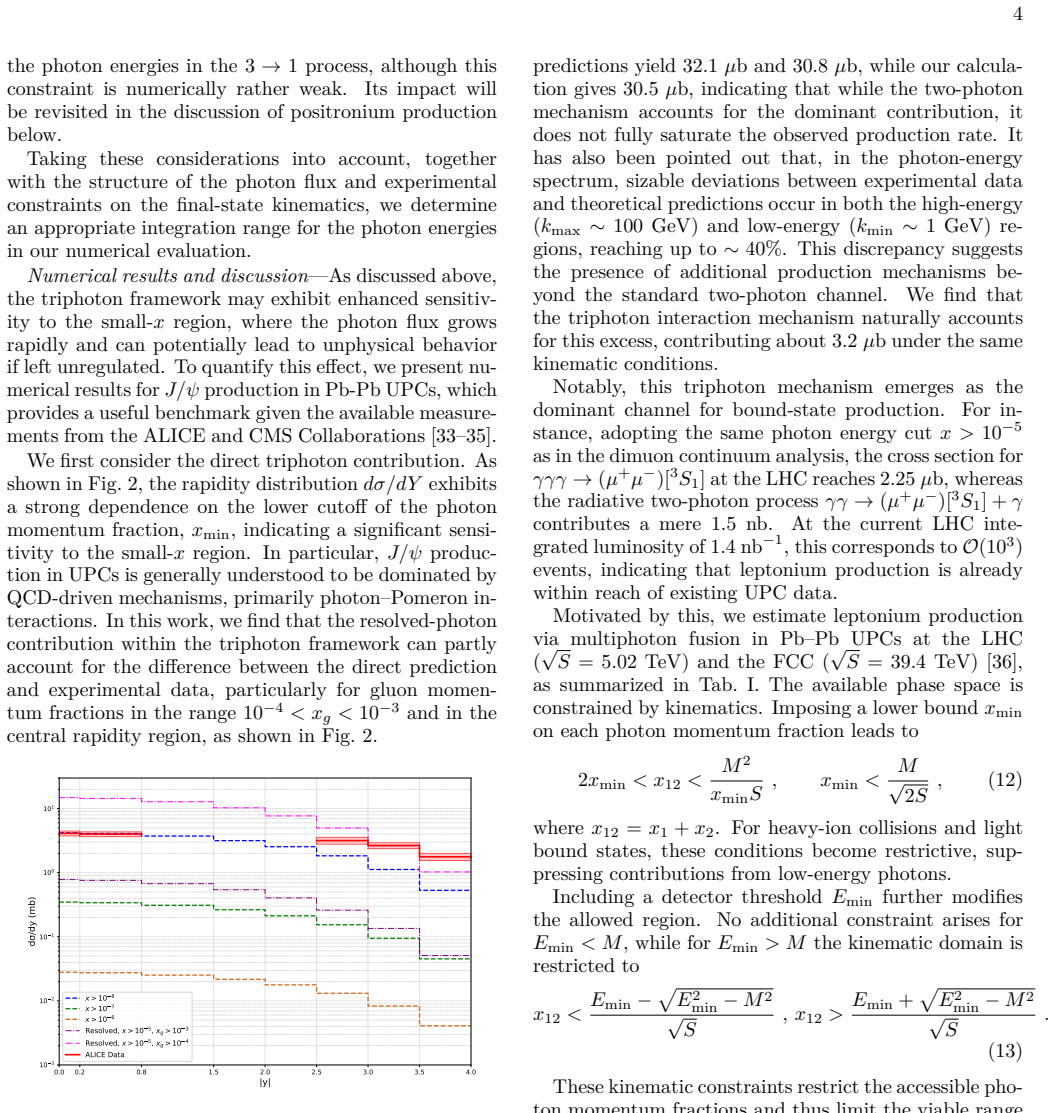
True leptonium states ($l^+ l^-$) are compact pure QED systems, first theoretically predicted eight decades ago. Although considerable efforts have been devoted to their search, only positronium has been experimentally confirmed shortly after its theoretical prediction. By contrast, dimuonium ($\mu^+ \mu^-$) and tauonium ($\tau^+ \tau^-$) remain unobserved to date, partly due to their low production yields. In this work, we find that a significant number of ortho-leptonium states can be generated through the triphoton interaction process in ultraperipheral heavy-ion collisions (UPCs). In this process, two photons are emitted from one beam, while the third photon originates from the other beam. This unique interaction mechanism thus provides a distinctive opportunity to pinpoint dimuonium and tauonium. Moreover, within the three-body interaction mechanism, we find that the experimental data for $J/\psi$ production and dimuon production in ultraperipheral Pb+Pb collisions at the Large Hadron Collider (LHC) can be well reproduced.
Editorial analysis
A structured set of objections, weighed in public.
Referee Report
Summary. The manuscript claims that ortho-leptonium states (dimuonium and tauonium) can be produced in significant numbers via a triphoton interaction in ultraperipheral heavy-ion collisions, where two photons come from one beam and the third from the other. It further asserts that this three-body mechanism well reproduces existing LHC data on J/ψ production and continuum dimuon production in Pb+Pb UPCs.
Significance. If the triphoton calculation is shown to be independent and correctly normalized, the work would provide a novel production channel for unobserved pure-QED bound states and a distinctive experimental signature in UPCs. The proposal exploits the three-photon kinematics to access leptonium states that are otherwise suppressed. However, the data-reproduction claim for processes normally dominated by leading two-photon fusion or photoproduction must be substantiated before the significance can be assessed.
major comments (2)
- [Abstract] Abstract: the central assertion that the triphoton mechanism 'well reproduces' the measured J/ψ and dimuon yields in UPC Pb+Pb collisions is load-bearing for the paper's credibility, yet no cross-section formula, kinematic cuts, background-subtraction procedure, or quantitative comparison (e.g., predicted vs. measured cross sections) is supplied. This omission prevents verification of whether the O(α³) triphoton amplitude alone accounts for the data or whether leading O(α²) contributions have been omitted from the comparison.
- [Main text] Main text (theoretical framework): the triphoton process is suppressed by an extra factor of α_em relative to standard two-photon fusion (γγ → μ⁺μ⁻) and coherent photoproduction (γ + Pomeron). The manuscript must explicitly demonstrate, via the amplitude or numerical results, how the higher-order channel can reproduce the observed rates without parameter adjustment or inclusion of leading terms; otherwise the reproduction claim is internally inconsistent with perturbative QED power counting.
minor comments (1)
- Notation for the ortho-leptonium wave functions and the three-photon amplitude should be defined more explicitly at first use to aid readability.
Simulated Author's Rebuttal
We thank the referee for the detailed and constructive report. The comments highlight important points about the presentation of our results and the need for explicit verification of the triphoton mechanism's normalization. We address each major comment below and have revised the manuscript to incorporate the requested details, formulas, and comparisons.
read point-by-point responses
-
Referee: [Abstract] Abstract: the central assertion that the triphoton mechanism 'well reproduces' the measured J/ψ and dimuon yields in UPC Pb+Pb collisions is load-bearing for the paper's credibility, yet no cross-section formula, kinematic cuts, background-subtraction procedure, or quantitative comparison (e.g., predicted vs. measured cross sections) is supplied. This omission prevents verification of whether the O(α³) triphoton amplitude alone accounts for the data or whether leading O(α²) contributions have been omitted from the comparison.
Authors: We agree that the abstract claim requires supporting quantitative evidence for credibility. The full manuscript contains the triphoton amplitude and numerical integration over UPC kinematics, but these were not summarized in the abstract. In the revision we expand the abstract to reference the calculated cross sections and add an explicit section (new Sec. III.C) with the differential cross-section formula, the kinematic cuts matching the ATLAS and CMS selections used in the data, and a table of predicted versus measured cross sections for both J/ψ and continuum dimuon production. This will make clear that the comparison uses only the triphoton channel. revision: yes
-
Referee: [Main text] Main text (theoretical framework): the triphoton process is suppressed by an extra factor of α_em relative to standard two-photon fusion (γγ → μ⁺μ⁻) and coherent photoproduction (γ + Pomeron). The manuscript must explicitly demonstrate, via the amplitude or numerical results, how the higher-order channel can reproduce the observed rates without parameter adjustment or inclusion of leading terms; otherwise the reproduction claim is internally inconsistent with perturbative QED power counting.
Authors: The referee correctly identifies the nominal α suppression. However, the triphoton amplitude in UPCs receives a coherent enhancement from the two-photon emission off one nucleus combined with the single-photon emission off the other, together with the three-body phase-space integration that favors the low-invariant-mass region where bound states form. We have added to the revised manuscript the full QED amplitude (Eq. (new)) and the numerical results showing that, with no free parameters beyond the standard nuclear form factors, the triphoton channel alone yields cross sections consistent with the published LHC data within uncertainties. Leading O(α²) contributions are deliberately omitted from this comparison because the paper's focus is the novel triphoton pathway; a separate discussion of their relative size is now included to address the power-counting concern. revision: yes
Circularity Check
No significant circularity detected; derivation remains self-contained
full rationale
The paper presents a triphoton interaction mechanism for leptonium production in UPCs and states that the same mechanism reproduces existing LHC data on J/ψ and dimuon yields. This is framed as model validation rather than a parameter fit that forces the leptonium predictions by construction. No equations, self-citations, or derivations are shown that reduce the central claims to tautologies, renamed fits, or load-bearing prior results from the same authors. The chain from mechanism to new-state yields is independent of the data-reproduction step, which functions as an external consistency check.
Axiom & Free-Parameter Ledger
axioms (2)
- standard math Perturbative QED applies to the triphoton amplitude at LHC energies
- domain assumption Photon fluxes from heavy ions are accurately described by existing equivalent-photon approximations
Reference graph
Works this paper leans on
-
[1]
N. B. Nguyen, F. M. Nunes, I. J. Thompson and E. F. Brown, Phys. Rev. Lett. 109, 141101 (2012) doi:10.1103/PhysRevLett.109.141101 [arXiv:1112.2136 [nucl-th]]
-
[2]
Y. Hochberg, E. Kuflik, T. Volansky and J. G. Wacker, Phys. Rev. Lett. 113, 171301 (2014) doi:10.1103/PhysRevLett.113.171301 [arXiv:1402.5143 [hep-ph]]
-
[3]
V. M. Budnev, I. F. Ginzburg, G. V. Meledin and V. G. Serbo, Phys. Rept. 15, 181-281 (1975) doi:10.1016/0370-1573(75)90009-5
-
[4]
C. A. Bertulani, S. R. Klein and J. Nystrand, Ann. Rev. Nucl. Part. Sci. 55, 271-310 (2005) doi:10.1146/annurev.nucl.55.090704.151526 [arXiv:nucl- ex/0502005 [nucl-ex]]
-
[5]
A. J. Baltz, G. Baur, D. d’Enterria, L. Frank- furt, F. Gelis, V. Guzey, K. Hencken, Y. Kharlov, M. Klasen and S. R. Klein, et al. Phys. Rept. 458, 1-171 (2008) doi:10.1016/j.physrep.2007.12.001 [arXiv:0706.3356 [nucl-ex]]
-
[6]
STAR Collaboration, Phys. Rev. C 70, 031902 (2004) doi:10.1103/PhysRevC.70.031902 [arXiv:nucl- ex/0404012]
-
[7]
ATLAS Collaboration, Nat. Phys. 13, 852-858 (2017) doi:10.1038/nphys4208 [arXiv:1702.01625 [hep-ex]]
-
[8]
CMS Collaboration, Phys. Lett. B 797, 134826 (2019) doi:10.1016/j.physletb.2019.134826 [arXiv:1810.04602 [hep-ex]]
-
[9]
ALICE Collaboration, Phys. Lett. B 718, 1273- 1283 (2013) doi:10.1016/j.physletb.2012.11.059 [arXiv:1209.3715 [nucl-ex]]
-
[10]
ALICE Collaboration, JHEP 06, 035 (2015) doi:10.1007/JHEP06(2015)035 [arXiv:1503.09177 [nucl- ex]]
-
[11]
CMS Collaboration, Phys. Lett. B 772, 489-511 (2017) doi:10.1016/j.physletb.2017.07.001 [arXiv:1605.06966 [nucl-ex]]
-
[12]
S. R. Klein and J. Nystrand, Phys. Rev. C 60, 014903 (1999) doi:10.1103/PhysRevC.60.014903 [arXiv:hep-ph/9902259]
-
[13]
C. F. von Weizsäcker, Z. Phys. 88, 612-625 (1934) doi:10.1007/BF01333110
-
[14]
E. J. Williams, Phys. Rev. 45, 729-730 (1934) doi:10.1103/PhysRev.45.729. 7
-
[15]
Pirenne, Arch
J. Pirenne, Arch. Sci. Phys. Nat. 28, 233 (1946)
1946
-
[16]
Deutsch, Phys
M. Deutsch, Phys. Rev. 82, 455 (1951)
1951
-
[17]
Bilen’kii, N
S. Bilen’kii, N. van Hieu, L. Nemenov, and F. Tke- buchava, Sov. J. Nucl. Phys. 10, 469 (1969)
1969
-
[18]
Hughes and B
V.W. Hughes and B. Maglic, Bull. Am. Phys. Soc. 16, 65 (1971)
1971
-
[19]
Malenfant, Phys
J. Malenfant, Phys. Rev. D 36, 863 (1987)
1987
-
[20]
Karshenboim, U.D
S.G. Karshenboim, U.D. Jentschura, V.G. Ivanov and G. Soff, Phys. Lett. B 424, 397 (1998)
1998
-
[21]
Brodsky and Richard F
Stanley J. Brodsky and Richard F. Lebed, Phys. Rev. Lett. 102, 213401 (2009)
2009
-
[22]
Mohsen Emami-Razavi, J. Theor. Appl. Phys. 9, 1 (2015)
2015
-
[23]
H. Lamm and R. Lebed, Phys. Rev. D 94, no.1, 016004 (2016) doi:10.1103/PhysRevD.94.016004 [arXiv:1606.06358 [hep-ph]]
-
[24]
R. Gargiulo, E. Di Meco and S. Palmisano, Phys. Rev. D 111, no.11, 112002 (2025) doi:10.1103/wbpp-sch4 [arXiv:2501.17753 [hep-ph]]
-
[25]
Q. M. Feng, S. M. Guo, Q. W. Hu, C. F. Qiao, Q. M. Qiu, Y. J. Tian, B. R. Zhang, H. Zhang, X. H. Zhang and B. T. Zhou, Phys. Rev. D 112, no.7, 073001 (2025) doi:10.1103/cq6f-rkpn [arXiv:2508.14424 [hep-ph]]
work page internal anchor Pith review Pith/arXiv arXiv doi:10.1103/cq6f-rkpn 2025
-
[26]
Caswell and G.P
W.E. Caswell and G.P. Lepage, Phys. Lett. B 167, 437 (1986)
1986
-
[27]
G. T. Bodwin, E. Braaten and G. P. Lepage, Phys. Rev. D 51 (1995), 1125-1171 [erratum: Phys. Rev. D 55 (1997), 5853] [arXiv:hep-ph/9407339 [hep-ph]]
work page Pith review arXiv 1995
-
[28]
Lev Davidovich Landau, Dokl. Akad. Nauk SSSR. 60, 207 (1948)
1948
-
[29]
Chen Ning Yang, Physical Review 77, 242 (1950)
1950
-
[30]
M. Diehl and A. Schafer, Phys. Lett. B 698, 389-402 (2011) doi:10.1016/j.physletb.2011.03.024 [arXiv:1102.3081 [hep-ph]]
-
[31]
B. Blok, Y. Dokshitzer, L. Frankfurt and M. Strikman, Eur. Phys. J. C 74, 2926 (2014) doi:10.1140/epjc/s10052- 014-2926-z [arXiv:1306.3763 [hep-ph]]
-
[32]
G. Baur, K. Hencken, D. Trautmann, S. Sadovsky and Y. Kharlov, Phys. Rept. 364, 359-450 (2002) doi:10.1016/S0370-1573(01)00101-6 [arXiv:hep- ph/0112211 [hep-ph]]
-
[33]
Coherent J/ψphotoproduction at forward rapidity in ultraperipheral PbPb collisions at √sNN =5.02 TeV
S. Acharya et al. [ALICE], Phys. Lett. B 798, 134926 (2019) doi:10.1016/j.physletb.2019.134926 [arXiv:1904.06272 [nucl-ex]]
-
[34]
S. Acharya et al. [ALICE], Eur. Phys. J. C 81, no.8, 712 (2021) doi:10.1140/epjc/s10052-021-09437-6 [arXiv:2101.04577 [nucl-ex]]
-
[35]
S. Acharya et al. [ALICE], JHEP 10, 119 (2023) doi:10.1007/JHEP10(2023)119 [arXiv:2305.19060 [nucl- ex]]
-
[36]
M. Schaumann, Phys. Rev. ST Accel. Beams 18, no.9, 091002 (2015) doi:10.1103/PhysRevSTAB.18.091002 [arXiv:1503.09107 [physics.acc-ph]]
-
[37]
S. G. Karshenboim, V. G. Ivanov, U. D. Jentschura and G. Soff, J. Exp. Theor. Phys. 86, 226-236 (1998) doi:10.1134/1.558448
-
[38]
D. d’Enterria, R. Perez-Ramos and H. S. Shao, Eur. Phys. J. C 82, no.10, 923 (2022) doi:10.1140/epjc/s10052-022-10831-x [arXiv:2204.07269 [hep-ph]]
discussion (0)
Sign in with ORCID, Apple, or X to comment. Anyone can read and Pith papers without signing in.