Recognition: unknown
A Hidden Markov Framework for Physically Interpretable Arc Stability Dynamics in Welding Systems
Pith reviewed 2026-05-09 20:27 UTC · model grok-4.3
The pith
Welding arc stability can be tracked as transitions between three regimes using a Hidden Markov Model on spectral features of the current signal.
A machine-rendered reading of the paper's core claim, the machinery that carries it, and where it could break.
Core claim
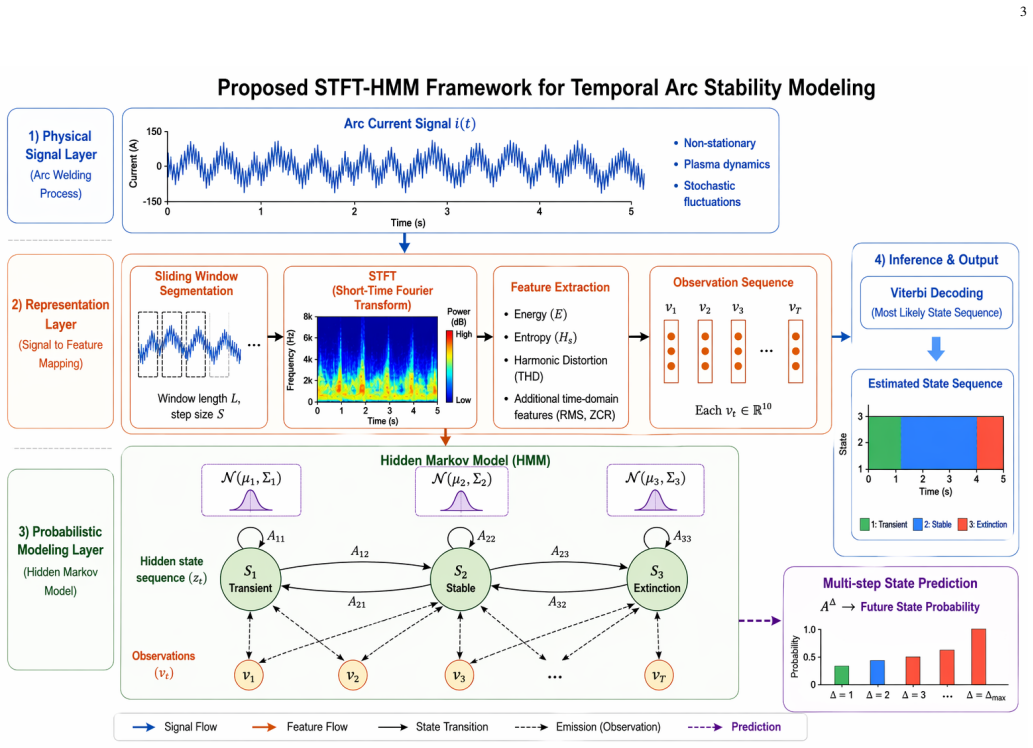
Arc dynamics are modeled as a sequence of latent operational regimes within a probabilistic state-space framework. The welding current signal is transformed into a time-frequency domain using Short-Time Fourier Transform, and a set of physically meaningful spectral descriptors, including energy, entropy, and centroid, is extracted to construct the observation sequence. A Hidden Markov Model is employed to capture temporal dependencies and estimate the evolution of arc states. The analysis reveals three dominant regimes, transient, stable, and extinction, with a clear monotonic increase in spectral energy and a corresponding decrease in entropy, indicating reduced variability under stable 0.0
What carries the argument
Hidden Markov Model that uses spectral energy, entropy, and centroid features from the Short-Time Fourier Transform of the welding current signal as observations to infer latent arc regimes.
Load-bearing premise
The chosen spectral descriptors are sufficient to separate physically distinct arc regimes despite partial overlap in feature space, and the learned states correspond to meaningful operational regimes rather than artifacts of the model.
What would settle it
High-speed video of the arc during periods labeled transient, stable, or extinction by the model showing no visible differences in arc length, flicker, or stability would undermine the claim that the states are physically interpretable.
Figures


read the original abstract
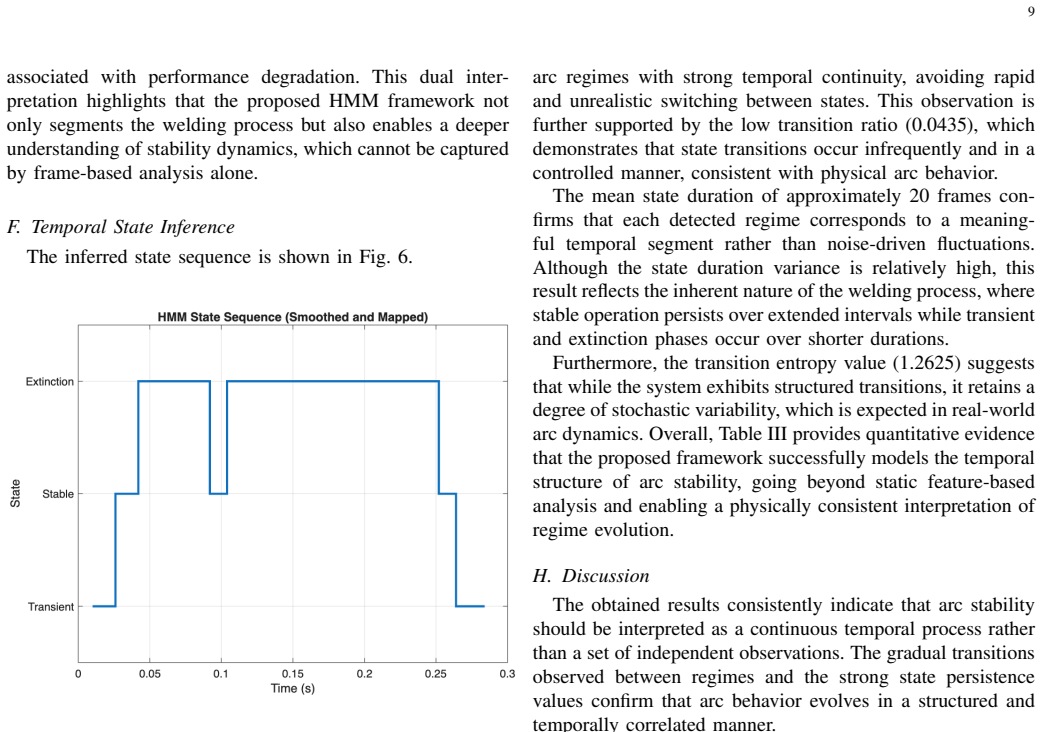
Electric arc welding (EAW) exhibits strongly non stationary and temporally evolving behavior, making reliable assessment of arc stability difficult using conventional frame based approaches. In this study, arc dynamics are modeled as a sequence of latent operational regimes within a probabilistic state-space framework. The welding current signal is transformed into a time-frequency domain using Short-Time Fourier Transform (STFT), and a set of physically meaningful spectral descriptors, including energy, entropy, and centroid, is extracted to construct the observation sequence. A Hidden Markov Model (HMM) is employed to capture temporal dependencies and estimate the evolution of arc states. The analysis reveals three dominant regimes, transient, stable, and extinction, with a clear monotonic increase in spectral energy and a corresponding decrease in entropy, indicating reduced variability under stable conditions. Despite partial overlap in the feature space, the inferred state sequence exhibits strong temporal coherence, supported by high state persistence and low transition rates. These findings highlight the limitations of static classification and emphasize the importance of temporal modeling. The proposed framework provides an interpretable and physically consistent representation of arc behavior, enabling more realistic monitoring and analysis of stability dynamics in welding processes.
Editorial analysis
A structured set of objections, weighed in public.
Referee Report
Summary. The paper proposes a Hidden Markov Model (HMM) to model non-stationary arc dynamics in electric arc welding from the current signal. The signal is transformed via Short-Time Fourier Transform (STFT) and reduced to three spectral descriptors (energy, entropy, centroid) that form the observation sequence. An HMM with three hidden states is trained to infer a sequence of latent regimes labeled post hoc as transient, stable, and extinction. The central claims are that these regimes exhibit monotonic trends (increasing energy, decreasing entropy) consistent with reduced variability under stable conditions, that the state sequence shows high temporal coherence via high self-transition probabilities and low transition rates, and that the framework supplies a physically interpretable alternative to static classifiers.
Significance. If the physical correspondence of the inferred states can be independently verified, the work would demonstrate the utility of HMMs for capturing temporal structure in welding signals where frame-wise classifiers fail. The emphasis on monotonic feature trends and state persistence provides a concrete, falsifiable signature that could be tested against additional sensors. However, the absence of quantitative validation metrics, cross-validation, or external grounding currently limits the strength of these claims.
major comments (3)
- [Abstract] Abstract: The assertion of three physically distinct regimes with 'clear monotonic increase in spectral energy and corresponding decrease in entropy' rests entirely on qualitative description. No quantitative metrics (e.g., Spearman rank correlation, p-values for trend tests, or effect sizes) or cross-validation results are supplied to support monotonicity or regime separation.
- [Abstract] Abstract: The paper acknowledges 'partial overlap in the feature space' yet concludes that the HMM states capture operational regimes via temporal coherence. No overlap quantification (e.g., Bhattacharyya distance, confusion rates between states, or sensitivity to the choice of three states) is reported, leaving open the possibility that the observed persistence is an artifact of the HMM self-transition bias rather than arc physics.
- [Abstract] Abstract: State labels (transient, stable, extinction) are assigned post hoc to the learned latent sequence without reference to independent physical anchors such as simultaneous voltage waveforms, high-speed video, or expert annotations. High self-transition probabilities are a direct modeling consequence and do not, by themselves, establish physical correspondence.
Simulated Author's Rebuttal
Thank you for the constructive review. The comments highlight opportunities to strengthen the quantitative support and clarify the physical grounding of the inferred states. We address each point below and have revised the manuscript accordingly.
read point-by-point responses
-
Referee: [Abstract] Abstract: The assertion of three physically distinct regimes with 'clear monotonic increase in spectral energy and corresponding decrease in entropy' rests entirely on qualitative description. No quantitative metrics (e.g., Spearman rank correlation, p-values for trend tests, or effect sizes) or cross-validation results are supplied to support monotonicity or regime separation.
Authors: We agree that quantitative metrics strengthen the claims. The revised manuscript now includes Spearman rank correlation coefficients and p-values for the monotonic trends in spectral energy and entropy across the decoded state sequences. We have also added k-fold cross-validation results for the HMM to quantify the stability of the three-regime separation. revision: yes
-
Referee: [Abstract] Abstract: The paper acknowledges 'partial overlap in the feature space' yet concludes that the HMM states capture operational regimes via temporal coherence. No overlap quantification (e.g., Bhattacharyya distance, confusion rates between states, or sensitivity to the choice of three states) is reported, leaving open the possibility that the observed persistence is an artifact of the HMM self-transition bias rather than arc physics.
Authors: We have added explicit quantification of state overlap. The revision reports Bhattacharyya distances between the Gaussian emission distributions of the three states and includes a sensitivity analysis varying the number of states while tracking persistence metrics. To address potential self-transition bias, we compare the learned transition matrix against a null model with uniform random transitions. revision: yes
-
Referee: [Abstract] Abstract: State labels (transient, stable, extinction) are assigned post hoc to the learned latent sequence without reference to independent physical anchors such as simultaneous voltage waveforms, high-speed video, or expert annotations. High self-transition probabilities are a direct modeling consequence and do not, by themselves, establish physical correspondence.
Authors: Labeling is post hoc but is motivated by the observed feature trends aligning with established arc-welding physics (high variability at ignition, reduced variability in steady operation, and decay at extinction). The revised discussion section explicitly states this interpretive basis and the limitations of current-only data. Self-transition probabilities are data-estimated rather than imposed; their high values reflect the slow evolution of regimes. We acknowledge that multimodal anchors (voltage/video) were unavailable in the original experiments and have added a limitations paragraph on the need for such validation. revision: partial
Circularity Check
No circularity: standard HMM pipeline with post-hoc interpretation
full rationale
The paper extracts spectral features (energy, entropy, centroid) via STFT from the welding current, trains a standard HMM on the resulting observation sequence, infers the latent state sequence, and then reports observed trends (monotonic energy increase, entropy decrease) across the three states to assign labels (transient/stable/extinction). This chain contains no self-definitional equations, no fitted parameters renamed as predictions, and no load-bearing self-citations or ansatzes. The state labels and coherence claims are interpretive summaries of data-driven outputs rather than quantities forced by construction from the model inputs. The framework is therefore self-contained.
Axiom & Free-Parameter Ledger
free parameters (2)
- Number of hidden states
- HMM transition and emission parameters
axioms (2)
- domain assumption Arc dynamics obey the Markov property: future state depends only on current state, not on earlier history.
- domain assumption The three chosen spectral descriptors capture the physically relevant variability in arc behavior.
invented entities (1)
-
Three latent arc regimes (transient, stable, extinction)
no independent evidence
Reference graph
Works this paper leans on
-
[1]
G. Tukahiruwa and C. Wandera, ”Influence of process parameters in gas- metal arc welding (GMAW) of carbon steels,” inWelding of Metallic Materials, IntechOpen, 2023, doi: 10.5772/intechopen.1002730
-
[2]
L. Zhang, L. Chen, B. Jia, S. Yang, M. Pan, and H. Pan, ”Interpretable arc stability monitoring via Physics-Guided Data Programming in robotic gas metal arc welding,”Journal of Manufacturing Processes, vol. 166, pp. 352–369, May 2026, doi: 10.1016/j.jmapro.2026.03.049
-
[3]
L. Chen, M. Liu, X. Liu, Z. Yu, P. Duan, Y . Liu, M. Fa, and B. Zheng, ”Bidirectional LSTM-based compensation of potential-asymmetry induced errors in double probe plasma diagnostics,”Journal of Physics D: Applied Physics, vol. 59, no. 3, p. 035206, Jan. 2026, doi: 10.1088/1361- 6463/ae357e
-
[4]
T. C. Akinci, ”Time-frequency analysis of the current measurement by hall effect sensors for electric arc welding machine,”Mechanika, vol. 85, no. 5, pp. 66–71, 2010
2010
-
[5]
G. de Alteriis, R. Schiano Lo Moriello, A. Astarita, and A. T. Silvestri, ”A coherence-driven method for instability frequency identification and uncertainty evaluation in friction stir welding,”Measurement, vol. 275, p. 121385, May 2026, doi: 10.1016/j.measurement.2026.121385
-
[6]
S. Kang, T. Yang, S. Jeon, M. Kang, and J. Shin, ”Accurate real-time weld shape monitoring in laser welding using spectral features and a deep neural network,”Measurement, vol. 270, p. 120903, Apr. 2026, doi: 10.1016/j.measurement.2026.120903
-
[7]
O. Akgun, A. Akan, H. Demir, and T. C. Akinci, ”Analysis of Gait Dy- namics of ALS Disease and Classification of Artificial Neural Networks,” Tehniˇcki vjesnik, vol. 25, no. S1, pp. 183–187, 2018. doi: 10.17559/TV- 20171011153544
-
[8]
S. Taskin, S. Seker, M. Karahan, and T. C. Akinci, ”Spectral analysis for current and temperature measurements in power cables,”Electric Power Components and Systems, vol. 37, no. 4, pp. 415–426, 2009. doi: 10.1080/15325000802599383
-
[9]
F. Khoshnaw, I. Krivtsun, and V . Korzhyk, ”Arc welding methods,” in Welding of Metallic Materials: Methods, Metallurgy, and Performance, Elsevier, 2023, pp. 37–71, doi: 10.1016/B978-0-323-90552-7.00004-3
-
[10]
A. Swierczynska, A. Janeczek, C. Pandey, et al., ”A bibliometric review of A-TIG welding: unveiling global research trends,”International Journal of Advanced Manufacturing Technology, vol. 143, pp. 1367–1387, Mar. 2026, doi: 10.1007/s00170-026-17474-2
-
[11]
T. C. Akinci, H. S. Nogay, and G. Gokmen, ”Determination of optimum operation cases in electric arc welding machine using neural network,” Journal of Mechanical Science and Technology, vol. 25, no. 4, pp. 1003– 1010, 2011. doi: 10.1007/s12206-011-0202-9
-
[12]
H. S. Nogay and T. C. Akinci, ”Classification of operation cases in electric arc welding machine by using deep convolutional neural networks,”Neural Computing and Applications, vol. 33, pp. 6657–6670,
-
[13]
doi: 10.1007/s00521-020-05443-4
-
[14]
A. Garc ´ıa Rodr´ıguez, C. C. Barriga Castellanos, J. E. Rocha-Gonzalez, and E. B ´arcenas, ”Time–frequency and spectral analysis of welding arc sound for automated SMAW quality classification,”Sensors, vol. 26, no. 8, p. 2357, 2026, doi: 10.3390/s26082357
-
[15]
P. Kah, G. O. Edigbe, B. Ndiwe, et al., ”Assessment of arc stability features for selected gas metal arc welding conditions,”SN Applied Sciences, vol. 4, p. 268, 2022, doi: 10.1007/s42452-022-05150-5
-
[16]
C. Capezza, A. Lepore, and K. Paynabar, ”Stream-based active learning for process monitoring,”Technometrics, vol. 68, no. 1, pp. 159–171, 2026, doi: 10.1080/00401706.2025.2561744
-
[17]
Z. Wang, S. He, X. Zhao, and M. Zhen, ”Condition-based maintenance for production systems: Inferring degradation states from quality charac- teristics,”IISE Transactions, 2026, doi: 10.1080/24725854.2026.2628678
-
[18]
D. Griffin and J. Lim, ”Signal estimation from modified short- time Fourier transform,”IEEE Transactions on Acoustics, Speech, and Signal Processing, vol. 32, no. 2, pp. 236–243, Apr. 1984, doi: 10.1109/TASSP.1984.1164317
-
[19]
J. K. Hammond and P. R. White, ”The analysis of non-stationary signals using time-frequency methods,”Journal of Sound and Vibration, vol. 190, no. 3, pp. 419–447, 1996, doi: 10.1006/jsvi.1996.0072
-
[20]
V . Sucic, N. Saulig, and B. Boashash, ”Analysis of local time-frequency entropy features for nonstationary signal components time supports de- tection,”Digital Signal Processing, vol. 34, pp. 56–66, Nov. 2014, doi: 10.1016/j.dsp.2014.07.013
-
[21]
G. Luo, D. Zhang, Y . Koh, K. Ng, and W. Leong, ”Time–frequency entropy-based partial-discharge extraction for nonintrusive measurement,” IEEE Transactions on Power Delivery, vol. 27, no. 4, pp. 1919–1927, Oct. 2012, doi: 10.1109/TPWRD.2012.2200911
-
[22]
Eric Wong, Vidroha Debroy, and Dianxiang Xu
B. Ghoraani and S. Krishnan, ”Time–frequency matrix feature extraction and classification of environmental audio signals,”IEEE Transactions on Audio, Speech, and Language Processing, vol. 19, no. 7, pp. 2197–2209, Sep. 2011, doi: 10.1109/TASL.2011.2118753
-
[23]
L. R. Rabiner, ”A tutorial on hidden Markov models and selected applications in speech recognition,”Proceedings of the IEEE, vol. 77, no. 2, pp. 257–286, Feb. 1989, doi: 10.1109/5.18626
-
[24]
P. J. Rousseeuw, ”Silhouettes: A graphical aid to the interpretation and validation of cluster analysis,”Journal of Computational and Ap- plied Mathematics, vol. 20, pp. 53–65, Nov. 1987, doi: 10.1016/0377- 0427(87)90125-7
-
[25]
V . Pavlovic, B. J. Frey, and T. S. Huang, ”Time-series classification using mixed-state dynamic Bayesian networks,” inProc. IEEE Conf. Computer Vision and Pattern Recognition (CVPR), Fort Collins, CO, USA, 1999, pp. 609–615, doi: 10.1109/CVPR.1999.784983. 11
-
[26]
S. Haykin and D. J. Thomson, ”Signal detection in a nonstationary environment reformulated as an adaptive pattern classification problem,” Proceedings of the IEEE, vol. 86, no. 11, pp. 2325–2344, Nov. 1998, doi: 10.1109/5.726792
-
[27]
S. H. Holan and N. Ravishanker, ”Time series clustering and classifi- cation via frequency domain methods,”WIREs Computational Statistics, vol. 10, no. 6, p. e1444, 2018, doi: 10.1002/wics.1444
-
[28]
J. Kohlmorgen, ”Tracking and visualization of changes in high- dimensional non-parametric distributions,” inProc. IEEE Workshop on Machine Learning for Signal Processing (MLSP), Sao Luis, Brazil, 2004, pp. 203–212, doi: 10.1109/MLSP.2004.1422975
-
[29]
B. Sin and J. H. Kim, ”Nonstationary hidden Markov model,”Signal Processing, vol. 46, no. 1, pp. 31–46, Sep. 1995, doi: 10.1016/0165- 1684(95)00070-T
-
[30]
M. Basseville and A. Benveniste, ”Sequential segmentation of nonsta- tionary digital signals using spectral analysis,”Information Sciences, vol. 29, no. 1, pp. 57–73, Feb. 1983, doi: 10.1016/0020-0255(83)90009-9
discussion (0)
Sign in with ORCID, Apple, or X to comment. Anyone can read and Pith papers without signing in.