Recognition: unknown
Critical role of phase-dependent properties in modeling photothermal sintering of LiCoO2 cathodes
Pith reviewed 2026-05-09 21:15 UTC · model grok-4.3
The pith
Phase-dependent properties cause amorphous LiCoO2 to reach higher peak temperatures during photothermal sintering than constant-property models predict.
A machine-rendered reading of the paper's core claim, the machinery that carries it, and where it could break.
Core claim
The authors demonstrate that crystalline, constant-property models systematically overestimate safe operating windows for photothermal sintering of LiCoO2 because amorphous LiCoO2 absorbs more strongly at the relevant wavelengths and conducts heat less efficiently. They achieve this by training an Allegro neural network potential to compute thermal conductivities via Green-Kubo methods for both phases, employing a thin-interface model to capture grain-size dependence with amorphous material as the intergranular phase, and integrating these with measured optical properties in multiphysics simulations.
What carries the argument
The Allegro neural network potential trained to near-ab initio accuracy for computing phase-specific thermal conductivities, integrated with a thin-interface model that treats amorphous LiCoO2 as an effective intergranular phase to reproduce grain-size effects on thermal transport.
Load-bearing premise
The trained neural network potential accurately reproduces thermal conductivities for both amorphous and crystalline LiCoO2 phases, and the thin-interface model correctly represents grain-size effects on heat transport.
What would settle it
Direct measurement of peak temperatures reached during photothermal sintering of LiCoO2 films starting in amorphous versus crystalline states, or experimental thermal conductivity data as a function of grain size in sintered films.
Figures


read the original abstract
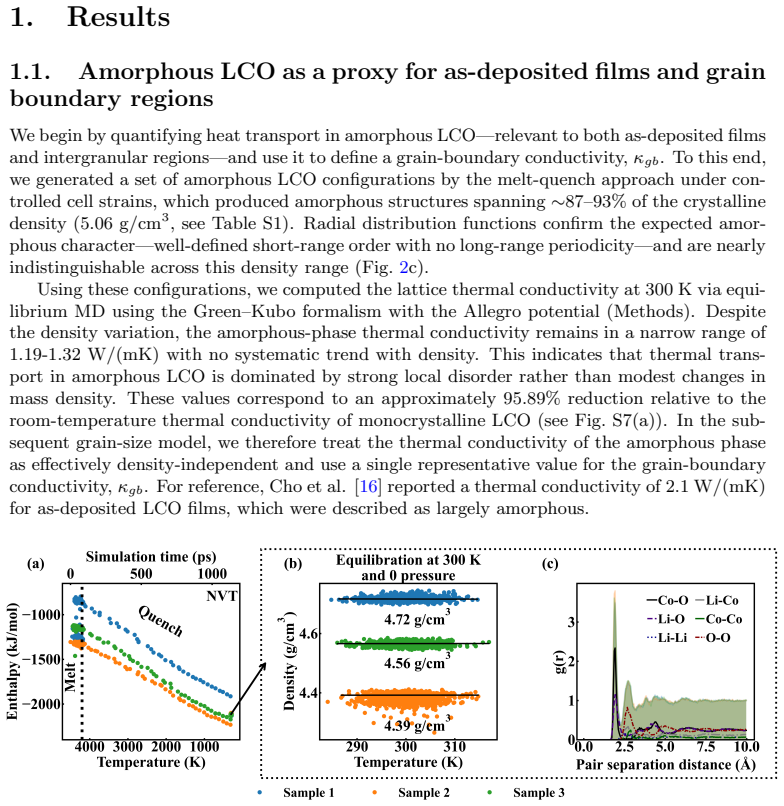
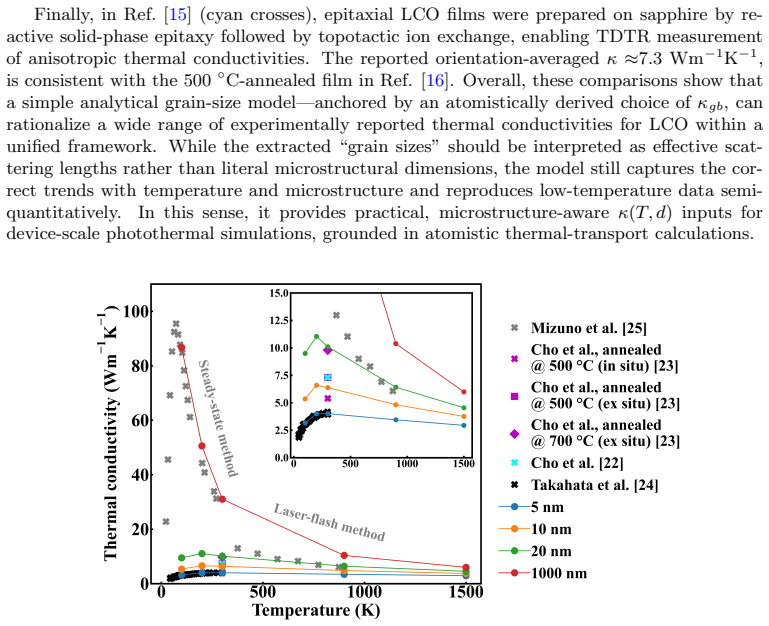
Photothermal (photonic) sintering crystallizes as-deposited amorphous LiCoO2 (LCO) cathodes for solid-state thin-film batteries using millisecond, surface-localized heating. However, process design often relies on 1D models with phase-averaged, temperature-independent properties, which can mispredict peak temperatures and thermal damage margins. Here we develop a multiscale, data-driven framework that provides phase- and grain size-resolved thermophysical inputs for stoichiometric LCO. We train an Allegro neural network potential with near-ab initio accuracy, enabling Green-Kubo calculations of thermal conductivity for crystalline and amorphous phases. The low, weakly density-dependent conductivity of amorphous LCO motivates its use as an effective intergranular phase in a thin-interface model that reproduces observed grain-size-dependent thermal transport. Combined with measured wavelength-resolved optical properties in 1D multiphysics simulations, we show amorphous LCO absorbs more strongly and reaches higher peak temperatures than crystalline LCO; thus crystalline, constant-property models systematically overestimate safe operating windows.
Editorial analysis
A structured set of objections, weighed in public.
Referee Report
Summary. The manuscript develops a multiscale framework for modeling photothermal sintering of LiCoO2 cathodes. It trains an Allegro neural network potential to enable Green-Kubo calculations of thermal conductivity in crystalline and amorphous phases, incorporates a thin-interface model for grain-size effects, and combines these with measured wavelength-resolved optical properties in 1D multiphysics simulations. The central claim is that amorphous LCO absorbs more strongly and reaches higher peak temperatures than crystalline LCO, so that constant-property models systematically overestimate safe operating windows.
Significance. If the quantitative predictions hold, the work is significant for highlighting how phase-dependent thermophysical properties (particularly lower thermal conductivity and higher optical absorption in the amorphous phase) affect peak temperature predictions and process margins in photothermal sintering of thin-film battery cathodes. The integration of machine-learned potentials with Green-Kubo transport calculations and a grain-size model represents a methodological advance over phase-averaged approaches, provided the underlying accuracy is demonstrated.
major comments (3)
- [Methods (Allegro potential training and Green-Kubo calculations)] The validation of the Allegro neural network potential for amorphous-phase thermal conductivity is insufficiently documented. No direct comparisons of computed κ_amorphous to DFT benchmarks or experimental data are reported, nor are training-set details (e.g., fraction of amorphous configurations) or error bars on the resulting 1-D temperature fields; this directly undermines the quantitative claim that amorphous LCO produces measurably higher peak temperatures.
- [Thin-interface model and grain-size effects] The thin-interface grain-size model is presented as reproducing observed grain-size-dependent transport, but the mapping from Green-Kubo bulk conductivities to effective intergranular properties is not shown to be parameter-free or independently validated against grain-boundary scattering data; this assumption is load-bearing for the phase-resolved temperature predictions.
- [Abstract and Results] No quantitative results (e.g., peak temperature differences, error bars, or direct comparison of phase-dependent vs. constant-property 1D simulations) are supplied in the abstract or summary, making it impossible to assess the magnitude of the claimed overestimation of safe operating windows.
minor comments (2)
- Notation for thermal conductivity (κ) and optical absorption coefficients should be defined consistently across sections and figures.
- Figure captions for the 1D temperature profiles should explicitly state the pulse parameters, boundary conditions, and which curves correspond to crystalline vs. amorphous cases.
Simulated Author's Rebuttal
We thank the referee for the constructive and detailed comments, which help us improve the clarity and documentation of our work. We address each major comment below and will revise the manuscript to incorporate the suggested changes where appropriate.
read point-by-point responses
-
Referee: [Methods (Allegro potential training and Green-Kubo calculations)] The validation of the Allegro neural network potential for amorphous-phase thermal conductivity is insufficiently documented. No direct comparisons of computed κ_amorphous to DFT benchmarks or experimental data are reported, nor are training-set details (e.g., fraction of amorphous configurations) or error bars on the resulting 1-D temperature fields; this directly undermines the quantitative claim that amorphous LCO produces measurably higher peak temperatures.
Authors: We agree that the validation details for the amorphous phase require more explicit documentation to support the quantitative temperature predictions. In the revised manuscript, we will add direct comparisons of the computed amorphous thermal conductivity to available DFT benchmarks, include training-set composition details such as the fraction of amorphous configurations used, and report error bars on the 1-D temperature fields propagated from the neural network potential uncertainties. These additions will be placed in the Methods section and Supporting Information. revision: yes
-
Referee: [Thin-interface model and grain-size effects] The thin-interface grain-size model is presented as reproducing observed grain-size-dependent transport, but the mapping from Green-Kubo bulk conductivities to effective intergranular properties is not shown to be parameter-free or independently validated against grain-boundary scattering data; this assumption is load-bearing for the phase-resolved temperature predictions.
Authors: The thin-interface model derives effective intergranular properties directly from the phase-specific Green-Kubo conductivities to match literature observations of grain-size-dependent transport. While the mapping incorporates some assumptions about interface resistance, it is not fitted to arbitrary parameters. In the revision, we will explicitly detail the mapping procedure, clarify its grounding in the bulk conductivities, and add a discussion of any available grain-boundary scattering data for independent validation to the extent such data exist. revision: partial
-
Referee: [Abstract and Results] No quantitative results (e.g., peak temperature differences, error bars, or direct comparison of phase-dependent vs. constant-property 1D simulations) are supplied in the abstract or summary, making it impossible to assess the magnitude of the claimed overestimation of safe operating windows.
Authors: We acknowledge that the abstract and summary sections currently lack specific numerical results. In the revised manuscript, we will update the abstract to include quantitative values such as the peak temperature differences between amorphous and crystalline phases, associated uncertainties, and a concise comparison of phase-dependent versus constant-property 1D simulation outcomes to quantify the overestimation of safe operating windows. revision: yes
Circularity Check
No circularity: derivation uses externally trained NN potential and measured optical data
full rationale
The paper trains an Allegro neural network potential (with near-ab initio accuracy) on separate reference data, then applies Green-Kubo to obtain phase-specific thermal conductivities and combines these with independently measured wavelength-resolved optical properties in 1D multiphysics simulations. No load-bearing step reduces by construction to a fitted parameter, self-citation, or ansatz imported from the authors' prior work; the temperature predictions and overestimation claim follow directly from these external inputs without redefinition or statistical forcing.
Axiom & Free-Parameter Ledger
axioms (2)
- domain assumption The Allegro neural network potential achieves near-ab initio accuracy for thermophysical properties of both crystalline and amorphous stoichiometric LCO.
- domain assumption Amorphous LCO can be treated as a low-conductivity effective intergranular phase in a thin-interface model that reproduces grain-size-dependent transport.
Reference graph
Works this paper leans on
-
[1]
Atomic resolution of lithium ions in LiCoO 2,
Y. Shao-Horn, L. Croguennec, C. Delmas, E. C. Nelson, and M. A. O’Keefe, “Atomic resolution of lithium ions in LiCoO 2,”Nature Materials, vol. 2, no. 7, pp. 464–467, 2003
2003
-
[2]
Sputtered LiCoO 2 cathode materials for all-solid-state thin-film lithium microbatteries,
C. M. Julien, A. Mauger, and O. M. Hussain, “Sputtered LiCoO 2 cathode materials for all-solid-state thin-film lithium microbatteries,”Materials, vol. 12, no. 17, p. 2687, 2019
2019
-
[3]
Solid-state redox reactions of LiCoO2 (R3m) for 4 volt secondary lithium cells,
T. Ohzuku and A. Ueda, “Solid-state redox reactions of LiCoO2 (R3m) for 4 volt secondary lithium cells,”Journal of The Electrochemical Society, vol. 141, no. 11, p. 2972, 1994
1994
-
[4]
LiCoO 2: Formation, structure, lithium and oxygen nonstoichiometry, elec- trochemical behaviour and transport properties,
E. Antolini, “LiCoO 2: Formation, structure, lithium and oxygen nonstoichiometry, elec- trochemical behaviour and transport properties,”Solid State Ionics, vol. 170, no. 3-4, pp. 159–171, 2004
2004
-
[5]
Electrochemical evaluation of LiCoO 2 synthesized by decomposition and intercalation of hydroxides for lithium-ion battery ap- plications,
B. Huang, Y. Jang, Y. Chiang, and D. Sadoway, “Electrochemical evaluation of LiCoO 2 synthesized by decomposition and intercalation of hydroxides for lithium-ion battery ap- plications,”Journal of applied electrochemistry, vol. 28, pp. 1365–1369, 1998
1998
-
[6]
Trace doping of multiple elements enables stable battery cycling of LiCoO 2 at 4.6 V,
J.-N. Zhang, Q. Li, C. Ouyang, X. Yu, M. Ge, X. Huang, E. Hu, C. Ma, S. Li, R. Xiao, et al., “Trace doping of multiple elements enables stable battery cycling of LiCoO 2 at 4.6 V,”Nature Energy, vol. 4, no. 7, pp. 594–603, 2019
2019
-
[7]
Ni-Al-Cr superalloy as high temperature cathode current collector for advanced thin film Li batteries,
A. N. Filippin, T.-Y. Lin, M. Rawlence, T. Z¨ und, K. Kravchyk, J. Sastre-Pellicer, S. G. Haass, A. W¨ ackerlin, M. V. Kovalenko, and S. Buecheler, “Ni-Al-Cr superalloy as high temperature cathode current collector for advanced thin film Li batteries,”Rsc Advances, vol. 8, no. 36, pp. 20304–20313, 2018
2018
-
[8]
Chromium nitride as a sta- ble cathode current collector for all-solid-state thin film Li-ion batteries,
A. N. Filippin, M. Rawlence, A. W¨ ackerlin, T. Feurer, T. Z¨ und, K. Kravchyk, M. V. Kovalenko, Y. E. Romanyuk, A. N. Tiwari, and S. Buecheler, “Chromium nitride as a sta- ble cathode current collector for all-solid-state thin film Li-ion batteries,”RSC Advances, vol. 7, no. 43, pp. 26960–26967, 2017
2017
-
[9]
Directly integrated all-solid- state flexible lithium batteries on polymer substrate,
H. Yim, S.-H. Yu, S. H. Baek, Y.-E. Sung, and J.-W. Choi, “Directly integrated all-solid- state flexible lithium batteries on polymer substrate,”Journal of Power Sources, vol. 455, p. 227978, 2020
2020
-
[10]
Recent advances in printed thin-film batteries,
B. Clement, M. Lyu, E. S. Kulkarni, T. Lin, Y. Hu, V. Lockett, C. Greig, and L. Wang, “Recent advances in printed thin-film batteries,”Engineering, vol. 13, pp. 238–261, 2022
2022
-
[11]
Rebohle, S
L. Rebohle, S. Prucnal, and D. Reichel,Flash lamp annealing. Switzerland: Springer, 2019
2019
-
[12]
Photonic methods for rapid crystallization of LiMn 2O4 cathodes for solid-state thin-film batteries,
X. Chen, J. Sastre, M. Rumpel, A. Flegler, A. Singhania, J. B. Bonner, P. Hoffmann, and Y. E. Romanyuk, “Photonic methods for rapid crystallization of LiMn 2O4 cathodes for solid-state thin-film batteries,”Journal of Power Sources, vol. 495, p. 229424, 2021
2021
-
[13]
Temperature measurement in rapid thermal processing with focus on the application to flash lamp annealing,
D. Reichel, W. Skorupa, W. Lerch, and J. Gelpey, “Temperature measurement in rapid thermal processing with focus on the application to flash lamp annealing,”Critical reviews in solid state and materials sciences, vol. 36, no. 2, pp. 102–128, 2011. 15
2011
-
[14]
Simulating the thermal response of thin films during photonic curing,
M. J. Guillot, S. C. McCool, and K. A. Schroder, “Simulating the thermal response of thin films during photonic curing,” inASME International Mechanical Engineering Congress and Exposition, vol. 45233, pp. 19–27, 2012
2012
-
[15]
Anisotropic heat conduction in ion-substituted layered cobalt oxides,
H. J. Cho, Y. Takashima, Y. Nezu, T. Onozato, and H. Ohta, “Anisotropic heat conduction in ion-substituted layered cobalt oxides,”Advanced Materials Interfaces, vol. 7, no. 3, p. 1901816, 2020
2020
-
[16]
Electrochemically tunable thermal conductivity of lithium cobalt oxide,
J. Cho, M. D. Losego, H. G. Zhang, H. Kim, J. Zuo, I. Petrov, D. G. Cahill, and P. V. Braun, “Electrochemically tunable thermal conductivity of lithium cobalt oxide,”Nature communications, vol. 5, no. 4035, pp. 1–6, 2014
2014
-
[17]
Thermal conductivity of A xBO2-type layered oxides Na0.77MnO2 and LiCoO 2,
K. Takahata and I. Terasaki, “Thermal conductivity of A xBO2-type layered oxides Na0.77MnO2 and LiCoO 2,”Japanese journal of applied physics, vol. 41, no. 2R, p. 763, 2002
2002
-
[18]
Thermoelec- tric properties of LiCo 1−xMxO2 (M= Cu, Mg, Ni, Zn): Comparison with LiyCoO 2 and NayCoO2 systems,
S. Mizuno, H. Fujishiro, M. Ishizawa, T. Naito, H. Katsui, and T. Goto, “Thermoelec- tric properties of LiCo 1−xMxO2 (M= Cu, Mg, Ni, Zn): Comparison with LiyCoO 2 and NayCoO2 systems,”Japanese Journal of Applied Physics, vol. 56, no. 2, p. 021101, 2017
2017
-
[19]
Phon: A program to calculate phonons using the small displacement method,
D. Alf` e, “Phon: A program to calculate phonons using the small displacement method,” Computer Physics Communications, vol. 180, no. 12, pp. 2622–2633, 2009
2009
-
[20]
Implementation strategies in phonopy and phono3py,
A. Togo, L. Chaput, T. Tadano, and I. Tanaka, “Implementation strategies in phonopy and phono3py,”Journal of Physics: Condensed Matter, vol. 35, no. 35, p. 353001, 2023
2023
-
[21]
Quantum prediction of ultra-low thermal conductivity in lithium intercalation materials,
T. Feng, A. O’hara, and S. T. Pantelides, “Quantum prediction of ultra-low thermal conductivity in lithium intercalation materials,”Nano Energy, vol. 75, p. 104916, 2020
2020
-
[22]
Lattice model calculation of the strain energy density and other properties of crystalline LiCoO 2,
F. Hart and J. Bates, “Lattice model calculation of the strain energy density and other properties of crystalline LiCoO 2,”Journal of Applied Physics, vol. 83, no. 12, pp. 7560– 7566, 1998
1998
-
[23]
An interatomic potential for the Li-Co-O ternary system,
E. Lee, K.-R. Lee, and B.-J. Lee, “An interatomic potential for the Li-Co-O ternary system,”Computational Materials Science, vol. 142, pp. 47–58, 2018
2018
-
[24]
Diffusion behaviors of lithium ions at the cathode/electrolyte interface from a global neural network potential,
Y. Sun, C. Shang, Y.-B. Fang, Z.-P. Liu, X.-G. Gong, and J.-H. Yang, “Diffusion behaviors of lithium ions at the cathode/electrolyte interface from a global neural network potential,” Journal of Materials Chemistry A, vol. 12, no. 48, pp. 33808–33817, 2024
2024
-
[25]
Matlantis, software as a service style material discovery tool
S. Takamoto, C. Shinagawa, D. Motoki, K. Nakago, W. Li, I. Kurata, T. Watan- abe, Y. Yayama, H. Iriguchi, Y. Asano, T. Onodera, T. Ishii, T. Kudo, H. Ono, R. Sawada, R. Ishitani, M. Ong, T. Yamaguchi, T. Kataoka, A. Hayashi, N. Charoen- phakdee, and T. Ibuka, “Matlantis, software as a service style material discovery tool.” https://matlantis.com/
-
[26]
Towards universal neural network potential for material discovery applicable to arbitrary combination of 45 elements,
S. Takamoto, C. Shinagawa, D. Motoki, K. Nakago, W. Li, I. Kurata, T. Watanabe, Y. Yayama, H. Iriguchi, Y. Asano,et al., “Towards universal neural network potential for material discovery applicable to arbitrary combination of 45 elements,”Nature Commu- nications, vol. 13, no. 2991, pp. 1–11, 2022
2022
-
[27]
Generalized gradient approximation made simple,
J. P. Perdew, K. Burke, and M. Ernzerhof, “Generalized gradient approximation made simple,”Physical review letters, vol. 77, no. 18, p. 3865, 1996
1996
-
[28]
The DFT+U: Approaches, accuracy, and applications,
S. A. Tolba, K. M. Gameel, B. A. Ali, H. A. Almossalami, and N. K. Allam, “The DFT+U: Approaches, accuracy, and applications,” inDensity Functional Calculations-Recent Pro- gresses of Theory and Application, IntechOpen, 2018
2018
-
[29]
A consistent and accurate ab initio parametrization of density functional dispersion correction (DFT-D) for the 94 elements H-Pu,
S. Grimme, J. Antony, S. Ehrlich, and H. Krieg, “A consistent and accurate ab initio parametrization of density functional dispersion correction (DFT-D) for the 94 elements H-Pu,”The Journal of Chemical Physics, vol. 132, no. 15, p. 154104, 2010
2010
-
[30]
Learning local equivariant representations for large-scale atomistic dynamics,
A. Musaelian, S. Batzner, A. Johansson, L. Sun, C. J. Owen, M. Kornbluth, and B. Kozin- sky, “Learning local equivariant representations for large-scale atomistic dynamics,”Na- ture Communications, vol. 14, no. 1, p. 579, 2023
2023
-
[31]
A new model for the effective thermal conductivity of polycrys- talline solids,
F. Badry and K. Ahmed, “A new model for the effective thermal conductivity of polycrys- talline solids,”AIP advances, vol. 10, 2020
2020
-
[32]
Anisotropic thermal diffusivity and conductivity of ybco (123) and ybco (211) mixed crystals. i,
H. Fujishiro, M. Ikebe, T. Naito, K. Noto, S. Kohayashi, and S. Yoshizawa, “Anisotropic thermal diffusivity and conductivity of ybco (123) and ybco (211) mixed crystals. i,” Japanese journal of applied physics, vol. 33, no. 9R, p. 4965, 1994
1994
-
[33]
Thermal diffusivity by the laser flash technique,
S. F. Corbin and D. M. Turriff, “Thermal diffusivity by the laser flash technique,”Char- acterization of Materials, pp. 1–10, 2002. 16
2002
-
[34]
Johra,Description of the Laser Flash Analysis Method for Thermal Diffusivity Mea- surement with the LFA 447
H. Johra,Description of the Laser Flash Analysis Method for Thermal Diffusivity Mea- surement with the LFA 447. No. 73 in DCE Lecture notes, Denmark: Department of Civil Engineering, Aalborg University, 2019
2019
-
[35]
Decreasing the uncertainty of classical laser flash analysis using numerical algorithms robust to noise and systematic errors,
A. Lunev and R. Heymer, “Decreasing the uncertainty of classical laser flash analysis using numerical algorithms robust to noise and systematic errors,”Review of Scientific Instruments, vol. 91, no. 6, 2020
2020
-
[36]
Model for lattice thermal conductivity at low temperatures,
J. Callaway, “Model for lattice thermal conductivity at low temperatures,”Physical Re- view, vol. 113, p. 1046, 1959
1959
-
[37]
Effect of point imperfections on lattice thermal con- ductivity,
J. Callaway and H. C. von Baeyer, “Effect of point imperfections on lattice thermal con- ductivity,”Physical Review, vol. 120, p. 1149, 1960
1960
-
[38]
Introduction to comsol multiphysics®,
C. Multiphysics, “Introduction to comsol multiphysics®,”COMSOL Multiphysics, Burlington, MA, accessed Feb, vol. 9, no. 2018, p. 32, 1998
2018
-
[39]
Analytical model for the optical functions of amorphous semiconductors from the near-infrared to ultraviolet: Applications in thin film photovoltaics,
A. S. Ferlauto, G. M. Ferreira, J. M. Pearce, C. R. Wronski, R. W. Collins, X. Deng, and G. Ganguly, “Analytical model for the optical functions of amorphous semiconductors from the near-infrared to ultraviolet: Applications in thin film photovoltaics,”Journal of Applied Physics, vol. 92, no. 5, pp. 2424–2436, 2002. 531 citations - Most comprehensive mode...
2002
-
[40]
A universal Urbach rule for disordered organic semiconductors,
C. Kaiser, O. J. Sandberg, N. Zarrabi, W. Li, P. Meredith, and A. Armin, “A universal Urbach rule for disordered organic semiconductors,”Nature Communications, vol. 12, no. 1, p. 3988, 2021. 181 citations - Demonstrates universal relationship between Urbach energy and disorder
2021
-
[41]
Black TiO 2 synthesis by chemical reduction methods for photocatalysis applications,
L. Andronic and A. Enescu, “Black TiO 2 synthesis by chemical reduction methods for photocatalysis applications,”Frontiers in Chemistry, vol. 8, p. 565489, 2020. 101 citations - Discusses defect-enhanced optical absorption in transition metal oxides
2020
-
[42]
Thermodynamic properties of stoichiometric lithium cobaltite LiCoO 2,
O. Jankovsky, J. Kovarik, J. Leitner, K. Ruzicka, and D. Sedmidubsky, “Thermodynamic properties of stoichiometric lithium cobaltite LiCoO 2,”Thermochimica Acta, vol. 634, pp. 26–30, 2016
2016
-
[43]
Flash lamp annealing enables thin-film solid-state batteries on aluminum foil,
X. Chen, J. Sastre, A. Aribia, E. Gilshtein, and Y. E. Romanyuk, “Flash lamp annealing enables thin-film solid-state batteries on aluminum foil,”ACS Applied Energy Materials, vol. 4, no. 6, pp. 5408–5414, 2021
2021
-
[44]
Lithium cobalt oxide cathode film prepared by rf sputtering,
C.-L. Liao and K.-Z. Fung, “Lithium cobalt oxide cathode film prepared by rf sputtering,” Journal of Power Sources, vol. 128, no. 2, pp. 263–269, 2004
2004
-
[45]
Fast parallel algorithms for short-range molecular dynamics,
S. Plimpton, “Fast parallel algorithms for short-range molecular dynamics,”Journal of Computational Physics, vol. 117, no. 1, pp. 1–19, 1995
1995
-
[46]
The atomic simulation environ- ment—a python library for working with atoms,
A. H. Larsen, J. J. Mortensen, J. Blomqvist, I. E. Castelli, R. Christensen, M. Du lak, J. Friis, M. N. Groves, B. Hammer, C. Hargus,et al., “The atomic simulation environ- ment—a python library for working with atoms,”Journal of Physics: Condensed Matter, vol. 29, no. 27, p. 273002, 2017
2017
-
[47]
Visualization and analysis of atomistic simulation data with OVITO–the Open Visualization Tool,
A. Stukowski, “Visualization and analysis of atomistic simulation data with OVITO–the Open Visualization Tool,”Modelling and Simulation in Materials Science and Engineering, vol. 18, no. 1, p. 015012, 2010
2010
-
[48]
Robust structural identification via polyhe- dral template matching,
P. M. Larsen, S. Schmidt, and J. Schiøtz, “Robust structural identification via polyhe- dral template matching,”Modelling and Simulation in Materials Science and Engineering, vol. 24, no. 5, p. 055007, 2016
2016
-
[49]
The materials project: Accelerating materials design through theory-driven data and tools,
A. Jain, J. Montoya, S. Dwaraknath, N. E. Zimmermann, J. Dagdelen, M. Horton, P. Huck, D. Winston, S. Cholia, S. P. Ong, and K. Persson, “The materials project: Accelerating materials design through theory-driven data and tools,” inHandbook of Materials Mod- eling: Methods: Theory and Modeling(W. Andreoni and Y. S., eds.), pp. 1751–1784, Switzerland: Spri...
2020
-
[50]
Rapid estimation of elastic constants by molecular dynamics simulation under constant stress,
W. Shinoda, M. Shiga, and M. Mikami, “Rapid estimation of elastic constants by molecular dynamics simulation under constant stress,”Physical Review B, vol. 69, no. 13, p. 134103, 2004
2004
-
[51]
Ab initio molecular dynamics for liquid metals,
G. Kresse and J. Hafner, “Ab initio molecular dynamics for liquid metals,”Phys. Rev. B, vol. 47, no. 1, pp. 558–561, 1993
1993
-
[52]
Ab initio molecular-dynamics simulation of the liquid- metalamorphous- semiconductor transition in germanium,
G. Kresse and J. Hafner, “Ab initio molecular-dynamics simulation of the liquid- metalamorphous- semiconductor transition in germanium,”Phys. Rev. B, vol. 49, no. 20, pp. 14251–14269, 1994. 17
1994
-
[53]
Efficient iterative schemes for ab initio total-energy cal- culations using a plane-wave basis set,
G. Kresse and J. Furthm¨ uller, “Efficient iterative schemes for ab initio total-energy cal- culations using a plane-wave basis set,”Phys. Rev. B, vol. 54, no. 16, pp. 11169–11186, 1996
1996
-
[54]
Efficiency of ab-initio total energy calculations for metals and semiconductors using a plane-wave basis set,
G. Kresse and J. Furthm¨ uller, “Efficiency of ab-initio total energy calculations for metals and semiconductors using a plane-wave basis set,”Comput. Mater. Sci., vol. 6, no. 1, pp. 15–50, 1996
1996
-
[55]
Ab-initio simulations of materials using vasp: Density-functional theory and beyond,
J. Hafner, “Ab-initio simulations of materials using vasp: Density-functional theory and beyond,”Journal of computational chemistry, vol. 29, no. 13, pp. 2044–2078, 2008
2044
-
[56]
Electron- energy-loss spectra and the structural stability of nickel oxide: An LSDA+ U study,
S. L. Dudarev, G. A. Botton, S. Y. Savrasov, C. Humphreys, and A. P. Sutton, “Electron- energy-loss spectra and the structural stability of nickel oxide: An LSDA+ U study,” Physical Review B, vol. 57, no. 3, p. 1505, 1998
1998
-
[57]
An efficient algorithm for finding the minimum energy path for cation migration in ionic materials,
Z. Rong, D. Kitchaev, P. Canepa, W. Huang, and G. Ceder, “An efficient algorithm for finding the minimum energy path for cation migration in ionic materials,”The Journal of Chemical Physics, vol. 145, no. 7, p. 74112, 2016
2016
-
[58]
E(3)-equivariant graph neural networks for data-efficient and accurate interatomic potentials,
S. Batzner, A. Musaelian, L. Sun, M. Geiger, J. P. Mailoa, M. Kornbluth, N. Molinari, T. E. Smidt, and B. Kozinsky, “E(3)-equivariant graph neural networks for data-efficient and accurate interatomic potentials,”Nature communications, vol. 13, no. 1, p. 2453, 2022
2022
-
[59]
Directional message passing for molecu- lar graphs,
J. Gasteiger, J. Groß, and S. G¨ unnemann, “Directional message passing for molecu- lar graphs,”arXiv preprint, 2020. Preprint athttps://doi.org/10.48550/arXiv.2003. 03123
-
[60]
Gaussian Error Linear Units (GELUs)
D. Hendrycks and K. Gimpel, “Gaussian error linear units (gelus),” 2016. Preprint at https://arxiv.org/abs/1606.08415
work page internal anchor Pith review arXiv 2016
-
[61]
Adam: A Method for Stochastic Optimization
D. P. Kingma and B. J., “Adam: A method for stochastic optimization,” 2014. Preprint athttps://arxiv.org/abs/abs/1412.6980
work page internal anchor Pith review Pith/arXiv arXiv 2014
-
[62]
Pytorch: an im- perative style, high-performance deep learning library,
A. Paszke, S. Gross, F. Massa, A. Lerer, J. Bradbury, G. Chanan, T. Killeen, Z. Lin, N. Gimelshein, L. Antiga, A. Desmaison, A. K¨ opf, E. Yang, Z. DeVito, M. Raison, A. Te- jani, S. Chilamkurthy, B. Steiner, L. Fang, J. Bai, and S. Chintala, “Pytorch: an im- perative style, high-performance deep learning library,” inProceedings of the 33rd Inter- nationa...
2019
-
[63]
The conjugate gradient method in extremal problems,
B. T. Polyak, “The conjugate gradient method in extremal problems,”USSR Computa- tional Mathematics and Mathematical Physics, vol. 9, no. 4, pp. 94–112, 1969
1969
-
[64]
Structural relaxation made simple,
E. Bitzek, P. Koskinen, F. G¨ ahler, M. Moseler, and P. Gumbsch, “Structural relaxation made simple,”Physical review letters, vol. 97, no. 17, p. 170201, 2006
2006
-
[65]
Band structure diagram paths based on crystallography,
Y. Hinuma, G. Pizzi, Y. Kumagai, F. Oba, and I. Tanaka, “Band structure diagram paths based on crystallography,”Computational Materials Science, vol. 128, pp. 140–184, 2017
2017
-
[66]
Spglib: a software library for crystal symmetry search,
A. Togo, K. Shinohara, and I. Tanaka, “Spglib: a software library for crystal symmetry search,”Science and Technology of Advanced Materials: Methods, vol. 4, no. 1, p. 2384822, 2024
2024
-
[67]
Equivariant graph neural network inter- atomic potential for green-kubo thermal conductivity in phase change materials,
S.-H. Lee, J. Li, V. Olevano, and B. Skl´ enard, “Equivariant graph neural network inter- atomic potential for green-kubo thermal conductivity in phase change materials,”Phys. Rev. Mater., vol. 8, p. 033802, Mar 2024. 18
2024
discussion (0)
Sign in with ORCID, Apple, or X to comment. Anyone can read and Pith papers without signing in.