Recognition: unknown
Toward Inferring the Surface Fluxes of Biosignature Gases on Rocky Exoplanets from Telescope Spectra
Pith reviewed 2026-05-08 13:28 UTC · model grok-4.3
The pith
A method infers surface gas fluxes from exoplanet spectra by inverting a photochemical-climate model, yielding a probabilistic link to biology that abundances alone cannot provide.
A machine-rendered reading of the paper's core claim, the machinery that carries it, and where it could break.
Core claim
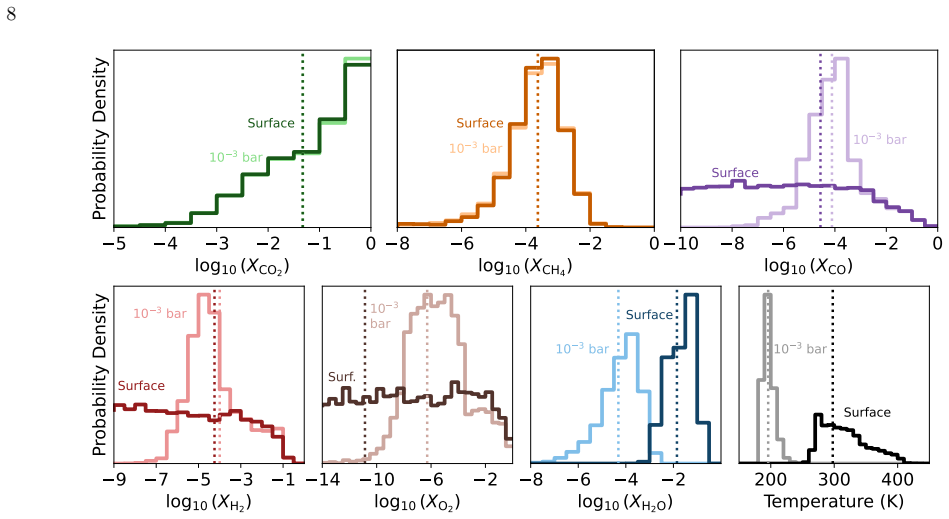
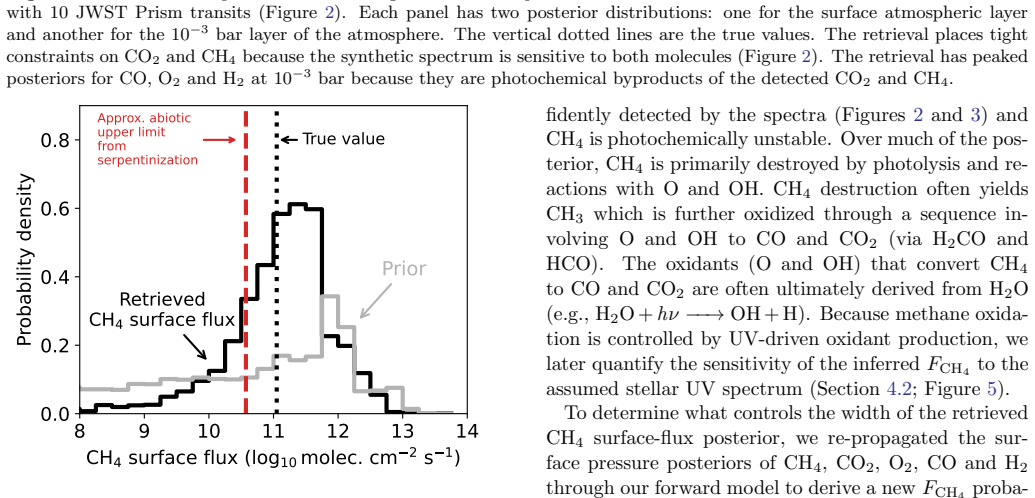
We develop a method for inferring the fluxes of gases at a planetary surface by inverting a coupled photochemical-climate model. As a proof-of-concept, we apply the approach to a synthetic 10-transit JWST NIRSpec Prism spectrum of TRAPPIST-1 e assuming it hosts a biosphere similar to the Archean Earth's. The retrieval confidently detects CO2 and CH4 and can constrain the flux of CH4 into the atmosphere to within approximately 1.5 orders of magnitude provided that TRAPPIST-1's near-UV spectrum is accurately known. We demonstrate how inferred surface gas fluxes naturally fold into a probabilistic assessment of life, finding that ~80% of the surface gas flux posterior is consistent with a CH4-�
What carries the argument
Inversion of a coupled photochemical-climate model that connects surface gas fluxes to atmospheric composition and observable spectra.
If this is right
- The spectrum yields confident detections of CO2 and CH4.
- The CH4 surface flux is constrained to within 1.5 orders of magnitude at the 68 percent credible interval.
- Approximately 80 percent of the surface gas flux posterior is consistent with a CH4-producing metabolism.
- Life detection becomes more robust by focusing on the fluxes that sustain the observed gases rather than on abundances alone.
- All results remain conditional on the assumptions built into the forward model.
Where Pith is reading between the lines
- The same inversion framework could be run on spectra from future observatories to test biosignature claims on a wider range of planets.
- Expanding the model priors to include additional metabolisms would allow direct comparison of how well different biological scenarios fit the same spectrum.
- Real observations of TRAPPIST-1 e could be used to check whether the Archean-Earth biosphere assumption produces consistent flux posteriors.
Load-bearing premise
The results assume that the planet hosts a biosphere similar to the Archean Earth's and that the star's near-UV spectrum is accurately known.
What would settle it
An actual JWST spectrum of TRAPPIST-1 e whose retrieved methane flux posterior shows less than 20 percent overlap with the range produced by known biological metabolisms.
Figures



read the original abstract
The James Webb Space Telescope and the future Habitable Worlds Observatory aim to discover exoplanet atmospheric spectra that detect life. Currently, most existing spectral "retrieval" algorithms focus on inferring the abundances of biogenic gases from these spectra. However, abundances are hard to interpret as signatures of life because they are modified by photochemistry, climate, and atmospheric escape. To address this problem, we develop a method for inferring the fluxes of gases at a planetary surface by inverting a coupled photochemical-climate model. As a proof-of-concept, we apply the approach to a synthetic 10-transit JWST NIRSpec Prism spectrum of TRAPPIST-1 e assuming it hosts a biosphere similar to the Archean Earth's. The retrieval confidently detects CO$_2$ and CH$_4$ and can constrain the flux of CH$_4$ into the atmosphere to within approximately 1.5 orders of magnitude (68$\%$ credible interval) provided that TRAPPIST-1's near-UV spectrum is accurately known. We demonstrate how inferred surface gas fluxes naturally fold into a probabilistic assessment of life, finding that ~ 80$\%$ of the surface gas flux posterior is consistent with a CH$_4$-producing metabolism for our nominal test case. As with any inverse problem, these results are conditional on a number of assumptions in our forward model. Overall, we argue that increasing the robustness of life detection on exoplanets requires moving beyond atmospheric abundances toward inference of the surface fluxes that sustain them.
Editorial analysis
A structured set of objections, weighed in public.
Referee Report
Summary. The manuscript develops a method to infer surface gas fluxes on rocky exoplanets by inverting a coupled photochemical-climate model from telescope spectra. As a proof-of-concept, the authors apply this inversion to a synthetic 10-transit JWST NIRSpec Prism spectrum of TRAPPIST-1 e, assuming an Archean Earth-like biosphere. They report detection of CO2 and CH4, a constraint on the CH4 surface flux to within approximately 1.5 orders of magnitude at 68% credible interval (conditional on accurate knowledge of the stellar near-UV spectrum), and that approximately 80% of the flux posterior is consistent with biological CH4 production.
Significance. If validated, this work represents a significant step toward more interpretable biosignature detection by shifting focus from atmospheric abundances to the underlying surface fluxes that sustain them. The integration of flux posteriors into a probabilistic life assessment is particularly promising. The proof-of-concept on synthetic data for TRAPPIST-1 e demonstrates feasibility, but its broader impact will depend on extension to real observations and testing against alternative scenarios.
major comments (2)
- [Abstract] The claimed 1.5 orders of magnitude constraint on CH4 flux and the 80% biological consistency are presented without accompanying details on the inversion methodology, error propagation, or validation against known cases; this makes it difficult to evaluate whether the central claims are fully supported by the analysis.
- [Methods] The results are explicitly conditional on the forward model assumptions, including the Archean-like biosphere and accurate TRAPPIST-1 near-UV spectrum. The manuscript should include a sensitivity analysis or robustness test to variations in these assumptions, as they appear load-bearing for the reported precision and life assessment probability.
minor comments (2)
- [Abstract] The abstract mentions 'a synthetic 10-transit JWST NIRSpec Prism spectrum' but does not specify the noise model or data reduction assumptions used in generating the synthetic data.
- Consider adding a figure showing the posterior distribution of the CH4 flux to visually support the 1.5 dex claim.
Simulated Author's Rebuttal
We are grateful to the referee for their positive assessment of the work and for the constructive major comments. We address each point below and have revised the manuscript to incorporate the suggestions where feasible.
read point-by-point responses
-
Referee: [Abstract] The claimed 1.5 orders of magnitude constraint on CH4 flux and the 80% biological consistency are presented without accompanying details on the inversion methodology, error propagation, or validation against known cases; this makes it difficult to evaluate whether the central claims are fully supported by the analysis.
Authors: We thank the referee for noting this. The abstract is a concise summary by design; the full details of the inversion methodology (Bayesian retrieval inverting the coupled photochemical-climate model), error propagation (via posterior sampling with nested sampling), and validation (recovery of input surface fluxes from synthetic spectra) are provided in Sections 3, 4, and 5, respectively. We have revised the abstract to include a short clause referencing these sections and the synthetic validation approach, while preserving brevity. revision: partial
-
Referee: [Methods] The results are explicitly conditional on the forward model assumptions, including the Archean-like biosphere and accurate TRAPPIST-1 near-UV spectrum. The manuscript should include a sensitivity analysis or robustness test to variations in these assumptions, as they appear load-bearing for the reported precision and life assessment probability.
Authors: We agree that additional sensitivity tests would strengthen the presentation of the conditional nature of the results. In the revised manuscript we will add a new subsection (in Section 5) that perturbs the assumed Archean biosphere parameters (e.g., surface fluxes of other gases, haze optical depth) and the stellar NUV spectrum within current observational uncertainties for TRAPPIST-1, and we will report the resulting changes to the CH4 flux posterior width and the biological consistency fraction. revision: yes
Circularity Check
No significant circularity
full rationale
The paper presents a standard Bayesian inversion of an external coupled photochemical-climate forward model to recover surface fluxes from a synthetic spectrum. The workflow is explicitly conditional on the forward model assumptions (including stellar UV and Archean-like biosphere), with the CH4 flux posterior reported as approximate (1.5 dex at 68% CI) and folded into a probabilistic life assessment. No derivation step reduces by construction to a fitted input, self-citation, or renamed ansatz; the central result is an application of an independent inverse-problem technique rather than a tautological re-expression of its inputs.
Axiom & Free-Parameter Ledger
axioms (2)
- domain assumption The planet hosts a biosphere similar to the Archean Earth's
- domain assumption TRAPPIST-1's near-UV spectrum is accurately known
Reference graph
Works this paper leans on
-
[1]
Agol, E., Dorn, C., Grimm, S. L., et al. 2021, PSJ, 2, 1, doi: 10.3847/PSJ/abd022
-
[2]
Allen, N. H., Espinoza, N., Boehm, V. A., et al. 2026, AJ, 171, 105, doi: 10.3847/1538-3881/ae28cb
-
[3]
Mayne, N. J. 2017, A&A, 598, A97, doi: 10.1051/0004-6361/201629322
-
[4]
2026, arXiv e-prints, arXiv:2601.09766, doi: 10.48550/arXiv.2601.09766
Arney, G., Parenteau, N., Hinkel, N., et al. 2026, arXiv e-prints, arXiv:2601.09766, doi: 10.48550/arXiv.2601.09766
-
[5]
Batalha, N. E., Marley, M. S., Lewis, N. K., & Fortney, J. J. 2019, ApJ, 878, 70, doi: 10.3847/1538-4357/ab1b51
-
[6]
E., Mandell, A., Pontoppidan, K., et al
Batalha, N. E., Mandell, A., Pontoppidan, K., et al. 2017, PASP, 129, 064501, doi: 10.1088/1538-3873/aa65b0
-
[7]
Buchner, J., Georgakakis, A., Nandra, K., et al. 2014, A&A, 564, A125, doi: 10.1051/0004-6361/201322971
-
[8]
C., & Kasting, J
Catling, D. C., & Kasting, J. F. 2017, Atmospheric evolution on inhabited and lifeless worlds (Cambridge University Press)
2017
-
[9]
C., Krissansen-Totton, J., Kiang, N
Catling, D. C., Krissansen-Totton, J., Kiang, N. Y., et al. 2018, Astrobiol., 18, 709, doi: 10.1089/ast.2017.1737
-
[10]
Currie, M. H., & Meadows, V. S. 2025, PSJ, 6, 96, doi: 10.3847/PSJ/adc004
-
[11]
Espinoza, N., Allen, N. H., Glidden, A., et al. 2025, ApJL, 990, L52, doi: 10.3847/2041-8213/adf42e
-
[12]
Gordon, I. E., Rothman, L. S., Hill, C., et al. 2017, JQSRT, 203, 3, doi: 10.1016/j.jqsrt.2017.06.038 17
-
[13]
Pierrehumbert, R. T. 2021, PSJ, 2, 207, doi: 10.3847/PSJ/ac214c Guzm´ an-Marmolejo, A., Segura, A., & Escobar-Briones, E. 2013, Astrobiology, 13, 550, doi: 10.1089/ast.2012.0817
-
[14]
Hargreaves, R. J., Gordon, I. E., Rey, M., et al. 2020, ApJS, 247, 55, doi: 10.3847/1538-4365/ab7a1a
-
[15]
2005, Geobiology, 3, 53, doi: 10.1111/j.1472-4669.2005.00049.x
Kharecha, P., Kasting, J., & Siefert, J. 2005, Geobiology, 3, 53, doi: 10.1111/j.1472-4669.2005.00049.x
-
[16]
Kozakis, T., Mendon¸ ca, J. M., & Buchhave, L. A. 2022, A&A, 665, A156, doi: 10.1051/0004-6361/202244164
-
[17]
Krissansen-Totton, J., Garland, R., Irwin, P., & Catling, D. C. 2018a, AJ, 156, 114, doi: 10.3847/1538-3881/aad564
-
[18]
Krissansen-Totton, J., Olson, S., & Catling, D. C. 2018b, Science Advances, 4, eaao5747, doi: 10.1126/sciadv.aao5747
-
[19]
Krissansen-Totton, J., Ulses, A. G., Frissell, M., et al. 2025, arXiv e-prints, arXiv:2507.14771, doi: 10.48550/arXiv.2507.14771 L´ opez-Morales, M., Ben-Ami, S., Gonzalez-Abad, G., et al. 2019, AJ, 158, 24, doi: 10.3847/1538-3881/ab21d7
-
[20]
Lustig-Yaeger, J., Meadows, V. S., & Lincowski, A. P. 2019, AJ, 158, 27, doi: 10.3847/1538-3881/ab21e0
-
[21]
MacDonald, R. J., & Madhusudhan, N. 2017, MNRAS, 469, 1979, doi: 10.1093/mnras/stx804
-
[22]
Meadows, V. S., Lincowski, A. P., & Lustig-Yaeger, J. 2023, PSJ, 4, 192, doi: 10.3847/PSJ/acf488
-
[23]
2022, MNRAS, 510, 980, doi: 10.1093/mnras/stab3383
Mikal-Evans, T. 2022, MNRAS, 510, 980, doi: 10.1093/mnras/stab3383
-
[24]
Mlawer, E. J., Payne, V. H., Moncet, J.-L., et al. 2012, Philosophical Transactions of the Royal Society of London Series A, 370, 2520, doi: 10.1098/rsta.2011.0295 Molli` ere, P., Wardenier, J. P., van Boekel, R., et al. 2019, A&A, 627, A67, doi: 10.1051/0004-6361/201935470
-
[25]
Mukherjee, S., Batalha, N. E., & Marley, M. S. 2021, ApJ, 910, 158, doi: 10.3847/1538-4357/abe53b
-
[26]
Parenteau, N., Ulses, A. G., Metz, C., et al. 2026, arXiv e-prints, arXiv:2601.08883, doi: 10.48550/arXiv.2601.08883
-
[27]
Peacock, S., Barman, T., Shkolnik, E. L., Hauschildt, P. H., & Baron, E. 2019, ApJ, 871, 235, doi: 10.3847/1538-4357/aaf891
-
[28]
doi:10.1051/0004-6361/202140366 , nasaads =
Quanz, S. P., Ottiger, M., Fontanet, E., et al. 2022, A&A, 664, A21, doi: 10.1051/0004-6361/202140366
-
[29]
Ranjan, S., Schwieterman, E. W., Leung, M., Harman, C. E., & Hu, R. 2023, ApJL, 958, L15, doi: 10.3847/2041-8213/ad037c
-
[30]
Ranjan, S., Wogan, N. F., Glidden, A., et al. 2025, ApJL, 993, L39, doi: 10.3847/2041-8213/ae1026
-
[31]
Rathcke, A. D., Buchhave, L. A., de Wit, J., et al. 2025, ApJL, 979, L19, doi: 10.3847/2041-8213/ada5c7
-
[32]
Scarsdale, N., Wogan, N., Wakeford, H. R., et al. 2024, AJ, 168, 276, doi: 10.3847/1538-3881/ad73cf
-
[33]
Schindler, T. L., & Kasting, J. F. 2000, Icarus, 145, 262, doi: 10.1006/icar.2000.6340
-
[34]
Segura, A., Kasting, J. F., Meadows, V., et al. 2005, Astrobiology, 5, 706, doi: 10.1089/ast.2005.5.706
-
[35]
H., & Pandis, S
Seinfeld, J. H., & Pandis, S. N. 2016, Atmospheric chemistry and physics: from air pollution to climate change (John Wiley & Sons)
2016
-
[36]
L., Schwieterman, E
Sneed, E. L., Schwieterman, E. W., Peacock, S. R., et al. 2026,
2026
-
[37]
doi:10.1073/pnas.2117933119 , nasaads =
Thompson, M. A., Krissansen-Totton, J., Wogan, N., Telus, M., & Fortney, J. J. 2022, Proceedings of the National Academy of Science, 119, e2117933119, doi: 10.1073/pnas.2117933119
-
[38]
Santhanam, K. 1989, J. Geophys. Res., 94, 16287, doi: 10.1029/JD094iD13p16287
-
[39]
Wilson, D. J., Froning, C. S., Duvvuri, G. M., et al. 2021, ApJ, 911, 18, doi: 10.3847/1538-4357/abe771
-
[40]
2025, Photochem, v0.6.7 Zenodo, doi: 10.5281/zenodo.16322107
Wogan, N. 2025, Photochem, v0.6.7 Zenodo, doi: 10.5281/zenodo.16322107
-
[41]
Wogan, N., Krissansen-Totton, J., & Catling, D. C. 2020, PSJ, 1, 58, doi: 10.3847/PSJ/abb99e
-
[42]
Wogan, N., Lopez, J., Batalha, N., & Fortney, J. 2025, Resampled Opacity Databases for PICASO from the Photochem model, v1.0.0 Zenodo, doi: 10.5281/zenodo.17381172
-
[43]
Wogan, N. F., Batalha, N. E., Zahnle, K. J., et al. 2024, ApJL, 963, L7, doi: 10.3847/2041-8213/ad2616
-
[44]
Wogan, N. F., Batalha, N. E., Zahnle, K., et al. 2025, arXiv e-prints, arXiv:2509.25578, doi: 10.48550/arXiv.2509.25578
-
[45]
L., Bartlett, S., Chen, S., & Tierney, L
Wong, M. L., Bartlett, S., Chen, S., & Tierney, L. 2022, Life, 12, 783, doi: 10.3390/life12060783
discussion (0)
Sign in with ORCID, Apple, or X to comment. Anyone can read and Pith papers without signing in.