Recognition: unknown
OptiMat Alloys: a FAIR, living database of multi-principal element alloys enabled by a conversational agent
Pith reviewed 2026-05-09 21:11 UTC · model grok-4.3
The pith
A conversational agent powered by large language models lets any materials scientist request on-demand computations for multi-principal element alloys while storing every result with full provenance.
A machine-rendered reading of the paper's core claim, the machinery that carries it, and where it could break.
Core claim
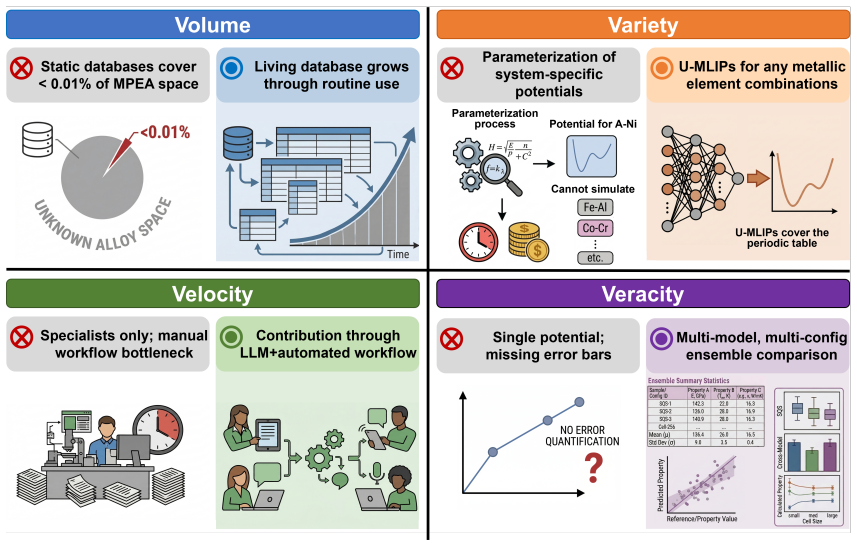
OptiMat Alloys is a large-language-model conversational agent built on three pillars: a living database that archives every calculation with provenance, a zero-programming web interface, and uncertainty quantification through cross-potential and cross-configuration validation. By coupling foundational machine learning interatomic potentials that cover near-all elements with natural-language interaction, the system enables targeted, on-demand computations guided by user domain knowledge.
What carries the argument
The conversational agent that interprets arbitrary natural-language queries into valid, reproducible computations using foundational machine learning interatomic potentials.
If this is right
- Users without programming expertise can obtain alloy property data tailored to their specific composition and condition questions.
- The database continuously expands with every new query, eliminating the incompleteness of pre-computed repositories.
- Cross-validation between different potentials and configurations supplies immediate uncertainty estimates for each result.
- Computational screening of multi-principal element alloys becomes accessible to any materials scientist rather than specialists only.
Where Pith is reading between the lines
- Integration with experimental feedback loops could allow the agent to prioritize calculations that resolve measured discrepancies.
- The same architecture might extend to other classes of materials once suitable foundational potentials become available.
- Version control of the underlying potentials would be required to keep historical queries reproducible as models improve.
Load-bearing premise
The machine learning interatomic potentials remain accurate across the full range of multi-principal element compositions and the agent translates any natural-language query into correct, reproducible calculations without introducing errors.
What would settle it
A known alloy property, such as formation energy for a specific equiatomic composition, yields inconsistent numerical values or diverges from established reference data when requested through different phrasings of the same query.
Figures




read the original abstract
The FAIR principles have transformed how computational data and workflows are shared in materials research, yet existing repositories can only serve pre-computed entries -- broad coverage is perpetually incomplete and cannot adapt to new questions on demand. To address these challenges, we present OptiMat Alloys, a large language model-powered conversational agent for multi-principal element alloy exploration built on three pillars: a living database that stores every calculation with provenance, low-barrier accessibility through a web interface requiring zero programming expertise, and built-in uncertainty quantification via cross-potential and cross-configuration validation. Coupling foundational machine learning interatomic potentials covering near-all periodic table of elements with natural-language interaction, OptiMat Alloys enables targeted, on-demand computation guided by the user's domain knowledge-extending FAIR from pre-computed repositories to on-demand knowledge generation and making computational alloy screening accessible to any materials scientist.
Editorial analysis
A structured set of objections, weighed in public.
Referee Report
Summary. The manuscript presents OptiMat Alloys, an LLM-powered conversational agent for multi-principal element alloy exploration. Built on three pillars—a living database storing every calculation with provenance, a zero-programming web interface, and built-in uncertainty quantification via cross-potential and cross-configuration validation—it couples foundational machine-learning interatomic potentials (covering near-all elements) with natural-language interaction to enable targeted, on-demand property computations, thereby extending FAIR principles from static pre-computed repositories to dynamic, user-guided knowledge generation.
Significance. If the described components function reliably, the work could meaningfully lower barriers to computational alloy screening, allowing domain experts without programming skills to generate and validate properties on demand for compositionally complex alloys. The living-database and provenance features would also support reproducibility and cumulative data reuse, potentially accelerating discovery in high-entropy and multi-principal-element systems.
major comments (3)
- [Abstract] Abstract: the central claim that the system delivers 'usable accuracy' and 'reproducible computations' for arbitrary MPEA compositions rests on the performance of foundational ML interatomic potentials and the agent's query-interpretation step, yet the manuscript supplies no benchmarks, error statistics, or validation against DFT/experiment for high-entropy or compositionally complex cases.
- [System Architecture / Uncertainty Quantification] The description of uncertainty quantification (cross-potential and cross-configuration validation) provides no quantitative results, such as error distributions, failure rates, or comparisons to reference data, leaving the asserted reliability of on-demand calculations unverified.
- [Conversational Agent Implementation] No example natural-language queries, success rates for mapping to valid workflows, or reported hallucination/invalid-input rates are given, which directly undermines the assertion that the agent correctly interprets arbitrary queries without introducing errors.
minor comments (1)
- [Abstract] The abstract is lengthy and could be tightened while preserving the three-pillar structure and key claims.
Simulated Author's Rebuttal
We thank the referee for their constructive and detailed review of our manuscript. The comments highlight important areas where additional evidence is needed to support the claims regarding accuracy, reliability, and agent performance. We address each major comment below and will implement revisions to incorporate the requested benchmarks, quantitative results, and examples.
read point-by-point responses
-
Referee: [Abstract] Abstract: the central claim that the system delivers 'usable accuracy' and 'reproducible computations' for arbitrary MPEA compositions rests on the performance of foundational ML interatomic potentials and the agent's query-interpretation step, yet the manuscript supplies no benchmarks, error statistics, or validation against DFT/experiment for high-entropy or compositionally complex cases.
Authors: We acknowledge that the current manuscript does not include dedicated benchmarks or error statistics for high-entropy and compositionally complex MPEAs, even though the foundational potentials are drawn from prior validated work. To strengthen the abstract and the overall narrative, we will add a new results subsection with benchmarks against DFT for representative MPEA compositions. This will include quantitative error statistics (e.g., MAE for energies, lattice parameters, and moduli) and a discussion of reproducibility enabled by the provenance-tracked living database. revision: yes
-
Referee: [System Architecture / Uncertainty Quantification] The description of uncertainty quantification (cross-potential and cross-configuration validation) provides no quantitative results, such as error distributions, failure rates, or comparisons to reference data, leaving the asserted reliability of on-demand calculations unverified.
Authors: The referee correctly notes the absence of quantitative results for the uncertainty quantification procedures. We will revise the System Architecture section to include concrete quantitative data: error distributions from cross-potential comparisons, observed failure rates where cross-validation triggers alerts, and direct comparisons to DFT reference data for selected test alloys. These additions will be presented with figures and tables to substantiate the reliability claims. revision: yes
-
Referee: [Conversational Agent Implementation] No example natural-language queries, success rates for mapping to valid workflows, or reported hallucination/invalid-input rates are given, which directly undermines the assertion that the agent correctly interprets arbitrary queries without introducing errors.
Authors: We agree that explicit examples and performance metrics are required to demonstrate the agent's reliability. In the revised manuscript we will add an appendix or dedicated subsection containing representative natural-language queries, their parsed workflows, and quantitative metrics from internal testing (success rates for valid workflow mapping, observed hallucination rates, and invalid-input handling). We will also describe the guardrails and validation steps used to reduce errors. revision: yes
Circularity Check
No significant circularity in system-description paper
full rationale
The manuscript presents OptiMat Alloys as a software system and database interface that couples pre-existing foundational ML interatomic potentials with an LLM-based conversational agent. No equations, derivations, fitted parameters, or predictions appear in the provided text; the work contains no self-referential definitions, no renaming of known results, and no load-bearing self-citations that reduce the central claim to its own inputs. The description is therefore self-contained as an engineering integration claim resting on external components rather than internal circular reasoning.
Axiom & Free-Parameter Ledger
axioms (1)
- domain assumption Machine learning interatomic potentials trained on elemental and binary data generalize accurately to multi-principal element alloys
invented entities (1)
-
OptiMat Alloys conversational agent and living database
no independent evidence
Reference graph
Works this paper leans on
-
[1]
Wilkinson, Michel Dumontier, IJsbrand Jan Aalbersberg, Gabrielle Appleton, Myles Axton, Arie Baak, Niklas Blomberg, Jan-Willem Boiten, Luiz Bonino da Silva Santos, Philip E
Mark D. Wilkinson, Michel Dumontier, IJsbrand Jan Aalbersberg, Gabrielle Appleton, Myles Axton, Arie Baak, Niklas Blomberg, Jan-Willem Boiten, Luiz Bonino da Silva Santos, Philip E. Bourne, Jildau Bouwman, Anthony J. Brookes, Tim Clark, Merc` e Crosas, Ingrid Dillo, Olivier Dumon, Scott Edmunds, Chris T. Evelo, Richard Finkers, Alejandra Gonzalez-Beltran,...
2016
-
[2]
Koch, Kurt Kremer, Wolf- gang A
Matthias Scheffler, Martin Aeschlimann, Martin Albrecht, Tristan Bereau, Hans-Joachim Bun- gartz, Claudia Felser, Mark Greiner, Axel Groß, Christoph T. Koch, Kurt Kremer, Wolf- gang A. Nagel, Taisuke Nakamura, Kikuji Sagiyama, Alexander Schl¨ uter, Georg Spenke, Dag- mar Stachel, Christoph Strunk, Thomas Weidinger, et al. Fair data enabling new horizons f...
2022
-
[3]
The NOMAD laboratory: from data sharing to artificial intelligence.Journal of Physics: Materials, 2(3):036001, 2019
Claudia Draxl and Matthias Scheffler. The NOMAD laboratory: from data sharing to artificial intelligence.Journal of Physics: Materials, 2(3):036001, 2019. NOMAD repository and AI toolkit
2019
-
[4]
Anubhav Jain, Shyue Ping Ong, Geoffroy Hautier, Wei Chen, William Davidson Richards, Stephen Dacek, Shreyas Cholia, Dan Gunter, David Skinner, Gerbrand Ceder, and Kristin A. Persson. Commentary: The materials project: A materials genome approach to accelerating materials innovation.APL Materials, 1(1):011002, 2013
2013
-
[5]
Horton, Patrick Huck, Ruo Xi Yang, Jason M
Matthew K. Horton, Patrick Huck, Ruo Xi Yang, Jason M. Munro, Shyam Dwaraknath, Alex M. Ganose, Ryan S. Kingsbury, Mingjian Wen, Jimmy X. Shen, Tyler S. Mathis, Aaron D. Kaplan, Karlo Berket, Janosh Riebesell, Janine George, Andrew S. Rosen, Evan W. C. Spotte- Smith, Matthew J. McDermott, Orion A. Cohen, Alex Dunn, Matthew C. Kuner, Gian-Marco Rignanese, ...
2025
-
[6]
Stefano Curtarolo, Wahyu Setyawan, Gus L. W. Hart, Michal Jahnatek, Roman V. Chepulskii, Richard H. Taylor, Shidong Wang, Junkai Xue, Kesong Yang, Ohad Levy, Michael J. Mehl, Harold T. Stokes, Denis O. Demchenko, and Dane Morgan. Aflow: An automatic framework for high-throughput materials discovery.Computational Materials Science, 58:218–226, 2012
2012
-
[7]
Garrity, Andrew C
Kamal Choudhary, Kevin F. Garrity, Andrew C. E. Reid, Brian DeCost, Adam J. Biacchi, Angela R. Hight Walker, Zachary Trautt, Jason Hattrick-Simpers, A. Gilad Kusne, Andrea Centrone, Albert Davydov, Jie Jiang, Ruth Pachter, Anne Chaka, and Francesca Tavazza. The joint automated repository for various integrated simulations (JARVIS) for data-driven material...
2020
-
[8]
Yakutovich, Valeria Granata, Fernando Gargiulo, Marco Borelli, Martin Uhrin, Sebastiaan P
Leopold Talirz, Snehal Kumbhar, Elsa Passaro, Aliaksandr V. Yakutovich, Valeria Granata, Fernando Gargiulo, Marco Borelli, Martin Uhrin, Sebastiaan P. Huber, Spyros Zoupanos, Carl S. Adorf, Casper W. Andersen, Ole Sch¨ utt, Carlo A. Pignedoli, Daniele Passerone, Joost VandeVondele, Thomas C. Schulthess, Berend Smit, Giovanni Pizzi, and Nicola Marzari. Ma-...
2020
-
[9]
Huber, Spyros Zoupanos, Martin Uhrin, Leopold Talirz, Leonid Kahle, Rico H¨ auselmann, Dominik Gresch, Tiziano M¨ uller, Aliaksandr V
Sebastiaan P. Huber, Spyros Zoupanos, Martin Uhrin, Leopold Talirz, Leonid Kahle, Rico H¨ auselmann, Dominik Gresch, Tiziano M¨ uller, Aliaksandr V. Yakutovich, Casper W. Ander- sen, Francisco F. Ramirez, Carl S. Adorf, Fernando Gargiulo, Snehal Kumbhar, Elsa Passaro, 23 Conrad Johnston, Andrius Merkys, Andrea Cepellotti, Nicolas Mounet, Nicola Marzari, B...
2020
-
[10]
N’Diaye, and Kristin Persson
Patrick Huck, Daniel Gunter, Shreyas Cholia, Donald Winston, Alpha T. N’Diaye, and Kristin Persson. User applications driven by the community contribution framework MPContribs in the Materials Project.Concurrency and Computation: Practice and Experience, 28(7):1982– 1993, 2016
1982
-
[11]
George, Dierk Raabe, and Robert O
Easo P. George, Dierk Raabe, and Robert O. Ritchie. High-entropy alloys.Nature Reviews Materials, 4:515–534, 2019
2019
-
[12]
D. B. Miracle and O. N. Senkov. A critical review of high entropy alloys and related concepts. Acta Materialia, 122:448–511, 2017
2017
-
[13]
Thermo-calc databases overview, 2025
Thermo-Calc Software AB. Thermo-calc databases overview, 2025. Accessed: October 2025
2025
-
[14]
J. M. Rickman, H. M. Chan, M. P. Harmer, J. A. Smeltzer, C. J. Marvel, A. Roy, and G. Bal- asubramanian. Materials informatics for the screening of multi-principal elements and high- entropy alloys.Nature Communications, 10:2618, 2019. Quantifies the informatics challenge of screening MPEAs
2019
-
[15]
Docherty, and Samuel J
Ge Lei, R. Docherty, and Samuel J. Cooper. Materials science in the era of large language models: a perspective.Digital Discovery, 2024
2024
-
[16]
A survey on large language model based autonomous agents.Frontiers of Computer Science, 18:186345, 2024
Lei Wang, Chen Ma, Xueyang Feng, Zeyu Zhang, Hao Yang, Jingsen Zhang, Zhiyuan Chen, Jiakai Tang, Xu Chen, Yankai Lin, Wayne Xin Zhao, Zhewei Wei, and Ji-Rong Wen. A survey on large language model based autonomous agents.Frontiers of Computer Science, 18:186345, 2024
2024
-
[17]
Kresse and J
G. Kresse and J. Furthm¨ uller. Efficient iterative schemes for ab initio total-energy calculations using a plane-wave basis set.Physical Review B, 54(16):11169–11186, 1996
1996
-
[18]
Thompson, H
Aidan P. Thompson, H. Metin Aktulga, Richard Berger, Dan S. Bolintineanu, W. Michael Brown, Paul S. Crozier, Pieter J. in ’t Veld, Axel Kohlmeyer, Stan G. Moore, Trung Dac Nguyen, Ray Shan, Mark J. Stevens, Julien Tranchida, Christian Trott, and Steven J. Plimp- ton. LAMMPS – a flexible simulation tool for particle-based materials modeling at the atomic, ...
2022
-
[19]
Castelli, Rune Chris- tensen, Marcin Du lak, Jesper Friis, Michael N
Ask Hjorth Larsen, Jens Jørgen Mortensen, Jakob Blomqvist, Ivano E. Castelli, Rune Chris- tensen, Marcin Du lak, Jesper Friis, Michael N. Groves, Bjørk Hammer, Cory Hargus, Eric D. Hermes, Paul C. Jennings, Peter Bjerre Jensen, James Kermode, John R. Kitchin, Esben Leon- hard Kolsbjerg, Joseph Kubal, Kristen Kaasbjerg, Steen Lysgaard, J´ on Bergmann Maron...
2017
-
[20]
Software 2.0
Andrej Karpathy. Software 2.0. Medium, 2017. Defines Software 1.0 (classical code) vs 2.0 (neural networks)
2017
-
[21]
Software is changing (again)
Andrej Karpathy. Software is changing (again). Keynote at YC AI Startup School, San Francisco, June 2025, 2025. Extends Software 1.0/2.0 framework to Software 3.0 (LLMs as natural-language programming)
2025
-
[22]
Mark Neumann, James Gin, Benjamin Rhodes, Steven Bennett, Zhiyi Li, Hitarth Choubisa, Arthur Hussey, and Jonathan Godwin. Orb: A fast, scalable neural network potential. arXiv preprint arXiv:2410.22570, 2024. Orbital Materials universal ML potential; also available at https://github.com/orbital-materials/orb-models. 24
-
[23]
Mailoa, Mordechai Kornbluth, Nicola Molinari, Tess E
Simon Batzner, Albert Musaelian, Lixin Sun, Mario Geiger, Jonathan P. Mailoa, Mordechai Kornbluth, Nicola Molinari, Tess E. Smidt, and Boris Kozinsky. E(3)-equivariant graph neu- ral networks for data-efficient and accurate interatomic potentials.Nature Communications, 13:2453, 2022. NequIP architecture
2022
-
[24]
Ilyes Batatia, D´ avid P´ eter Kov´ acs, Gregor N. C. Simm, Christoph Ortner, and G´ abor Cs´ anyi. Mace: Higher order equivariant message passing neural networks for fast and accurate force fields.Advances in Neural Information Processing Systems, 35:11423–11436, 2022. NeurIPS 2022
2022
-
[25]
Chue Hong, Daniel S
Michelle Barker, Neil P. Chue Hong, Daniel S. Katz, Anna-Lena Lamprecht, Carlos Martinez- Ortiz, Fotis Psomopoulos, Jennifer Harber, Leyla Jael Castro, Martin Gruber, Paula Grenier, et al. Introducing the FAIR principles for research software.Scientific Data, 9:622, 2022. FAIR4RS: extends FAIR from data to research software
2022
-
[26]
Boiko, Robert MacKnight, Ben Kline, and Gabe Gomes
Daniil A. Boiko, Robert MacKnight, Ben Kline, and Gabe Gomes. Autonomous chemical research with large language models.Nature, 624:570–578, 2023. Coscientist system
2023
-
[27]
Bran, Sam Cox, Oliver Schilter, Carlo Baldassari, Andrew D
Andres M. Bran, Sam Cox, Oliver Schilter, Carlo Baldassari, Andrew D. White, and Philippe Schwaller. Augmenting large language models with chemistry tools.Nature Machine Intelli- gence, 6:525–535, 2024. ChemCrow system
2024
-
[28]
Alireza Ghafarollahi and Markus J. Buehler. Automating alloy design and discovery with physics-aware multimodal multiagent ai.Proceedings of the National Academy of Sciences, 122(4):e2414074122, 2025. AtomAgents system; published January 2025
2025
-
[29]
Modular large language model agents for multi-task computational materials science
Akshat Chaudhari, Janghoon Ock, and Amir Barati Farimani. Modular large language model agents for multi-task computational materials science. ChemRxiv preprint, 2025. MatSciAgent system
2025
-
[30]
A fine-tuned large language model based molecular dynamics agent for code generation to obtain material thermodynamic pa- rameters.Scientific Reports, 15:10295, 2025
Zhuofan Shi, Chunxiao Xin, Tong Huo, Yuntao Jiang, Bowen Wu, Xingyue Chen, Wei Qin, Xinjian Ma, Gang Huang, Zhenyu Wang, and Xiang Jing. A fine-tuned large language model based molecular dynamics agent for code generation to obtain material thermodynamic pa- rameters.Scientific Reports, 15:10295, 2025. MDAgent system
2025
-
[31]
arXiv preprint arXiv:2401.17244 , year=
Yuan Chiang, Elvis Hsieh, Chia-Hong Chou, and Janosh Riebesell. LLaMP: Large language model made powerful for high-fidelity materials knowledge retrieval and distillation. arXiv preprint arXiv:2401.17244, 2024. LLaMP system; also published at EMNLP 2025
-
[32]
Fengxu Yang and Jack D. Evans. QUASAR: A universal autonomous system for atomistic sim- ulation and a benchmark of its capabilities. arXiv preprint arXiv:2602.00185, 2026. QUASAR system
work page internal anchor Pith review Pith/arXiv arXiv 2026
-
[33]
Chainlit: Build production-ready conversational ai.https://github.com/ Chainlit/chainlit, 2024
Chainlit Team. Chainlit: Build production-ready conversational ai.https://github.com/ Chainlit/chainlit, 2024. Accessed: 2025-11-22
2024
-
[34]
Plotly: An interactive, open-source, and browser-based graphing library for Python, 2026
Nicolas Kruchten, Andrew Seier, and Chris Parmer. Plotly: An interactive, open-source, and browser-based graphing library for Python, 2026. Version 6.7.0.https://github.com/ plotly/plotly.py
2026
-
[35]
Visualization and analysis of atomistic simulation data with ovito– the open visualization tool.Modelling and Simulation in Materials Science and Engineering, 18:015012, 2010
Alexander Stukowski. Visualization and analysis of atomistic simulation data with ovito– the open visualization tool.Modelling and Simulation in Materials Science and Engineering, 18:015012, 2010. OVITO visualization software
2010
-
[36]
Autogen: Enabling next-gen llm applications via multi-agent conversations
Qingyun Wu, Gagan Bansal, Jieyu Zhang, Yiran Wu, Beibin Li, Erkang Zhu, Li Jiang, Xiaoyun Zhang, Shaokun Zhang, Jiale Liu, et al. Autogen: Enabling next-gen llm applications via multi-agent conversations. InFirst conference on language modeling, 2024
2024
-
[37]
OpenRouter: A unified interface for large language models, 2023
OpenRouter. OpenRouter: A unified interface for large language models, 2023. Accessed: April 2026. 25
2023
-
[38]
Ollama: Get up and running with large language models locally, 2023
Ollama Contributors. Ollama: Get up and running with large language models locally, 2023. Accessed: April 2026
2023
-
[39]
GLM-4.5: Agentic, Reasoning, and Coding (ARC) Foundation Models
GLM Team. GLM-4.5: Agentic, reasoning, and coding (ARC) foundation models. arXiv preprint arXiv:2508.06471, 2025
work page internal anchor Pith review arXiv 2025
-
[40]
MiMo-V2-Flash Technical Report
Xiaomi LLM-Core Team. MiMo-V2-Flash technical report. arXiv preprint arXiv:2601.02780, 2026
work page internal anchor Pith review arXiv 2026
-
[41]
gpt-oss-120b & gpt-oss-20b Model Card
OpenAI. gpt-oss-120b & gpt-oss-20b model card. arXiv preprint arXiv:2508.10925, 2025
work page internal anchor Pith review arXiv 2025
-
[42]
Introducing GPT-4.1 in the API.https://openai.com/index/gpt-4-1/, 2025
OpenAI. Introducing GPT-4.1 in the API.https://openai.com/index/gpt-4-1/, 2025. Accessed: 2026-02-05
2025
-
[43]
MIT Press, Cambridge, MA, 2nd edition, 1971
Gene Simmons and Herbert Wang.Single Crystal Elastic Constants and Calculated Aggregate Properties: A Handbook. MIT Press, Cambridge, MA, 2nd edition, 1971
1971
-
[44]
Y. S. Touloukian, R. K. Kirby, R. E. Taylor, and P. D. Desai.Thermophysical Properties of Matter, Vol. 12: Thermal Expansion—Metallic Elements and Alloys. IFI/Plenum, New York, 1975
1975
-
[45]
Chase, Jr.NIST-JANAF Thermochemical Tables
Malcolm W. Chase, Jr.NIST-JANAF Thermochemical Tables. American Chemical Society and American Institute of Physics, 4th edition, 1998. Journal of Physical and Chemical Reference Data, Monograph No. 9
1998
-
[46]
Z. Wu, H. Bei, G. M. Pharr, and E. P. George. Temperature dependence of the mechanical properties of equiatomic solid solution alloys with face-centered cubic crystal structures.Acta Materialia, 81:428–441, 2014
2014
-
[47]
Ke Jin, B. C. Sales, G. M. Stocks, German Samolyuk, Markus Daene, W. J. Weber, Yanwen Zhang, and Hongbin Bei. Tailoring the physical properties of Ni-based single-phase equiatomic alloys by modifying the chemical complexity.Scientific Reports, 6:20159, 2016
2016
-
[48]
Koval, J
Natalia E. Koval, J. I. Juaristi, R. D´ ıez Mui˜ no, and M. Alducin. Structure and properties of CoCrFeNiX multi-principal element alloys fromab initiocalculations.Journal of Applied Physics, 127(14):145102, 2020
2020
-
[49]
Nitol, Artur Tamm, Subah Mubassira, Shuozhi Xu, and Saryu J
Mashroor S. Nitol, Artur Tamm, Subah Mubassira, Shuozhi Xu, and Saryu J. Fensin. Achieving DFT accuracy in short range ordering and stacking fault energy using moment tensor potential for CoCrFeNi and CoCrNi. arXiv preprint arXiv:2509.11231, 2025
-
[50]
A. Tamm, A. Aabloo, M. Klintenberg, M. Stocks, and A. Caro. Atomic-scale properties of Ni-based FCC ternary, and quaternary alloys.Acta Materialia, 99:307–312, 2015
2015
-
[51]
A. J. Zaddach, Changning Niu, C. C. Koch, and Douglas L. Irving. Mechanical properties and stacking fault energies of NiFeCrCoMn high-entropy alloy.JOM, 65(12):1780–1789, 2013
2013
-
[52]
P. Nagy, N. Rohbeck, R. N. Widmer, Z. Heged˝ us, J. Michler, L. Peth˝ o, J. L. L´ ab´ ar, and J. Gubicza. Combinatorial study of phase composition, microstructure and mechanical behav- ior of Co-Cr-Fe-Ni nanocrystalline film processed by multiple-beam-sputtering physical vapor deposition.Materials, 15(6):2319, 2022
2022
-
[53]
Effect of residual stress and mi- crostructure on mechanical properties of sputter-grown cu/w nanomultilayers.APL Materials, 12(10), 2024
Giacomo Lorenzin, Fedor F Klimashin, Jeyun Yeom, Yang Hu, Johann Michler, Jolanta Janczak-Rusch, Vladyslav Turlo, and Claudia Cancellieri. Effect of residual stress and mi- crostructure on mechanical properties of sputter-grown cu/w nanomultilayers.APL Materials, 12(10), 2024
2024
-
[54]
V. A. Bykov, T. V. Kulikova, I. S. Sipatov, E. V. Sterkhov, D. A. Kovalenko, and R. E. Ryltsev. Transport properties of equiatomic CoCrFeNi high-entropy alloy with a single-phase face-centered cubic structure.Crystals, 13(11):1567, 2023. 26
2023
-
[55]
High-entropy alloy mapping in the Co-Cr-Fe-Mo-Ni- W compositional library using a combinatorial thin film.Journal of Alloys and Compounds, 1048:185264, 2025
Ao Wang, L´ aszl´ o Peth¨ o, Zolt´ an Heged¨ us, Maria Watroba, Johann Michler, Jozef Vesel´ y, Peter Min´ arik, P´ eter Nagy, and Jen˝ o Gubicza. High-entropy alloy mapping in the Co-Cr-Fe-Mo-Ni- W compositional library using a combinatorial thin film.Journal of Alloys and Compounds, 1048:185264, 2025
2025
-
[56]
Scalable parallel monte carlo algorithm for atomistic simulations of precipitation in alloys.Physical Review B—Condensed Matter and Materials Physics, 85(18):184203, 2012
Babak Sadigh, Paul Erhart, Alexander Stukowski, Alfredo Caro, Enrique Martinez, and Luis Zepeda-Ruiz. Scalable parallel monte carlo algorithm for atomistic simulations of precipitation in alloys.Physical Review B—Condensed Matter and Materials Physics, 85(18):184203, 2012
2012
-
[57]
ToPolyAgent: AI agents for coarse-grained bead-spring topological polymer simulations.Digital Discovery, 5(2):901–909, 2026
Lijie Ding, Jan-Michael Carrillo, and Changwoo Do. ToPolyAgent: AI agents for coarse-grained bead-spring topological polymer simulations.Digital Discovery, 5(2):901–909, 2026
2026
-
[58]
Crystalyse: a multi-tool agent for materials design
Ryan Nduma, Hyunsoo Park, and Aron Walsh. Crystalyse: a multi-tool agent for materials design. arXiv preprint arXiv:2512.00977, 2025
-
[59]
Jan Janssen, Edward O. Pyzer-Knapp, Alex M. Ganose, et al. LangSim: Large language model interface for atomistic simulation. 2024 LLM Hackathon for Applications in Materials Science and Chemistry, 2024. Hackathon proceedings: arXiv:2411.15221
-
[60]
Huan Zhang, Yizhan Li, Wenhao Huang, Ziyu Hou, Yu Song, Xuye Liu, Farshid Effaty, Jinya Jiang, Sifan Wu, Qianggang Ding, Izumi Takahara, Leonard R. MacGillivray, Teruyasu Mi- zoguchi, Tianshu Yu, Lizi Liao, Yuyu Luo, Yu Rong, Jia Li, Ying Diao, Heng Ji, and Bang Liu. Towards agentic intelligence for materials science.arXiv preprint arXiv:2602.00169v2, 2026
-
[61]
Agentic material science.Journal of Materials Informatics, 6(1):10, 2026
Chengbo Li, Nian Ran, and Jianjun Liu. Agentic material science.Journal of Materials Informatics, 6(1):10, 2026
2026
-
[62]
Willatt, Mikhail A
F´ elix Musil, Michael J. Willatt, Mikhail A. Langovoy, and Michele Ceriotti. Fast and accu- rate uncertainty estimation in chemical machine learning.Journal of Chemical Theory and Computation, 15(2):906–915, 2019
2019
-
[63]
A framework to evaluate machine learning crystal stability predictions.Nature Machine Intelligence, 7(6):836– 847, 2025
Janosh Riebesell, Rhys EA Goodall, Philipp Benner, Yuan Chiang, Bowen Deng, Gerbrand Ceder, Mark Asta, Alpha A Lee, Anubhav Jain, and Kristin A Persson. A framework to evaluate machine learning crystal stability predictions.Nature Machine Intelligence, 7(6):836– 847, 2025
2025
-
[64]
Perdew, Kieron Burke, and Matthias Ernzerhof
John P. Perdew, Kieron Burke, and Matthias Ernzerhof. Generalized gradient approximation made simple.Physical Review Letters, 77(18):3865–3868, 1996
1996
-
[65]
arXiv preprint arXiv:2410.12771 , year=
Luis Barroso-Luque, Muhammed Shuaibi, Xiang Fu, Brandon M. Wood, Misko Dzamba, Meng Gao, Ammar Rizvi, C. Lawrence Zitnick, and Zachary W. Ulissi. Open materials 2024 (omat24) inorganic materials dataset and models. arXiv preprint arXiv:2410.12771, 2024. Meta FAIR dataset with 100M+ DFT calculations
-
[66]
Bartel, and Gerbrand Ceder
Bowen Deng, Peichen Zhong, KyuJung Jun, Janosh Riebesell, Kevin Han, Christopher J. Bartel, and Gerbrand Ceder. CHGNet as a pretrained universal neural network potential for charge-informed atomistic modelling.Nature Machine Intelligence, 5:1031–1041, 2023. Introduces the MPtrj dataset of 1.58M Materials Project trajectory frames
2023
-
[67]
Th´ eo Cavignac, Jonathan Schmidt, Pierre-Paul De Breuck, Antoine Loew, Tiago F. T. Cerqueira, Hai-Chen Wang, Anton Bochkarev, Yury Lysogorskiy, Aldo H. Romero, Ralf Drautz, Silvana Botti, and Miguel A. L. Marques. AI-driven expansion and application of the Alexandria database. arXiv preprint arXiv:2512.09169, 2025. Alexandria PBE dataset with MP-compatib...
work page internal anchor Pith review Pith/arXiv arXiv 2025
-
[68]
Alex Zunger, S.-H. Wei, L. G. Ferreira, and James E. Bernard. Special quasirandom structures. Physical Review Letters, 65:353, 1990. Original SQS methodology
1990
-
[69]
Models of configurationally-complex alloys made simple.Computer Physics Communications, 286:108664, 2023
Dominik Gehringer, Martin Fri´ ak, and David Holec. Models of configurationally-complex alloys made simple.Computer Physics Communications, 286:108664, 2023. sqsgenerator library. 27
2023
-
[70]
L. Vegard. Die Konstitution der Mischkristalle und die Raumf¨ ullung der Atome.Zeitschrift f¨ ur Physik, 5(1):17–26, 1921
1921
-
[71]
Struc- tural relaxation made simple.Physical Review Letters, 97:170201, 2006
Erik Bitzek, Pekka Koskinen, Franz G¨ ahler, Michael Moseler, and Peter Gumbsch. Struc- tural relaxation made simple.Physical Review Letters, 97:170201, 2006. FIRE (Fast Inertial Relaxation Engine) optimizer
2006
-
[72]
Robust structural identification via polyhedral template matching.Modelling and Simulation in Materials Science and Engineer- ing, 24:055007, 2016
Peter Mahler Larsen, Søren Schmidt, and Jakob Schiøtz. Robust structural identification via polyhedral template matching.Modelling and Simulation in Materials Science and Engineer- ing, 24:055007, 2016. Polyhedral Template Matching (PTM) algorithm
2016
-
[73]
R. Hill. The elastic behaviour of a crystalline aggregate.Proceedings of the Physical Society. Section A, 65:349–354, 1952. Hill averaging (arithmetic mean of Voigt and Reuss)
1952
-
[74]
S. F. Pugh. XCII. relations between the elastic moduli and the plastic properties of polycrys- talline pure metals.The London, Edinburgh, and Dublin Philosophical Magazine and Journal of Science, 45(367):823–843, 1954
1954
-
[75]
Ranganathan and Martin Ostoja-Starzewski
Shivakumar I. Ranganathan and Martin Ostoja-Starzewski. Universal elastic anisotropy index. Physical Review Letters, 101:055504, 2008. Universal anisotropy indexA U
2008
-
[76]
Elate: an open-source online application for analysis and visualization of elastic tensors.Journal of Physics: Condensed Matter, 28:275201, 2016
Romain Gaillac, Pluton Pullumbi, and Fran¸ cois-Xavier Coudert. Elate: an open-source online application for analysis and visualization of elastic tensors.Journal of Physics: Condensed Matter, 28:275201, 2016. ELATE elastic anisotropy visualization
2016
-
[77]
Oxford University Press, Oxford, 1954
Max Born and Kun Huang.Dynamical Theory of Crystal Lattices. Oxford University Press, Oxford, 1954
1954
-
[78]
Necessary and sufficient elastic stability conditions in various crystal systems.Physical Review B, 90:224104, 2014
F´ elix Mouhat and Fran¸ cois-Xavier Coudert. Necessary and sufficient elastic stability conditions in various crystal systems.Physical Review B, 90:224104, 2014
2014
-
[79]
First-principles phonon calcula- tions of thermal expansion in ti 3sic2, ti3alc2, and ti 3gec2.Physical Review B, 81:174301, 2010
Atsushi Togo, Laurent Chaput, Isao Tanaka, and Gilles Hug. First-principles phonon calcula- tions of thermal expansion in ti 3sic2, ti3alc2, and ti 3gec2.Physical Review B, 81:174301, 2010. QHA methodology for thermal expansion
2010
-
[80]
First principles phonon calculations in materials science.Scripta Materialia, 108:1–5, 2015
Atsushi Togo and Isao Tanaka. First principles phonon calculations in materials science.Scripta Materialia, 108:1–5, 2015. Phonopy software for phonon calculations
2015
discussion (0)
Sign in with ORCID, Apple, or X to comment. Anyone can read and Pith papers without signing in.