Recognition: unknown
Quark and gluon production in the presence of the time-varying chiral magnetic current
Pith reviewed 2026-05-09 21:23 UTC · model grok-4.3
The pith
Time variation of the chiral magnetic conductivity modifies quark and gluon production rates and implies strong jet polarization in quark-gluon plasma.
A machine-rendered reading of the paper's core claim, the machinery that carries it, and where it could break.
Core claim
The central claim is that the time variation of b0, the chiral magnetic conductivity proportional to the chiral imbalance, alters the spectra and energy loss of particles produced via chiral Cherenkov and associated processes. When applied to relativistic heavy-ion collisions with a specific model for the relaxation of the initial P-odd domain, the computed energy loss leads to the conclusion of strong polarization of jets in the quark-gluon plasma.
What carries the argument
The time-dependent chiral magnetic conductivity b0, which induces an electric current along the magnetic field direction and determines the rates of chiral Cherenkov radiation and related particle production processes.
If this is right
- Rates for all relevant production processes are obtained in the ultra-relativistic approximation for both Abelian and non-Abelian systems.
- Energy loss is computed explicitly using a model of the relaxation of the initial P-odd domain in the quark-gluon plasma.
- The time dependence of b0 produces modifications to particle spectra that differ from the constant-b0 case.
- The calculations imply strong polarization of jets as a direct consequence of the varying chiral current.
Where Pith is reading between the lines
- The predicted polarization could serve as an independent experimental handle on the lifetime of chiral imbalance in the plasma.
- Similar time-dependent effects might appear in other systems where chiral imbalance evolves, such as early-universe plasmas.
- The results suggest that jet observables in heavy-ion data should be reexamined for signatures beyond standard hydrodynamic or partonic energy loss.
Load-bearing premise
The ultra-relativistic approximation holds for all relevant processes and the specific model chosen for relaxation of the initial P-odd domain accurately captures the time dependence of b0 in realistic heavy-ion collisions.
What would settle it
Experimental measurements of jet polarization or energy-loss asymmetry in heavy-ion collisions at facilities like RHIC or the LHC that either match or fail to match the predicted levels from the time-dependent b0 model.
Figures




read the original abstract
The chiral magnetic effect consists in the induction of the electric current along the direction of the magnetic field. The corresponding transport coefficient $b_0$, known as the chiral magnetic conductivity, is proportional to the chiral imbalance in the medium. In many systems, such as quark-gluon plasma, $b_0$ is time-dependent. This paper studies the effect of the time variation of $b_0$ on the particle spectra and energy loss produced through the chiral Cherenkov and associated processes in Abelian and non-Abelian systems. The rates of all processes are derived in the ultra-relativistic approximation. The results are applied to the relativistic heavy-ion collisions utilizing a specific model describing the relaxation of the initial $P$-odd domain within the quark-gluon plasma. The corresponding energy loss is computed. The results suggest strong polarization of jets in quark-gluon plasma.
Editorial analysis
A structured set of objections, weighed in public.
Referee Report
Summary. The paper derives the rates for quark and gluon production through chiral Cherenkov and associated processes in the presence of a time-dependent chiral magnetic conductivity b0, for both Abelian and non-Abelian cases, in the ultra-relativistic approximation. These rates are applied to heavy-ion collisions using one specific parametrization of the relaxation of an initial P-odd domain in the quark-gluon plasma; the resulting energy loss is computed and used to suggest strong jet polarization.
Significance. If the derivations are correct and the chosen relaxation model representative of realistic QGP evolution, the work would identify a novel time-dependent mechanism contributing to jet polarization via the chiral magnetic effect, potentially observable in heavy-ion data and extending prior CME studies.
major comments (1)
- [Application to heavy-ion collisions] The headline claim of strong jet polarization rests on the energy-loss asymmetry obtained from a single specific model for the time dependence of b0(t) describing relaxation of the initial P-odd domain. No variation of the functional form, relaxation timescale, or comparison against hydrodynamic or lattice-motivated profiles is performed, so it is unclear whether the polarization survives under plausible changes to this input. This model dependence directly controls the central phenomenological conclusion.
minor comments (1)
- The abstract states that rates are derived but provides no equations, limiting statements, or validation against known static-b0 limits; including at least the leading expression for the rate would improve accessibility.
Simulated Author's Rebuttal
We thank the referee for the careful reading of our manuscript and the constructive comment on the phenomenological application. We address the point below and will revise the manuscript to better contextualize the model dependence.
read point-by-point responses
-
Referee: [Application to heavy-ion collisions] The headline claim of strong jet polarization rests on the energy-loss asymmetry obtained from a single specific model for the time dependence of b0(t) describing relaxation of the initial P-odd domain. No variation of the functional form, relaxation timescale, or comparison against hydrodynamic or lattice-motivated profiles is performed, so it is unclear whether the polarization survives under plausible changes to this input. This model dependence directly controls the central phenomenological conclusion.
Authors: We agree that the quantitative strength of the jet polarization signal depends on the specific parametrization chosen for b0(t). The model employed is a simple exponential relaxation of the initial P-odd domain, selected because it is representative of the decay timescales discussed in the CME literature for QGP. The derivations of the production rates themselves are independent of this choice and hold for arbitrary time-dependent b0(t). To address the concern, the revised manuscript will include a brief sensitivity study varying the relaxation timescale over a range motivated by hydrodynamic estimates of chiral imbalance evolution. We will also add a qualitative discussion of how alternative functional forms (e.g., power-law or hydrodynamically motivated profiles) would modify the asymmetry, while noting that the qualitative mechanism of time-dependent chiral Cherenkov radiation producing polarization remains present whenever b0 varies on timescales comparable to jet propagation. These additions will be placed in the phenomenological section. revision: yes
Circularity Check
No significant circularity; derivation chain is self-contained.
full rationale
The paper first derives the production rates for chiral Cherenkov and related processes in the ultra-relativistic limit from the underlying equations of motion (Abelian and non-Abelian cases). These rates are then applied to heavy-ion collisions by inserting an explicit, externally chosen parametrization of b0(t) that describes relaxation of the initial P-odd domain. The resulting energy-loss asymmetry and jet-polarization suggestion are direct numerical consequences of that insertion. Because the relaxation model is introduced as an independent input rather than fitted to the computed spectra or defined in terms of the output quantities, no step reduces to its own result by construction. No load-bearing self-citations, uniqueness theorems, or ansatzes smuggled via prior work are required for the central claims. The derivation therefore remains independent of the final polarization statement.
Axiom & Free-Parameter Ledger
axioms (2)
- domain assumption Ultra-relativistic approximation for deriving process rates
- domain assumption Specific model accurately describes relaxation of initial P-odd domain
Reference graph
Works this paper leans on
-
[1]
Constantb 0 At a constantb 0, ˜a(q) is proportional to the delta function expressing energy conservation. After some algebra, (31) reduces to [21]: d˙w(q→qγ) dxd2k⊥ = e2 16π2E X λ λEb0 1 + (1−x) 2 x −2m 2 δ k2 ⊥ −λb 0Ex(1−x) +m 2x2 .(35) The first term in the braces of (31) and (35) is proportional to the splitting functionP γq(x). 2.b 0(t) =A+Btanh t τ I...
-
[2]
1, with the color indicating gluon polarization
and yields the result: I= τ2 −iΛBτ /2−2 Γ(−iΛBτ /2)Γ 1 2 − iΛτ 2 (A+B) +iατ+ϵτ Γ 1 2 iΛτ 2 (A−B)−iατ+ϵτ .(37) In particular, replacing Λ =λ,α=k−E+E ′ and using (32) yields for the amplitude (33): ˜a(E−E′) = τ√2kz 2−iλBτ /2−1 Γ(−iλBτ /2)Γ iτ 2 − λ 2 (A+B) + k2 ⊥ +x 2m2 2x(1−x)p z −iϵ ×Γ iτ 2 λ 2 (A−B)− k2 ⊥ +x 2m2 2x(1−x)p z −iϵ .(38) The final formula for...
-
[3]
As the result, ˜a(E+E′) = 2πδ(ω−E−E ′)/√2kz
Constantb 0 At constantb 0, the amplitude (26) reduces toa(t) =e −iωt/√2kz, whereω=k z −λb 0/2. As the result, ˜a(E+E′) = 2πδ(ω−E−E ′)/√2kz. The square of this quantity involves the product of two identical delta functions. One of them is interpreted as (2π) −1 times the observation time, whereas the other one can be cast in the following form: δ(ω−E−E ′)...
-
[4]
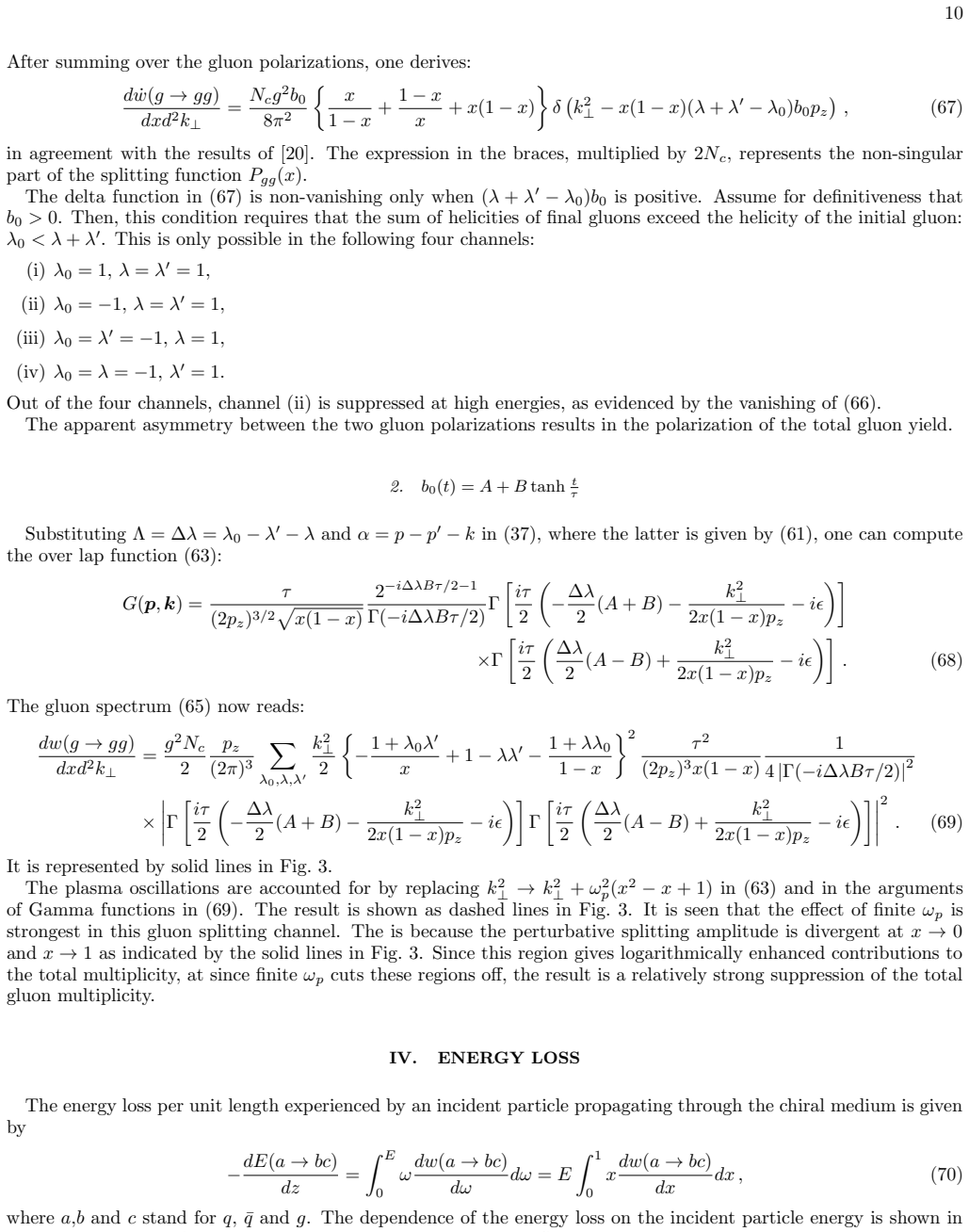
Constantb 0 In the particular case of constantb 0, the overlap functionGis proportional to the delta function expressing energy conservation. Upon integrating over time in (62), the gluon production rate reads: d˙w(g→gg) dxd2k⊥ = Ncg2b0 26π2 x(1−x) X λ0,λ,λ′ (λ+λ ′ −λ 0) −1 +λ 0λ′ x + 1−λλ ′ − 1 +λλ 0 1−x 2 ×δ k2 ⊥ −x(1−x)(λ+λ ′ −λ 0)b0pz .(66) 10 After s...
- [5]
-
[6]
Kharzeev, Parity violation in hot QCD: Why it can happen, and how to look for it, Phys
D. Kharzeev, Parity violation in hot QCD: Why it can happen, and how to look for it, Phys. Lett. B633, 260 (2006), arXiv:hep-ph/0406125
-
[7]
D. E. Kharzeev, L. D. McLerran, and H. J. Warringa, The Effects of topological charge change in heavy ion collisions: ’Event by event P and CP violation’, Nucl. Phys. A803, 227 (2008), arXiv:0711.0950 [hep-ph]
work page Pith review arXiv 2008
- [8]
-
[9]
D. Kharzeev and A. Zhitnitsky, Charge separation induced by P-odd bubbles in QCD matter, Nucl. Phys. A797, 67 (2007), arXiv:0706.1026 [hep-ph]
-
[10]
K. Fukushima, D. E. Kharzeev, and H. J. Warringa, The Chiral Magnetic Effect, Phys. Rev. D78, 074033 (2008), arXiv:0808.3382 [hep-ph]
work page Pith review arXiv 2008
-
[11]
E. Barredo-Alamilla, L. F. Urrutia, and M. M. Ferreira, Jr., Electromagnetic radiation in chiral matter: The Cherenkov case, Phys. Rev. D107, 096024 (2023), arXiv:2305.07963 [hep-ph]
- [12]
-
[13]
Y. Akamatsu and N. Yamamoto, Chiral Plasma Instabilities, Phys. Rev. Lett.111, 052002 (2013), arXiv:1302.2125 [nucl- th]
- [14]
-
[15]
Tuchin, Radiative instability of quantum electrodynamics in chiral matter, Phys
K. Tuchin, Radiative instability of quantum electrodynamics in chiral matter, Phys. Lett. B786, 249 (2018), arXiv:1806.07340 [hep-ph]
-
[16]
X.-G. Huang and K. Tuchin, Transition Radiation as a Probe of the Chiral Anomaly, Phys. Rev. Lett.121, 182301 (2018), arXiv:1808.00635 [hep-ph]
-
[17]
Tuchin, Chiral Cherenkov and chiral transition radiation in anisotropic matter, Phys
K. Tuchin, Chiral Cherenkov and chiral transition radiation in anisotropic matter, Phys. Rev. D98, 114026 (2018), arXiv:1809.08181 [hep-ph]
-
[18]
J. Hansen and K. Tuchin, Collisional energy loss and the chiral magnetic effect, Phys. Rev. C104, 034903 (2021), arXiv:2012.06089 [hep-ph]
-
[19]
J. Hansen and K. Tuchin, Bremsstrahlung in chiral medium: Anomalous magnetic contribution to the Bethe-Heitler formula, Phys. Rev. D105, 116008 (2022), arXiv:2203.13134 [hep-ph]
-
[20]
J. Hansen and K. Tuchin, Electromagnetic bremsstrahlung and energy loss in chiral medium, Phys. Rev. D108, 076007 (2023), arXiv:2307.05761 [hep-ph]
- [21]
-
[22]
J. Hansen and K. Tuchin, Chiral effects on radiation and energy loss in quark–gluon plasma, Int. J. Mod. Phys. E33, 2430011 (2024), arXiv:2409.16338 [hep-ph]
-
[23]
J. Hansen and K. Tuchin, Time evolution of parity-odd cascades in homogeneous Abelian and non-Abelian media with chiral imbalance, Phys. Rev. D112, 014010 (2025), arXiv:2503.00933 [hep-ph]
-
[24]
J. Hansen and K. Tuchin, Color chiral Cherenkov radiation and energy loss in the quark-gluon plasma, Phys. Rev. D110, 014027 (2024), arXiv:2405.08697 [hep-ph]
-
[25]
K. Tuchin, Chiral Cherenkov radiation in the presence of a time-dependent chiral chemical potential, Phys. Rev. C112, 044903 (2025), arXiv:2507.07324 [hep-ph]. 13
-
[26]
T. Lappi and S. Schlichting, Linearly polarized gluons and axial charge fluctuations in the Glasma, Phys. Rev. D97, 034034 (2018), arXiv:1708.08625 [hep-ph]
- [27]
- [28]
-
[29]
Bodeker, On the effective dynamics of soft nonAbelian gauge fields at finite temperature, Phys
D. Bodeker, On the effective dynamics of soft nonAbelian gauge fields at finite temperature, Phys. Lett. B426, 351 (1998), arXiv:hep-ph/9801430
-
[30]
M. Joyce and M. E. Shaposhnikov, Primordial magnetic fields, right-handed electrons, and the Abelian anomaly, Phys. Rev. Lett.79, 1193 (1997), arXiv:astro-ph/9703005
-
[31]
A. Boyarsky, J. Frohlich, and O. Ruchayskiy, Self-consistent evolution of magnetic fields and chiral asymmetry in the early Universe, Phys. Rev. Lett.108, 031301 (2012), arXiv:1109.3350 [astro-ph.CO]
- [32]
-
[33]
Tuchin, Electromagnetic field and the chiral magnetic effect in the quark-gluon plasma, Phys
K. Tuchin, Electromagnetic field and the chiral magnetic effect in the quark-gluon plasma, Phys. Rev. C91, 064902 (2015), arXiv:1411.1363 [hep-ph]
- [34]
-
[35]
C. Manuel and J. M. Torres-Rincon, Dynamical evolution of the chiral magnetic effect: Applications to the quark-gluon plasma, Phys. Rev. D92, 074018 (2015), arXiv:1501.07608 [hep-ph]
- [36]
-
[37]
K. Tuchin, Polarized electromagnetic radiation by chiral media with time-dependent chiral chemical potential, Phys. Lett. B872, 140080 (2026), arXiv:2508.12923 [hep-ph]
-
[38]
Wilczek, Two Applications of Axion Electrodynamics, Phys
F. Wilczek, Two Applications of Axion Electrodynamics, Phys. Rev. Lett.58, 1799 (1987)
1987
-
[39]
S. M. Carroll, G. B. Field, and R. Jackiw, Limits on a Lorentz and Parity Violating Modification of Electrodynamics, Phys. Rev. D41, 1231 (1990)
1990
-
[40]
Sikivie, On the Interaction of Magnetic Monopoles With Axionic Domain Walls, Phys
P. Sikivie, On the Interaction of Magnetic Monopoles With Axionic Domain Walls, Phys. Lett. B137, 353 (1984)
1984
-
[41]
M. E. Peskin and D. V. Schroeder,An Introduction to quantum field theory(Addison-Wesley, Reading, USA, 1995)
1995
-
[42]
D. H. Rischke, The quark–gluon plasma in equilibrium, Progress in Particle and Nuclear Physics52, 197 (2004)
2004
-
[43]
Bateman, A
H. Bateman, A. Erd´ elyi, W. Magnus, and F. Oberhettinger,Tables of integral transforms, Vol. 1 (McGraw-Hill New York, 1954)
1954
discussion (0)
Sign in with ORCID, Apple, or X to comment. Anyone can read and Pith papers without signing in.