Recognition: unknown
Ion Channel Dynamics in Temperature-Dependent Weibel Instability Saturation
Pith reviewed 2026-05-08 13:23 UTC · model grok-4.3
The pith
With mobile ions included, the Weibel instability in interpenetrating plasma beams saturates through late-time ion channel merging that increases magnetic energy and stretches structures along the beam.
A machine-rendered reading of the paper's core claim, the machinery that carries it, and where it could break.
Core claim
In simulations of interpenetrating plasma beams with mobile ions, early-time behavior resembles the stationary-ion case, yet late-time evolution is controlled by the ion-Weibel instability. As ion channels merge, magnetic energy continues to rise and the magnetic structures extend farther along the beam. Electrons thermalize rapidly to equilibrium, whereas ions retain distinct bulk velocities for much longer and thermalize more gradually. The simulated conditions fall inside the firehose/Weibel-unstable region of observed proton temperature-anisotropy diagrams, and the electron-ion thermalization disparity resembles features seen in spacecraft data at a quasi-perpendicular bow shock.
What carries the argument
1X2V continuum Vlasov-Maxwell simulations of interpenetrating beams with mobile ions and temperature anisotropy, which follow the formation and merging of ion channels and the resulting magnetic-field evolution.
If this is right
- Magnetic energy keeps increasing at late times instead of saturating early.
- Magnetic structures become more elongated along the beam direction after ion channels merge.
- Electrons reach thermal equilibrium far faster than ions, which retain separate bulk velocities longer.
- The simulated electron-ion thermalization contrast matches features observed in solar-wind and bow-shock data.
Where Pith is reading between the lines
- The slower ion thermalization may control how beam kinetic energy partitions into heat and magnetic fields inside astrophysical shocks.
- Laser-plasma experiments aiming to reproduce Weibel-driven shocks should track ion mobility to capture the extended magnetic structures.
- The temperature-dependent channel-merging process could be tested by varying the initial ion temperature anisotropy in follow-up runs.
Load-bearing premise
The chosen 1X2V continuum Vlasov-Maxwell model with the given beam parameters and temperature anisotropy fully captures the ion-Weibel saturation process without collisions or three-dimensional effects.
What would settle it
Higher-dimensional simulations or laser-plasma experiments that show magnetic energy saturating once electrons thermalize, with no further growth from ion-channel merging, would falsify the claim that late-time dynamics are dominated by the ion-Weibel instability.
Figures


read the original abstract
We present 1X2V continuum Vlasov-Maxwell simulations of interpenetrating plasma beams with mobile ions. While the early-time evolution is similar to the stationary-ion case, the late-time dynamics are dominated by the ion-Weibel instability. As ion channels merge, the magnetic energy increases and the magnetic structures extend further along the beam direction. Electrons rapidly reach thermal equilibrium, whereas ions retain distinct bulk velocities for much longer and thermalize more slowly. These results are relevant to collisionless shock formation in astrophysical compact objects and laser-plasma experiments. Wind/SWE observations place all four simulated cases in the firehose/Weibel-unstable region of the proton temperature anisotropy diagram, and MMS1 observations of a quasi-perpendicular bow shock ($\theta_{Bn}\approx83^\circ$, $M_A\approx27$) show a qualitatively similar electron-ion thermalization disparity.
Editorial analysis
A structured set of objections, weighed in public.
Referee Report
Summary. The manuscript presents 1X2V continuum Vlasov-Maxwell simulations of interpenetrating plasma beams with mobile ions. It claims that early-time evolution resembles the stationary-ion case, but late-time dynamics are dominated by the ion-Weibel instability. Ion channels merge, increasing magnetic energy and extending magnetic structures along the beam direction. Electrons reach thermal equilibrium rapidly while ions retain distinct bulk velocities longer and thermalize more slowly. Results are connected to collisionless shock formation, with qualitative consistency to Wind/SWE proton anisotropy data and MMS1 bow-shock observations.
Significance. If the reduced-dimensionality results prove robust, the work clarifies the role of mobile ions and temperature anisotropy in Weibel saturation, offering a mechanism for the observed electron-ion thermalization disparity in shocks. This has direct relevance to astrophysical compact-object shocks and laser-plasma experiments, building on first-principles kinetic modeling.
major comments (2)
- [Results section on late-time evolution] The central claim that late-time dynamics are dominated by ion-Weibel instability with channel merging increasing magnetic energy rests on the 1X2V Vlasov-Maxwell system. Standard Weibel/filamentation physics requires transverse electromagnetic interactions in the plane perpendicular to the beam for full channel coalescence; a single spatial coordinate cannot resolve 2D filament merging or associated current redistribution, raising the possibility that the reported late-time magnetic energy growth and structure extension are geometric artifacts rather than physical behavior.
- [Methods and Simulation Setup] No quantitative error bars, convergence tests with respect to grid resolution or velocity-space discretization, or validation against known analytic limits of the Weibel instability are supplied for the simulation outcomes. This absence undermines assessment of whether the reported electron-ion thermalization disparity and ion channel dynamics are numerically robust.
minor comments (1)
- [Abstract] The abstract states that all four simulated cases lie in the firehose/Weibel-unstable region but does not list the specific beam velocities, densities, or anisotropy ratios used; these parameters should be stated explicitly for reproducibility.
Simulated Author's Rebuttal
We thank the referee for their careful reading of our manuscript and for providing constructive feedback. We address each of the major comments in detail below, offering clarifications on the physical interpretation of our reduced-dimensionality results and indicating the revisions we will make to strengthen the numerical validation.
read point-by-point responses
-
Referee: [Results section on late-time evolution] The central claim that late-time dynamics are dominated by ion-Weibel instability with channel merging increasing magnetic energy rests on the 1X2V Vlasov-Maxwell system. Standard Weibel/filamentation physics requires transverse electromagnetic interactions in the plane perpendicular to the beam for full channel coalescence; a single spatial coordinate cannot resolve 2D filament merging or associated current redistribution, raising the possibility that the reported late-time magnetic energy growth and structure extension are geometric artifacts rather than physical behavior.
Authors: We acknowledge that the 1X2V geometry inherently limits the representation of fully two-dimensional transverse filament merging, as the single spatial dimension (aligned with the beam) precludes explicit resolution of interactions in the perpendicular plane. In our simulations, the observed 'ion channel merging' corresponds to the coarsening of magnetic structures and current filaments along the beam direction, driven by the ion temperature anisotropy that sustains the Weibel instability at late times. This leads to an increase in magnetic energy and extension of structures, consistent with the inverse energy transfer expected in anisotropy-driven instabilities. While this does not capture the complete 2D coalescence dynamics, the essential physics of magnetic field amplification and the disparity in electron-ion thermalization remain physically meaningful and have been validated in similar reduced models for Weibel saturation. To address the concern of potential artifacts, we will add a dedicated paragraph in the revised manuscript discussing the limitations and strengths of the 1X2V approximation, including references to higher-dimensional studies for context. revision: partial
-
Referee: [Methods and Simulation Setup] No quantitative error bars, convergence tests with respect to grid resolution or velocity-space discretization, or validation against known analytic limits of the Weibel instability are supplied for the simulation outcomes. This absence undermines assessment of whether the reported electron-ion thermalization disparity and ion channel dynamics are numerically robust.
Authors: We agree that explicit convergence tests, error bars, and validation against analytic limits are essential to establish the numerical robustness of the results. In the revised manuscript, we will include a new subsection detailing convergence studies with respect to spatial grid resolution and velocity-space discretization (e.g., number of velocity grid points). We will also present comparisons of the early-time linear growth rates of the Weibel instability against known analytic predictions from linear Vlasov theory. Quantitative error estimates, derived from these convergence tests, will be added for key quantities including magnetic energy evolution and the timescales of electron versus ion thermalization. These additions will allow readers to better assess the reliability of the reported late-time dynamics and thermalization disparity. revision: yes
Circularity Check
No circularity: results follow directly from first-principles Vlasov-Maxwell integration
full rationale
The paper reports outcomes of direct 1X2V continuum Vlasov-Maxwell simulations initialized with chosen beam parameters and temperature anisotropy. All reported dynamics (early-time similarity to stationary-ion case, late-time ion-Weibel dominance, channel merging, differential thermalization) are generated by evolving the kinetic equations forward in time; no parameter is fitted to the target observables and then relabeled as a prediction. Post-simulation placement of the four cases into the Wind/SWE firehose/Weibel-unstable region and qualitative comparison to MMS1 bow-shock data constitute external benchmarking rather than load-bearing inputs. No self-citations, uniqueness theorems, or ansatzes are invoked to close the central derivation chain.
Axiom & Free-Parameter Ledger
axioms (2)
- standard math The Vlasov-Maxwell system governs the evolution of the distribution functions and electromagnetic fields in the collisionless regime.
- domain assumption The initial interpenetrating beam configuration and temperature anisotropy are representative of the astrophysical and experimental regimes being modeled.
Reference graph
Works this paper leans on
-
[1]
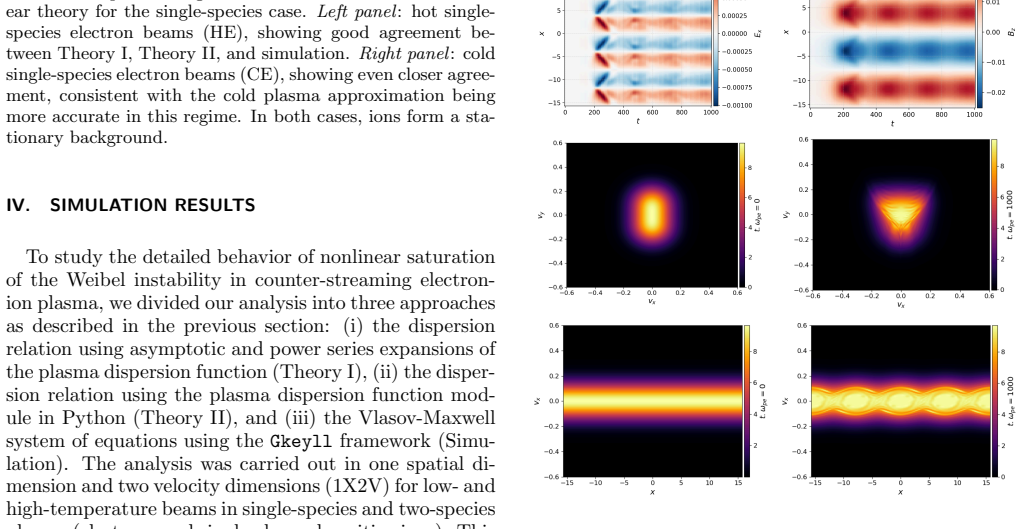
Single-species hot electron beams (HE) FIG. 3. Single-species high-temperature plasma beams (HE case).Top panel: time evolution of electric field energy (left) and magnetic field energy (right).Second panel: spatio- temporal evolution ofE x (left) andB z (right).Third panel: velocity distribution inV x–Vy space attω pe = 0 (left) and tωpe = 1000 (right), ...
-
[2]
Single-species cold electron beams (CE) For initially unmagnetized cold plasma with a station- ary ion background, the parameterζ≫1. Using the asymptotic expansion ofZ(ζ) forζ≫1, the cold Weibel dispersion relation is obtained from equation (9) as ω4 −ω 2(ω2 pe +c 2k2 x)−ω 2 peu2 dk2 x = 0.(14) Solving forω, the four roots are ω=± r 1 2 h (ω2pe +c 2k2)± q...
-
[3]
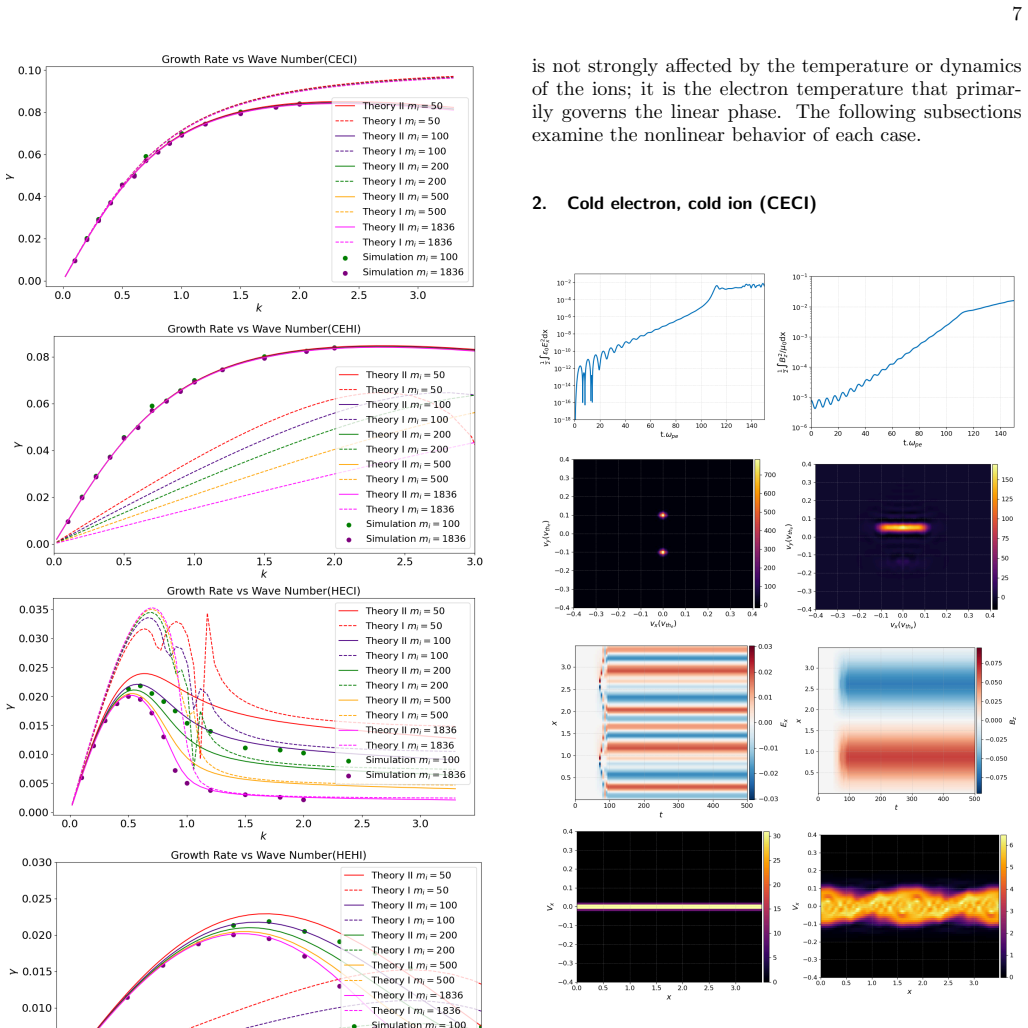
Growth rate We divide our study into four categories according to the electron and proton temperatures as given in Ta- ble II: cold electron cold ion (CECI), cold electron hot ion (CEHI), hot electron cold ion (HECI), and hot elec- tron hot ion (HEHI). Considering the asymptotic expan- sion (for cold species) and the small-argument power se- ries (for hot...
-
[4]
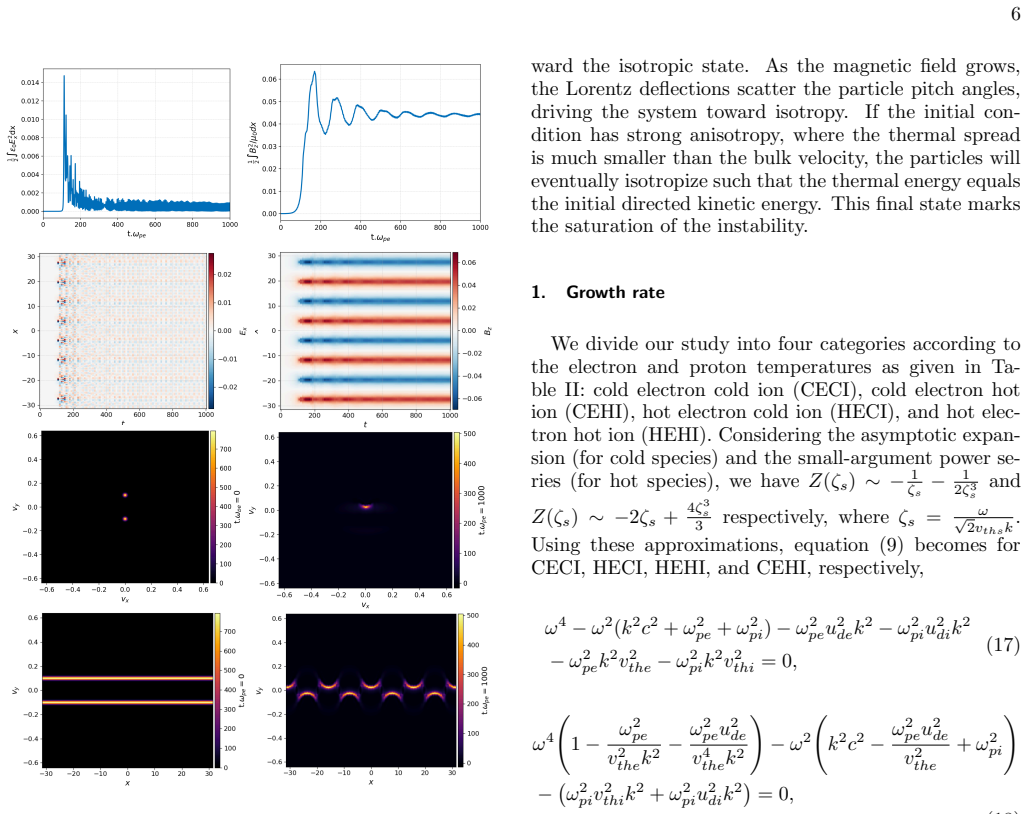
Cold electron, cold ion (CECI) FIG. 6. Multi-species cold electron, cold ion (CECI) case. Top panel: time evolution of electric field energy (left) and magnetic field energy (right). Both energies saturate at com- parable levels aftertω pe ≃115, consistent with the role of electrostatic potential wells alongside magnetic trapping.Sec- ond panel: velocity ...
-
[5]
Hot electron, cold ion (HECI) Here we consider hot electrons and cold ions. Be- cause of their lower mass and higher thermal energy, electrons react to field perturbations much faster than the ions, which is why many previous studies ignored the ion dynamics altogether 7,8,10. The present work, by treating ions as a fully kinetic species, shows the dis- t...
-
[6]
From the top panel of Fig
Hot electron, hot ion (HEHI) Simulations for the HEHI case were performed with pa- rameters given in Table II. From the top panel of Fig. 8, the electric field grows with some noise untiltω pe = 60, then continues growing totω pe = 142 before saturat- ing. The magnetic field energy grows totω pe = 172 and then saturates, slightly later than in the HECI ca...
-
[7]
Spontaneously growing transverse waves in a plasma due to an anisotropic velocity distribution,
Cold electron, hot ion (CEHI) Simulations for the CEHI case were performed with pa- rameters given in Table II. From the top panel of Fig. 10, the electric field grows with some noise untiltω pe = 14, after which the noise disappears; the field continues grow- ing untiltω pe ≃70 and then saturates. The magnetic field energy grows totω pe = 75 and then sat...
discussion (0)
Sign in with ORCID, Apple, or X to comment. Anyone can read and Pith papers without signing in.