Recognition: unknown
Heavy Quark Transport is Non-Gaussian Beyond Leading Log
Pith reviewed 2026-05-09 21:20 UTC · model grok-4.3
The pith
Heavy quark transport beyond leading logarithm at weak coupling is non-Gaussian, with asymmetric exponential tails in the longitudinal momentum transfer distribution that control equilibration.
A machine-rendered reading of the paper's core claim, the machinery that carries it, and where it could break.
Core claim
We find that heavy quark transport beyond leading logarithm at weak coupling is intrinsically non-Gaussian: the longitudinal momentum transfer distribution has asymmetric exponential tails that are crucial for equilibration dynamics. We show this by computing the leading-order momentum transfer kernel for relativistic heavy quarks in weakly coupled non-Abelian plasmas, matching perturbative momentum transfer on the thermal scale to hard-thermal-loop-resummed soft physics. This is the same structure previously found in strongly coupled holographic plasmas, showing that it is not peculiar to weak or strong coupling, conformality, or supersymmetry. We therefore expect that this is a robust特征而物理
What carries the argument
The leading-order momentum transfer kernel constructed by matching perturbative hard-scale contributions to hard-thermal-loop-resummed soft physics.
If this is right
- Equilibration rates and paths for heavy quarks cannot be captured by Gaussian diffusion approximations alone.
- The asymmetric tails alter the momentum loss profile compared with leading-logarithmic treatments.
- The non-Gaussian feature is expected to appear in real quark-gluon plasma independent of coupling strength.
- Transport modeling in heavy-ion collisions must use the full momentum-transfer distribution rather than moments only.
Where Pith is reading between the lines
- Full non-Gaussian kernels may be required for accurate predictions of heavy-quark spectra and flow in hydrodynamic simulations.
- The shared structure between weak and strong coupling suggests a possible universality that could be checked in other transport problems.
- Lattice calculations of heavy-quark momentum broadening could directly test for the presence of the asymmetric tails.
- Similar non-Gaussian features might appear in the transport of other colored particles through the plasma.
Load-bearing premise
The procedure that matches perturbative momentum transfers at the thermal scale to hard-thermal-loop resummed soft contributions faithfully reproduces the shape and asymmetry of the exponential tails.
What would settle it
A computation of the same kernel in an independent regularization scheme or a high-statistics simulation of momentum broadening that finds symmetric Gaussian tails without the reported exponential asymmetry would falsify the central claim.
Figures

read the original abstract
We find that heavy quark transport beyond leading logarithm at weak coupling is intrinsically non-Gaussian: the longitudinal momentum transfer distribution has asymmetric exponential tails that are crucial for equilibration dynamics. We show this by computing the leading-order momentum transfer kernel for relativistic heavy quarks in weakly coupled non-Abelian plasmas, matching perturbative momentum transfer on the thermal scale to hard-thermal-loop-resummed soft physics. This is the same structure previously found in strongly coupled holographic plasmas, showing that it is not peculiar to weak or strong coupling, conformality, or supersymmetry. We therefore expect that this is a robust feature that physical quark-gluon plasma should also exhibit.
Editorial analysis
A structured set of objections, weighed in public.
Referee Report
Summary. The paper computes the leading-order momentum transfer kernel for relativistic heavy quarks in weakly coupled non-Abelian plasmas. It matches perturbative pQCD contributions at the thermal scale to hard-thermal-loop resummed soft exchanges and finds that the longitudinal momentum transfer distribution develops asymmetric exponential tails beyond the leading-logarithm approximation. These tails render the transport intrinsically non-Gaussian and are argued to be crucial for equilibration dynamics. The same structure is noted in holographic calculations, suggesting robustness across coupling regimes.
Significance. If the result holds, it would establish that non-Gaussian features in heavy-quark transport are a general property of QCD plasmas rather than an artifact of strong coupling, conformality, or supersymmetry. The explicit leading-order matching procedure provides a controlled weak-coupling framework that can be systematically improved and compared to non-perturbative approaches, with direct relevance to heavy-flavor phenomenology in heavy-ion collisions.
major comments (2)
- [§4.1, Eq. (18)] §4.1, Eq. (18): The asymmetric exponential tails are obtained only after the hard-soft matching and subtraction of double-counted regions. The manuscript does not present the kernel for a range of separation scales μ or alternative infrared regulators, so it remains unclear whether the tail exponents and asymmetry are stable or sensitive to these choices.
- [§4.2, Fig. 4] §4.2, Fig. 4: The claim that the tails survive all approximations and are not an artifact of the matching procedure is load-bearing for the central assertion of intrinsic non-Gaussianity. An explicit variation study or error band on the tail region would be required to substantiate that a different but equally valid matching prescription cannot restore symmetry or alter the exponents.
minor comments (2)
- [§2] The notation for the momentum-transfer kernel K(q) and the decomposition into longitudinal and transverse components is introduced without a compact summary table; adding one would improve readability.
- [Figure 3] Figure 3 caption does not specify the value of the matching scale used for the plotted curves.
Simulated Author's Rebuttal
We thank the referee for their careful reading of our manuscript and for the valuable comments provided. We address each of the major comments in detail below, and have made revisions to the manuscript to incorporate additional checks as suggested.
read point-by-point responses
-
Referee: [§4.1, Eq. (18)] §4.1, Eq. (18): The asymmetric exponential tails are obtained only after the hard-soft matching and subtraction of double-counted regions. The manuscript does not present the kernel for a range of separation scales μ or alternative infrared regulators, so it remains unclear whether the tail exponents and asymmetry are stable or sensitive to these choices.
Authors: We acknowledge that the manuscript presents results for a specific choice of the separation scale μ. The hard-soft matching procedure is constructed such that physical observables are independent of μ in the overlapping regime, as is standard in effective field theory approaches. Nevertheless, to demonstrate this explicitly, we have added to the revised manuscript a study varying μ over a physically motivated range. The new results, included as an additional panel in Figure 4 or a new figure, show that both the asymmetry and the exponential nature of the tails are robust, with only minor quantitative changes in the exponents. We have also tested an alternative infrared regulator and find no qualitative difference. These additions confirm the stability of our findings. revision: yes
-
Referee: [§4.2, Fig. 4] §4.2, Fig. 4: The claim that the tails survive all approximations and are not an artifact of the matching procedure is load-bearing for the central assertion of intrinsic non-Gaussianity. An explicit variation study or error band on the tail region would be required to substantiate that a different but equally valid matching prescription cannot restore symmetry or alter the exponents.
Authors: We agree that an explicit variation study strengthens the central claim. The non-Gaussian tails arise from the hard, perturbative contributions to the momentum transfer, which are not affected by the soft resummation in a way that would symmetrize them. However, to provide the requested substantiation, the revised manuscript now includes error bands on the tail region of Fig. 4, obtained by varying the matching scale and the form of the cutoff function used in the subtraction. These bands demonstrate that the exponential tails and their asymmetry persist across different but valid matching prescriptions, without restoring Gaussian symmetry. We believe this addresses the concern while preserving the integrity of the leading-order calculation. revision: yes
Circularity Check
No circularity: explicit LO kernel computation yields non-Gaussian tails
full rationale
The paper derives the longitudinal momentum-transfer kernel via an explicit leading-order perturbative calculation matched to HTL resummation for soft exchanges. The asymmetric exponential tails emerge directly from this matching procedure and the resulting distribution, without any parameter fitting, self-definition of the output in terms of the input, or load-bearing self-citations. The comparison to holographic results is observational, not used to justify the weak-coupling result. The derivation chain is self-contained against external benchmarks and does not reduce to its inputs by construction.
Axiom & Free-Parameter Ledger
axioms (1)
- domain assumption Weak-coupling expansion is valid for the hard scale and HTL resummation captures the soft scale.
Reference graph
Works this paper leans on
-
[1]
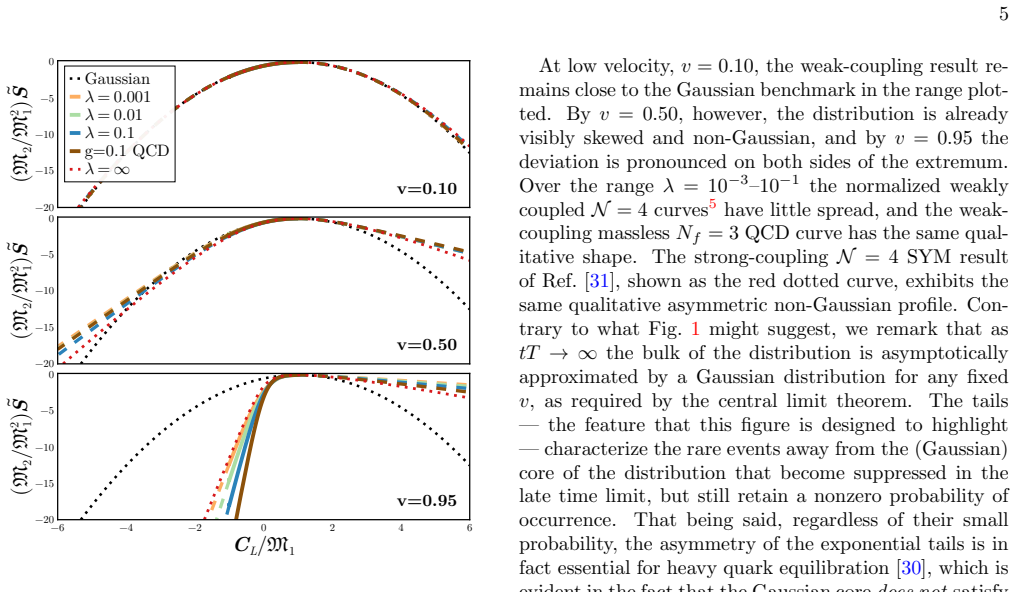
˜S(CL;v) versus CL/M1 forv= 0.10, 0.50, and 0.95. Rescaling by the first two longitudinal cumulants removes the overall drag and width, so that any purely Gaussian process collapses onto the universal parabola shown by the black dotted curve; deviations from that parabola therefore isolate genuine non-Gaussian shape. Colored curves show the weak-coupling ...
-
[2]
˜S(CL;v) againstC L/M1 in Fig. 1. With this normalization, the overall drag and width are scaled out, and any purely Gaussian process collapses onto a uni- versal parabola, shown by the black dotted curve. De- viations from that benchmark therefore isolate genuine non-Gaussian structure. At low velocity,v= 0.10, the weak-coupling result re- mains close to...
-
[3]
G. D. Moore and D. Teaney, Phys. Rev. C71, 064904 (2005), arXiv:hep-ph/0412346
work page Pith review arXiv 2005
-
[4]
H. van Hees and R. Rapp, Phys. Rev. C71, 034907 (2005), arXiv:nucl-th/0412015
-
[5]
H. van Hees, V. Greco, and R. Rapp, Phys. Rev. C73, 034913 (2006), arXiv:nucl-th/0508055
- [6]
-
[7]
Open Heavy Flavor in QCD Matter and in Nuclear Collisions
F. Prino and R. Rapp, J. Phys. G43, 093002 (2016), arXiv:1603.00529 [nucl-ex]
work page Pith review arXiv 2016
-
[8]
Y. Xuet al., Phys. Rev. C99, 014902 (2019), arXiv:1809.10734 [nucl-th]
-
[9]
A. Beraudoet al., Nucl. Phys. A979, 21 (2018), arXiv:1803.03824 [nucl-th]
-
[10]
S. Caoet al., Phys. Rev. C99, 054907 (2019), arXiv:1809.07894 [nucl-th]
-
[11]
Dong and V
X. Dong and V. Greco, Prog. Part. Nucl. Phys.104, 97 (2019)
2019
- [12]
-
[13]
Heavy Quark Diffusion in Strongly Coupled $\N=4$ Yang Mills
J. Casalderrey-Solana and D. Teaney, Phys. Rev. D74, 085012 (2006), arXiv:hep-ph/0605199
work page Pith review arXiv 2006
-
[14]
N. Brambilla, V. Leino, P. Petreczky, and A. Vairo, Phys. Rev. D102, 074503 (2020), arXiv:2007.10078 [hep-lat]
-
[15]
L. Altenkort, A. M. Eller, O. Kaczmarek, L. Mazur, G. D. Moore, and H.-T. Shu, Phys. Rev. D103, 014511 (2021), arXiv:2009.13553 [hep-lat]
-
[16]
N. Brambilla, V. Leino, J. Mayer-Steudte, and P. Pe- treczky (TUMQCD), Phys. Rev. D107, 054508 (2023), arXiv:2206.02861 [hep-lat]
-
[17]
L. Altenkort, O. Kaczmarek, R. Larsen, S. Mukherjee, P. Petreczky, H.-T. Shu, and S. Stendebach (HotQCD), Phys. Rev. Lett.130, 231902 (2023), arXiv:2302.08501 [hep-lat]
-
[18]
L. Altenkort, D. de la Cruz, O. Kaczmarek, R. Larsen, G. D. Moore, S. Mukherjee, P. Petreczky, H.-T. Shu, and S. Stendebach (HotQCD), Phys. Rev. Lett.132, 051902 (2024), arXiv:2311.01525 [hep-lat]
-
[19]
D. Bollweg, J. L. Dasilva Gol´ an, O. Kaczmarek, R. N. Larsen, G. D. Moore, S. Mukherjee, P. Petreczky, H.-T. Shu, S. Stendebach, and J. H. Weber (HotQCD), JHEP 09, 180 (2025), arXiv:2506.11958 [hep-lat]
-
[20]
S. Caron-Huot and G. D. Moore, Phys. Rev. Lett.100, 052301 (2008), arXiv:0708.4232 [hep-ph]
-
[21]
S. Caron-Huot and G. D. Moore, JHEP02, 081 (2008), arXiv:0801.2173 [hep-ph]
-
[22]
Y. Burnier, M. Laine, J. Langelage, and L. Mether, JHEP08, 094 (2010), arXiv:1006.0867 [hep-ph]
-
[23]
B. Scheihing-Hitschfeld and X. Yao, Phys. Rev. D 108, 054024 (2023), [Erratum: Phys.Rev.D 109, 099902 (2024)], arXiv:2306.13127 [hep-ph]
-
[24]
D. de la Cruz, A. M. Eller, and G. D. Moore, Phys. Rev. D110, 094057 (2024), arXiv:2410.01578 [hep-ph]
-
[25]
C. P. Herzog, A. Karch, P. Kovtun, C. Kozcaz, and L. G. Yaffe, JHEP07, 013 (2006), arXiv:hep-th/0605158
work page Pith review arXiv 2006
- [26]
- [27]
-
[28]
J. Casalderrey-Solana and D. Teaney, JHEP04, 039 (2007), arXiv:hep-th/0701123
- [29]
-
[30]
F. Scardina, S. K. Das, V. Minissale, S. Plumari, and V. Greco, Phys. Rev. C96, 044905 (2017), arXiv:1707.05452 [nucl-th]
-
[31]
Heavy Quark Energy Loss in the Hybrid Model,
A. Beraudo, J. F. Du Plessis, D. Pablos, and K. Ra- jagopal, “Heavy Quark Energy Loss in the Hybrid Model,” (2025), arXiv:2510.24847 [hep-ph]
-
[32]
K. Rajagopal, B. Scheihing-Hitschfeld, and U. A. Wiedemann, Phys. Rev. Lett.135, 242301 (2025), arXiv:2504.21139 [hep-ph]
-
[33]
K. Rajagopal, B. Scheihing-Hitschfeld, and U. A. Wiede- mann, JHEP07, 013 (2025), arXiv:2501.06289 [hep-ph]
-
[34]
Georgi, Phys
H. Georgi, Phys. Lett. B240, 447 (1990)
1990
-
[35]
L. V. Keldysh, Sov. Phys. JETP20, 1018 (1965)
1965
-
[36]
J. S. Schwinger, J. Math. Phys.2, 407 (1961)
1961
-
[37]
M. Laine and A. Vuorinen,Basics of Thermal Field The- ory, Vol. 925 (Springer, 2016) arXiv:1701.01554 [hep-ph]
-
[38]
Perturbative Thermal QCD: Formalism and Applications,
J. Ghiglieri, A. Kurkela, M. Strickland, and A. Vuorinen, Phys. Rept.880, 1 (2020), arXiv:2002.10188 [hep-ph]
-
[39]
Braaten and R
E. Braaten and R. D. Pisarski, Nucl. Phys. B337, 569 (1990)
1990
-
[40]
Braaten and R
E. Braaten and R. D. Pisarski, Nucl. Phys. B339, 310 (1990)
1990
-
[41]
Braaten and R
E. Braaten and R. D. Pisarski, Phys. Rev. D45, R1827 (1992)
1992
-
[42]
Caron-Huot,Hard thermal loops in the real-time formalism,JHEP04(2009) 004, [0710.5726]
S. Caron-Huot, JHEP04, 004 (2009), arXiv:0710.5726 [hep-ph]
-
[43]
Braaten and M
E. Braaten and M. H. Thoma, Phys. Rev. D44, 1298 (1991)
1991
-
[44]
Braaten and M
E. Braaten and M. H. Thoma, Phys. Rev. D44, R2625 (1991)
1991
-
[45]
J. F. Du Plessis and B. Scheihing-Hitschfeld, To Appear (2026)
2026
-
[46]
Rajagopal, B
K. Rajagopal, B. Scheihing-Hitschfeld, and U. A. Wiede- mann, To Appear (2026)
2026
- [47]
- [48]
-
[49]
J. Polchinski and J. Sully, JHEP10, 059 (2011), arXiv:1104.5077 [hep-th]
-
[50]
Gauge/String Duality, Hot QCD and Heavy Ion Collisions
J. Casalderrey-Solana, H. Liu, D. Mateos, K. Rajagopal, and U. Achim Wiedemann,Gauge/String Duality, Hot QCD and Heavy Ion Collisions(Cambridge University Press, 2014) arXiv:1101.0618 [hep-th]
work page Pith review arXiv 2014
-
[51]
Letter of intent for ALICE 3: A next-generation heavy- ion experiment at the LHC,
“Letter of intent for ALICE 3: A next-generation heavy- ion experiment at the LHC,” (2022), arXiv:2211.02491 [physics.ins-det]. End Matter Integrands.From perturbative finite temperature field theory one obtains IHard = Nc 2 Z k0 ep·v/T −1 |ek0/T −1||e(p·v−k0)/T −1| Θ 1−u 2 4|p| × (1−v 2)2 sgn(k0) +u v·p |p| k2 0 sgn(k0)+u v·p |p| 2 −(1−u 2) v2 − (v·p)2 p...
-
[52]
The explicit logarithm in the first line ln(m D/T) becomes ln(m D/Λ), and
-
[53]
µ2iL∥ iL∥ + v T + 1−µ 2 2 (iL⊥)2 #
the Heaviside step function in the last lineθ(T−|p|) becomesθ(Λ− |p|). Then, differentiating with respect to Λ gives a 1/Λ for the first and aδ(Λ− |p|) for the second. Using the explicit form ofI Match (24), it is then straightforward to check that the two contributions exactly cancel. Physically, this is because the log-enhanced contributions coming from...
discussion (0)
Sign in with ORCID, Apple, or X to comment. Anyone can read and Pith papers without signing in.