Recognition: unknown
Temporal Taskification in Streaming Continual Learning: A Source of Evaluation Instability
Pith reviewed 2026-05-09 22:55 UTC · model grok-4.3
The pith
Different valid ways to split the same data stream into tasks produce materially different continual learning performance metrics.
A machine-rendered reading of the paper's core claim, the machinery that carries it, and where it could break.
Core claim
Temporal taskification is a structural component of streaming continual learning evaluation: different valid partitions of the identical stream induce different regimes, so that continual finetuning, Experience Replay, Elastic Weight Consolidation, and Learning without Forgetting exhibit changed forecasting error, forgetting, and backward transfer when only the task boundaries are altered.
What carries the argument
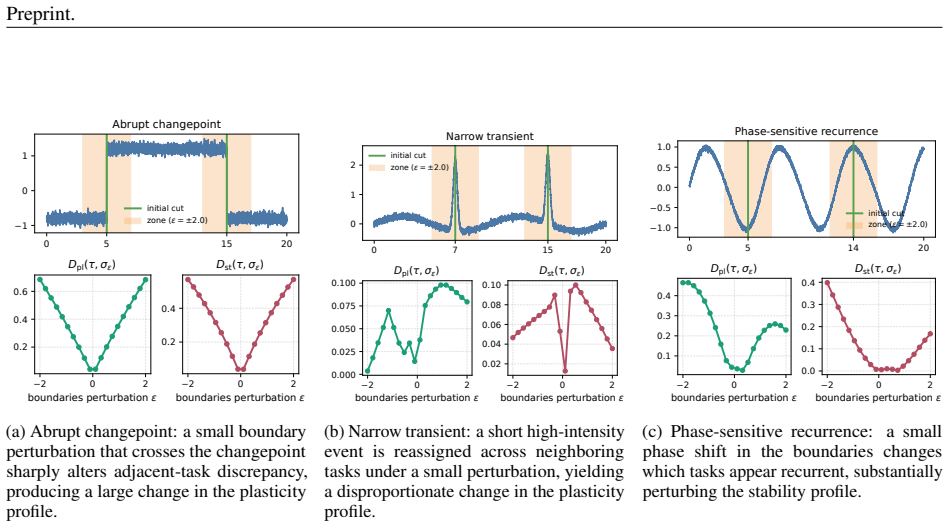
Boundary-Profile Sensitivity (BPS), which diagnoses how strongly small boundary perturbations alter the plasticity-stability regime induced by a taskification before any learner is trained, together with a profile distance between taskifications.
If this is right
- Benchmark conclusions in streaming continual learning depend on how the stream is taskified in addition to the learner and the data.
- Shorter taskifications produce noisier distribution-level patterns, larger structural distances between regimes, and higher Boundary-Profile Sensitivity.
- Relative performance rankings among methods such as Experience Replay and Elastic Weight Consolidation can shift when only the temporal boundaries change.
- Taskification must be treated as an explicit evaluation variable rather than an implicit preprocessing detail.
Where Pith is reading between the lines
- Published continual learning results on streaming data may not be directly comparable unless the taskification procedure and its sensitivity are reported.
- Future benchmarks could adopt Boundary-Profile Sensitivity as a standard diagnostic to indicate when results are fragile to boundary choices.
- The same taskification sensitivity issue is likely to appear in other temporal domains such as sensor streams or video sequences.
Load-bearing premise
The observed differences in performance metrics across splits are caused by the taskification structure itself rather than by interactions with the particular dataset statistics or the chosen model architectures.
What would settle it
Repeating the experiments on the same CESNET-Timeseries24 stream with the identical models and training budget but finding identical values of forecasting error, forgetting, and backward transfer for the 9-day, 30-day, and 44-day splits would falsify the claim.
Figures

read the original abstract
Streaming Continual Learning (CL) typically converts a continuous stream into a sequence of discrete tasks through temporal partitioning. We argue that this temporal taskification step is not a neutral preprocessing choice, but a structural component of evaluation: different valid splits of the same stream can induce different CL regimes and therefore different benchmark conclusions. To study this effect, we introduce a taskification-level framework based on plasticity and stability profiles, a profile distance between taskifications, and Boundary-Profile Sensitivity (BPS), which diagnoses how strongly small boundary perturbations alter the induced regime before any CL model is trained. We evaluate continual finetuning, Experience Replay, Elastic Weight Consolidation, and Learning without Forgetting on network traffic forecasting with CESNET-Timeseries24, keeping the stream, model, and training budget fixed while varying only the temporal taskification. Across 9-, 30-, and 44-day splits, we observe substantial changes in forecasting error, forgetting, and backward transfer, showing that taskification alone can materially affect CL evaluation. We further find that shorter taskifications induce noisier distribution-level patterns, larger structural distances, and higher BPS, indicating greater sensitivity to boundary perturbations. These results show that benchmark conclusions in streaming CL depend not only on the learner and the data stream, but also on how that stream is taskified, motivating temporal taskification as a first-class evaluation variable.
Editorial analysis
A structured set of objections, weighed in public.
Referee Report
Summary. The manuscript claims that temporal taskification in streaming continual learning is not a neutral preprocessing step but a structural factor that can induce different CL regimes and benchmark conclusions. The authors introduce plasticity and stability profiles, a profile distance metric, and Boundary-Profile Sensitivity (BPS) as a pre-training diagnostic for sensitivity to boundary perturbations. They evaluate continual finetuning, Experience Replay, EWC, and LwF on the CESNET-Timeseries24 network traffic forecasting task, holding the data stream, model family, and training budget fixed while varying only the temporal partitions (9-, 30-, and 44-day splits). The experiments show substantial differences in forecasting error, forgetting, and backward transfer, with shorter taskifications producing noisier patterns, larger structural distances, and higher BPS values. The conclusion is that taskification must be treated as a first-class evaluation variable.
Significance. If the result holds, the work identifies a previously under-examined source of evaluation instability in streaming CL. The controlled design—fixing the stream, model, and budget while varying only task boundaries—provides direct evidence that different valid partitions of the same data can materially alter metrics and conclusions. The BPS diagnostic is a constructive addition that allows sensitivity analysis before model training. The paper is strengthened by its focus on an existence claim rather than a universal one, though the single-domain scope limits broader claims about prevalence.
major comments (1)
- §4 (Experimental Evaluation): the reported differences across the three hand-chosen splits are presented without statistical significance tests or results from multiple random boundary perturbations within each granularity. This leaves open whether the observed changes in error, forgetting, and transfer are robust properties of the taskification structure or artifacts of the specific boundary locations chosen.
minor comments (2)
- The formal definitions of the plasticity and stability profiles and the BPS metric would benefit from explicit equations in the methods section to improve reproducibility and allow readers to verify the distance calculations.
- Figure captions and legends for the profile visualizations should explicitly state the units and scaling of the axes to avoid ambiguity when comparing across the 9-, 30-, and 44-day regimes.
Simulated Author's Rebuttal
We thank the referee for the constructive comment regarding the experimental evaluation. We address the concern point by point below and will revise the manuscript to incorporate additional analyses.
read point-by-point responses
-
Referee: §4 (Experimental Evaluation): the reported differences across the three hand-chosen splits are presented without statistical significance tests or results from multiple random boundary perturbations within each granularity. This leaves open whether the observed changes in error, forgetting, and transfer are robust properties of the taskification structure or artifacts of the specific boundary locations chosen.
Authors: We agree that the current presentation relies on three representative hand-chosen splits (9-, 30-, and 44-day) without formal statistical tests or additional random perturbations, which limits the ability to rule out boundary-specific artifacts. In the revision we will add statistical significance testing (e.g., Wilcoxon signed-rank tests) on the differences in forecasting error, forgetting, and backward transfer across the taskifications. We will also generate and report results from multiple random boundary perturbations within each granularity level to demonstrate that the observed trends and the higher BPS values for shorter taskifications are structural properties rather than artifacts of the particular splits chosen. These additions will be placed in §4 and the associated figures/tables. revision: yes
Circularity Check
No significant circularity detected
full rationale
The paper presents an empirical study that holds the underlying data stream, model family, and training budget fixed while varying only the temporal task boundaries (9-, 30-, and 44-day splits). The central claim—that different valid taskifications induce different CL evaluation outcomes—is supported by direct experimental measurements of forecasting error, forgetting, and backward transfer rather than any derivation or prediction that reduces to its own inputs. The introduced BPS metric and profile-based framework are defined explicitly from the observed plasticity/stability profiles to diagnose boundary sensitivity before model training; these definitions do not create a self-referential loop because the reported performance differences are measured independently on the fixed stream. No self-citations, fitted-input predictions, or ansatzes appear in the load-bearing steps.
Axiom & Free-Parameter Ledger
free parameters (1)
- task boundary locations
axioms (1)
- domain assumption Plasticity and stability profiles extracted from task-wise performance are sufficient to characterize the induced CL regime.
invented entities (2)
-
Boundary-Profile Sensitivity (BPS)
no independent evidence
-
plasticity and stability profiles
no independent evidence
Reference graph
Works this paper leans on
-
[1]
Scaling Learning Algorithms Towards
Bengio, Yoshua and LeCun, Yann , booktitle =. Scaling Learning Algorithms Towards
-
[2]
and Osindero, Simon and Teh, Yee Whye , journal =
Hinton, Geoffrey E. and Osindero, Simon and Teh, Yee Whye , journal =. A Fast Learning Algorithm for Deep Belief Nets , volume =
-
[3]
2016 , publisher=
Deep learning , author=. 2016 , publisher=
2016
-
[4]
IEEE Transactions on Industrial Informatics , volume=
An adaptive continual learning method for nonstationary industrial time series prediction , author=. IEEE Transactions on Industrial Informatics , volume=. 2024 , publisher=
2024
-
[5]
Computers & Electrical Engineering , volume=
IncLSTM: incremental ensemble LSTM model towards time series data , author=. Computers & Electrical Engineering , volume=. 2021 , publisher=
2021
-
[6]
2021 IEEE International Conference on Data Mining (ICDM) , pages=
Continual learning for multivariate time series tasks with variable input dimensions , author=. 2021 IEEE International Conference on Data Mining (ICDM) , pages=. 2021 , organization=
2021
-
[7]
2009 , publisher=
Learning multiple layers of features from tiny images , author=. 2009 , publisher=
2009
-
[8]
Scientific Data , volume=
Cesnet-timeseries24: Time series dataset for network traffic anomaly detection and forecasting , author=. Scientific Data , volume=. 2025 , publisher=
2025
-
[9]
2009 IEEE conference on computer vision and pattern recognition , pages=
Imagenet: A large-scale hierarchical image database , author=. 2009 IEEE conference on computer vision and pattern recognition , pages=. 2009 , organization=
2009
-
[10]
Engineering Proceedings , volume=
Continual learning for time series forecasting: a first survey , author=. Engineering Proceedings , volume=. 2024 , publisher=
2024
-
[11]
Advances in neural information processing systems , volume=
Experience replay for continual learning , author=. Advances in neural information processing systems , volume=
-
[12]
Proceedings of the national academy of sciences , volume=
Overcoming catastrophic forgetting in neural networks , author=. Proceedings of the national academy of sciences , volume=. 2017 , publisher=
2017
-
[13]
IEEE transactions on pattern analysis and machine intelligence , volume=
Learning without forgetting , author=. IEEE transactions on pattern analysis and machine intelligence , volume=. 2017 , publisher=
2017
-
[14]
Advances in neural information processing systems , volume=
Attention is all you need , author=. Advances in neural information processing systems , volume=
-
[15]
F., Shchur, O., K ¨uken, J., Auer, A., Han, B., Mercado, P., Rangapuram, S
Chronos-2: From univariate to universal forecasting , author=. arXiv preprint arXiv:2510.15821 , year=
-
[16]
Information fusion , volume=
Continual learning for robotics: Definition, framework, learning strategies, opportunities and challenges , author=. Information fusion , volume=. 2020 , publisher=
2020
-
[17]
An empirical investigation of catastrophic forgetting in gradient-based neural networks , author=. arXiv preprint arXiv:1312.6211 , year=
-
[18]
Exemplar-free continual representation learning via learnable drift compensation , year =
Gomez-Villa, Alex and Goswami, Dipam and Wang, Kai and Bagdanov, Andrew D and Twardowski, Bartlomiej and van de Weijer, Joost , booktitle =. Exemplar-free continual representation learning via learnable drift compensation , year =
-
[19]
Lifelong Machine Learning , year =
Zhiyuan Chen and Bing Liu , publisher =. Lifelong Machine Learning , year =
-
[20]
International conference on machine learning , pages=
Overcoming catastrophic forgetting with hard attention to the task , author=. International conference on machine learning , pages=. 2018 , organization=
2018
-
[21]
Don't forget, there is more than forgetting: new metrics for Continual Learning , author=. arXiv preprint arXiv:1810.13166 , year=
-
[22]
Towards robust evaluations of continual learning , author=. arXiv preprint arXiv:1805.09733 , year=
-
[23]
Advances in neural information processing systems , volume=
Gradient episodic memory for continual learning , author=. Advances in neural information processing systems , volume=
-
[24]
Proceedings of the IEEE/CVF conference on computer vision and pattern recognition , pages=
Task-free continual learning , author=. Proceedings of the IEEE/CVF conference on computer vision and pattern recognition , pages=
-
[25]
Neural Computation , volume=
Task-agnostic continual learning using online variational bayes with fixed-point updates , author=. Neural Computation , volume=. 2021 , publisher=
2021
-
[26]
European Conference on Computer Vision , pages=
A metric learning reality check , author=. European Conference on Computer Vision , pages=. 2020 , organization=
2020
-
[27]
Proceedings of the European Conference on Computer Vision (ECCV) , year =
Riemannian Walk for Incremental Learning: Understanding Forgetting and Intransigence , author =. Proceedings of the European Conference on Computer Vision (ECCV) , year =
-
[28]
Proceedings of the Thirty-Second AAAI Conference on Artificial Intelligence (AAAI) , year =
Measuring Catastrophic Forgetting in Neural Networks , author =. Proceedings of the Thirty-Second AAAI Conference on Artificial Intelligence (AAAI) , year =
-
[29]
IEEE Transactions on Pattern Analysis and Machine Intelligence , year =
A Continual Learning Survey: Defying Forgetting in Classification Tasks , author =. IEEE Transactions on Pattern Analysis and Machine Intelligence , year =
-
[30]
IEEE transactions on pattern analysis and machine intelligence , volume=
A comprehensive survey of continual learning: Theory, method and application , author=. IEEE transactions on pattern analysis and machine intelligence , volume=. 2024 , publisher=
2024
-
[31]
Re-evaluating continual learning scenarios: A categorization and case for strong baselines , author=. arXiv preprint arXiv:1810.12488 , year=
-
[32]
Proceedings of the 26th Annual International Conference on Machine Learning (ICML) , pages =
Curriculum Learning , author =. Proceedings of the 26th Annual International Conference on Machine Learning (ICML) , pages =. 2009 , publisher =
2009
-
[33]
Proceedings of the International Conference on Learning Representations (ICLR) , year =
Scalable and Order-robust Continual Learning with Additive Parameter Decomposition , author =. Proceedings of the International Conference on Learning Representations (ICLR) , year =
-
[34]
Advances in Neural Information Processing Systems 33 (NeurIPS) , year =
Dark Experience for General Continual Learning: a Strong, Simple Baseline , author =. Advances in Neural Information Processing Systems 33 (NeurIPS) , year =
-
[35]
Advances in Neural Information Processing Systems 32 (NeurIPS) , year =
Online Continual Learning with Maximal Interfered Retrieval , author =. Advances in Neural Information Processing Systems 32 (NeurIPS) , year =
-
[36]
Neurocomputing , year =
Online Continual Learning in Image Classification: An Empirical Survey , author =. Neurocomputing , year =
-
[37]
Proceedings of the IEEE/CVF Conference on Computer Vision and Pattern Recognition (CVPR) , year =
Real-Time Evaluation in Online Continual Learning: A New Hope , author =. Proceedings of the IEEE/CVF Conference on Computer Vision and Pattern Recognition (CVPR) , year =
-
[38]
International Conference on Learning Representations (ICLR) , year =
New Insights on Reducing Abrupt Representation Change in Online Continual Learning , author =. International Conference on Learning Representations (ICLR) , year =
-
[39]
International Conference on Learning Representations (ICLR) , year =
A Neural Dirichlet Process Mixture Model for Task-Free Continual Learning , author =. International Conference on Learning Representations (ICLR) , year =
-
[40]
Nature Machine Intelligence , year =
Three Types of Incremental Learning , author =. Nature Machine Intelligence , year =
-
[41]
Proceedings of the IEEE/CVF Conference on Computer Vision and Pattern Recognition (CVPR) , year =
Computationally Budgeted Continual Learning: What Does Matter? , author =. Proceedings of the IEEE/CVF Conference on Computer Vision and Pattern Recognition (CVPR) , year =
-
[42]
2021 , publisher =
Du, Yuntao and Wang, Jindong and Feng, Wenjie and Pan, Sinno Jialin and Qin, Tao and Xu, Renjun and Wang, Chongjun , booktitle =. 2021 , publisher =
2021
-
[43]
International Conference on Learning Representations (ICLR) , year =
Reversible Instance Normalization for Accurate Time-Series Forecasting against Distribution Shift , author =. International Conference on Learning Representations (ICLR) , year =
-
[44]
Advances in Neural Information Processing Systems 35 (NeurIPS) , year =
Non-stationary Transformers: Exploring the Stationarity in Time Series Forecasting , author =. Advances in Neural Information Processing Systems 35 (NeurIPS) , year =
-
[45]
Recht, Benjamin and Roelofs, Rebecca and Schmidt, Ludwig and Shankar, Vaishaal , booktitle =. Do
-
[46]
Proceedings of Machine Learning and Systems (MLSys) , volume =
Accounting for Variance in Machine Learning Benchmarks , author =. Proceedings of Machine Learning and Systems (MLSys) , volume =
-
[47]
The benchmark lottery , author=. arXiv preprint arXiv:2107.07002 , year=
-
[48]
Proceedings of the IEEE Conference on Computer Vision and Pattern Recognition (CVPR) , pages =
Unbiased Look at Dataset Bias , author =. Proceedings of the IEEE Conference on Computer Vision and Pattern Recognition (CVPR) , pages =. 2011 , publisher =
2011
-
[49]
ACM Computing Surveys , year =
A Survey on Concept Drift Adaptation , author =. ACM Computing Surveys , year =
-
[50]
IEEE Transactions on Knowledge and Data Engineering , year =
Learning under Concept Drift: A Review , author =. IEEE Transactions on Knowledge and Data Engineering , year =
-
[51]
IEEE transactions on pattern analysis and machine intelligence , volume=
A continual learning survey: Defying forgetting in classification tasks , author=. IEEE transactions on pattern analysis and machine intelligence , volume=. 2021 , publisher=
2021
discussion (0)
Sign in with ORCID, Apple, or X to comment. Anyone can read and Pith papers without signing in.