Recognition: unknown
Angular analysis of the B^+toπ^+μ^+μ^- decay
Pith reviewed 2026-05-08 13:11 UTC · model grok-4.3
The pith
The first measurement of forward-backward asymmetry and flat term in the B+ to pi+ mu+ mu- decay finds Standard Model predictions inside the reported confidence intervals.
A machine-rendered reading of the paper's core claim, the machinery that carries it, and where it could break.
Core claim
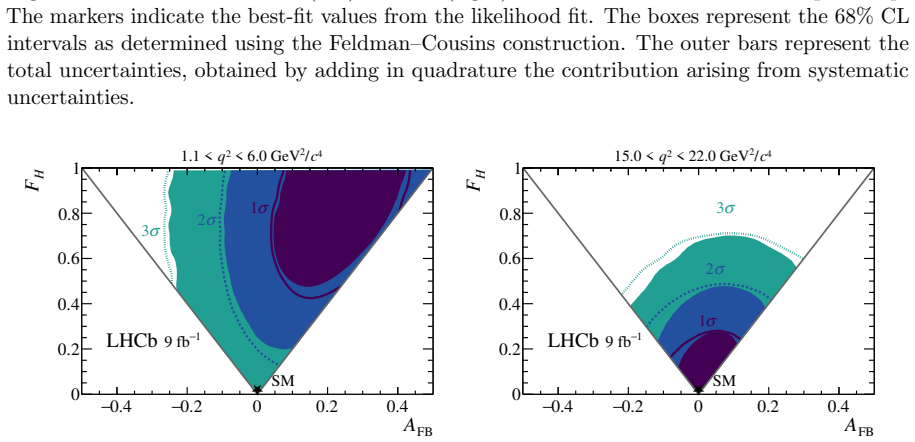
The angular distribution of the B+ to pi+ mu+ mu- decay is described by the forward-backward asymmetry AFB and the flat term FH. Using proton-proton collision data corresponding to 9 inverse femtobarns, the first determination of these parameters in two dimuon-mass intervals yields results consistent with Standard Model calculations, lying within the 68 percent confidence level interval in the high-mass region and within the 99 percent interval in the low-mass region.
What carries the argument
The forward-backward asymmetry AFB and flat term FH, which together parameterize the angular distribution of the two muons in the dimuon rest frame.
Load-bearing premise
The analysis assumes that background contributions, detector efficiencies, and acceptance corrections are accurately modeled and do not introduce significant biases in the extracted angular parameters.
What would settle it
A statistically significant measurement of either AFB or FH lying outside the quoted confidence intervals in the high-mass or low-mass region would show a discrepancy with the Standard Model.
Figures




read the original abstract
This paper presents the first measurement of the forward-backward asymmetry, $A_{\rm FB}$, and the flat term, $F_{H}$, that parameterise the angular distribution of the $B^+\to\pi^+\mu^+\mu^-$ decay. The proton-proton collision dataset used in the analysis corresponds to an integrated luminosity of 9 fb$^{-1}$, collected with the LHCb experiment between 2011 and 2018. The analysis is performed in two intervals of dimuon mass squared, one above and one below the region containing the $J\mskip -3mu/\mskip -2mu\psi$ and $\psi(2S)$ narrow charmonium resonances. The Standard Model predictions lie within the obtained $68\%$ confidence level interval in the high-mass and within the $99\%$ interval in the low-mass region.
Editorial analysis
A structured set of objections, weighed in public.
Referee Report
Summary. The paper reports the first measurement of the forward-backward asymmetry A_FB and the flat term F_H parameterizing the angular distribution of the rare decay B^+ → π^+ μ^+ μ^-. Using 9 fb^{-1} of LHCb proton-proton collision data collected 2011-2018, the analysis is performed in two intervals of dimuon mass squared (q^2), one above and one below the narrow charmonium resonances J/ψ and ψ(2S). The central result is that Standard Model predictions lie within the obtained 68% CL interval in the high-mass region and within the 99% CL interval in the low-mass region.
Significance. If the result holds, this supplies the first experimental constraints on these angular observables in a b→d transition, adding a new data point to tests of the Standard Model and searches for new physics in flavor-changing neutral currents. The choice of a large LHCb dataset and the explicit avoidance of resonance regions are appropriate and strengthen the analysis; the direct extraction of A_FB and F_H from data (rather than derived quantities) is a methodological strength.
major comments (2)
- [Abstract] Abstract: the claim that SM predictions lie within the 68% CL (high-mass) and 99% CL (low-mass) intervals is central to the paper, yet no numerical values for the measured A_FB and F_H, their uncertainties, or the SM reference values are supplied, preventing verification of the stated consistency.
- [Analysis] The extraction of unbiased A_FB and F_H requires accurate modeling of backgrounds, efficiencies, and acceptance corrections (especially near the excluded resonance regions). The manuscript provides no quantitative information on systematic uncertainty budgets, fit stability tests, or validation with control samples, which directly affects the reliability of the reported CL intervals.
minor comments (1)
- The integrated luminosity is stated as 9 fb^{-1}; confirm that the exact value and its uncertainty are reported consistently in the main text and tables.
Simulated Author's Rebuttal
We thank the referee for the careful review of our manuscript and the positive recommendation for minor revision. The comments are constructive and we address each major point below.
read point-by-point responses
-
Referee: [Abstract] Abstract: the claim that SM predictions lie within the 68% CL (high-mass) and 99% CL (low-mass) intervals is central to the paper, yet no numerical values for the measured A_FB and F_H, their uncertainties, or the SM reference values are supplied, preventing verification of the stated consistency.
Authors: We agree that the abstract would benefit from explicit numerical values to allow immediate verification. In the revised manuscript we will augment the abstract with the measured A_FB and F_H values (including uncertainties) in both q^2 intervals together with the corresponding Standard Model predictions. revision: yes
-
Referee: [Analysis] The extraction of unbiased A_FB and F_H requires accurate modeling of backgrounds, efficiencies, and acceptance corrections (especially near the excluded resonance regions). The manuscript provides no quantitative information on systematic uncertainty budgets, fit stability tests, or validation with control samples, which directly affects the reliability of the reported CL intervals.
Authors: The manuscript already contains dedicated sections describing the background model, efficiency and acceptance corrections, and the angular fit procedure. Nevertheless, we accept that a consolidated quantitative summary would strengthen the presentation. We will add an explicit systematic uncertainty budget (with individual contributions tabulated), results of fit stability tests, and validation studies performed on control samples such as B^+ → J/ψ K^+ decays. revision: yes
Circularity Check
No significant circularity in experimental measurement
full rationale
The paper reports a direct experimental extraction of the angular observables A_FB and F_H from LHCb collision data in two dimuon mass-squared intervals, after standard background subtraction, efficiency, and acceptance corrections. The central result is a comparison of these fitted values to independent Standard Model predictions, with the SM lying inside the reported confidence intervals. No derivation chain is claimed that reduces by the paper's own equations to quantities defined in terms of the fitted parameters themselves, nor does any load-bearing step rely on self-citation of an unverified uniqueness theorem or ansatz. The analysis is self-contained against external benchmarks (data-driven control samples and simulation validation), yielding a normal non-finding of circularity.
Axiom & Free-Parameter Ledger
free parameters (1)
- A_FB and F_H fit parameters
axioms (1)
- domain assumption Standard Model angular distribution form for b→sℓℓ decays
Reference graph
Works this paper leans on
-
[1]
Cabibbo, Unitary symmetry and leptonic decays , Phys
N. Cabibbo, Unitary symmetry and leptonic decays , Phys. Rev. Lett. 10 (1963) 531
1963
-
[2]
Kobayashi and T
M. Kobayashi and T. Maskawa, C P-violation in the renormalizable theory of weak interaction, Prog. Theor. Phys. 49 (1973) 652
1973
-
[3]
Aaijet al.,First observation of the decay B+ →π +µ+µ−, JHEP12(2012) 125,arXiv:1210.2645
LHCb collaboration, R. Aaij et al., First observation of the decay B+ → π+µ+µ−, JHEP 12 (2012) 125, arXiv:1210.2645. 11
-
[4]
LHCb collaboration, R. Aaij et al., First measurement of the differential branching fraction and C P asymmetry of the B+ → π+µ+µ− decay, JHEP 10 (2015) 034, arXiv:1509.00414
- [5]
-
[6]
C. Hambrock, A. Khodjamirian, and A. Rusov, Hadronic effects and observables in B → πℓ+ℓ− decay at large recoil, Phys. Rev. D92 (2015) 074020, arXiv:1506.07760
- [7]
-
[8]
A. Khodjamirian and A. V. Rusov, Bs → Kℓν ℓ and B(s) → π(K)ℓ+ℓ− decays at large recoil and CKM matrix elements , JHEP 08 (2017) 112, arXiv:1703.04765
work page Pith review arXiv 2017
- [9]
- [10]
- [11]
- [12]
- [13]
-
[14]
F. Beaujean, C. Bobeth, and S. Jahn, Constraints on tensor and scalar couplings from B → K ¯µµ and Bs → ¯µµ, Eur. Phys. J. C75 (2015) 456, arXiv:1508.01526
-
[15]
G. Isidori, S. Nabeebaccus, and R. Zwicky, QED corrections in B → Kℓ +ℓ− at the double-differential level, JHEP 12 (2020) 104, arXiv:2009.00929
-
[16]
BaBar collaboration, B. Aubert et al., Measurements of branching fractions, rate asymmetries, and angular distributions in the rare decays B → Kℓ +ℓ− and B → K ∗ℓ+ℓ−, Phys. Rev. D73 (2006) 092001, arXiv:hep-ex/0604007
-
[17]
Belle collaboration, J.-T. Wei et al., Measurement of the differential branching fraction and forward-backward asymmetry for B → K (∗)ℓ+ℓ−, Phys. Rev. Lett. 103 (2009) 171801, arXiv:0904.0770
-
[18]
CDF collaboration, T. Aaltonen et al. , Measurements of the angular distribu- tions in the decays B → K (∗)µ+µ− at CDF , Phys. Rev. Lett. 108 (2012) 081807, arXiv:1108.0695. 12
- [19]
-
[20]
LHCb collaboration, R. Aaij et al. , Angular analysis of charged and neutral B → Kµ +µ− decays, JHEP 05 (2014) 082, arXiv:1403.8045
-
[21]
LHCb collaboration, A. A. Alves Jr. et al., The LHCb detector at the LHC , JINST 3 (2008) S08005
2008
-
[22]
Aaijet al.,LHCb detector performance, Int
LHCb collaboration, R. Aaij et al., LHCb detector performance, Int. J. Mod. Phys. A30 (2015) 1530022, arXiv:1412.6352
-
[23]
Aaijet al.,Performance of the LHCb Vertex Locator, JINST9(2014) P09007, arXiv:1405.7808
R. Aaij et al., Performance of the LHCb Vertex Locator , JINST 9 (2014) P09007, arXiv:1405.7808
-
[24]
Arinket al.,Performance of the LHCb Outer Tracker, JINST9(2014) P01002, arXiv:1311.3893
R. Arink et al., Performance of the LHCb Outer Tracker , JINST 9 (2014) P01002, arXiv:1311.3893
-
[25]
P. d’Argent et al., Improved performance of the LHCb Outer Tracker in LHC Run 2 , JINST 12 (2017) P11016, arXiv:1708.00819
-
[26]
Adinolfi et al., Performance of the LHCb RICH detector at the LHC , Eur
M. Adinolfi et al., Performance of the LHCb RICH detector at the LHC , Eur. Phys. J. C73 (2013) 2431, arXiv:1211.6759
-
[27]
C. Abell´ an Betetaet al., Calibration and performance of the LHCb calorimeters in Run 1 and 2 at the LHC , arXiv:2008.11556
- [28]
-
[29]
Aaijet al.,The LHCb trigger and its performance in 2011, JINST8(2013) P04022, arXiv:1211.3055
R. Aaij et al., The LHCb trigger and its performance in 2011 , JINST 8 (2013) P04022, arXiv:1211.3055
-
[30]
N. Grieser et al., The LHCb stripping project: Sustainable legacy data processing for high-energy physics, Comput. Softw. Big. Sci. 9 (2025) 21, arXiv:2509.05294
-
[31]
A Brief Introduction to PYTHIA 8.1
T. Sj¨ ostrand, S. Mrenna, and P. Skands,A brief introduction to PYTHIA 8.1, Comput. Phys. Commun. 178 (2008) 852, arXiv:0710.3820
work page internal anchor Pith review arXiv 2008
-
[32]
Belyaev et al., Handling of the generation of primary events in Gauss, the LHCb simulation framework, J
I. Belyaev et al., Handling of the generation of primary events in Gauss, the LHCb simulation framework, J. Phys. Conf. Ser. 331 (2011) 032047
2011
-
[33]
D. J. Lange, The EvtGen particle decay simulation package , Nucl. Instrum. Meth. A462 (2001) 152
2001
-
[34]
N. Davidson, T. Przedzinski, and Z. Was, PHOTOS interface in C++: Technical and physics documentation , Comp. Phys. Comm. 199 (2016) 86, arXiv:1011.0937
-
[35]
New Results on B->pi, K, eta Decay Formfactors from Light-Cone Sum Rules
P. Ball and R. Zwicky, New results on B → π, K, η decay form factors from light-cone sum rules, Phys. Rev. D71 (2005) 014015, arXiv:hep-ph/0406232. 13
work page Pith review arXiv 2005
-
[36]
Allison et al., Geant4 developments and applications , IEEE Trans
Geant4 collaboration, J. Allison et al., Geant4 developments and applications , IEEE Trans. Nucl. Sci. 53 (2006) 270; Geant4 collaboration, S. Agostinelli et al., Geant4: A simulation toolkit , Nucl. Instrum. Meth. A506 (2003) 250
2006
-
[37]
Clemencic et al., The LHCb simulation application, Gauss: Design, evolution and experience, J
M. Clemencic et al., The LHCb simulation application, Gauss: Design, evolution and experience, J. Phys. Conf. Ser. 331 (2011) 032023
2011
-
[38]
LHCb collaboration, R. Aaij et al., Measurement of the track reconstruction efficiency at LHCb, JINST 10 (2015) P02007, arXiv:1408.1251
-
[39]
S. Tolk, J. Albrecht, F. Dettori, and A. Pellegrino, Data driven trigger efficiency determination at LHCb , LHCb-PUB-2014-039, 2014
2014
-
[40]
Anderlini et al., The PIDCalib package , LHCb-PUB-2016-021, 2016
L. Anderlini et al., The PIDCalib package , LHCb-PUB-2016-021, 2016
2016
- [41]
-
[42]
Likhomanenkoet al.,LHCb topological trigger reoptimization, J
T. Likhomanenko et al., LHCb topological trigger reoptimization, J. Phys. Conf. Ser. 664 (2015) 082025, arXiv:1510.00572
-
[43]
Aaij et al., Search for D∗(2007)0 → µ+µ− in B− → π−µ+µ− decays, Eur
LHCb collaboration, R. Aaij et al., Search for D∗(2007)0 → µ+µ− in B− → π−µ+µ− decays, Eur. Phys. J. C83 (2023) 666, arXiv:2304.01981
-
[44]
Breiman, J
L. Breiman, J. H. Friedman, R. A. Olshen, and C. J. Stone, Classification and regression trees, Wadsworth international group, Belmont, California, USA, 1984
1984
-
[45]
Chen and C
T. Chen and C. Guestrin, XGBoost: A scalable tree boosting system , in Proceedings of the 22nd ACM SIGKDD International Conference on Knowledge Discovery and Data Mining, KDD ’16, (New York, NY, USA), 785–794, ACM, 2016
2016
-
[46]
LHCb collaboration, R. Aaij et al., Search for B+ c → π+µ+µ− decays and measurement of the branching fraction ratio B(B+ c → ψ(2S)π+)/B(B+ c → J/ ψπ+), Eur. Phys. J. C84 (2024) , arXiv:2312.12228
-
[47]
Aaij et al., Search for B∗0 (s) → µ+µ− in B+ c → π+µ+µ− decays, Eur
LHCb collaboration, R. Aaij et al., Search for B∗0 (s) → µ+µ− in B+ c → π+µ+µ− decays, Eur. Phys. J C85 (2025) 20, arXiv:2409.17209
-
[48]
Navas et al., Review of particle physics , Phys
Particle Data Group, S. Navas et al., Review of particle physics , Phys. Rev. D110 (2024) 030001
2024
-
[49]
Aaijet al.,Study of the rare B0 s and B0 decays into the π+π−µ+µ− final state, Phys
LHCb collaboration, R. Aaij et al. , Study of the rare B0 s and B0 decays into the π+π−µ+µ− final state, Phys. Lett. B743 (2015) 46, arXiv:1412.6433
-
[50]
Skwarnicki, A study of the radiative cascade transitions between the Upsilon-prime and Upsilon resonances , PhD thesis, Institute of Nuclear Physics, Krakow, 1986, DESY-F31-86-02
T. Skwarnicki, A study of the radiative cascade transitions between the Upsilon-prime and Upsilon resonances , PhD thesis, Institute of Nuclear Physics, Krakow, 1986, DESY-F31-86-02
1986
-
[52]
LHCb collaboration, R. Aaij et al., Differential measurement of the branching fraction and C P asymmetry of the decay B± → π±µ+µ−, LHCb-PAPER-2026-016, CERN- EP-2026-XXX, in preparation, to be submitted to JHEP
2026
-
[53]
Aubert et al., Evidence for direct CP violation from Dalitz- plot analysis of B± → K ±π∓π±, Phys
BaBar collaboration, B. Aubert et al., Evidence for direct CP violation from Dalitz- plot analysis of B± → K ±π∓π±, Phys. Rev. D78 (2008) 012004, arXiv:0803.4451
-
[54]
Aaij et al., Amplitude analysis of the B+ → π+π+π− decay, Phys
LHCb collaboration, R. Aaij et al., Amplitude analysis of the B+ → π+π+π− decay, Phys. Rev. D101 (2020) 012006, arXiv:1909.05212
-
[55]
Efron, Bootstrap methods: Another look at the jackknife , Ann
B. Efron, Bootstrap methods: Another look at the jackknife , Ann. Statist. 7 (1979) 1
1979
-
[56]
In preparation, doi: XXXX/hepdata.XXX
LHCb collaboration, HEPData for this analysis , 2026. In preparation, doi: XXXX/hepdata.XXX
2026
-
[57]
G. J. Feldman and R. D. Cousins, Unified approach to the classical statistical analysis of small signals , Phys. Rev. D57 (1998) 3873, arXiv:physics/9711021. 15 LHCb collaboration R. Aaij38 , M. Abdelfatah 69, A.S.W. Abdelmotteleb 57 , C. Abellan Beteta 51 , F. Abudin´ en59 , T. Ackernley61 , A. A. Adefisoye 69 , B. Adeva47 , M. Adinolfi 55 , P. Adlarson8...
work page Pith review arXiv 1998
discussion (0)
Sign in with ORCID, Apple, or X to comment. Anyone can read and Pith papers without signing in.