Recognition: unknown
When Quotes Crumble: Detecting Transient Mechanical Liquidity Erosion in Limit Order Books
Pith reviewed 2026-05-09 22:48 UTC · model grok-4.3
The pith
A neural model trained on order book features detects mechanical quote erosion with 36 percent higher AUC than rule-based methods when given simulator labels.
A machine-rendered reading of the paper's core claim, the machinery that carries it, and where it could break.
Core claim
The central claim is that a detection pipeline using order book features and a neural model can identify mechanically driven crumbling events against ground truth generated by stochastic regime switches in a simulated market maker. The neural model delivers a 36 percent AUC gain over rule-based baselines and maintains performance in normal, high-volatility, bull, and bear conditions. Ablation studies establish that the same pipeline generalizes whether liquidity withdrawals are independent or autocorrelated.
What carries the argument
A neural network that ingests sequences of order book features to produce calibrated probabilities of mechanical crumbling, trained on labels produced by regime switches in a market-maker agent.
If this is right
- The neural model substantially outperforms fixed rule-based detection of crumbling quotes in AUC.
- Performance stays consistent when market conditions move between normal, high-volatility, upward-trending, and downward-trending regimes.
- The framework continues to work when the underlying withdrawal process changes from independent to autocorrelated dynamics.
Where Pith is reading between the lines
- The learned features could be reused to build lighter, rule-like indicators suitable for very low-latency environments.
- Running the detector on live feeds might let market participants separate mechanical liquidity stress from informed repricing and adjust quoting accordingly.
- The same simulation-plus-neural pipeline could be applied to other microstructure problems where ground truth for intent is otherwise unavailable.
Load-bearing premise
The quote erosion patterns created by stochastic regime switches in the simulated market maker are representative of mechanical liquidity withdrawal that occurs in real electronic markets.
What would settle it
Applying the trained model to historical order book data around independently documented mechanical events, such as market-maker system outages or exchange-imposed quoting restrictions, and measuring whether predicted probabilities rise sharply only during those events.
Figures



read the original abstract
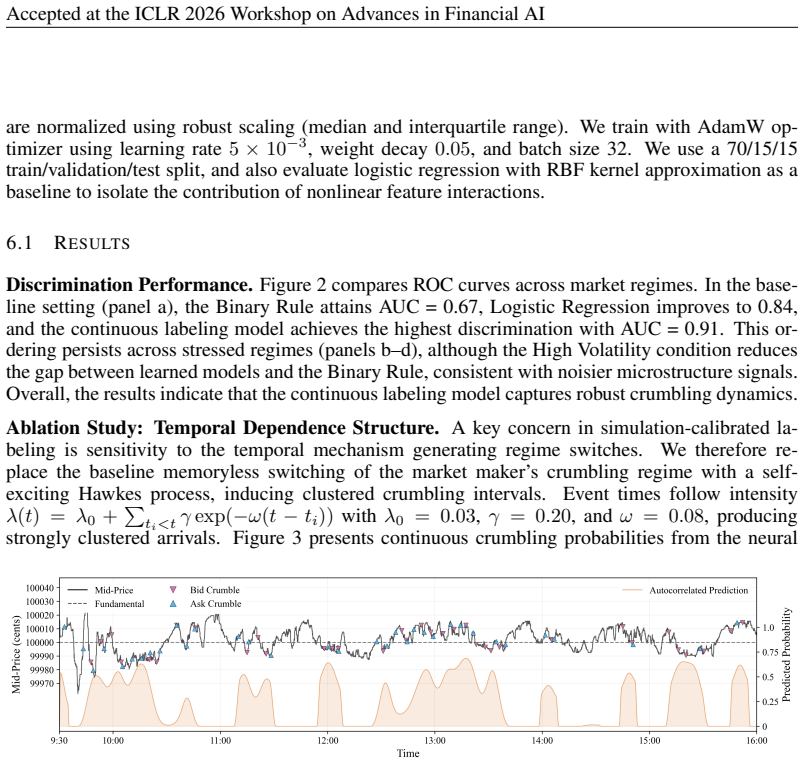
We study the detection of transient liquidity erosion ("crumbling quotes") in electronic limit order books, where observable quote deterioration may reflect either mechanical liquidity withdrawal or informational repricing. Using the ABIDES agent-based simulator, we construct a multi-agent environment in which crumbling emerges from stochastic regime switches in a market maker, providing time-resolved ground truth unavailable in real market data. We develop a detection pipeline that identifies mechanically driven quote erosion using order book features, and train a neural model to produce calibrated crumbling probabilities. Experiments demonstrate that the proposed framework reliably identifies crumbling events against agent-level ground truth, with the neural model achieving +36% AUC improvement over rule-based baselines and robust performance across normal, high-volatility, bull, and bear market conditions. Ablation studies on temporal features and varying the dependence structure of the ground-truth mechanism confirm that the framework generalizes across both independent and autocorrelated liquidity withdrawal dynamics.
Editorial analysis
A structured set of objections, weighed in public.
Referee Report
Summary. The manuscript presents a framework for detecting transient mechanical liquidity erosion ('crumbling quotes') in limit order books. Using the ABIDES multi-agent simulator, ground-truth crumbling events are generated exclusively via stochastic regime switches in a market-maker agent. A feature-based detection pipeline is developed and a neural model is trained to output calibrated crumbling probabilities. Experiments report that the neural model achieves a +36% AUC improvement over rule-based baselines and maintains robust performance across normal, high-volatility, bull, and bear market conditions. Ablation studies examine temporal features and the dependence structure of the ground-truth mechanism.
Significance. If the simulated crumbling dynamics prove representative of real electronic markets, the work would offer a valuable controlled testbed for distinguishing mechanical liquidity withdrawal from informational repricing, with potential applications in surveillance and liquidity-risk modeling. The use of an external agent-based simulator to supply time-resolved labels is a methodological strength that avoids direct circularity. However, the significance is currently limited by the absence of any calibration or distributional comparison against empirical LOB data.
major comments (3)
- [§4 (Experiments)] §4 (Experiments) and Table 2: the reported +36% AUC improvement is given without error bars, confidence intervals, or the number of independent simulation runs, so it is impossible to judge whether the gain is statistically reliable or sensitive to random seeds.
- [§3 (Simulation Setup)] §3 (Simulation Setup): the claim that ABIDES regime switches produce quote-erosion trajectories representative of mechanical liquidity withdrawal rests on no quantitative comparison of feature distributions, event durations, depth profiles, or conditional statistics against real-market episodes (e.g., flash-crash or inventory-driven withdrawals). This is load-bearing for any transfer of the detection pipeline beyond the simulator.
- [§5 (Ablation Studies)] §5 (Ablation Studies): all ablations vary parameters inside the same ABIDES market-maker generative model; no sensitivity analysis is performed with respect to alternative market-maker behaviors (different inventory targets, risk limits, or regulatory constraints), so the reported generalization to 'independent and autocorrelated' dynamics remains internal to one family of simulations.
minor comments (2)
- [Abstract] The abstract states that the neural model produces 'calibrated crumbling probabilities' but supplies no description of the calibration procedure (Platt scaling, isotonic regression, etc.).
- [§4 (Experiments)] Feature-selection details (how the order-book features were chosen or ranked) are omitted from the experimental section, complicating reproducibility.
Simulated Author's Rebuttal
We thank the referee for the constructive comments on our manuscript. We address each major point below, indicating where revisions will be made to improve statistical reporting, clarify scope, and discuss limitations.
read point-by-point responses
-
Referee: [§4 (Experiments)] §4 (Experiments) and Table 2: the reported +36% AUC improvement is given without error bars, confidence intervals, or the number of independent simulation runs, so it is impossible to judge whether the gain is statistically reliable or sensitive to random seeds.
Authors: We agree that the absence of error bars and run counts limits assessment of reliability. In the revised manuscript, we will rerun all experiments over 30 independent simulation trials with distinct random seeds, reporting mean AUC values with standard deviations for the neural model and all baselines. Error bars will be added to Table 2, and §4 will include a brief analysis of seed sensitivity. revision: yes
-
Referee: [§3 (Simulation Setup)] §3 (Simulation Setup): the claim that ABIDES regime switches produce quote-erosion trajectories representative of mechanical liquidity withdrawal rests on no quantitative comparison of feature distributions, event durations, depth profiles, or conditional statistics against real-market episodes (e.g., flash-crash or inventory-driven withdrawals). This is load-bearing for any transfer of the detection pipeline beyond the simulator.
Authors: We acknowledge that no quantitative distributional matching to real-market episodes is performed. The ABIDES setup is intentionally designed to generate labeled mechanical withdrawals via inventory regime switches, enabling supervised training that is impossible with unlabeled empirical data. We do not claim statistical equivalence to real events. In the revision, we will revise §3 to explicitly frame the simulator as a controlled testbed for evaluating detection methods under known generative mechanisms, rather than a calibrated replica of real markets, and will add a limitations paragraph discussing transferability. revision: partial
-
Referee: [§5 (Ablation Studies)] §5 (Ablation Studies): all ablations vary parameters inside the same ABIDES market-maker generative model; no sensitivity analysis is performed with respect to alternative market-maker behaviors (different inventory targets, risk limits, or regulatory constraints), so the reported generalization to 'independent and autocorrelated' dynamics remains internal to one family of simulations.
Authors: The ablations in §5 systematically vary the temporal dependence structure of the regime switches (independent versus autocorrelated) while holding the underlying market-maker agent fixed, to isolate the effect of dependence on detection performance. Extending to entirely different market-maker implementations would require new agent models and is outside the current scope. We will add text in §5 and the conclusion noting that results pertain to this class of inventory-driven behaviors and recommending future sensitivity studies with alternative simulators or regulatory constraints. revision: partial
Circularity Check
No significant circularity in simulation-based detection framework
full rationale
The paper generates independent ground-truth labels for crumbling events exclusively via stochastic regime switches in the ABIDES market-maker agent, which are external to the order-book features and detection model. The neural network is trained in standard supervised fashion to predict these simulator-provided labels from observable LOB features, with performance measured against separate rule-based baselines on held-out simulation trajectories. No derivation step reduces the central claim (AUC improvement and robustness) to its inputs by construction, no parameters are fitted and then relabeled as predictions, and no load-bearing self-citations or uniqueness theorems appear. The framework is self-contained against the external ABIDES benchmark.
Axiom & Free-Parameter Ledger
free parameters (1)
- neural network weights and hyperparameters
axioms (1)
- domain assumption ABIDES stochastic regime switches in market makers produce realistic mechanical liquidity erosion
Reference graph
Works this paper leans on
-
[1]
Scaling Learning Algorithms Towards
Bengio, Yoshua and LeCun, Yann , booktitle =. Scaling Learning Algorithms Towards
-
[2]
and Osindero, Simon and Teh, Yee Whye , journal =
Hinton, Geoffrey E. and Osindero, Simon and Teh, Yee Whye , journal =. A Fast Learning Algorithm for Deep Belief Nets , volume =
-
[3]
2016 , publisher=
Deep learning , author=. 2016 , publisher=
2016
-
[4]
Abides: Towards high-fidelity market simulation for ai research , author=. arXiv preprint arXiv:1904.12066 , year=
-
[5]
Proceedings of the 2020 ACM SIGSIM Conference on Principles of Advanced Discrete Simulation , pages=
ABIDES: Towards high-fidelity multi-agent market simulation , author=. Proceedings of the 2020 ACM SIGSIM Conference on Principles of Advanced Discrete Simulation , pages=
2020
-
[6]
Proceedings of the Second ACM International Conference on AI in Finance , pages=
ABIDES-gym: gym environments for multi-agent discrete event simulation and application to financial markets , author=. Proceedings of the Second ACM International Conference on AI in Finance , pages=
-
[7]
Proceedings of the First ACM International Conference on AI in Finance , pages=
Get real: Realism metrics for robust limit order book market simulations , author=. Proceedings of the First ACM International Conference on AI in Finance , pages=
-
[8]
Proceedings of the Third ACM International Conference on AI in Finance , pages=
Learning not to spoof , author=. Proceedings of the Third ACM International Conference on AI in Finance , pages=
-
[9]
Handbook of computational economics , volume=
Agent-based computational finance , author=. Handbook of computational economics , volume=. 2006 , publisher=
2006
-
[10]
The economy as an evolving complex system II , pages=
Asset pricing under endogenous expectations in an artificial stock market , author=. The economy as an evolving complex system II , pages=. 2018 , publisher=
2018
-
[11]
2015 , publisher=
Algorithmic and high-frequency trading , author=. 2015 , publisher=
2015
-
[12]
Journal of Financial Economics , volume=
Bid, ask and transaction prices in a specialist market with heterogeneously informed traders , author=. Journal of Financial Economics , volume=. 1985 , publisher=
1985
-
[13]
Econometrica: Journal of the Econometric Society , pages=
Continuous auctions and insider trading , author=. Econometrica: Journal of the Econometric Society , pages=. 1985 , publisher=
1985
-
[14]
The Review of Financial Studies , volume=
High-frequency trading and price discovery , author=. The Review of Financial Studies , volume=. 2014 , publisher=
2014
-
[15]
The Journal of Finance , volume=
Measuring the information content of stock trades , author=. The Journal of Finance , volume=. 1991 , publisher=
1991
-
[16]
Journal of Risk , volume=
Optimal execution of portfolio transactions , author=. Journal of Risk , volume=
-
[17]
Journal of Financial Markets , volume=
Optimal control of execution costs , author=. Journal of Financial Markets , volume=. 1998 , publisher=
1998
-
[18]
2013 , publisher=
The science of algorithmic trading and portfolio management , author=. 2013 , publisher=
2013
-
[19]
Proceedings of the 23rd International Conference on Machine Learning , pages=
Reinforcement learning for optimized trade execution , author=. Proceedings of the 23rd International Conference on Machine Learning , pages=
-
[20]
Applied Mathematical Finance , volume=
Double deep q-learning for optimal execution , author=. Applied Mathematical Finance , volume=. 2021 , publisher=
2021
-
[21]
Proceedings of the 6th ACM International Conference on AI in Finance , pages=
Learning to Trade with Preferences: Interpretable Execution via Mixture-of-Experts , author=. Proceedings of the 6th ACM International Conference on AI in Finance , pages=
-
[22]
2004 , publisher=
Pairs Trading: quantitative methods and analysis , author=. 2004 , publisher=
2004
-
[23]
The Review of Financial Studies , volume=
Pairs trading: Performance of a relative-value arbitrage rule , author=. The Review of Financial Studies , volume=. 2006 , publisher=
2006
-
[24]
The Quarterly Journal of Economics , volume=
The high-frequency trading arms race: Frequent batch auctions as a market design response , author=. The Quarterly Journal of Economics , volume=. 2015 , publisher=
2015
-
[25]
The Journal of Finance , volume=
High-frequency trading and market performance , author=. The Journal of Finance , volume=. 2020 , publisher=
2020
-
[26]
arms race
Quantifying the high-frequency trading “arms race” , author=. The Quarterly Journal of Economics , volume=. 2022 , publisher=
2022
-
[27]
The Journal of Finance , volume=
Every cloud has a silver lining: Fast trading, microwave connectivity, and trading costs , author=. The Journal of Finance , volume=. 2020 , publisher=
2020
-
[28]
Journal of financial Markets , volume=
High frequency trading and the new market makers , author=. Journal of financial Markets , volume=. 2013 , publisher=
2013
-
[29]
Proceedings of the 12th ACM Conference on Electronic Commerce , pages=
Market making and mean reversion , author=. Proceedings of the 12th ACM Conference on Electronic Commerce , pages=
-
[30]
Journal of Artificial Intelligence Research , volume=
Welfare effects of market making in continuous double auctions , author=. Journal of Artificial Intelligence Research , volume=
-
[31]
Journal of International Money and Finance , volume=
A geographical model for the daily and weekly seasonal volatility in the foreign exchange market , author=. Journal of International Money and Finance , volume=. 1993 , publisher=
1993
-
[32]
IEEE Transactions on Signal Processing , volume=
Deeplob: Deep convolutional neural networks for limit order books , author=. IEEE Transactions on Signal Processing , volume=. 2019 , publisher=
2019
-
[33]
Quantitative Finance , volume=
Deep hedging , author=. Quantitative Finance , volume=. 2019 , publisher=
2019
-
[34]
The Review of Financial Studies , volume=
Flow toxicity and liquidity in a high-frequency world , author=. The Review of Financial Studies , volume=. 2012 , publisher=
2012
-
[35]
The Journal of Finance , volume=
The flash crash: High-frequency trading in an electronic market , author=. The Journal of Finance , volume=. 2017 , publisher=
2017
-
[36]
The Review of Financial Studies , volume=
Limit order book as a market for liquidity , author=. The Review of Financial Studies , volume=. 2005 , publisher=
2005
-
[37]
Econometrica , volume=
Market microstructure invariance: Empirical hypotheses , author=. Econometrica , volume=. 2016 , publisher=
2016
-
[38]
The Journal of Finance , volume=
Does algorithmic trading improve liquidity? , author=. The Journal of Finance , volume=. 2011 , publisher=
2011
-
[39]
Applied Reinforcement Learning with Python: With OpenAI Gym, Tensorflow, and Keras , pages=
Market making via reinforcement learning , author=. Applied Reinforcement Learning with Python: With OpenAI Gym, Tensorflow, and Keras , pages=. 2019 , publisher=
2019
-
[40]
Expert Systems with Applications , volume=
An application of deep reinforcement learning to algorithmic trading , author=. Expert Systems with Applications , volume=. 2021 , publisher=
2021
-
[41]
2026 , eprint=
A unified theory of order flow, market impact, and volatility , author=. 2026 , eprint=
2026
-
[42]
Mathematical Finance , volume=
Deep order flow imbalance: Extracting alpha at multiple horizons from the limit order book , author=. Mathematical Finance , volume=. 2023 , publisher=
2023
discussion (0)
Sign in with ORCID, Apple, or X to comment. Anyone can read and Pith papers without signing in.