Recognition: unknown
Interpolation above S4
Pith reviewed 2026-05-08 13:00 UTC · model grok-4.3
The pith
Craig interpolation holds for the six extensions of S4 that remained open.
A machine-rendered reading of the paper's core claim, the machinery that carries it, and where it could break.
Core claim
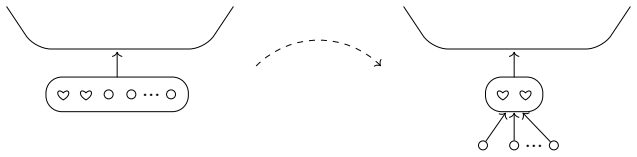
We complete Maksimova's classification of the normal extensions of S4 with interpolation. In particular, we prove Craig interpolation for the six extensions of S4 for which Craig interpolation was still open. The proof strategy builds upon the ideas of Smoryński, but employs a novel approach using Fine's frame formulas for splitting clusters.
What carries the argument
Fine's frame formulas for splitting clusters, which divide the semantic structures of the logics to isolate the conditions needed for interpolation.
If this is right
- The complete list of normal extensions of S4 that have Craig interpolation is now known without gaps.
- These six logics join the previously settled cases in satisfying the interpolation property.
- The lattice of normal extensions of S4 has a fully determined subset where the property holds.
- The same semantic technique resolves the open cases that earlier methods left untouched.
Where Pith is reading between the lines
- The same splitting technique might resolve interpolation questions for extensions of related logics such as K4 or S5.
- A decision procedure could now be constructed to check the interpolation property for any given finite axiomatization above S4.
- The result links interpolation to specific frame conditions that can be checked directly on finite models.
Load-bearing premise
The novel use of Fine's frame formulas for splitting clusters succeeds in establishing interpolation for precisely these six logics.
What would settle it
A pair of formulas A and B in one of the six logics such that A semantically entails B yet no interpolant C exists whose language is contained in the common symbols of A and B.
Figures

read the original abstract
We complete Maksimova's classification of the normal extensions of S4 with interpolation. In particular, we prove Craig interpolation for the six extensions of S4 for which Craig interpolation was still open. The proof strategy builds upon the ideas of Smory\'nski, but employs a novel approach using Fine's frame formulas for splitting clusters.
Editorial analysis
A structured set of objections, weighed in public.
Referee Report
Summary. The manuscript completes Maksimova's classification of the normal extensions of S4 possessing the Craig interpolation property. It establishes interpolation for the six previously open cases by constructing interpolants via Fine's frame formulas that split clusters in S4-frames while preserving the relevant frame properties of each logic, building on the semantic strategy of Smoryński.
Significance. If the proofs hold, the result finishes a long-standing classification problem in modal logic. The explicit, case-by-case semantic constructions using cluster-splitting frame formulas constitute a concrete advance over purely abstract existence arguments and supply a uniform method that may extend to related interpolation questions.
minor comments (2)
- [Abstract] The abstract refers to 'the six extensions' without naming them or giving their axiomatizations; listing the logics (e.g., by their additional axioms) would improve immediate readability.
- [Main proofs] In the verification steps for each logic, cross-references from the extracted interpolant back to the specific S4-frame condition being preserved could be made more explicit.
Simulated Author's Rebuttal
We thank the referee for their careful reading and positive evaluation of the manuscript. We are gratified that the work is recognized as completing Maksimova's classification of normal extensions of S4 with the Craig interpolation property, and that the semantic constructions via Fine's frame formulas are viewed as a concrete contribution.
Circularity Check
No significant circularity detected
full rationale
The paper supplies explicit semantic constructions for Craig interpolants in each of the six open S4-extensions, using Fine frame formulas to split clusters while preserving frame properties. These case-by-case arguments are spelled out directly in the manuscript without reduction to fitted parameters, self-definitional loops, or load-bearing self-citations. The work cites Maksimova and Smorynski for background classification but the novel splitting technique and verification steps are independently verifiable from the stated S4-frame semantics and do not collapse to prior inputs by construction.
Axiom & Free-Parameter Ledger
Reference graph
Works this paper leans on
-
[1]
Bezhanishvili
N. Bezhanishvili. ‘Lattices of Intermediate and Cylindric Modal Logics’ . PhD thesis. Universiteit van Amsterdam, 2006
2006
-
[2]
Blackburn, M
P. Blackburn, M. de Rijke and Y. Venema. Modal Logic. Vol. 53. Cambridge Tracts in Theoretical Computer Science. Cambridge University Press, 2001
2001
-
[3]
G. Boolos. ‘On Systems of Modal Logic with Provability Interpretations’ . Theoria 46.1 (1980), pp. 7–18. DOI: 10.1111/j.1755-2567.1980.tb00686.x
-
[4]
Chagrov and M
A. Chagrov and M. Zakharyaschev. Modal Logic . Vol. 35. Oxford Logic Guides. Oxford University Press, 1997
1997
-
[5]
K. Fine. ‘An ascending chain of S4 logics’ . Theoria 40.2 (1974), pp. 110–116. DOI: 10.1111/j.1755-2567.1974.tb00081.x
-
[6]
D. M. Gabbay and L. L. Maksimova. Interpolation and Definability. Vol. 46. Oxford Logic Guides. Oxford University Press, 2005
2005
-
[7]
V. A. Jankov. ‘Constructing a sequence of strongly independent superintuitionistic propositional calculi’ . Trans. from the Russian by A. Yablonski.Soviet Mathematics 9.4 (1968), pp. 806–807
1968
-
[8]
L. L. Maksimova. ‘Craig’s theorem in superintuitionistic logics and amalgamable varieties of pseudo-Boolean algebras’ . Algebra and Logic 16 (1978), pp. 427–455. DOI: 10.1007/BF01670006
-
[9]
L. L. Maksimova. ‘Interpolation theorems in modal logics and amalgamable vari- eties of topological Boolean algebras’ . Algebra and Logic 18 (1980), pp. 348–370. DOI: 10.1007/BF01673502
-
[10]
L. L. Maksimova. ‘Interpolation theorems in modal logics. Sufficient conditions’ . Algebra and Logic 19.2 (1981), pp. 120–132. DOI: 10.1007/BF01669837
-
[11]
L. L. Maksimova. ‘Interpolation in normal modal logics’ . Russian. Matematicheskie Issledovaniya. Neklassicheskie logiki 98 (1987), pp. 40–56
1987
-
[12]
W. Rautenberg. ‘Splitting lattices of logics’ . Archiv für mathematische Logik und Grundlagenforschung 20 (1980), pp. 155–159. DOI: 10.1007/BF02021134
-
[13]
C. Smoryński. ‘Beth’s Theorem and Self-Referential Sentences’ . In: Logic Col- loquium ’77 (Wrołcaw, Poland, 1st–12th Aug. 1977). Ed. by A. Macintyre, L. Pacholski and J. Paris. Vol. 96. Studies in Logic and the Foundations of Mathemat- ics. North-Holland Publishing Company, 1978, pp. 253–261. DOI: 10.1016/S0049- 237X(08)72008-1. 14
-
[14]
Zakharyaschev
M. Zakharyaschev. ‘Canonical Formulas for K4. Part I: Basic Results’ . The Journal of Symbolic Logic 57.4 (1992), pp. 1377–1402. DOI: 10 . 2307 / 2275372. JSTOR: 2275372. 15
1992
discussion (0)
Sign in with ORCID, Apple, or X to comment. Anyone can read and Pith papers without signing in.