Differentiable Forward Modeling for Efficient and Accurate Shear Inference
Pith reviewed 2026-05-08 13:39 UTC · model grok-4.3
The pith
Differentiable forward modeling infers cosmic shear with multiplicative bias below 0.0013 without external calibration.
A machine-rendered reading of the paper's core claim, the machinery that carries it, and where it could break.
Core claim
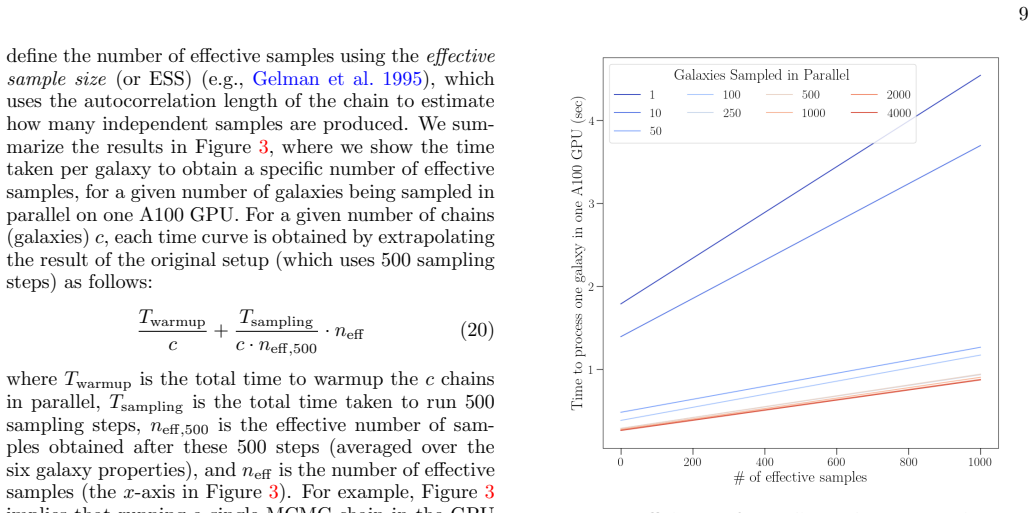
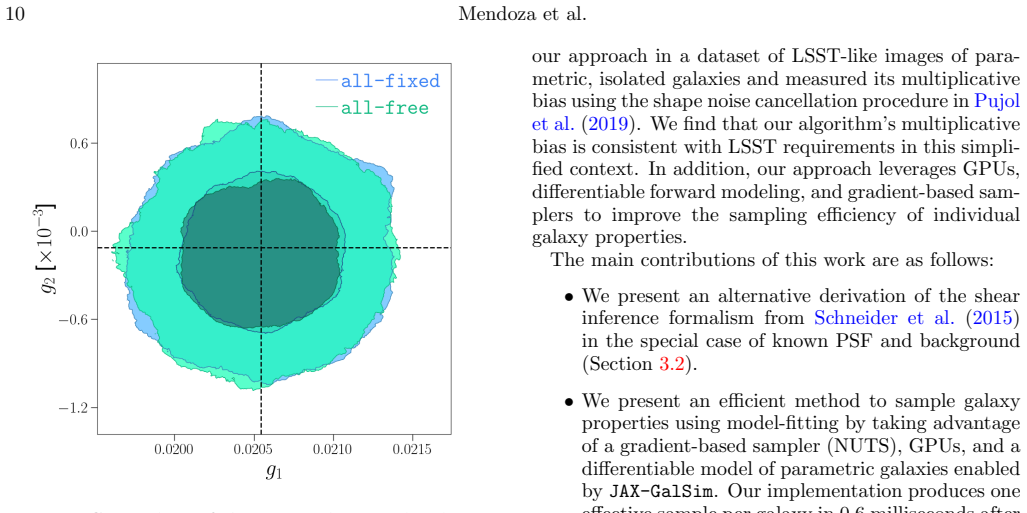
The central claim is that a differentiable forward modeling approach to Bayesian shear inference, when the PSF and sky are known, automatically handles noise bias and achieves an absolute multiplicative bias |m| below 0.9 × 10^{-3} at 3σ for known galaxy property distributions and below 1.3 × 10^{-3} when inferred jointly, meeting LSST requirements in simulations of isolated exponential galaxies, while enabling efficient MCMC sampling on GPUs at 0.45 seconds per galaxy for 300 effective samples.
What carries the argument
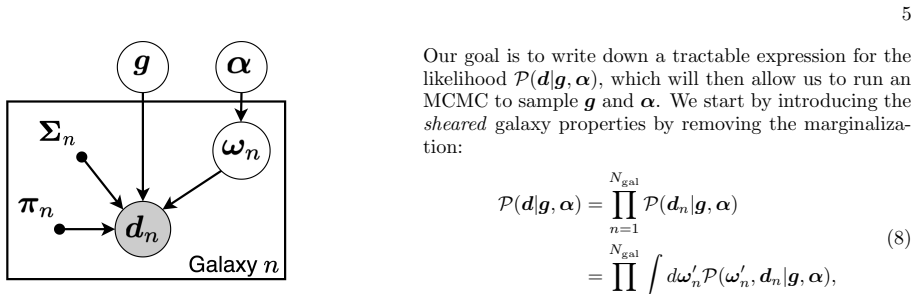
Differentiable forward models of galaxies used within a gradient-based Markov chain Monte Carlo sampler to infer shear while accounting for pixel noise.
If this is right
- The shear estimate requires no external calibration for noise bias.
- The method remains accurate when galaxy property distributions are inferred simultaneously with shear.
- GPU acceleration makes processing billions of galaxies computationally feasible for large surveys.
- The bias performance satisfies the requirements for Stage-IV dark energy surveys like LSST.
Where Pith is reading between the lines
- Extending the framework to include effects like galaxy blending and detection would allow testing on more realistic simulated data.
- Applying the method to actual survey images could validate its performance beyond the isolated galaxy assumption.
- The use of differentiable models suggests potential for end-to-end differentiable cosmological inference pipelines.
- Further optimization of the sampling could reduce computation time even more for full survey applications.
Load-bearing premise
The point spread function and sky background are known exactly and the validation uses only isolated exponential galaxies with either known or jointly inferred intrinsic property distributions.
What would settle it
A simulation study that includes blended galaxies, complex morphologies, detection and selection effects, followed by checking if the recovered |m| exceeds 2 × 10^{-3} at 3 sigma, would directly test whether the bias control holds for realistic conditions.
Figures


read the original abstract
Forthcoming Stage-IV dark energy optical surveys, such as LSST, have the ambitious goal of measuring cosmological parameters at sub-percent precision. Realizing their full scientific potential requires very precise measurement of the cosmic shear signal and control of corresponding systematics. In this work, we present a modern implementation of the Bayesian shear inference framework in Schneider et al. (2014), in the case that the PSF and sky background are known. This framework automatically propagates the pixel-noise measurement error from each galaxy into the final shear estimate, and thus requires no external calibration to handle noise bias. As a first application of this new implementation, we infer the cosmic shear posterior from simulated images consisting of isolated exponential galaxies with LSST-like levels of shape and pixel noise. In this simplified scenario, we estimate the absolute multiplicative bias $|m|$ of our approach to be below $0.9 \times 10^{-3} \, [3\sigma]$ when the intrinsic distribution of galaxy properties is known, and below $1.3 \times 10^{-3}\, [3\sigma]$ when these distributions are inferred alongside shear. Both results are within the LSST requirement of $|m| < 2 \times10^{-3}$. Additionally, we make progress towards the algorithm's computational feasibility in the context of modern wide-field surveys, where billions of galaxies must be processed, by leveraging differentiable forward models of galaxies, gradient-based samplers, and GPUs. Our final galaxy-fitting MCMC produces $300$ effective samples of galaxy properties in $0.45$ seconds per galaxy using a single A100 GPU. In the future, we seek to generalize our algorithm to handle selection, detection, and model shear biases so it can be applied to real survey data.
Editorial analysis
A structured set of objections, weighed in public.
Referee Report
Summary. The manuscript presents a differentiable forward-modeling implementation of the Bayesian shear inference framework from Schneider et al. (2014), restricted to the case of known PSF and sky background. It employs gradient-based MCMC sampling on GPUs to jointly sample galaxy properties and shear while automatically propagating pixel-noise uncertainties. On simulated images of isolated exponential galaxies with LSST-like shape and pixel noise, the method reports absolute multiplicative bias |m| below 0.9 × 10^{-3} (3σ) when intrinsic property distributions are known a priori and below 1.3 × 10^{-3} (3σ) when those distributions are inferred jointly with shear; both values satisfy the LSST requirement |m| < 2 × 10^{-3}. Per-galaxy runtime is stated as 0.45 s for 300 effective samples on a single A100 GPU. The authors explicitly scope the result to this simplified matched-model regime and flag generalization to selection, detection, blending, and complex morphologies as future work.
Significance. If the reported bias levels hold under the stated assumptions, the work constitutes a meaningful step toward calibration-free shear measurement at the precision required by Stage-IV surveys. The combination of differentiable galaxy models with modern gradient-based sampling directly addresses both the noise-bias problem and the computational scaling barrier for billions of galaxies. The explicit scoping to isolated exponentials with known PSF avoids over-claim while demonstrating that full posterior propagation can meet LSST multiplicative-bias targets in a controlled setting; this provides a concrete baseline against which more realistic extensions can be judged.
major comments (2)
- [§4] §4 (simulation and inference setup): the reported 3σ bounds on |m| are obtained from a finite number of simulated galaxies whose intrinsic ellipticity and size distributions are either fixed or jointly sampled; the manuscript should state the exact number of galaxies used, the convergence diagnostics applied to the MCMC chains, and whether the quoted uncertainties incorporate the finite-sample variance of the bias estimator itself.
- [§3.2] §3.2 (differentiable forward model): the claim that pixel-noise error is automatically propagated without external calibration rests on the differentiability of the model; an explicit statement is needed on whether the chosen galaxy profile (exponential) and any numerical approximations in the rendering step introduce additional systematic terms that are not captured by the reported bias figures.
minor comments (3)
- [Abstract] The abstract and introduction should make the scope limitation (isolated exponentials, known PSF) more prominent in the first paragraph so that readers immediately understand the controlled nature of the test.
- [Figures] Figure captions for the bias-versus-shear plots should list the exact simulation parameters (noise levels, galaxy density, prior widths) rather than referring only to 'LSST-like' conditions.
- [Methods] A short table summarizing the MCMC settings (number of chains, burn-in, thinning, effective sample size per galaxy) would improve reproducibility.
Simulated Author's Rebuttal
We thank the referee for their positive assessment of the work and for the constructive recommendation of minor revision. The comments highlight useful points for improving clarity and reproducibility, which we address below. We have prepared revisions to the manuscript that incorporate the requested details without changing the scope or conclusions of the study.
read point-by-point responses
-
Referee: [§4] §4 (simulation and inference setup): the reported 3σ bounds on |m| are obtained from a finite number of simulated galaxies whose intrinsic ellipticity and size distributions are either fixed or jointly sampled; the manuscript should state the exact number of galaxies used, the convergence diagnostics applied to the MCMC chains, and whether the quoted uncertainties incorporate the finite-sample variance of the bias estimator itself.
Authors: We agree that these details strengthen the presentation of the results. In the revised manuscript we will explicitly report the number of simulated galaxies used for the bias measurements in each case, describe the MCMC convergence diagnostics that were applied (including the Gelman-Rubin statistic), and clarify that the quoted 3σ uncertainties on |m| are computed from the standard error of the bias estimator across the ensemble and therefore already incorporate finite-sample variance. revision: yes
-
Referee: [§3.2] §3.2 (differentiable forward model): the claim that pixel-noise error is automatically propagated without external calibration rests on the differentiability of the model; an explicit statement is needed on whether the chosen galaxy profile (exponential) and any numerical approximations in the rendering step introduce additional systematic terms that are not captured by the reported bias figures.
Authors: We thank the referee for requesting this clarification. Because the analysis is performed in a strictly matched-model regime, the same exponential profile and rendering procedure are used both to generate the simulated images and to sample the posterior. Consequently, any systematic contributions from the profile choice or from numerical approximations in the rendering (e.g., pixel integration) are fully included in the measured bias values. The differentiability of the forward model ensures that pixel-noise uncertainties are propagated exactly into the shear posterior without external calibration. We will add an explicit paragraph in §3.2 stating this point. revision: yes
Circularity Check
Minor self-citation of prior framework; central bias measurement independent
full rationale
The paper implements the Bayesian shear inference framework from Schneider et al. (2014) (one author overlap) but applies it to forward-simulated isolated exponential galaxies whose noise realizations and intrinsic property distributions are generated independently of the inference model. The reported |m| bounds are obtained by direct comparison of inferred shear posteriors against the known input shear in these simulations; no equation or fitted parameter is redefined as a prediction by construction. The self-citation is not load-bearing for the bias result, which remains a first-application measurement on matched-model data. No self-definitional loops, fitted-input predictions, or ansatz smuggling are present in the derivation chain.
Axiom & Free-Parameter Ledger
axioms (2)
- domain assumption PSF and sky background are known
- domain assumption Galaxies are isolated exponential profiles
Reference graph
Works this paper leans on
-
[1]
The advantage of using theη parameterization is that the ellipticity domain is now the real numbers. Thus, Gaussian noise can be added to each component independently to obtain noisy ellipticities: ˜η1,2 ∼ N(η 1,2, ση),(A.2) whereσ η is the independent scatter of each component representing a degree of measurement error. We choose the value ofσ η = 0.1 by...
-
[2]
| (A.3) whereε ′ 1,2 are the noiseless ellipticities in theεparam- eterization. The first factor is the likelihood defined by Equation A.2, the second factor is the interim prior on ellipticities which we choose to be the same as in Equa- tion 14, and the last factor is the absolute determinant of the Jacobian defined by the inverse of Equation A.1. In te...
work page 2000
discussion (0)
Sign in with ORCID, Apple, or X to comment. Anyone can read and Pith papers without signing in.