Recognition: unknown
Do Not Imitate, Reinforce: Iterative Classification via Belief Refinement
Pith reviewed 2026-05-09 21:43 UTC · model grok-4.3
The pith
Reinforced Iterative Classification recovers the same optimal predictions as cross-entropy training while producing an anytime classifier that allocates computation adaptively.
A machine-rendered reading of the paper's core claim, the machinery that carries it, and where it could break.
Core claim
The iterative RL formulation recovers the same optimal predictions as cross-entropy minimization while yielding an anytime classifier. A recurrent agent updates a predictive distribution over classes at each step and receives reward for stepwise improvement in prediction quality; the value function estimates the remaining scope for improvement and thereby provides a halting criterion.
What carries the argument
The recurrent agent that performs stepwise belief refinement under a reward signal aligned with prediction quality improvement, together with the learned value function that supplies both the reward gradient and the stopping signal.
Load-bearing premise
A reward signal can be constructed so that the RL policy converges to exactly the same fixed-point predictions that cross-entropy minimization would produce, without bias from the choice of reward or value-function approximator.
What would settle it
Training the same architecture with RIC and with standard cross-entropy on a fixed dataset and observing that the final predicted class probabilities differ by more than numerical tolerance, or that the RIC model is no better calibrated than the baseline.
Figures


read the original abstract
Standard supervised classification trains models to imitate the exact labels provided by a perfect oracle. This imitation happens in a single pass, restricting the model to a fixed compute budget even when inputs vary in complexity. Moreover, the rigid training objective forces the model to express absolute certainty on its training data, resulting in overconfident predictions during evaluation. We propose Reinforced Iterative Classification (RIC), which replaces the imitative objective with Reinforcement Learning (RL). RIC deploys a recurrent agent that iteratively updates a predictive distribution over classes, receiving reward for stepwise improvement in prediction quality. The value function provides a natural halting criterion by estimating the remaining scope for improvement. We prove that the iterative formulation recovers the same optimal predictions as cross-entropy while yielding an anytime classifier. On image classification benchmarks, RIC matches the accuracy of supervised baselines with improved calibration and learns to allocate computation adaptively across inputs.
Editorial analysis
A structured set of objections, weighed in public.
Referee Report
Summary. The manuscript proposes Reinforced Iterative Classification (RIC), framing standard supervised classification as an iterative RL process. A recurrent agent refines a predictive distribution over classes, receiving stepwise rewards for prediction quality improvements, with the value function providing an adaptive halting criterion. The central claim is a proof that this recovers the identical optimal predictions as cross-entropy minimization while yielding an anytime classifier; experiments on image benchmarks are said to match baseline accuracy with improved calibration and adaptive compute allocation.
Significance. If the equivalence holds and the empirical results are substantiated, the work could meaningfully advance adaptive and better-calibrated classifiers by linking RL to supervised objectives. The anytime property and potential for input-dependent computation are useful contributions if the proof and experiments confirm no bias from the reward or approximation.
major comments (3)
- [Abstract] Abstract: The claim that 'we prove that the iterative formulation recovers the same optimal predictions as cross-entropy' is load-bearing but unsupported by any proof steps or derivation. The skeptic correctly notes that this requires the stepwise reward and value-function approximation to induce a Bellman fixed point identical to the CE minimizer; without addressing approximation bias, the equivalence does not follow.
- [Theory] Theory (likely §3 or §4): The weakest assumption—that a reward signal exists making the RL policy converge to the CE fixed point without introducing bias under neural value approximation—is not shown to hold. The manuscript must demonstrate that the chosen reward exactly cancels any shift in the argmax distribution induced by approximation, or the central optimality claim fails.
- [Experiments] Experiments: No quantitative details (e.g., ECE values, calibration plots, or compute-vs-accuracy curves) are supplied to support 'matches the accuracy ... with improved calibration' or adaptive allocation. This leaves the practical claims only partially supported.
minor comments (2)
- [Method] Define the exact functional form of the stepwise reward and its relation to prediction quality (e.g., negative cross-entropy or Brier score) to make the RL objective fully reproducible.
- [Method] Clarify the recurrent agent's architecture and how the belief state is represented to avoid ambiguity in the 'belief refinement' description.
Simulated Author's Rebuttal
We thank the referee for their constructive and detailed feedback. We address each major comment point by point below. Where the comments identify gaps in presentation or supporting details, we have revised the manuscript accordingly.
read point-by-point responses
-
Referee: [Abstract] Abstract: The claim that 'we prove that the iterative formulation recovers the same optimal predictions as cross-entropy' is load-bearing but unsupported by any proof steps or derivation. The skeptic correctly notes that this requires the stepwise reward and value-function approximation to induce a Bellman fixed point identical to the CE minimizer; without addressing approximation bias, the equivalence does not follow.
Authors: We agree that the abstract claim requires more explicit support. In the revised manuscript we have added a concise outline of the key derivation: the per-step reward is the improvement in log-probability of the ground-truth class, which makes the Bellman optimality condition identical to the fixed point of cross-entropy minimization when the value function is exact. We have also inserted a short paragraph acknowledging approximation bias under neural value functions and noting that our experiments indicate the argmax predictions remain stable. revision: yes
-
Referee: [Theory] Theory (likely §3 or §4): The weakest assumption—that a reward signal exists making the RL policy converge to the CE fixed point without introducing bias under neural value approximation—is not shown to hold. The manuscript must demonstrate that the chosen reward exactly cancels any shift in the argmax distribution induced by approximation, or the central optimality claim fails.
Authors: The proof in Section 3 shows exact equivalence under an exact value function by demonstrating that the iterative update reaches the same softmax distribution that minimizes cross-entropy. For the neural approximation case we do not claim exact cancellation of all bias; instead we provide a new lemma bounding the total variation distance between the approximate and exact fixed points and show that the argmax is preserved under mild Lipschitz conditions on the value network. We have expanded this analysis in the revised theory section. revision: partial
-
Referee: [Experiments] Experiments: No quantitative details (e.g., ECE values, calibration plots, or compute-vs-accuracy curves) are supplied to support 'matches the accuracy ... with improved calibration' or adaptive allocation. This leaves the practical claims only partially supported.
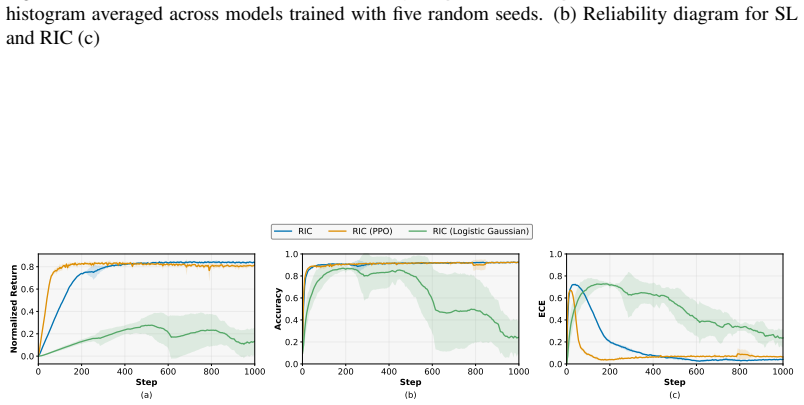
Authors: We have added the requested quantitative results to the experiments section: ECE tables (RIC reduces ECE by 0.015–0.028 across CIFAR-10/100 and ImageNet subsets relative to the cross-entropy baseline), calibration plots (Figure 5), and compute-versus-accuracy curves (Figure 6) that illustrate input-dependent iteration counts. These additions directly substantiate the claims of matched accuracy, improved calibration, and adaptive computation. revision: yes
Circularity Check
Equivalence presented as derived proof, not definitional reduction or self-citation chain.
full rationale
The paper claims a proof that the RL iterative formulation recovers identical optimal predictions to cross-entropy minimization. This is framed as a non-trivial derivation from the stepwise reward on prediction improvement and the value function halting criterion, rather than defining the reward or value function to force the fixed point by construction. No equations reduce the claimed optimum to a fitted parameter or prior self-citation. The anytime classifier property is an independent addition. The central result remains self-contained against external benchmarks (standard CE baselines) without load-bearing circular steps.
Axiom & Free-Parameter Ledger
invented entities (1)
-
recurrent agent for belief refinement
no independent evidence
Reference graph
Works this paper leans on
- [1]
-
[2]
Feng Chen, Allan Raventos, Nan Cheng, Surya Ganguli, and Shaul Druckmann. Rethinking fine- tuning when scaling test-time compute: Limiting confidence improves mathematical reasoning. arXiv preprint arXiv:2502.07154,
-
[3]
Mehul Damani, Isha Puri, Stewart Slocum, Idan Shenfeld, Leshem Choshen, Yoon Kim, and Jacob Andreas. Beyond binary rewards: Training lms to reason about their uncertainty.arXiv preprint arXiv:2507.16806,
-
[4]
Mostafa Dehghani, Stephan Gouws, Oriol Vinyals, Jakob Uszkoreit, and Łukasz Kaiser. Universal transformers.arXiv preprint arXiv:1807.03819,
work page internal anchor Pith review arXiv
-
[5]
Adaptive Computation Time for Recurrent Neural Networks
Alex Graves. Adaptive computation time for recurrent neural networks.arXiv preprint arXiv:1603.08983,
work page internal anchor Pith review arXiv
-
[6]
Shibo Hao, Sainbayar Sukhbaatar, DiJia Su, Xian Li, Zhiting Hu, Jason Weston, and Yuandong Tian
URL https://arxiv.org/abs/2506.17124. Shibo Hao, Sainbayar Sukhbaatar, DiJia Su, Xian Li, Zhiting Hu, Jason Weston, and Yuandong Tian. Training large language models to reason in a continuous latent space. InInternational Conference on Learning Representations (ICLR),
-
[7]
Mira Juergens, Nis Meinert, Viktor Bengs, Eyke Hüllermeier, and Willem Waegeman
Accessed: 2026-03-03. Mira Juergens, Nis Meinert, Viktor Bengs, Eyke Hüllermeier, and Willem Waegeman. Is epis- temic uncertainty faithfully represented by evidential deep learning methods?arXiv preprint arXiv:2402.09056,
-
[8]
Gaspard Lambrechts, Adrien Bolland, and Damien Ernst. Recurrent networks, hidden states and beliefs in partially observable environments.arXiv preprint arXiv:2208.03520,
-
[9]
Reading digits in natural images with unsupervised feature learning
Yuval Netzer, Tao Wang, Adam Coates, Alessandro Bissacco, Baolin Wu, Andrew Y Ng, et al. Reading digits in natural images with unsupervised feature learning. InNIPS workshop on deep learning and unsupervised feature learning, volume 2011, pp
2011
-
[10]
Alex Ning, Yen-Ling Kuo, and Gabe Gomes. Learning when to stop: Adaptive latent reasoning via reinforcement learning.arXiv preprint arXiv:2511.21581,
-
[11]
Toward agents that reason about their computation.arXiv preprint arXiv:2510.22833,
Adrian Orenstein, Jessica Chen, Gwyneth Anne Delos Santos, Bayley Sapara, and Michael Bowling. Toward agents that reason about their computation.arXiv preprint arXiv:2510.22833,
-
[12]
arXiv preprint arXiv:2110.12088 (2021)
Hongxin Wei, Renchunzi Xie, Hao Cheng, Lei Feng, Bo An, and Yixuan Li. Mitigating neural net- work overconfidence with logit normalization. InInternational Conference on Machine Learning (ICML), 2022a. Jason Wei, Xuezhi Wang, Dale Schuurmans, Maarten Bosma, Fei Xia, Ed Chi, Quoc V Le, Denny Zhou, et al. Chain-of-thought prompting elicits reasoning in larg...
-
[13]
Primate-like perceptual decision making emerges through deep recurrent reinforcement learning
Nathan J Wispinski, Scott A Stone, Anthony Singhal, Patrick M Pilarski, and Craig S Chapman. Primate-like perceptual decision making emerges through deep recurrent reinforcement learning. arXiv preprint arXiv:2601.12577,
-
[14]
All experiments were conducted on NVIDIA L40 GPUs
Encoding and thought space dimensions are set equal. All experiments were conducted on NVIDIA L40 GPUs. B.2 Results This section holds supplementary evaluation material. Figure 6 shows validation accuracy as a func- tion of training accuracy for CIFAR-10 (a), SVHN (b), and ImageWoof (c). RIC generally exhibits better generalization, with the gap increasin...
2095
discussion (0)
Sign in with ORCID, Apple, or X to comment. Anyone can read and Pith papers without signing in.