Recognition: unknown
Vacuum structure of a scalar field on a torus with uniform magnetic flux
Pith reviewed 2026-05-08 10:56 UTC · model grok-4.3
The pith
A complex scalar field on a torus with magnetic flux develops a nonzero, position-dependent vacuum expectation value only above a critical torus area.
A machine-rendered reading of the paper's core claim, the machinery that carries it, and where it could break.
Core claim
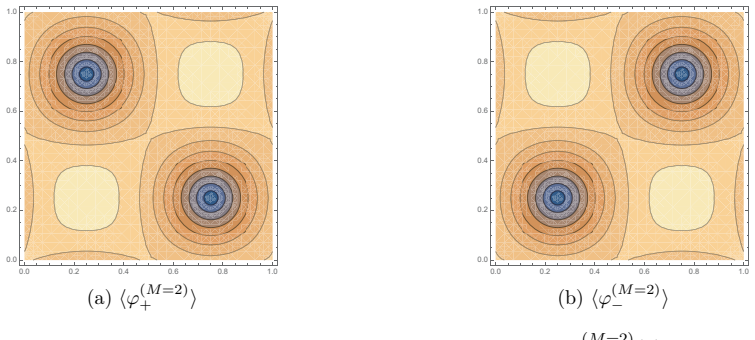
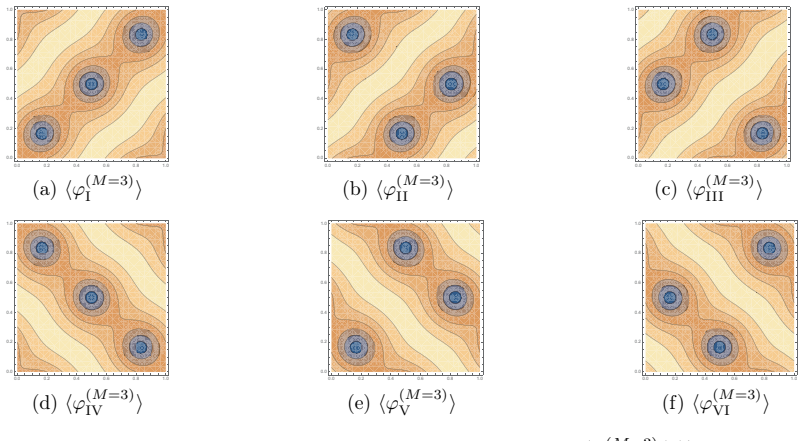
When the area of the torus exceeds a critical value, the vacuum expectation value of the complex scalar field becomes nonvanishing. Any nonzero vacuum expectation value necessarily exhibits nontrivial dependence on the coordinates of the torus. In the lowest-mode approximation a single vacuum configuration appears for M=1, while two and six degenerate vacuum configurations arise for M=2 and M=3, respectively, each with distinct symmetry properties under the underlying torus and flux symmetries.
What carries the argument
lowest-mode approximation for the scalar field modes in the uniform magnetic flux background on the torus, which reduces the vacuum search to minimizing an effective potential for the lowest modes.
If this is right
- For M=1 the vacuum is unique.
- For M=2 the vacuum has two-fold degeneracy.
- For M=3 the vacuum has six-fold degeneracy.
- Any nonzero vacuum expectation value breaks translation invariance on the torus.
- The chosen vacua may preserve or spontaneously break the discrete symmetries of the magnetized torus.
Where Pith is reading between the lines
- The position dependence of the vacuum expectation value could source additional effective potentials for moduli fields if the torus size is allowed to vary.
- The pattern of degeneracy for successive M may generalize to higher flux quanta and suggest a counting rule tied to the flux.
- Analogous critical-area phenomena might appear in lattice models of scalar fields coupled to U(1) gauge fields with background flux.
Load-bearing premise
The lowest-mode approximation is sufficient to determine the vacuum configurations, their degeneracy, and their symmetry properties for the values of M considered.
What would settle it
Evaluating the full effective potential including higher modes and checking whether a nonzero position-dependent vacuum expectation value appears exactly when the torus area surpasses the reported critical value would test the result.
Figures


read the original abstract
We investigate the vacuum expectation value of a complex scalar field on a two-dimensional torus with quantized magnetic flux $M$. A characteristic feature of this system is the emergence of a critical area: when the area of the torus exceeds this critical value, the vacuum expectation value becomes nonvanishing. Furthermore, any nonzero vacuum expectation value necessarily exhibits nontrivial dependence on the coordinates of the torus. Employing the lowest-mode approximation, we find a single vacuum configuration for $M=1$, whereas two and six degenerate vacuum configurations arise for $M=2$ and $M=3$, respectively. We then analyze the symmetry properties of these vacuum configurations and determine whether they preserve or spontaneously break the symmetry of the underlying system.
Editorial analysis
A structured set of objections, weighed in public.
Referee Report
Summary. The paper investigates the vacuum expectation value of a complex scalar field on a two-dimensional torus with quantized magnetic flux M. It reports a critical area above which the VEV becomes nonvanishing and necessarily exhibits nontrivial coordinate dependence on the torus. Employing the lowest-mode approximation, the work finds a single vacuum for M=1, two degenerate vacua for M=2, and six degenerate vacua for M=3, then analyzes whether these configurations preserve or spontaneously break the underlying symmetries.
Significance. If the results are robust beyond the truncation, the identification of a critical area and the mandatory coordinate dependence of any nonzero VEV would provide a concrete example of how magnetic flux on a compact space enforces nontrivial vacuum structure and controls degeneracy patterns. This could be relevant to effective descriptions in QFT on tori or Landau-level physics.
major comments (1)
- [lowest-mode approximation (as stated in the abstract and employed for all quantitative results)] The central claims—the existence and value of the critical area, the exact degeneracy counts (1/2/6 vacua for M=1/2/3), the mandatory nontrivial coordinate dependence, and the symmetry-breaking patterns—are obtained exclusively inside the lowest-mode truncation. No error estimate, bound on truncation error, comparison of the effective potential with the next Landau level, or stability analysis against mode mixing near the critical area (where the VEV is parametrically small) is supplied. Because the reported degeneracy and spontaneous symmetry breaking are read off from the truncated energy functional, any significant admixture of higher modes could lift degeneracies or alter the coordinate dependence, directly affecting the strongest claims.
Simulated Author's Rebuttal
We thank the referee for the careful reading of our manuscript and for highlighting the importance of assessing the robustness of the lowest-mode approximation. We address this point in detail below and will revise the manuscript accordingly.
read point-by-point responses
-
Referee: [lowest-mode approximation (as stated in the abstract and employed for all quantitative results)] The central claims—the existence and value of the critical area, the exact degeneracy counts (1/2/6 vacua for M=1/2/3), the mandatory nontrivial coordinate dependence, and the symmetry-breaking patterns—are obtained exclusively inside the lowest-mode truncation. No error estimate, bound on truncation error, comparison of the effective potential with the next Landau level, or stability analysis against mode mixing near the critical area (where the VEV is parametrically small) is supplied. Because the reported degeneracy and spontaneous symmetry breaking are read off from the truncated energy functional, any significant admixture of higher modes could lift degeneracies or alter the coordinate dependence, directly affecting the strongest claims.
Authors: We agree that all quantitative results, including the reported critical area and degeneracy counts, are obtained within the lowest-mode truncation, as stated in the abstract and throughout the text. This truncation is motivated by the Landau-level structure of the problem, where the energy gap to the next level grows with the magnetic flux and the inverse area; however, we did not provide explicit error estimates or a stability analysis against mode mixing. In the revised manuscript we will add a dedicated subsection discussing the regime of validity of the approximation. This will include (i) a perturbative estimate of the admixture of the first excited Landau level near the critical area, (ii) a qualitative argument that the degeneracy pattern remains stable when the VEV is small because the higher-mode corrections are parametrically suppressed by the Landau-level gap, and (iii) a brief comparison of the effective potential evaluated with and without the next level for a representative set of parameters. We will also explicitly state that the mandatory coordinate dependence of any nonzero VEV follows from the topology of the lowest Landau level and is therefore robust beyond the truncation, while the precise degeneracy counts are approximation-dependent. revision: yes
Circularity Check
No significant circularity; derivation self-contained in lowest-mode truncation
full rationale
The paper derives the critical area, nonvanishing VEV, coordinate dependence, and vacuum degeneracies (1/2/6 for M=1/2/3) by minimizing the effective potential under the lowest-mode approximation applied to the scalar field on the torus with flux M. This follows directly from the model's Lagrangian and the truncation choice without any self-definitional loops, fitted inputs renamed as predictions, or load-bearing self-citations that reduce the central claims to unverified priors. The steps are independent applications of standard methods on compact manifolds, with the approximation stated explicitly rather than smuggled in or justified circularly.
Axiom & Free-Parameter Ledger
axioms (2)
- domain assumption Magnetic flux through the torus is quantized to an integer M
- ad hoc to paper The lowest-mode approximation suffices to determine the vacuum expectation value and its degeneracy
Reference graph
Works this paper leans on
-
[1]
Broken Symmetries and the Masses of Gauge Boso ns,
P. W. Higgs, “Broken Symmetries and the Masses of Gauge Boso ns,” Phys. Rev. Lett. 13 (1964) 508–509
1964
-
[2]
Spontaneous Symmetry Breakdown without Mas sless Bosons,
P. W. Higgs, “Spontaneous Symmetry Breakdown without Mas sless Bosons,” Phys. Rev. 145 (1966) 1156–1163
1966
-
[3]
A Model of Leptons,
S. Weinberg, “A Model of Leptons,” Phys. Rev. Lett. 19 (1967) 1264–1266
1967
-
[4]
Weak and Electromagnetic Interactions,
A. Salam, “Weak and Electromagnetic Interactions,” Conf. Proc. C 680519 (1968) 367–377
1968
-
[5]
Plasmons, Gauge Invariance, and Mass,
P. W. Anderson, “Plasmons, Gauge Invariance, and Mass,” Phys. Rev. 130 (1963) 439–442
1963
-
[6]
Spontaneou sly broken translational invariance of compactified space,
M. Sakamoto, M. Tachibana, and K. Takenaga, “Spontaneou sly broken translational invariance of compactified space,” Phys. Lett. B 457 (1999) 33–38 , arXiv:hep-th/9902069
-
[7]
Novel phase structure of twi sted O(N) phi**4 model on M**(D-1) x S**1,
K. Ohnishi and M. Sakamoto, “Novel phase structure of twi sted O(N) phi**4 model on M**(D-1) x S**1,” Phys. Lett. B 486 (2000) 179–185 , arXiv:hep-th/0005017
-
[8]
Vacuum structure of twisted scalar field theories on M**(D-1) x S**1,
H. Hatanaka, S. Matsumoto, K. Ohnishi, and M. Sakamoto, “ Vacuum structure of twisted scalar field theories on M**(D-1) x S**1,” Phys. Rev. D 63 (2001) 105003 , arXiv:hep-th/0010283
-
[9]
Spontaneou s breaking of the rotational symmetry induced by monopoles in extra dimensions,
S. Matsumoto, M. Sakamoto, and S. Tanimura, “Spontaneou s breaking of the rotational symmetry induced by monopoles in extra dimensions,” Phys. Lett. B 518 (2001) 163–170 , arXiv:hep-th/0105196
-
[10]
M. Sakamoto and S. Tanimura, “Spontaneous breaking of t he C, P, and rotational symmetries by topological defects in extra two dimensions, ” Phys. Rev. D 65 (2002) 065004 , arXiv:hep-th/0108208
-
[11]
Pha se Structure of Gauge Theories on an Interval,
Y. Fujimoto, T. Nagasawa, S. Ohya, and M. Sakamoto, “Pha se Structure of Gauge Theories on an Interval,” Prog. Theor. Phys. 126 (2011) 841–854 , arXiv:1108.1976 [hep-th] . 23
-
[12]
D. Cremades, A. Ibáñez, and F. Marchesano, “Computing y ukawa couplings from magnetized extra dimensions,” JHEP 05 (2004) 079 , arXiv:hep-th/0404229
-
[13]
Non-Abelian discrete gauge symmetries in 4d string models ,
M. Berasaluce-Gonzalez, P. G. Camara, F. Marchesano, D. Regalado, and A. M. Uranga, “Non-Abelian discrete gauge symmetries in 4d string models ,” JHEP 09 (2012) 059 , arXiv:1206.2383 [hep-th]
-
[14]
Noncom mutative compactifications of type I strings on tori with magnetic background flux,
R. Blumenhagen, L. Goerlich, B. Kors, and D. Lust, “Noncom mutative compactifications of type I strings on tori with magnetic background flux,” JHEP 10 (2000) 006 , arXiv:hep-th/0007024
- [15]
-
[16]
Classification of three-generation models on m agnetized orbifolds,
T.-h. Abe, Y. Fujimoto, T. Kobayashi, T. Miura, K. Nishi waki, M. Sakamoto, and Y. Tatsuta, “Classification of three-generation models on m agnetized orbifolds,” Nucl. Phys. B 894 (2015) 374–406 , arXiv:1501.02787 [hep-ph]
-
[17]
Three fermionic gener ations on a topological defect in extra dimensions,
M. V. Libanov and S. V. Troitsky, “Three fermionic gener ations on a topological defect in extra dimensions,” Nucl. Phys. B 599 (2001) 319–333 , arXiv:hep-ph/0011095
-
[18]
Three gen erations on a local vortex in extra dimensions,
J. M. Frere, M. V. Libanov, and S. V. Troitsky, “Three gen erations on a local vortex in extra dimensions,” Phys. Lett. B 512 (2001) 169–173 , arXiv:hep-ph/0012306
-
[19]
Fermion masses and quantum numbers from ex tra dimensions,
A. Neronov, “Fermion masses and quantum numbers from ex tra dimensions,” Phys. Rev. D 65 (Jan, 2002) 044004 . https://link.aps.org/doi/10.1103/PhysRevD.65.044004
-
[20]
Fermion generations, mas ses, and mixings in a 6d brane model,
S. Aguilar and D. Singleton, “Fermion generations, mas ses, and mixings in a 6d brane model,” Phys. Rev. D 73 (Apr, 2006) 085007 . https://link.aps.org/doi/10.1103/PhysRevD.73.085007
-
[21]
Fermion Generations from ’Apple-Shaped’ Extra Dimensions,
M. Gogberashvili, P. Midodashvili, and D. Singleton, “ Fermion Generations from ’Apple-Shaped’ Extra Dimensions,” JHEP 08 (2007) 033 , arXiv:0706.0676 [hep-th]
-
[22]
Fermion Families from Two Layer W arped Extra Dimensions,
Z.-q. Guo and B.-Q. Ma, “Fermion Families from Two Layer W arped Extra Dimensions,” JHEP 08 (2008) 065 , arXiv:0808.2136 [hep-ph]
-
[23]
Spacetime as a topological insul ator: Mechanism for the origin of the fermion generations,
D. B. Kaplan and S. Sun, “Spacetime as a topological insul ator: Mechanism for the origin of the fermion generations,” Phys. Rev. Lett. 108 (May, 2012) 181807 . https://link.aps.org/doi/10.1103/PhysRevLett.108.181807
-
[24]
N. Arkani-Hamed and M. Schmaltz, “Hierarchies without symmetries from extra dimensions,” Phys. Rev. D 61 (2000) 033005 , arXiv:hep-ph/9903417
-
[25]
Families as neighbors in e xtra dimension,
G. R. Dvali and M. A. Shifman, “Families as neighbors in e xtra dimension,” Phys. Lett. B 475 (2000) 295–302 , arXiv:hep-ph/0001072
-
[26]
Bulk Fields and Supersymmetry in a Slice of AdS
T. Gherghetta and A. Pomarol, “Bulk fields and supersymme try in a slice of AdS,” Nucl. Phys. B 586 (2000) 141–162 , arXiv:hep-ph/0003129. 24
work page Pith review arXiv 2000
-
[27]
Supersymmetry breaking, fermion masses and a small extra dimension,
D. E. Kaplan and T. M. P. Tait, “Supersymmetry breaking, fermion masses and a small extra dimension,” JHEP 06 (2000) 020 , arXiv:hep-ph/0004200
-
[28]
Fermion masses, mixings and pro ton decay in a Randall-Sundrum model,
S. J. Huber and Q. Shafi, “Fermion masses, mixings and pro ton decay in a Randall-Sundrum model,” Phys. Lett. B 498 (2001) 256–262 , arXiv:hep-ph/0010195
-
[29]
Quark mass hierarchy and mixing via geometry of extra dimension with point interacti ons,
Y. Fujimoto, T. Nagasawa, K. Nishiwaki, and M. Sakamoto , “Quark mass hierarchy and mixing via geometry of extra dimension with point interacti ons,” PTEP 2013 (2013) 023B07 , arXiv:1209.5150 [hep-ph]
-
[30]
D ynamical generation of fermion mass hierarchy in an extra dimension,
Y. Fujimoto, T. Miura, K. Nishiwaki, and M. Sakamoto, “D ynamical generation of fermion mass hierarchy in an extra dimension,” Phys. Rev. D 97 (Jun, 2018) 115039 . https://link.aps.org/doi/10.1103/PhysRevD.97.115039
-
[31]
Gaussi an froggatt-nielsen mechanism on magnetized orbifolds,
H. Abe, T. Kobayashi, K. Sumita, and Y. Tatsuta, “Gaussi an froggatt-nielsen mechanism on magnetized orbifolds,” Phys. Rev. D 90 (Nov, 2014) 105006 . https://link.aps.org/doi/10.1103/PhysRevD.90.105006
-
[32]
cp phase from twisted higgs vacuum expectation value in extra dimension,
Y. Fujimoto, K. Nishiwaki, and M. Sakamoto, “ cp phase from twisted higgs vacuum expectation value in extra dimension,” Phys. Rev. D 88 (Dec, 2013) 115007 . https://link.aps.org/doi/10.1103/PhysRevD.88.115007
-
[33]
Flavor mixings in flux co mpactifications,
W. Buchmuller and J. Schweizer, “Flavor mixings in flux co mpactifications,” Phys. Rev. D 95 no. 7, (2017) 075024 , arXiv:1701.06935 [hep-ph]
-
[34]
Flavor physics without fla vor symmetries,
W. Buchmuller and K. M. Patel, “Flavor physics without fla vor symmetries,” Phys. Rev. D 97 (Apr, 2018) 075019 . https://link.aps.org/doi/10.1103/PhysRevD.97.075019
-
[35]
T. Kobayashi, Y. Nishioka, H. Otsuka, and M. Tanimoto, “ More about quark Yukawa textures from selection rules without group actions,” JHEP 05 (2025) 177 , arXiv:2503.09966 [hep-ph]
-
[36]
Operator analysis of physical states on magnetized T 2/Z N orbifolds,
T.-h. Abe, Y. Fujimoto, T. Kobayashi, T. Miura, K. Nishi waki, and M. Sakamoto, “Operator analysis of physical states on magnetized T 2/Z N orbifolds,” Nucl. Phys. B 890 (2014) 442–480 , arXiv:1409.5421 [hep-th]
-
[37]
Bachas,A Way to break supersymmetry,arXiv:hep-th/9503030
C. Bachas, “A Way to break supersymmetry,” arXiv:hep-th/9503030
-
[38]
Open strings in background gauge fields,
A. Abouelsaood, C. G. Callan, Jr., C. R. Nappi, and S. A. Y ost, “Open strings in background gauge fields,” Nucl. Phys. B 280 (1987) 599–624
1987
-
[39]
Fermion Wavefunc tions in Magnetized branes: Theta identities and Yukawa couplings,
I. Antoniadis, A. Kumar, and B. Panda, “Fermion Wavefunc tions in Magnetized branes: Theta identities and Yukawa couplings,” Nucl. Phys. B 823 (2009) 116–173 , arXiv:0904.0910 [hep-th]
-
[40]
M. Sakamoto and S. Tanimura, “An extension of Fourier an alysis for the n-torus in the magnetic field and its application to spectral analysis of th e magnetic Laplacian,” Journal of Mathematical Physics 44 no. 11, (11, 2003) 5042–5069 . https://doi.org/10.1063/1.1616203. 25
discussion (0)
Sign in with ORCID, Apple, or X to comment. Anyone can read and Pith papers without signing in.