Recognition: unknown
Theoretical prediction of strong-coupling superconductivity in a hypothetical NaAlH3 phase at ambient pressure
Pith reviewed 2026-05-08 09:27 UTC · model grok-4.3
The pith
Hypothetical cubic NaAlH3 phase shows strong electron-phonon coupling and superconductivity up to 73.7 K at ambient pressure.
A machine-rendered reading of the paper's core claim, the machinery that carries it, and where it could break.
Core claim
In the hypothetical cubic Pm-3m phase of NaAlH3, first-principles calculations within density functional theory and the Migdal-Eliashberg formalism yield an electron-phonon coupling constant λ = 2.23. Solving the Eliashberg equations gives a superconducting critical temperature of 73.7 K when μ* = 0.1. The electronic structure is metallic, with Al- and Na-derived states contributing substantially at the Fermi level. The superconducting gap ratio 2Δ(0)/k_B T_c reaches approximately 4.8 and the specific-heat jump ΔC/γ T_c reaches approximately 2.2, both larger than the corresponding BCS weak-coupling limits.
What carries the argument
Electron-phonon coupling strength λ obtained from the phonon density of states and electronic structure of the cubic NaAlH3 lattice, then inserted into the Migdal-Eliashberg equations to compute T_c, gap, and specific heat.
If this is right
- The phase remains metallic with dominant Al and Na contributions to the density of states at the Fermi level.
- Phonon dispersion calculations confirm dynamic stability without imaginary modes.
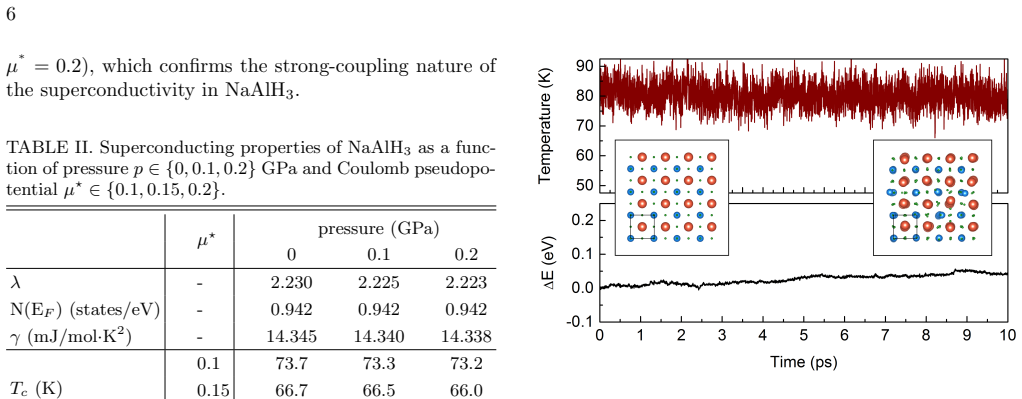
- Ab initio molecular dynamics runs indicate thermal stability at finite temperatures.
- The gap ratio of 4.8 and specific-heat jump of 2.2 exceed the BCS weak-coupling values of 3.53 and 1.43.
- Superconductivity is obtained at ambient pressure without external compression.
Where Pith is reading between the lines
- If the phase can be synthesized experimentally, resistivity and specific-heat measurements could directly test the predicted 73.7 K transition.
- Analogous first-principles searches on other alkali-metal aluminum hydrides could identify further candidates with comparable coupling strengths.
- Confirmation would lower the pressure barrier that currently limits most hydride superconductors to laboratory conditions.
Load-bearing premise
The hypothetical cubic Pm-3m NaAlH3 phase is dynamically stable with no imaginary phonon frequencies and thermally stable under ab initio molecular dynamics.
What would settle it
Observation of imaginary frequencies anywhere in the phonon dispersion or decomposition of the structure during room-temperature molecular-dynamics runs would falsify the stability premise and remove the basis for the predicted superconductivity.
Figures


read the original abstract
We present a comprehensive first-principles investigation of a hypothetical cubic Pm-3m phase of the ternary hydride NaAlH3, focusing on its lattice dynamics, electronic structure, and electron-phonon-mediated superconducting properties at ambient pressure. Using density functional theory and the Migdal-Eliashberg formalism, we find an exceptionally strong electron-phonon coupling ($\lambda=2.23$), resulting in a superconducting critical temperature of up to 73.7 K for a Coulomb pseudopotential $\mu^* = 0.1$. Phonon dispersion calculations, complemented by ab initio molecular dynamics simulations, indicate dynamic and thermal stability within the adopted theoretical framework. The electronic structure exhibits a metallic character with substantial contributions from Al- and Na-derived states at the Fermi level. The resulting superconducting gap ratio ($2\Delta(0)/k_B T_c \approx 4.8$) and specific heat jump ($\Delta C/\gamma T_c \approx 2.2$) significantly exceed BCS weak-coupling predictions, highlighting the strong-coupling nature of superconductivity in this hypothetical phase.
Editorial analysis
A structured set of objections, weighed in public.
Referee Report
Summary. The manuscript presents a first-principles DFT investigation of the hypothetical cubic Pm-3m NaAlH3 phase, reporting dynamic and thermal stability from phonon dispersion (no imaginary modes) and AIMD simulations. It finds a metallic electronic structure with Al- and Na-derived states at the Fermi level, an exceptionally strong electron-phonon coupling λ=2.23, and solves the Migdal-Eliashberg equations to obtain Tc up to 73.7 K at the conventional μ*=0.1, together with strong-coupling signatures (2Δ(0)/kBTc ≈4.8 and ΔC/γTc ≈2.2).
Significance. If the phase exists, the prediction would be a notable example of ambient-pressure high-Tc superconductivity in a ternary hydride, obtained via standard, reproducible DFT+Migdal-Eliashberg methods. The consistent treatment of strong-coupling observables (gap ratio, specific-heat jump) adds internal coherence to the claim, though the result remains conditional on the unverified hypothetical structure.
major comments (2)
- [Lattice dynamics and stability] The stability of the Pm-3m phase is load-bearing for the entire Tc prediction. While phonon dispersion and AIMD are stated to confirm dynamic and thermal stability within the adopted framework, the manuscript should supply quantitative AIMD details (supercell size, temperature, run length, and any monitored order parameters) in the lattice-dynamics section so readers can judge the robustness of this premise.
- [Superconducting properties] The central numerical result Tc=73.7 K is obtained with the fixed conventional choice μ*=0.1. Given λ=2.23, the manuscript should report Tc as a function of μ* (e.g., over 0.05–0.15) in the Eliashberg-results section to quantify sensitivity; the present single-value presentation makes the quoted Tc dependent on an external parameter rather than emerging directly from the first-principles inputs.
minor comments (2)
- [Abstract] The abstract uses the qualifier 'up to 73.7 K'; the corresponding results section should explicitly state that this is the value computed at μ*=0.1 and clarify whether any other μ* yields a higher Tc.
- [Superconducting properties] Notation for the gap ratio and specific-heat jump is given numerically in the abstract; the main text should define the symbols 2Δ(0) and ΔC/γTc at first use and reference the relevant Eliashberg-equation solution.
Simulated Author's Rebuttal
We thank the referee for the careful reading of our manuscript and the constructive comments, which we believe will improve the clarity and completeness of the presentation. We address each major comment below and will revise the manuscript to incorporate the requested information.
read point-by-point responses
-
Referee: [Lattice dynamics and stability] The stability of the Pm-3m phase is load-bearing for the entire Tc prediction. While phonon dispersion and AIMD are stated to confirm dynamic and thermal stability within the adopted framework, the manuscript should supply quantitative AIMD details (supercell size, temperature, run length, and any monitored order parameters) in the lattice-dynamics section so readers can judge the robustness of this premise.
Authors: We agree that quantitative AIMD details are important for readers to assess the claimed stability. In the revised manuscript we will expand the lattice-dynamics section to report the supercell size, simulation temperature, run length, and the structural order parameters that were monitored during the AIMD trajectories. These additions will be drawn directly from the calculations already performed and will not change the stability conclusions. revision: yes
-
Referee: [Superconducting properties] The central numerical result Tc=73.7 K is obtained with the fixed conventional choice μ*=0.1. Given λ=2.23, the manuscript should report Tc as a function of μ* (e.g., over 0.05–0.15) in the Eliashberg-results section to quantify sensitivity; the present single-value presentation makes the quoted Tc dependent on an external parameter rather than emerging directly from the first-principles inputs.
Authors: We agree that showing the dependence on μ* strengthens the presentation for a strong-coupling case. In the revised manuscript we will add Tc values (or a compact table/figure) for μ* in the range 0.05–0.15 within the Eliashberg-results section. This will quantify the sensitivity while retaining the conventional μ*=0.1 result as the primary quoted value. revision: yes
Circularity Check
No significant circularity; derivation is self-contained
full rationale
The paper assumes a hypothetical Pm-3m NaAlH3 structure, verifies its dynamic and thermal stability via phonon dispersion and AIMD within DFT, computes first-principles electronic structure and electron-phonon matrix elements to obtain λ=2.23, then solves the Migdal-Eliashberg equations with the conventional fixed value μ*=0.1 to obtain Tc and related quantities. No quantity is defined in terms of another that is then presented as a prediction from it; μ* is not fitted to the output but chosen externally as standard practice; stability checks are independent of the superconductivity results; no load-bearing self-citations or uniqueness theorems from the authors are invoked. The chain produces derived quantities from computed inputs without reduction by construction.
Axiom & Free-Parameter Ledger
free parameters (1)
- μ* =
0.1
axioms (2)
- domain assumption Migdal-Eliashberg formalism accurately describes electron-phonon superconductivity in this system
- standard math DFT (with unspecified functional) yields reliable phonon dispersions and electronic states for the hypothetical structure
invented entities (1)
-
Hypothetical cubic Pm-3m NaAlH3 phase
no independent evidence
Reference graph
Works this paper leans on
-
[1]
Metallic hydrogen: a high-temperature superconductor?
N. W. Ashcroft, “Metallic hydrogen: a high-temperature superconductor?” Physical Review Letters21, 1748 (1968)
1968
-
[2]
Hydrogen dominant metallic alloys: high temperature superconductors?
N. W. Ashcroft, “Hydrogen dominant metallic alloys: high temperature superconductors?” Physical Review Letters92, 187002 (2004)
2004
-
[3]
The metallization and superconductiv- ity of dense hydrogen sulfide,
Yinwei Li, Jian Hao, Hanyu Liu, Yanling Li, and Yanming Ma, “The metallization and superconductiv- ity of dense hydrogen sulfide,” The Journal of Chemical Physics140, 174712 (2014)
2014
-
[4]
Conventional superconductiv- ity at 203 Kelvin at high pressures in the sulfur hydride system,
A. P. Drozdov, M. I. Eremets, I. A. Troyan, V. Kseno- fontov, and S. I. Shylin, “Conventional superconductiv- ity at 203 Kelvin at high pressures in the sulfur hydride system,” Nature525, 73 (2015)
2015
-
[5]
Crystal structure of the superconducting phase of sulfur hydride,
Mari Einaga, Masafumi Sakata, Takahiro Ishikawa, Kat- suya Shimizu, Mikhail I. Eremets, Alexander P. Droz- dov, Ivan A. Troyan, Naohisa Hirao, and Yasuo Ohishi, “Crystal structure of the superconducting phase of sulfur hydride,” Nature Physics12, 835–838 (2016)
2016
-
[6]
Clean-limit superconductivity inim 3mh3S synthesized from sulfur and hydrogen donor ammonia borane,
Israel Osmond, Owen Moulding, Sam Cross, Takaki Muramatsu, Annabelle Brooks, Oliver Lord, Timofey Fedotenko, Jonathan Buhot, and Sven Friedemann, “Clean-limit superconductivity inim 3mh3S synthesized from sulfur and hydrogen donor ammonia borane,” Phys. Rev. B105, L220502 (2022)
2022
-
[7]
Super- conductivity at 250 K in lanthanum hydride under high pressures,
A. P. Drozdov, P. P. Kong, V. S. Minkov, S. P. Besedin, M. A. Kuzovnikov, S. Mozaffari, L. Balicas, F. F. Bal- akirev, D. E. Graf, V. B. Prakapenka, E. Greenberg, D. A. Knyazev, M. Tkacz, and M. I. Eremets, “Super- conductivity at 250 K in lanthanum hydride under high pressures,” Nature569, 528–531 (2019)
2019
-
[8]
Evidence for superconductivity above 260 K in lanthanum superhy- dride at megabar pressures,
Maddury Somayazulu, Muhtar Ahart, Ajay K. Mishra, Zachary M. Geballe, Maria Baldini, Yue Meng, Vik- tor V. Struzhkin, and Russell J. Hemley, “Evidence for superconductivity above 260 K in lanthanum superhy- dride at megabar pressures,” Physical Review Letters 122, 027001 (2019)
2019
-
[9]
Synthesis of clathrate cerium superhydride CeH9 at 80-100 GPa with atomic hydrogen sublattice,
Nilesh P. Salke, M. Mahdi Davari Esfahani, Youjun Zhang, Ivan A. Kruglov, Jianshi Zhou, Yaguo Wang, Eran Greenberg, Vitali B. Prakapenka, Jin Liu, Artem R. Oganov, and Jung Fu Lin, “Synthesis of clathrate cerium superhydride CeH9 at 80-100 GPa with atomic hydrogen sublattice,” Nature Communications10, 4453 (2019)
2019
-
[10]
Anomalous high-temperature superconductivity in YH 6,
Ivan A. Troyan, Dmitrii V. Semenok, Alexander G. Kvashnin, Andrey V. Sadakov, Oleg A. Sobolevskiy, Vladimir M. Pudalov, Anna G. Ivanova, Vitali B. 8 Prakapenka, Eran Greenberg, Alexander G. Gavril- iuk, Igor S. Lyubutin, Viktor V. Struzhkin, Aitor Bergara, Ion Errea, Raffaello Bianco, Matteo Calandra, Francesco Mauri, Lorenzo Monacelli, Ryosuke Akashi, an...
2021
-
[11]
Superconduc- tivity up to 243 K in the yttrium-hydrogen system under high pressure,
Panpan Kong, Vasily S. Minkov, Mikhail A. Kuzovnikov, Alexander P. Drozdov, Stanislav P. Besedin, Shirin Mozaffari, Luis Balicas, Fedor Fedorovich Balakirev, Vi- tali B. Prakapenka, Stella Chariton, Dmitry A. Knyazev, Eran Greenberg, and Mikhail I. Eremets, “Superconduc- tivity up to 243 K in the yttrium-hydrogen system under high pressure,” Nature Commun...
2021
-
[12]
Effect of doping on the phase stability and superconduc- tivity in LaH 10,
Zepeng Wu, Yang Sun, Artur P. Durajski, Feng Zheng, Vladimir Antropov, Kai-Ming Ho, and Shunqing Wu, “Effect of doping on the phase stability and superconduc- tivity in LaH 10,” Physical Review Materials7, L101801 (2023)
2023
-
[13]
New super- conducting superhydride LaC 2H8 at relatively low stabi- lization pressure,
Artur P. Durajski and Radoslaw Szczesniak, “New super- conducting superhydride LaC 2H8 at relatively low stabi- lization pressure,” Physical Chemistry Chemical Physics 23, 25070–25074 (2021)
2021
-
[14]
(La,Th)H 10: Potential high-T c (242 K) superconductors stabilized thermodynamically below 200 GPa,
Peng Song, Artur P. Durajski, Zhufeng Hou, Abdul Ghaf- far, Rohit Dahule, Rados law Szczesniak, Kenta Hongo, and Ryo Maezono, “(La,Th)H 10: Potential high-T c (242 K) superconductors stabilized thermodynamically below 200 GPa,” The Journal of Physical Chemistry C128, 2656–2665 (2024)
2024
-
[15]
Prediction of high-T c superconductivity in ternary actinium beryllium hydrides at low pressure,
Kun Gao, Wenwen Cui, Jingming Shi, Artur P. Dura- jski, Jian Hao, Silvana Botti, Miguel A. L. Marques, and Yinwei Li, “Prediction of high-T c superconductivity in ternary actinium beryllium hydrides at low pressure,” Physical Review B109, 014501 (2024)
2024
-
[16]
First- principles pressure dependent investigation of the phys- ical properties of KB 2H8: A prospective high-T c super- conductor,
Ashraful Alam, F. Parvin, and S.H. Naqib, “First- principles pressure dependent investigation of the phys- ical properties of KB 2H8: A prospective high-T c super- conductor,” Results in Physics58, 107498 (2024)
2024
-
[17]
Design principles for high-temperature superconductors with a hydrogen-based alloy backbone at moderate pres- sure,
Zihan Zhang, Tian Cui, Michael J. Hutcheon, Alice M. Shipley, Hao Song, Mingyang Du, Vladimir Z. Kresin, Defang Duan, Chris J. Pickard, and Yansun Yao, “Design principles for high-temperature superconductors with a hydrogen-based alloy backbone at moderate pres- sure,” Physical Review Letters128, 047001 (2022)
2022
-
[18]
Ternary ScC2H8 superconductor at moderate pressure,
Izabela A. Wrona, Radoslaw Szczesniak, and Artur P. Durajski, “Ternary ScC2H8 superconductor at moderate pressure,” The Journal of Physical Chemistry C128, 9247–9255 (2024)
2024
-
[19]
LaBH 8: Towards high-Tc low- pressure superconductivity in ternary superhydrides,
Simone Di Cataldo, Christoph Heil, Wolfgang von der Linden, and Lilia Boeri, “LaBH 8: Towards high-Tc low- pressure superconductivity in ternary superhydrides,” Physical Review B104, L020511 (2021)
2021
-
[20]
Prediction of high-T c superconductivity in ternary lan- thanum borohydrides,
Xiaowei Liang, Aitor Bergara, Xudong Wei, Xiaoxu Song, Linyan Wang, Rongxin Sun, Hanyu Liu, Russell J. Hemley, Lin Wang, Guoying Gao, and Yongjun Tian, “Prediction of high-T c superconductivity in ternary lan- thanum borohydrides,” Physical Review B104, 134501 (2021)
2021
-
[21]
Stoichiometric ternary super- hydride LaBeH8 as a new template for high-temperature superconductivity at 110 K under 80 GPa,
Yinggang Song, Jingkai Bi, Yuki Nakamoto, Katsuya Shimizu, Hanyu Liu, Bo Zou, Guangtao Liu, Hongbo Wang, and Yanming Ma, “Stoichiometric ternary super- hydride LaBeH8 as a new template for high-temperature superconductivity at 110 K under 80 GPa,” Physical Re- view Letters130, 266001 (2023)
2023
-
[22]
Superconductivity above 105 K in non- clathrate ternary lanthanum borohydride below megabar pressure,
Xiaoxu Song, Xiaokuan Hao, Xudong Wei, Xin-Ling He, Hanyu Liu, Liang Ma, Guangtao Liu, Hongbo Wang, Jingyu Niu, Shaojie Wang, Yanpeng Qi, Zhongyuan Liu, Wentao Hu, Bo Xu, Lin Wang, Guoying Gao, and Yongjun Tian, “Superconductivity above 105 K in non- clathrate ternary lanthanum borohydride below megabar pressure,” Journal of the American Chemical Society ...
2024
-
[23]
Phase diagram and superconductivity of calcium alanates under pressure,
Simone Di Cataldo and Lilia Boeri, “Phase diagram and superconductivity of calcium alanates under pressure,” Journal of Physics: Condensed Matter35, 445701 (2023)
2023
-
[24]
High- temperature superconductivity in perovskite hydride be- low 10 GPa,
Mingyang Du, Hongyu Huang, Zihan Zhang, Min Wang, Hao Song, Defang Duan, and Tian Cui, “High- temperature superconductivity in perovskite hydride be- low 10 GPa,” Advanced Science11, 2408370 (2024)
2024
-
[25]
Data-driven de- sign of high pressure hydride superconductors using DFT and deep learning,
Daniel Wines and Kamal Choudhary, “Data-driven de- sign of high pressure hydride superconductors using DFT and deep learning,” Materials Futures3, 025602 (2024)
2024
-
[26]
A recipe for an effective selection of promising candidates for high-temperature superconductors among binary hydrides,
Izabela A. Wrona, Pawel Niegodajew, and Artur P. Du- rajski, “A recipe for an effective selection of promising candidates for high-temperature superconductors among binary hydrides,” Materials Today Physics46, 101499 (2024)
2024
-
[27]
The first principles insights of aluminum-based hydrides for hydrogen storage applica- tion,
Wahidullah Khan, “The first principles insights of aluminum-based hydrides for hydrogen storage applica- tion,” International Journal of Hydrogen Energy63, 596– 608 (2024)
2024
-
[28]
QUANTUM ESPRESSO: a modular and open-source software project for quantum simulations of materials,
Paolo Giannozzi, Stefano Baroni, Nicola Bonini, Mat- teo Calandra, Roberto Car, Carlo Cavazzoni, Davide Ceresoli, Guido L Chiarotti, Matteo Cococcioni, Ismaila Dabo,et al., “QUANTUM ESPRESSO: a modular and open-source software project for quantum simulations of materials,” Journal of Physics: Condensed Matter21, 395502 (2009)
2009
-
[29]
Advanced capabilities for materials modelling with Quantum ESPRESSO,
P Giannozzi, O Andreussi, T Brumme, O Bunau, M Buongiorno Nardelli, M Calandra, R Car, C Cavaz- zoni, D Ceresoli, M Cococcioni,et al., “Advanced capabilities for materials modelling with Quantum ESPRESSO,” Journal of Physics: Condensed Matter29, 465901 (2017)
2017
-
[30]
Atoms, molecules, solids, and surfaces: Ap- plications of the generalized gradient approximation for exchange and correlation,
John P. Perdew, J. A. Chevary, S. H. Vosko, Koblar A. Jackson, Mark R. Pederson, D. J. Singh, and Carlos Fiolhais, “Atoms, molecules, solids, and surfaces: Ap- plications of the generalized gradient approximation for exchange and correlation,” Physical Review B46, 6671– 6687 (1992)
1992
-
[31]
Pseudopotentials for high- throughput DFT calculations,
Kevin F. Garrity, Joseph W. Bennett, Karin M. Rabe, and David Vanderbilt, “Pseudopotentials for high- throughput DFT calculations,” Computational Materials Science81, 446–452 (2014)
2014
-
[32]
physics.rutgers.edu/gbrv
The ready-to-use ultrasoft pseudopotentials were taken from the GBRV pseudopotential library:https://www. physics.rutgers.edu/gbrv
-
[33]
Efficient linear scaling geometry optimization and transition-state search for direct wavefunction op- timization schemes in density functional theory using a plane-wave basis,
Salomon R Billeter, Alessandro Curioni, and Wanda An- dreoni, “Efficient linear scaling geometry optimization and transition-state search for direct wavefunction op- timization schemes in density functional theory using a plane-wave basis,” Computational Materials Science27, 437 – 445 (2003)
2003
-
[34]
Special points for brillouin-zone integrations,
Hendrik J. Monkhorst and James D. Pack, “Special points for brillouin-zone integrations,” Physical Review B13, 5188–5192 (1976)
1976
-
[35]
Green’s-function approach to linear response in solids,
Stefano Baroni, Paolo Giannozzi, and Andrea Testa, “Green’s-function approach to linear response in solids,” 9 Physical Review Letters58, 1861–1864 (1987)
1987
-
[36]
CP2K: An elec- tronic structure and molecular dynamics software pack- age - quickstep: Efficient and accurate electronic struc- ture calculations,
Thomas D. K¨ uhne, Marcella Iannuzzi, Mauro Del Ben, Vladimir V. Rybkin, Patrick Seewald, Frederick Stein, Teodoro Laino, Rustam Z. Khaliullin, Ole Sch¨ utt, Flo- rian Schiffmann, Dorothea Golze,et al., “CP2K: An elec- tronic structure and molecular dynamics software pack- age - quickstep: Efficient and accurate electronic struc- ture calculations,” J. Ch...
2020
-
[37]
Interactions between electrons and lattice vibrations in a superconductor,
G. M. Eliashberg, “Interactions between electrons and lattice vibrations in a superconductor,” Journal of Ex- perimental and Theoretical Physics11, 696 (1960)
1960
-
[38]
Iter- ative analytic continuation of the electron self-energy to the real axis,
F. Marsiglio, M. Schossmann, and J. P. Carbotte, “Iter- ative analytic continuation of the electron self-energy to the real axis,” Physical Review B37, 4965 (1988)
1988
-
[39]
Eliashberg theory: A short review,
F. Marsiglio, “Eliashberg theory: A short review,” An- nals of Physics417, 168102 (2020)
2020
-
[40]
The numerical solution of the imaginary- axis Eliashberg equations,
R. Szcz¸ e´ sniak, “The numerical solution of the imaginary- axis Eliashberg equations,” Acta Physica Polonica A 109, 179 (2006)
2006
-
[41]
Isotope effect in superconducting lanthanum hydride under high compres- sion,
Artur P. Durajski, Radoslaw Szczesniak, Yinwei Li, Chongze Wang, and Jun-Hyung Cho, “Isotope effect in superconducting lanthanum hydride under high compres- sion,” Physical Review B101, 214501 (2020)
2020
-
[42]
First- principles estimation of low-pressure superconductivity in KC 2H8 ternary hydride,
Artur P. Durajski and Radoslaw Szczesniak, “First- principles estimation of low-pressure superconductivity in KC 2H8 ternary hydride,” Physica Status Solidi RRL 17, 2300043 (2023)
2023
-
[43]
Properties of boson-exchange supercon- ductors,
J. P. Carbotte, “Properties of boson-exchange supercon- ductors,” Reviews of Modern Physics62, 1027 (1990)
1990
-
[44]
First-principles study on hydrogen storage properties of the new hydride perovskite XAlH3 (X=Na, K),
Nanlin Xu, Ruijie Song, Jingyi Zhang, Yan Chen, Shan- jun Chen, Song Li, Zaifu Jiang, and Weibin Zhang, “First-principles study on hydrogen storage properties of the new hydride perovskite XAlH3 (X=Na, K),” Interna- tional Journal of Hydrogen Energy60, 434–440 (2024)
2024
-
[45]
A database of high-pressure crystal structures from hydrogen to lanthanum,
Federico Giannessi, Simone Di Cataldo, Santanu Saha, and Lilia Boeri, “A database of high-pressure crystal structures from hydrogen to lanthanum,” Scientific Data 11, 766 (2024)
2024
-
[46]
Thermodynamic modeling of the sodium alanates and the na–al–h system,
Caian Qiu, Susanne M. Opalka, Gregory B. Olson, and Donald L. Anton, “Thermodynamic modeling of the sodium alanates and the na–al–h system,” International Journal of Materials Research97, 1484–1494 (2006)
2006
-
[47]
Phonon-mediated high-temperature superconduc- tivity in the ternary borohydride KB 2H8 under pressure near 12 GPa,
Miao Gao, Xun-Wang Yan, Zhong-Yi Lu, and Tao Xi- ang, “Phonon-mediated high-temperature superconduc- tivity in the ternary borohydride KB 2H8 under pressure near 12 GPa,” Physical Review B104, L100504 (2021)
2021
-
[48]
Prediction of ambient pressure conventional supercon- ductivity above 80 K in hydride compounds,
Antonio Sanna, Tiago F. T. Cerqueira, Yue-Wen Fang, Ion Errea, Alfred Ludwig, and Miguel A. L. Marques, “Prediction of ambient pressure conventional supercon- ductivity above 80 K in hydride compounds,” npj Com- putational Materials10, 44 (2024)
2024
-
[49]
See Supplemental Material at:https://doi.org/XXXfor the pressure-dependent phonon dispersion of NaAlH 3 and comparison of phonon spectra of NaAlH 3 and NaAlD3
-
[50]
Transition temperature of strong- coupled superconductors,
W. L. McMillan, “Transition temperature of strong- coupled superconductors,” Physical Review167, 331– 344 (1968)
1968
-
[51]
Transition temperature of strong-coupled superconductors reanalyzed,
P. B. Allen and R. C. Dynes, “Transition temperature of strong-coupled superconductors reanalyzed,” Physical Review B12, 905–922 (1975)
1975
-
[52]
Superconductivity at very strong coupling,
P B Allen and R C Dynes, “Superconductivity at very strong coupling,” Journal of Physics C: Solid State Physics8, L158 (1975)
1975
-
[53]
Theory of superconductivity,
J. Bardeen, L. N. Cooper, and J. R. Schrieffer, “Theory of superconductivity,” Physical Review108, 1175–1204 (1957)
1957
-
[54]
High- temperature study of superconducting hydrogen and deu- terium sulfide,
A.P. Durajski, R. Szczesniak, and L. Pietronero, “High- temperature study of superconducting hydrogen and deu- terium sulfide,” Annalen der Physik528, 358–364 (2016)
2016
-
[55]
5281/zenodo.17338327
The database is available at:https://doi.org/10. 5281/zenodo.17338327
discussion (0)
Sign in with ORCID, Apple, or X to comment. Anyone can read and Pith papers without signing in.